
ChatGPT Ads Privacy Shift Introduces Account Security Risks
The April 2026 US privacy policy update to OpenAI's terms creates three new data-exposure pathways for advertisers running ChatGPT Ads—default-on marketing cookies for free users, inbound purchase data from advertisers, and outbound identifier sharing—functionally closing the gap with other ad platforms but without the audit tooling advertisers need. This article breaks down what changed and what it means for your account security.
- Platform
- ChatGPT Ads
- Change category
- policy
- Effective date
- 2026-04-30
- Change type
- policy shift
- Impact level
- high
April 30, 2026 is the date to put in the account notes. OpenAI’s US privacy policy update did not describe a breach, and it does not prove that any advertiser account was compromised. It did change the operating model around ChatGPT Ads in ways that matter for advertiser account security: more default collection, more advertiser-supplied conversion data, and more identifier sharing with marketing partners.
The clean before-and-after is this: in January, ChatGPT Ads were presented as a privacy-first advertising environment. By late April, the US policy language and outside reporting described something much closer to the plumbing media buyers already know from Google and Meta. The difference is not that OpenAI has suddenly become uniquely dangerous. The difference is that the data-sharing surface has expanded before most advertisers can inspect it with the kind of account-level controls they have learned to demand elsewhere.
The first operational tell did not come from an OpenAI announcement. WIRED reported that marketing cookies were enabled by default for free ChatGPT users, while Plus and Enterprise users were exempt from that default behavior.[1] That matters because defaults become campaign reality faster than policy language becomes a legal review ticket.

The Policy Change Creates Three Data Pathways
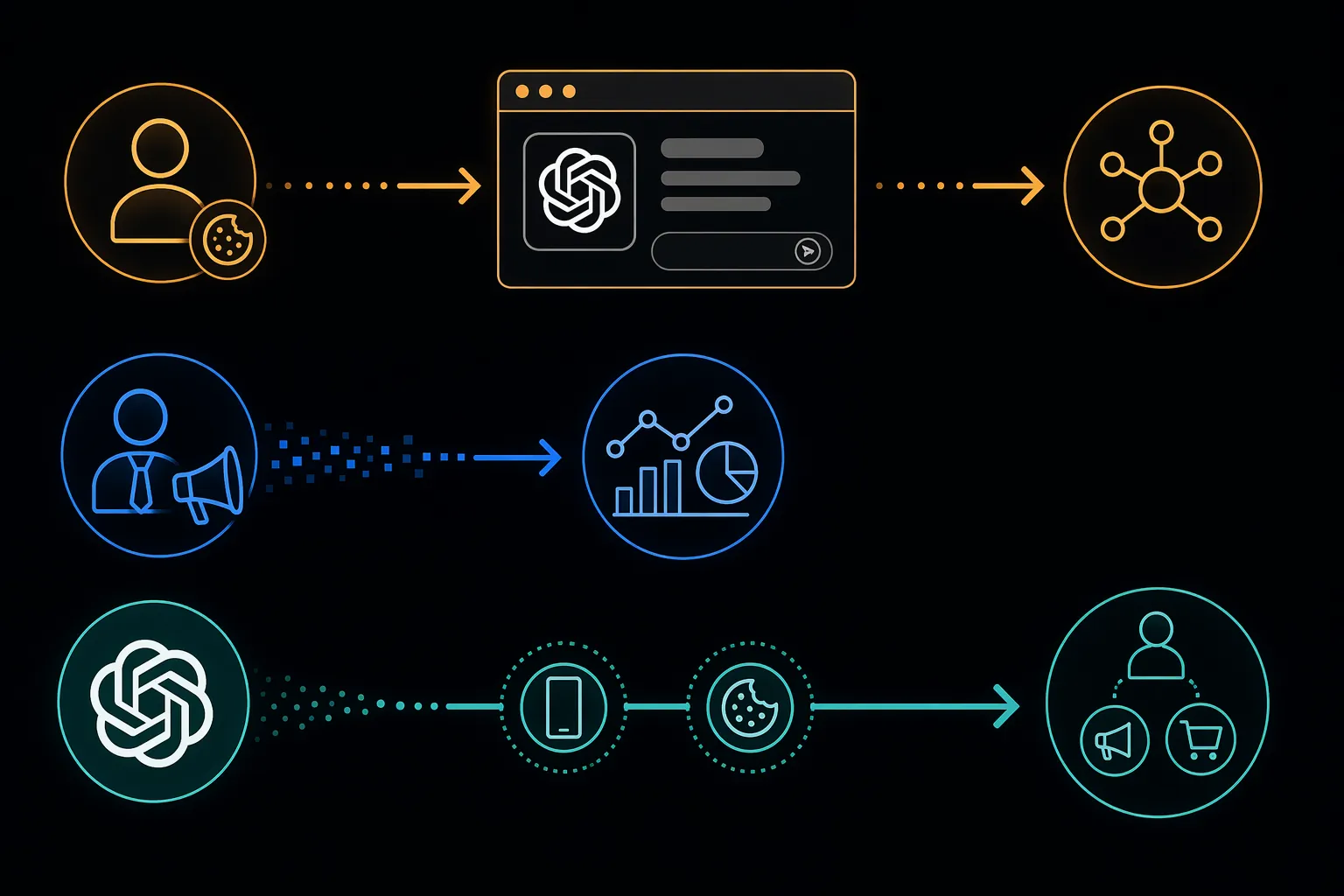
The April policy shift is easiest to read as three separate pipes. They do not all carry the same data, and they do not create the same risk. Grouping them together as “tracking” is too blunt. Separating them is how an advertiser can decide what needs legal review, what needs a client disclosure, and what needs platform access controls.
| Data pathway | What changed | Advertiser-side concern |
|---|---|---|
| Free-user marketing cookies | WIRED reported marketing cookies defaulted on for free ChatGPT users; Plus and Enterprise users were exempt. | Default behavior may affect how users enter ad audiences before an advertiser has reviewed the platform’s consent and disclosure model. |
| Advertiser purchase data sent to OpenAI | OpenAI’s US policy permits receiving purchase data from advertisers to measure ad effectiveness. | Advertisers may be sending customer or transaction-derived events into a system they cannot yet audit like mature ad platforms. |
| Identifiers shared with marketing partners | The US policy permits sharing limited identifiers such as cookie IDs and device IDs with marketing partners. | Account activity becomes part of a broader third-party ad and measurement chain. |
The cookie pathway is the most immediate change because it sits before campaign setup. WIRED’s finding was based on testing and was not a company announcement, which makes it more useful to operators than a polished launch note: it describes what a user account did by default.[1] For a free ChatGPT user, the reported state was not “opt in later after an advertiser decides to run measurement.” The reported state was that marketing cookies were already enabled unless changed.
The second pathway is inbound. OpenAI’s April 30 US privacy policy says it may receive information from advertisers, including purchase data, to measure the effectiveness of ads.[2] PPC Land’s coverage called out the same purchase-data permission as a meaningful advertising-policy change.[3] That is the familiar conversion-measurement bargain: the advertiser wants to know whether spend produced revenue, and the platform wants event data back so it can report, optimize, or prove value.
The third pathway is outbound. The April 30 US policy allows OpenAI to share limited identifiers, including cookie IDs and device IDs, with marketing partners.[2] The Keyword also reported the addition of “search and shopping providers” to OpenAI’s vendor-disclosure language.[4] That does not mean every advertiser receives raw ChatGPT user histories. It does mean OpenAI is no longer operating as a sealed ad environment where the relevant data stays only inside the chat product.
Why This Feels Familiar to Google and Meta Buyers
A media buyer who has worked in Google Ads or Meta Ads will recognize the shape immediately. A user interacts with a platform. The platform sets or reads identifiers. The advertiser sends conversion or purchase signals back. Marketing partners, measurement vendors, or related providers sit somewhere in the chain. The platform then sells targeting, reporting, and optimization against that joined-up activity.
Structurally, the April OpenAI model moves in that direction. Operationally, it is not there yet. Meta and Google did not become comfortable because their data-sharing model is simple; they became manageable because advertisers eventually got layers of tooling around it: pixels, conversion APIs, event managers, consent modes, diagnostics, data-source permissions, partner access logs, offline conversion workflows, and documentation that security and legal teams can argue over in detail.
ChatGPT Ads appears to be entering the same category without the same visible control surface. That is the account-security delta. The risk is not only whether OpenAI has a policy basis to receive or share data. The risk is whether the advertiser can prove what was configured, who approved it, which events were sent, which identifiers were involved, and whether an agency, contractor, or junior account user changed something that should have required review.
This is where “account security” stops meaning only login hygiene. Passwords, SSO, MFA, and seat permissions still matter. But in a paid media account, security also means control over data exits and data entries: conversion feeds, customer lists, partner integrations, event schemas, tagging permissions, and any setting that can expose user or purchase information outside the advertiser’s own environment.
The Measurement Gap Is the Part Advertisers Cannot Hand-Wave
The most awkward middle state is when data starts moving for measurement before most advertisers can see the measurement system clearly. Digiday reported that OpenAI had built a tool to track whether ChatGPT ads convert, with a conversion pixel available to select advertisers, while most accounts still had access only to impressions and clicks.[5] OpenAI did not respond to Digiday’s request for comment, so the pixel’s general availability remains unconfirmed.[5]
That combination creates a practical verification problem. The policy allows purchase data to come in. Reporting says conversion tracking exists for select advertisers. But if a typical advertiser can only see impressions and clicks, the account team cannot yet validate the full path from user exposure to event capture to attribution. They may know the platform is preparing to measure outcomes, but not have the normal places to inspect event quality, deduplication, consent treatment, or partner routing.
In mature ad accounts, the person responsible for performance can often answer basic control questions without opening a legal memo. Which pixel is installed? Which domain owns it? Which events fire? Are values passed? Are user identifiers hashed? Which partner has access? Which offline uploads ran last week? Who changed the data source? Those answers may still be messy, but the account usually has somewhere to look.
For ChatGPT Ads in Q3 2026, that inspection layer appears less developed than the policy permissions around data movement. That is not a reason to declare the product unusable. It is a reason to stop treating it as a low-risk test placement just because the ad unit is new or the January positioning sounded more privacy-contained.
What Each Pathway Changes Inside an Advertiser Account
Default-On Cookies Move Risk Ahead of Campaign Setup
When marketing cookies are off until a user or advertiser takes a visible action, the review process has a natural checkpoint. Someone has to enable something. Someone can document that choice. When marketing cookies are reported as default-on for free users, the checkpoint moves. The platform may already be creating advertising-relevant identifiers before the advertiser has built its own review around ChatGPT Ads.
For advertisers, this affects the explanation they owe internally. A growth lead can no longer say, without qualification, that ChatGPT Ads operate outside the familiar marketing-cookie model. The narrower, supportable statement is that WIRED found default-on marketing cookies for free users, not Plus or Enterprise users, and that OpenAI had not publicly announced that default behavior at the time of the report.[1]
Purchase Data Makes the Advertiser a Data Supplier
The purchase-data pathway changes the advertiser’s role. The advertiser is not only buying access to an audience. It may also be sending outcome data back into OpenAI’s environment so the platform can measure ad effectiveness.[2][3] That distinction matters for security reviews because outbound customer or transaction-derived data usually triggers a different level of scrutiny than media spend alone.
The immediate questions are ordinary but important: which purchases are eligible to be sent, whether values are included, how identifiers are matched, which users can configure the feed, whether agency users can activate it, whether the setup is account-wide or campaign-specific, and whether an advertiser can export a durable log of what was transmitted. The April policy text supports the existence of the purchase-data permission; it does not, by itself, answer those operational questions.
Identifier Sharing Adds Partner-Chain Exposure
Limited identifiers sound less sensitive than names, emails, chats, or payment details, and often they are. They are still the connective tissue of ad measurement. Cookie IDs and device IDs are how platforms, vendors, and partners decide whether two events belong near each other in an advertising system. OpenAI’s US policy permits sharing those limited identifiers with marketing partners.[2]
For an advertiser, the issue is not that every identifier is catastrophic. The issue is that identifier-sharing expands the number of systems whose behavior may affect campaign data, user disclosures, vendor reviews, and incident response. If a partner integration misfires, an advertiser may be asked to explain a chain it did not design and cannot fully observe.
Scope Limits Matter
The April 30 policy change discussed here is a US policy update. EU, EEA, and UK users remain under separate policy scopes, so it would be sloppy to describe this as one global ChatGPT Ads privacy state. International advertisers need to map campaign geography and user policy coverage before treating the US model as universal.
The free-user cookie finding also has a boundary. WIRED reported the default-on marketing cookie behavior for free ChatGPT accounts and said Plus and Enterprise users were exempt.[1] That distinction matters for B2B advertisers in particular, because the user population exposed to a ChatGPT ad may not match the user population inside a paid workspace.
The conversion pixel also needs careful wording. Based on Digiday’s reporting, it exists for select advertisers, but most accounts were still seeing only impressions and clicks, and broad availability was not confirmed by OpenAI.[5] So the right conclusion is not “every advertiser is already sending conversion events.” The right conclusion is that the policy and early tooling point toward conversion measurement while the average account may still lack the visibility to audit it.
The Mixpanel Incident Is a Warning About the Chain, Not a Chat Breach
The November 2025 Mixpanel incident belongs in this discussion, but only narrowly. OpenAI said a third-party analytics provider incident exposed account-associated data including names, emails, approximate location, and operating system or browser information for API users and some ChatGPT users who submitted help-center tickets or logged into platform.openai.com.[6] OpenAI also said no chat content, API keys, passwords, or payment details were exposed.[6]
That is not evidence that ChatGPT Ads caused a breach. It is evidence of a simpler operational fact: once analytics, advertising, measurement, and support systems depend on third parties, the risk surface includes vendors the advertiser cannot independently audit. A buyer may be held accountable for where campaign data goes, even when the weak point sits outside the ad account itself.
What to Treat as Account Security Work in Q3 2026
The Monday-morning work is not to panic-pause every ChatGPT Ads test. It is to move the platform into the same review lane as other data-sharing ad ecosystems. If an account will participate in conversion measurement, purchase-data sharing, or partner-based identifier flows, the setup needs more than a media plan and a budget cap.
- Document whether the campaign targets US users, because the April 30 policy change discussed here is US-specific.
- Ask whether the account has access to any conversion pixel, purchase-data upload, or event-sharing feature, and record whether the answer is confirmed in-platform or only inferred from policy language.
- Limit who can approve measurement integrations, not just who can launch ads or edit creative.
- Require a written description of what purchase or conversion data would be sent to OpenAI before enabling any outcome-based measurement.
- Treat marketing-partner identifier sharing as a vendor-chain issue for legal, security, and client disclosure reviews.
Some of these checks may not have satisfying answers yet. That is the operational gap advertisers need to document: what the policy permits, what the account interface exposes, and what the team can actually prove if security, legal, or a client asks for the chain of custody.
So the constrained judgment is this: the April 2026 US privacy policy update materially increases the account-security risk profile for advertisers, even though it is not a breach and even though the conversion tooling is not confirmed as generally available. Any advertiser evaluating ChatGPT Ads in Q3 2026 should treat it as a real data-sharing ad ecosystem, not the privacy-first exception it appeared to be at launch.
References
- OpenAI Enables Marketing Cookies by Default for Free ChatGPT Users, WIRED
- US privacy policy, OpenAI, April 30, 2026
- OpenAI's privacy policy now lets advertisers send purchase data, PPC Land
- OpenAI Opens ChatGPT User Data to Advertisers, The Keyword
- OpenAI builds tool to track whether ChatGPT ads convert, Digiday
- What to know about a recent Mixpanel security incident, OpenAI, November 2025
Primary source: OpenAI US privacy policy (April 30, 2026)