
California's teen social media law doesn't ban ad targeting
California's SB 976 doesn't ban teen ad targeting, despite the headlines. This dated tracker entry separates what the law actually changes for 13-17 campaigns — addictive-feed rules that shift teen inventory off algorithmic placements, and the January 2027 'reasonably determined not a minor' standard that turns age signals into CCPA and COPPA duties — from the platform-side targeting limits that predate it.
- Platform
- California
- Change category
- policy
- Effective date
- 0-01-01
- Change type
- policy shift
- Impact level
- Medium
As of Q3 2026, California’s SB 976 does not directly ban targeted ads to minors. If a client asks for the “California social media law kids ad targeting impact,” the clean answer is narrower: SB 976 restricts addictive algorithmic feeds for minors and changes default privacy expectations, while the ad-targeting limits most buyers already feel on Meta and TikTok came from platform policy, not from SB 976.
| Date / status | What happened | Operational read for teen campaigns |
|---|---|---|
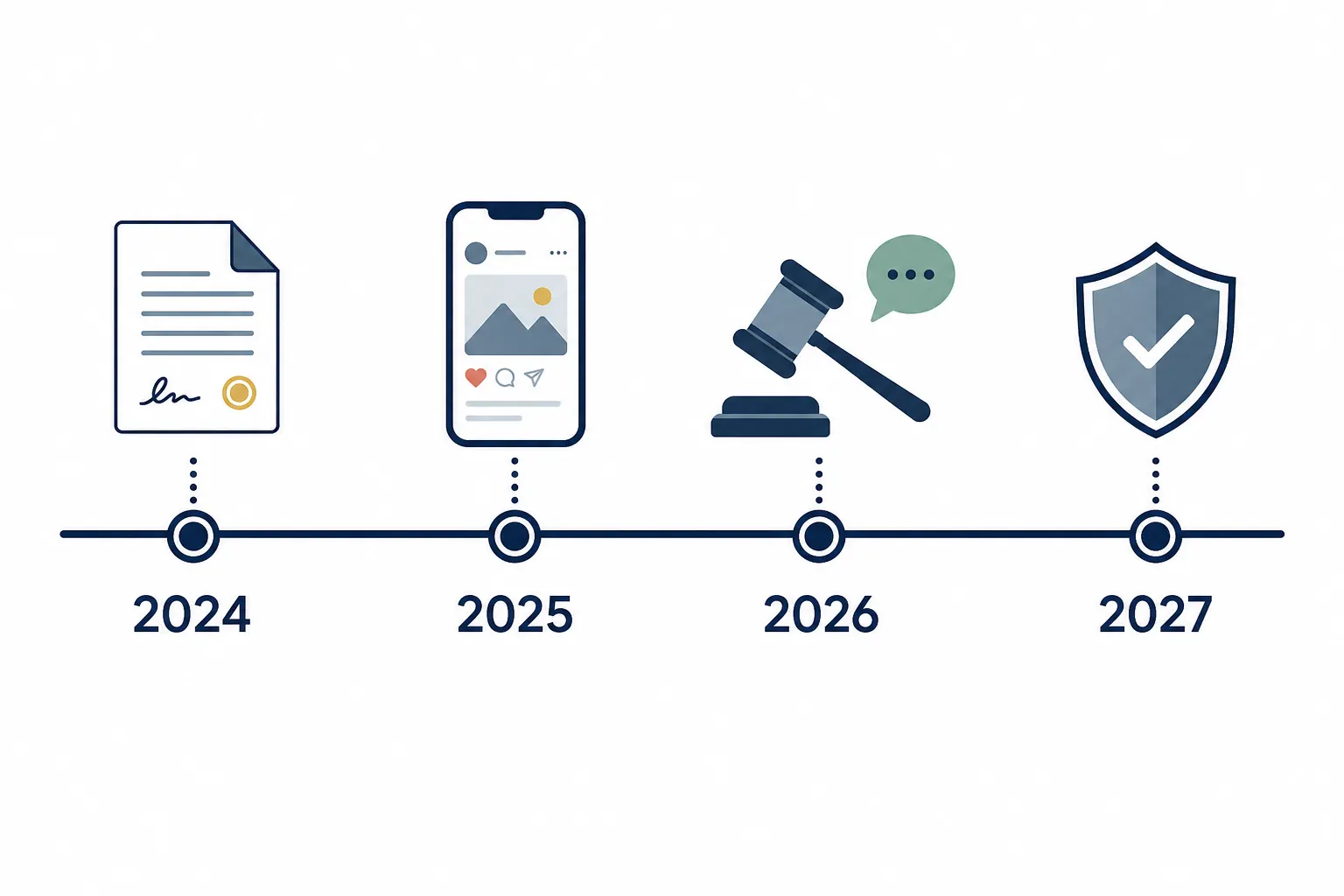
| September 20, 2024 | SB 976 was signed as Chapter 321, Statutes of 2024. [1][2] | Do not describe the statute as a teen ad-targeting ban. Its center of gravity is addictive feeds and minor privacy settings. |
| February 1, 2025 | The addictive-feed and default-privacy provisions took effect after a district court extended the original January 1, 2025 date. [1] | The near-term buying impact is placement and inventory shape, especially where teen delivery would otherwise run through algorithmically ranked feeds. |
| May 15, 2026 / June 30, 2026 | California’s Attorney General noticed SB 976 rulemaking on May 15, 2026, with a public hearing on June 30, 2026. [1][3] | The implementation details are still being converted into administrative rules, so do not over-specify unsupported platform-by-platform consequences. |
| January 1, 2027 | Regulations are due, and the law’s knowledge framework moves toward whether a platform can reasonably determine that a user is not a minor. [1][3] | This is the compliance inflection: age signals become harder to ignore, and adjacent CCPA, COPPA, and device-age-signal duties matter more. |
Three buckets buyers should not collapse into one headline
The fastest way to make a bad media memo is to write “California banned targeted ads to kids” and then use that sentence to explain every under-18 restriction in a platform UI. There are at least three different things getting mixed together.

First, SB 976 targets addictive feeds and default privacy settings for minors. In practical campaign language, that means the statute is more likely to affect whether a minor can be served content through an algorithmically personalized feed experience without the required consent conditions than whether a buyer can choose an age range in Ads Manager.
Second, California’s Age-Appropriate Design Code Act, AB 2273, is the California law that contains the more direct profiling concept marketers usually mean when they say “targeting.” But the profiling restriction remains preliminarily enjoined. The Ninth Circuit’s March 12, 2026 ruling affirmed the injunction on vagueness grounds while reviving other parts of the law, including age-estimation and default-privacy provisions. That is not the same as an active statewide ban on paid-social ad targeting to minors. [4]
Third, platform-side teen targeting limits already did a lot of the work buyers are noticing. Meta removed interest and activity-based targeting for teen users in 2021, and in January 2023 removed gender targeting and some engagement-based personalization, leaving age and location for teen ad targeting. [5] TikTok moved in July 2024 to limit U.S. 13–17 targeting to location, language, and device information, and its Business Resource Centre still frames minor-protection ad initiatives around restricted advertiser controls rather than a California-specific SB 976 ad ban. [6][7]
That separation matters because the setting you change on Monday depends on which bucket is actually moving. A statute can change covered-platform obligations without adding a new interest-targeting option or removing one. A platform can voluntarily remove teen audience levers before a statute takes effect. A court can leave one provision live and keep another frozen. Treating those as one blob is how campaigns get overcorrected.
What SB 976 changes now: feed availability, not a new age-targeting ban
The live operational issue under SB 976 is the addictive feed. For a buyer, that points to delivery surface and inventory composition. If a teen user cannot receive an algorithmically ranked addictive feed unless the required consent conditions are satisfied, then some teen impressions that might have lived in algorithmic feed environments become unavailable, consent-gated, or pushed toward non-addictive alternatives such as chronological surfaces.
That is materially different from a targeting prohibition. The law is not saying, “an advertiser may not select ages 13–17.” It is saying covered platforms have obligations around providing addictive feeds to minors. The buyer feels it downstream as fewer or different teen-eligible impressions in certain feed mechanics, not as a new California statutory toggle inside audience setup.
The litigation posture supports that narrower operating read. On September 9, 2025, the Ninth Circuit upheld the addictive-feed ban and default private-mode provisions under intermediate scrutiny, struck the like-count restriction under strict scrutiny, and returned the case to the district court. [8] You do not need to turn that into a First Amendment seminar to know the campaign implication: the feed and default-privacy pieces are the ones buyers should treat as real planning constraints, while not pretending the court converted SB 976 into an ad-targeting statute.
This is also where “inventory loss” needs careful wording. A campaign may see less delivery into algorithmic feed placements for teen users if the platform has to route those users away from restricted addictive feeds. That does not prove California banned the campaign’s targeting. It means the supply path changed before the audience-control logic changed.
What still works for 13–17 is mostly platform policy baseline
For the actual under-18 audience levers, start with platform rules. The California statutory layer matters, but it sits on top of a paid-social environment where the biggest teen targeting removals already happened. For the fuller channel-by-channel matrix, use the existing Gen Z paid ad targeting in 2026 guide rather than rebuilding that whole comparison here.
| Surface / platform | 13–17 targeting baseline | What SB 976 adds |
|---|---|---|
| Meta | Teen targeting is already limited to age and location under Meta’s earlier policy changes. [5] | SB 976 does not add a new Meta teen interest-targeting ban; it matters more to feed availability and minor privacy obligations on covered services. |
| TikTok | For U.S. 13–17 users, TikTok allows location, language, and device information rather than broader interest-style targeting. [6][7] | SB 976 should be read as a California covered-platform obligation around addictive feeds, not the source of TikTok’s July 2024 teen targeting limits. |
| Other covered social platforms | Expect platform-specific policies to determine the visible buying controls available for minors. | Watch whether teen delivery shifts from algorithmically personalized feed inventory toward consented, chronological, or otherwise non-addictive experiences. |
| 18–24 proxy audiences | Young-adult targeting is not the same as knowingly targeting minors, but proxy strategies can still create brand-safety and compliance review issues. | SB 976 is a minor-focused law; do not use 18–24 delivery as a lazy workaround for under-18 restrictions. |
The practical planning move is simple enough: keep separate columns for audience controls and delivery surfaces. If teen interest targeting is gone on a platform, that is probably platform policy. If teen feed inventory behaves differently in California, SB 976 may be part of the reason. Those are adjacent effects, not the same rule.
Why regulators care: the money is large, but the number is modeled
Teen ad inventory is not a rounding error. A Harvard Chan School analysis published in PLOS ONE estimated that social media platforms generated about $11 billion in U.S. ad revenue from users under 18, including $8.6 billion from ages 13–17. The same analysis estimated the under-18 share of revenue at 41% for Snapchat, 35% for TikTok, 27% for YouTube, and 16% for Instagram. [9]
That is useful context, not platform-disclosed revenue. It explains why lawmakers, state attorneys general, and platforms keep returning to teen feeds, targeting, and age assurance. It does not prove that SB 976 itself banned targeted advertising, and it should not be quoted to clients as if Snap, TikTok, YouTube, or Instagram published those teen revenue splits.
The January 1, 2027 shift is where age signals become operationally dangerous
The bigger compliance change for marketers is not a new under-18 interest segment. It is the age-knowledge environment arriving on January 1, 2027. SB 976 regulations are due then, and the statute’s framework moves toward whether a covered platform can reasonably determine that a user is not a minor. [1][3]
That phrasing matters. Today, a lot of ad-compliance conversations lean on “actual knowledge” as if a platform or advertiser is safe unless someone typed a birthdate into a CRM field and labeled the user 15. By 2027, the more relevant operational question becomes whether the system has enough age-related information that ignoring minor status is no longer credible.
AB 1043, California’s Digital Age Assurance Act, points in the same direction. Effective January 1, 2027, it creates an operating-system-provider age-bracket signal API, and receiving that signal equals actual knowledge. The law also carries Attorney General fines of $2,500 for negligent violations and $7,500 for intentional violations. [10]
Once a platform or downstream participant receives a reliable age bracket, the ad stack has a different problem than “Can I target this group?” It has to decide what that knowledge triggers: CCPA sale/share restrictions for users under 16 where the business has actual knowledge, COPPA duties for users under 13, consent flows, suppression logic, audit trails, and contract language that does not pretend age was unknowable.
For agencies, the uncomfortable part is documentation. If a platform exposes age-signal treatment, consent status, or minor-safe inventory classifications, those fields stop being trivia. They become reasons a campaign was eligible for one surface and blocked from another. The person approving the media plan should know which of those signals are being used, which are being passed through reporting, and which are only platform-side enforcement with no advertiser-level visibility.
A hypothetical 2027 workflow
Suppose, hypothetically, a social platform receives an operating-system age-bracket signal indicating a user is a minor. The platform may then classify that user into a minor-safe experience, restrict addictive-feed access unless the required consent conditions are met, and limit ad delivery to eligible placements. The advertiser may never see the user-level signal, but the campaign still feels the result through eligible reach, placement mix, and reporting categories.
Now suppose the same campaign is optimized to broad 18–24 delivery with creative obviously built for high-school students. That is not automatically an SB 976 violation from the facts given here. It is, however, the kind of proxy strategy that becomes harder to defend when age-assurance systems are producing stronger minor/non-minor signals and privacy teams are reviewing whether sale/share, profiling, or consent rules were triggered.
Enforcement and adjacent labels: important, but not a targeting rewrite
SB 976 enforcement is through Attorney General civil actions, with no private right of action. [2] That affects litigation exposure and complaint routing; it does not make the law optional. If a platform changes feed eligibility or minor defaults to reduce AG risk, buyers still inherit the inventory result.
AB 56 is another 2027 item worth keeping in the same calendar but not the same bucket. Its Surgeon-General warning-label requirements for minors are effective January 1, 2027. [11] That may affect user experience and platform compliance surfaces, but it is not the statutory source for removing teen interest targeting from a media-buying UI.
There are also recurring First Amendment and platform-challenge headlines around teen social media laws. For this operating read, the confirmed posture that matters is the Ninth Circuit’s September 2025 treatment of SB 976’s feed and privacy provisions and the March 2026 CAADCA ruling that left the profiling restriction enjoined. If a client memo needs lawsuit status beyond that, re-check the docket before turning a trade-press timeline into legal advice.
Client-safe wording for Q3 2026
A defensible client read is: California’s SB 976 does not directly ban targeted ads to minors. Its current paid-social impact is mainly placement-level, because covered platforms must manage minors’ access to addictive algorithmic feeds and default privacy settings. The under-18 targeting controls buyers see on Meta and TikTok largely come from platform policies that predate SB 976.
The harder date is January 1, 2027. By then, SB 976 regulations and AB 1043 age-bracket signals make minor-status knowledge more operational. Prepare for more age-signal-driven eligibility, consent, sale/share, and COPPA review. Do not tell clients California banned teen ad targeting; do adjust expectations around teen feed inventory now, and do prepare the compliance handoff for 2027.
References
- SB 976: Protecting Our Kids from Social Media Addiction, California Office of the Attorney General, https://oag.ca.gov/sb976
- California Legislature approves restrictions on social media platforms for minors, CalMatters Digital Democracy, https://calmatters.digitaldemocracy.org/bills/ca_202320240sb976
- California Attorney General Seeks Public Comment on Social Media Addiction Act Regulations, Jones Day, https://www.jonesday.com/en/insights/2026/06/california-attorney-general-seeks-public-comment-on-social-media-addiction-act-regulations
- Ninth Circuit Issues Mixed Ruling on California Age-Appropriate Design Code Act, Holland & Knight, March 19, 2026, https://www.hklaw.com/en/insights/publications/2026/03/ninth-circuit-issues-mixed-ruling-on-california-age-appropriate-design-code-act
- Meta adds additional ad targeting restrictions for teen users, Marketing Dive, January 12, 2023, https://www.marketingdive.com/news/meta-facebook-instagram-ad-targeting-restrictions-teen-users/640218/
- TikTok Limits Teen Ad-Targeting Methods, MediaPost, July 8, 2024, https://www.mediapost.com/publications/article/397525/tiktok-limits-teen-ad-targeting-methods.html
- Protecting minors on TikTok: advertising initiatives, TikTok Business Resource Centre, updated August 2026, https://ads.tiktok.com/business/help/article/protecting-minors-on-tiktok-advertising-initiatives
- Ninth Circuit Upholds Addictive Social Media Feed Ban for Minors Under Intermediate Scrutiny, Hunton Andrews Kurth, https://www.hunton.com/privacy-and-information-security-law/ninth-circuit-upholds-addictive-social-media-feed-ban-for-minors-under-intermediate-scrutiny
- Social media platforms make $11B in ad revenue from U.S. teens, Harvard Gazette, https://news.harvard.edu/gazette/story/2023/12/social-media-platforms-make-11b-in-ad-revenue-from-u-s-teens/
- Analyzing California's Digital Age Assurance Act (AB 1043), Troutman Pepper, https://www.troutman.com/insights/analyzing-californias-digital-age-assurance-act-ab-1043.html
- California Requires a Social Media Health Risk Warning for Minors (AB 56), Hunton Andrews Kurth, November 7, 2025, https://www.hunton.com/privacy-and-information-security-law/california-requires-a-social-media-health-risk-warning-for-minors-ab-56
Primary source: https://oag.ca.gov/sb976