
Scandinavia's AI rules restrict content, not targeting
Performance marketers assume Nordic DPA fines or school AI bans already constrain AI ad targeting in Scandinavia; the dated record supports neither. The binding levers are marketing-law content liability — Sweden's April 2026 chatbot ruling — and EU AI Act Article 50 transparency, while campaign-level impact remains a documented evidence gap.
- Platform
- EU AI Act
- Change category
- policy
- Effective date
- 2026-08-02
- Change type
- policy shift
- Impact level
- Low
Regulatory record through 30 August 2026: the supplied 2025–2026 evidence shows constraints on AI-generated advertising content and disclosure, not a Nordic rule changing audience targeting, auction mechanics, platform defaults, or campaign spend. No Nordic DPA decision on AI ad targeting is surfaced in the packet; the dated GDPR decisions identified instead concern Italy and Greece, in employment and individual-rights contexts.[1][2]
| Record | What it affects | What it does not establish |
|---|---|---|
| Sweden, 1 April 2026: Patent and Market Court chatbot ruling [3] | Misleading marketing content and advertiser responsibility | A restriction on targeting or auction delivery |
| EU AI Act Article 50: most transparency duties from 2 August 2026; generative-AI provider transparency deferred to 2 December 2026 [4] | Disclosure of synthetic content, AI agents, and certain generated material | A Nordic audience or bidding rule |
| Norway, announced 19–23 June 2026; effective fall 2026 [6] | Elementary students’ use of generative-AI tools | Marketing, advertising, or commercial-data processing |
| Nordic DPA enforcement in the supplied record [1][2][8] | No dated AI-ad-targeting decision is documented in this packet | Proof that no such action exists anywhere |

Sweden supplies the clearest advertising consequence
On 1 April 2026, Sweden’s Patent and Market Court treated an incorrect response from an AI chatbot as misleading marketing under the Swedish Marketing Practices Act.[3] The important fact for an advertiser is not that the system was automated. It is that an outward-facing commercial answer was wrong, and the resulting legal problem attached to the marketing communication.
That is content liability. It can require the advertiser to review claims, correct chatbot answers, and retain meaningful control over what reaches consumers. The judgment does not say that a platform’s lookalike audience, bidding model, conversion objective, or auction allocation was unlawful. Nor is it a DPA enforcement action. It is a single marketing-law judgment, so it demonstrates a legally actionable failure without establishing how frequently similar cases occur.
The same Swedish analysis describes advertisers using AI systems as AI Act deployers with an AI-literacy duty.[3] That duty reinforces the practical role of the person approving AI-produced creative or correcting an automated answer. It does not turn Sweden’s education policy into an advertising rule, and it does not establish a special Swedish limit on AI-based audience selection.
Article 50 is a disclosure regime, with dates marketers can act on
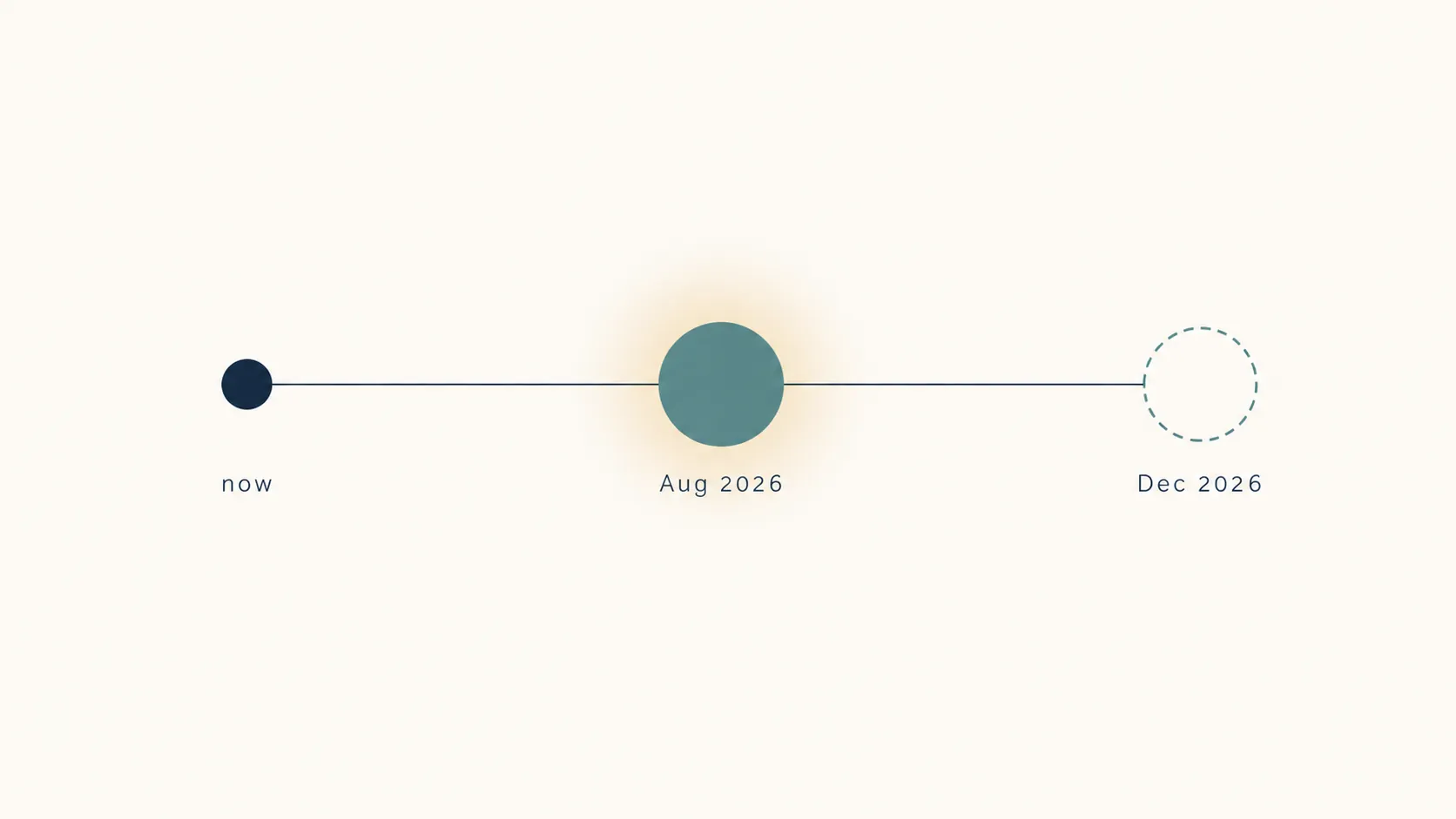
The EU AI Act provides the broader, dated compliance lever. Most Article 50 transparency obligations began on 2 August 2026. The transparency obligations for providers of generative-AI systems were deferred until 2 December 2026 by the Digital Omnibus.[4] For campaigns running now, the first question is therefore what the ad, chatbot, synthetic image, video, or agent communicates and whether the required disclosure is present—not whether the regulation has altered the auction.
The rules cover AI-generated or manipulated content, including deep fakes. A commercial purpose matters when considering the artistic or creative carve-out: a creative treatment does not automatically escape disclosure simply because it has an artistic presentation.[5] In practical terms, the commercial setting and the consumer’s ability to understand what they are seeing matter more than the production team’s description of the asset.
Meaningful human review and editorial control can, in the circumstances described by the guidance, remove the need for text disclosure.[5] That is a narrow operational point, not a blanket exemption for AI-assisted advertising. Review has to be meaningful: someone responsible must be able to assess and control the final communication rather than merely approve an automated workflow after publication.
AI agents have a separate transparency concern. They must disclose their artificial nature and the party on whose behalf they act, unless the interaction is obvious to a reasonably well-informed consumer.[4] An advertiser using an automated conversational agent should therefore review both the agent’s identity and the commercial principal behind it. The relevant exposure is what the consumer is told—or led to believe—during the interaction.
Article 99(4) allows fines of up to €15 million or 3% of worldwide annual turnover for the relevant infringements described in the legal analysis.[4] That is a ceiling for legal exposure, not an expected campaign cost and not evidence that any advertiser has lost a particular amount of spend or revenue. Enforcement is assigned to market-surveillance authorities and the EU AI Office, rather than being presented here as a Nordic DPA action.[4]
The targeting assumption does not have a dated bridge
The supplied record documents no 2025–2026 Nordic DPA enforcement against AI ad targeting by Sweden’s IMY, Norway’s Datatilsynet, or Finland’s Office of the Data Protection Ombudsman. That is a documented absence within this packet, not proof that no action exists: official DPA registers and EDPB Article 64 and 65 consistency records were not directly searched.
Norwegian GDPR and AI guidance raises adjacent issues around automated decision-making and contractual gaps in model training, but it does not supply a 2025–2026 DPA decision on AI ad targeting.[8] The distinction matters. A warning that a data practice may require legal review is not the same as a dated enforcement decision that changed an advertising product or stopped a targeting method.
There is also no sourced Meta or Google compliance change attributed to Nordic regulation in the materials. A 2026 account of Meta updates discusses default and compliance changes, but does not connect them to Scandinavian law.[7] Without that bridge, a platform setting observed by marketers cannot be reported as the consequence of a Nordic DPA fine, school policy, or Article 50 rule.
School restrictions are a youth-policy signal, not an ad rule
Norway announced in June 2026 that generative-AI tools would be banned for elementary students from fall 2026.[6] The reported measure covers student use in elementary schools. The supplied description contains no provision on advertising, marketing audiences, commercial data, ad-tech platforms, or campaign delivery.
That makes the policy relevant as a youth-norm bellwether: it signals caution around children’s exposure to and use of generative AI. It does not support the claim that Norwegian schools have constrained advertisers’ ability to target audiences or that school rules have changed platform auctions.
Denmark appears in the packet through a catalog entry for national guidelines on responsible AI integration in education, but the underlying provisions are not verified here.[9] No dated 2025–2026 Finnish national school-AI policy is supplied. Those gaps should remain gaps rather than being filled with generalized claims about a regional Scandinavian ban.
What marketers can verify at campaign level
The dated compliance work is concrete: review AI-generated claims, test chatbot answers, identify synthetic or deep-fake media, disclose AI agents where required, and document who exercised editorial control. Those tasks follow from the Swedish marketing-law ruling and Article 50 obligations.
The materials do not contain advertiser spend, ROAS, conversion loss, audience shrinkage, auction changes, or targeting-performance measurements. They therefore cannot support a claim that Scandinavian school rules or Nordic DPA fines have changed campaign results. As of the dated record, the defensible distinction is between liability for what AI marketing says and an unproven effect on the machinery that decides who receives it.
References
- News — European Data Protection Board
- Europrivacy Public News Feeds — Europrivacy
- AI in advertising: Key aspects for advertisers in Sweden — CMS, 28 May 2026
- AI transparency in advertising: European Commission’s guidelines under the AI Act — Gleiss Lutz
- EU AI Act guidance expands AI disclosure rules for advertisers and PR teams — Davis+Gilbert, 31 July 2026
- Norway bans AI use in elementary schools — Transparency Coalition, June 2026
- Meta Ads Changes 2026 — Common Thread Collective
- GDPR and AI in Norway: Guidance for UK tech companies — Nordia Law
- Denmark: Paving the way for AI in schools with national guidelines for responsible integration in education — Eurydice
Primary source: https://eur-lex.europa.eu/eli/reg/2024/1689/oj