

StatusGator
When social media posts won't publish or ads stop delivering, knowing whether a platform is really down is critical. This article compares 8 tools — from free instant checks to paid aggregators — so marketers can decide which to use for campaign go/no-go decisions and stakeholder communication.
Key Integrations
Marketing Categories
⚠ Notable Limitations
No free tier; detection may lag for some platforms not explicitly monitored
The worst time to discover your status checks are weak is launch morning, when posts will not publish, ads look frozen, and every refresh makes the Slack thread louder. In that moment, the useful question is not “what is platform monitoring?” It is: should the campaign owner keep publishing, pause spend, move the message to another channel, or tell the client there is still no clean answer?
The fastest answer usually comes in layers. Use a free instant checker in the first 10 seconds, look for official confirmation in the first 5 minutes, and use a paid aggregator when delayed detection would cost more than the tool. That is the practical split behind the best tools to check social media platform status for marketers.
| Tool | Best use | Free or paid | Platforms covered | Alerting ability | Key limitation |
|---|---|---|---|---|---|
| Down for Everyone or Just Me | Fast first check when a site or login page will not load | Free | Any URL you enter | No team-grade alerting | Checks reachability, not campaign-specific platform health |
| Downdetector | Crowd-sourced confirmation when users are reporting problems | Free consumer site; business products available | 35,000+ services across 72 countries | No free API or team alerting product | Consumer-oriented and ad-supported; reports need interpretation |
| Meta official status | Official confirmation for Meta business tools | Free | Meta services listed on metastatus.com | Status-page updates | Official acknowledgement can lag external signals |
| LinkedIn official status | Official confirmation for LinkedIn incidents | Free | Status-page updates | Useful for LinkedIn only | |
| StatusGator | Paid cross-platform monitoring and stakeholder alerts | Paid; plans start at $17/month | Meta, Instagram, and many other cloud and SaaS services | Yes | Most useful when the team will actually act on alerts |
| IsDown | Paid aggregator for early outage detection across services | 14-day free trial; pricing may shift after acquisition | Social media and SaaS services | Yes | Acquired by UptimeRobot in June 2026, so roadmap and packaging may change |
| UptimeRobot | Small-team bridge for monitoring chosen URLs or endpoints | Free tier available | Any URL or endpoint the marketer chooses | Yes | HTTP checks do not automatically equal social platform outage intelligence |
| Downdetector Explorer | Business-grade outage intelligence and API-style workflows | Quote-based | Downdetector’s monitored services | Business capabilities described by vendor | Pricing is not public, so fit and cost need sales validation |
The First 10 Seconds: Is It Just You?
When a scheduler fails or a platform login hangs, start with the bluntest tool: Down for Everyone or Just Me. It checks whether a URL appears reachable from outside your own browser, network, or device. That is enough to separate “our Wi-Fi or session is misbehaving” from “there may be a wider platform problem” before anyone starts rebuilding the post, clearing cookies, or blaming the creative file.
It is not a full social media outage tool. It will not tell you whether Instagram publishing is degraded, whether Meta ad delivery is delayed, or whether TikTok analytics are stale. Its value is narrower and still useful: it answers the first panic question quickly using the URL you give it.[1]
Downdetector is the better second tab when the issue feels bigger than a single URL. Its methodology is crowd-sourced: it looks at user problem reports against a rolling baseline, with status updates roughly every four minutes. Ookla says Downdetector tracks more than 35,000 services across 72 countries, which is why it is often the fastest public place to see whether other users are feeling the same failure.[2]
For marketers, that scale matters most on platforms where official status information is thin or absent. If X/Twitter or TikTok is acting strangely during a campaign window, Downdetector is often the practical public signal to check first. Treat it as a directional signal, not a verdict. A spike in complaints can support an update to stakeholders, but it does not prove that your specific ad account, scheduler, placement, or API workflow is affected.
The First 5 Minutes: Look for Official Confirmation
Once the free checks suggest a wider problem, move to official sources where they exist. Meta’s official status page is the place to check for Meta business products, including the tools marketers rely on when publishing, managing ads, or working inside business accounts.[3] LinkedIn also maintains an official status page for its platform.[4]
The value of an official page is not speed alone. It gives you wording you can safely pass upward: “Meta is reporting a disruption” is different from “people on the internet are complaining.” That difference matters when a paid launch is live and someone needs to decide whether to pause budget or wait.
The awkward part is coverage. The official-status-page tier works well for Meta and LinkedIn, but it does not apply cleanly to every major social platform. There are no comparable official status URLs for TikTok or X/Twitter. For those platforms, marketers are pushed back toward Downdetector, paid aggregators, and their own account-level evidence.
Why Official Status Pages Are Not Enough for Paid Campaign Teams
Official confirmation is useful, but it can arrive after the campaign team has already spent the most expensive hour of the incident waiting. StatusGator’s Meta status history shows a Meta Business Suite outage on July 19, 2026 that lasted 5 hours and 15 minutes. StatusGator says it detected the outage 1 hour and 59 minutes before Meta acknowledged it on the official status page.[5]
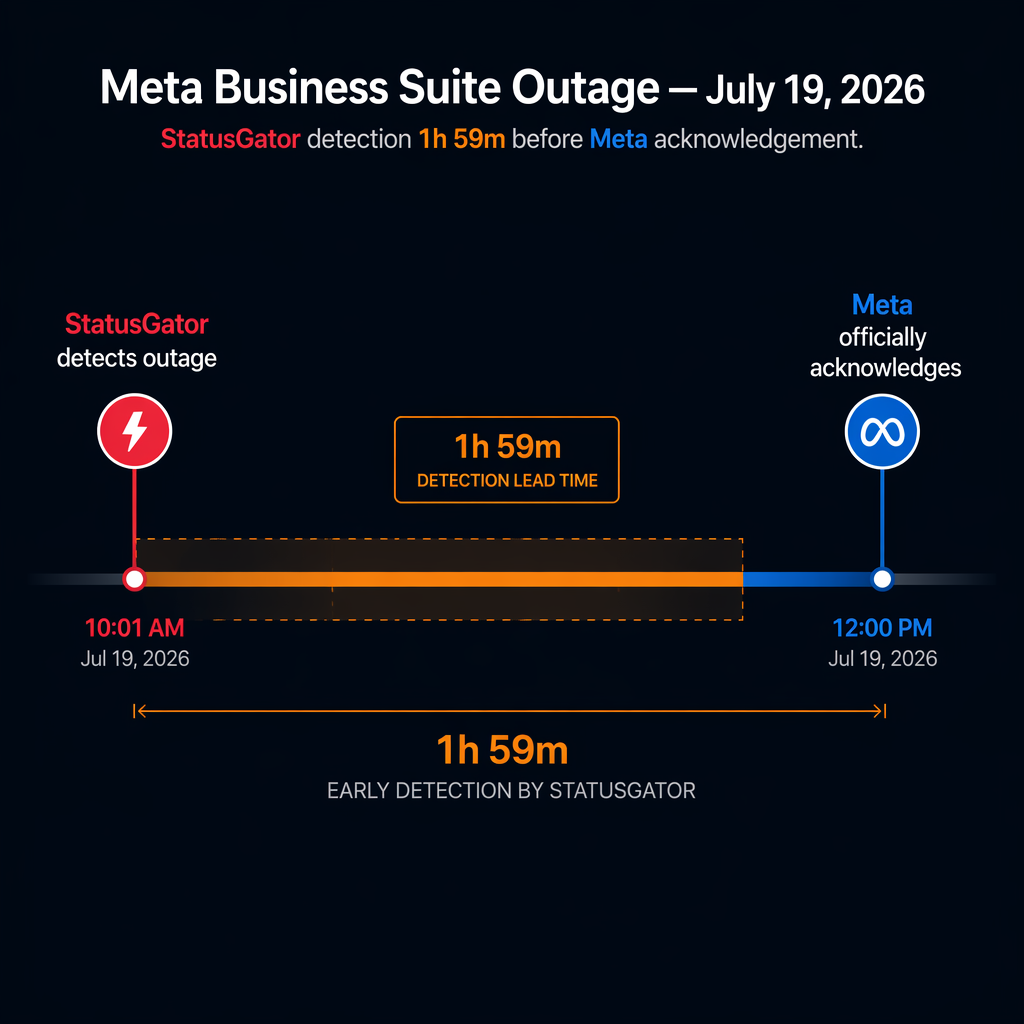
That gap is the budget argument. A solo marketer can often tolerate manual checks for a while. A team running paid campaigns across Meta, LinkedIn, TikTok, and X/Twitter cannot treat nearly two hours of uncertainty as harmless. During that window, someone may keep approving spend, delay a client update, ask a specialist to troubleshoot the wrong thing, or hold a launch that could have moved to email, search, or another social channel.
The same StatusGator Meta page makes the problem look less like a rare disaster and more like an operating condition. It recorded at least seven Meta downtime events between May 26 and July 19, 2026, including a 7-hour-54-minute incident on June 12, the 5-hour-15-minute Meta Business Suite outage on July 19, and a 1-hour-50-minute outage on July 16.[5]
StatusGator also rates Meta’s official status page with an “A” for accuracy, defined as an average delay under 15 minutes, while still showing that some incidents can be detected externally before they appear officially.[5] That is not an indictment of official pages. It is a reminder that “official” and “earliest useful signal” are not always the same thing.
StatusGator vs. IsDown: The Paid Aggregator Decision
StatusGator is the cleanest fit when the team needs alerts, a shared status view, and cross-service monitoring rather than one-off searches. It monitors Meta and Instagram among many other services, and its public Meta incident history gives marketers something they can use in a real incident: time-stamped external evidence.[5]
Its pricing also matters because the tool is easier to justify when the cost is visible. StatusGator lists paid plans starting at $17 per month, which puts it in the “campaign operations” budget conversation rather than the “enterprise procurement” pile.[6]
IsDown belongs in the same serious-consideration tier. Its homepage says it detected 45 outages in April 2026 up to 3.6 hours before vendor acknowledgement, and also flagged 104 incidents that vendors never officially reported.[7] Those are vendor-disclosed claims, not independent test results, but they point to the exact advantage a marketer is paying for: earlier warning and fewer blind spots.
There is one caution with IsDown in Q3 2026. The product says it was acquired by UptimeRobot in June 2026, so pricing, packaging, and integrations should be checked before a team standardizes on it.[7] That does not make it a weak option; it makes current verification part of the buying process.
For an agency or in-house paid media team, the decision between StatusGator and IsDown should come down to alert routing, service coverage, historical incident visibility, and how cleanly the tool supports stakeholder updates. The best monitoring product is the one that turns “something seems wrong” into a message the campaign owner can send without waiting for engineering.
Where UptimeRobot Fits
UptimeRobot is not a social media outage intelligence product in the same sense as StatusGator or IsDown. It is a practical bridge for small teams that want basic monitors on important URLs, login pages, landing pages, or endpoints. Its homepage lists 50 free monitors at 5-minute intervals and more than 3.3 million users.[8]
That free tier is useful if your immediate worry is, “Can our team reach this page?” or “Is this endpoint responding?” It is less useful if the question is, “Is Meta Business Suite degraded for publishing?” or “Are LinkedIn ad delivery delays affecting many advertisers?” UptimeRobot can tell you whether a chosen target responds; it cannot automatically know which social workflow matters to your campaign.
Small teams can still get value from it. Put UptimeRobot beside Downdetector and official status pages, not in place of them. It gives you a recurring check without buying a full aggregator, but the burden of choosing meaningful endpoints remains yours.
Downdetector Explorer Is a Different Buying Motion
Downdetector’s free site is easy to recommend as an instant check. Downdetector Explorer, the business product, is a different conversation. The for-business page positions Explorer around real-time outage detection, customer impact visibility, and API-style business use cases, but it does not publish pricing.[9]
That opacity does not make the product irrelevant. It may be a fit for companies that want Downdetector’s network-level view inside a broader operations or customer-experience workflow. For a marketing team simply trying to decide whether to pause social spend, though, quote-based pricing and sales validation make it harder to place beside StatusGator or IsDown as the default next step.
A Live-Incident Workflow Marketers Can Actually Use
During a live campaign incident, do not let every person check a different tab and argue from screenshots. Assign the first checker and move through the evidence in order of speed, then certainty.
- Check the obvious account-level causes: failed payment, rejected creative, expired access token, broken scheduler connection, or accidental pause.
- Run Down for Everyone or Just Me on the relevant platform URL or login page to rule out a local reachability issue.
- Check Downdetector for a report spike, especially for TikTok or X/Twitter where comparable official status pages are not available.
- Check Meta’s or LinkedIn’s official status page when the affected work is on those platforms.
- If your team uses StatusGator or IsDown, check the aggregator’s incident page and alert history for earlier or broader signals.
- Send an update that separates confirmed facts from working assumptions: what failed, which external signals exist, whether the platform has confirmed it, and what action the team is taking.
The action depends on the campaign’s exposure. If scheduled organic posts fail, the right move may be to hold publication and tell stakeholders the team is waiting on confirmation. If paid delivery stalls during a launch window, the safer move may be to pause or cap spend while the team confirms whether performance data is trustworthy. If one social platform is impaired and another channel is ready, the decision may be to shift the time-sensitive message rather than wait for the cleanest possible explanation.
The money at risk is hard to generalize because outages hit businesses unevenly. The most specific social-media example is dated: CNBC reported in October 2021 that creators and small businesses affected by the Facebook and Instagram outage described single-day losses ranging from $500 to more than $5,000, based on interviews with 10 businesses.[10] That is not a universal benchmark for 2026, but it is enough to show why “wait and refresh” can become a real cost center.
Which Tool Should You Use First?
For solo marketers and very small teams, start free. Keep Down for Everyone or Just Me, Downdetector, Meta status, and LinkedIn status bookmarked. Add UptimeRobot if you want recurring checks on the URLs or endpoints you care about and you are comfortable choosing those targets yourself.
For teams managing paid campaigns across multiple social platforms, budget for StatusGator or IsDown. The reason is not that free tools are useless; they are useful. The reason is that detection latency, shared alerts, and stakeholder communication become operational costs once multiple people are waiting for a decision.
Downdetector remains the fast public signal. Official status pages remain the cleanest confirmation when they exist. A paid aggregator earns its place when the team needs to know earlier, explain faster, and stop burning campaign time on manual refreshing.
References
- Down for Everyone or Just Me
- Downdetector Methodology — Downdetector
- Meta official status
- LinkedIn official status — LinkedIn
- StatusGator Meta status page — StatusGator
- StatusGator homepage — StatusGator
- IsDown homepage — IsDown
- UptimeRobot homepage — UptimeRobot
- Downdetector for Business (Explorer) — Downdetector
- Facebook, Instagram outage hurt creators, small businesses — CNBC, October 9, 2021

Comments
Join the discussion with an anonymous comment.