

Kimi K3
With Kimi K3's launch, the AI model landscape has a new contender. This comparison helps marketers decide which model—or combination of models—best fits their content, coding, and research workflows, based on pricing, benchmarks, and feature sets.
Marketing Categories
⚠ Notable Limitations
Higher verbosity, user experience gap; still new with distillation controversy
If your team is deciding whether to switch, add Kimi K3, or keep paying for Claude and ChatGPT, the practical answer is usually to route tasks instead of replacing the stack. Kimi K3 arrived on July 16, 2026 as a 2.8-trillion-parameter Mixture-of-Experts model, with open weights scheduled for July 27. Its API price of $3/$15 per MTok sits well below Claude Fable 5's $10/$50 and below GPT-5.6 Sol's $5/$30, so the real question is where the cheaper tokens survive actual workflows and where the rest of the stack still earns its keep.
At a glance
The fastest way to read the Kimi K3 vs Claude vs ChatGPT comparison is to treat price and benchmark position as inputs to a routing decision, not as a winner's podium.
| Model | API price | Benchmark signal | Best-fit workflow |
|---|---|---|---|
| Kimi K3 | $3/$15 per MTok [2] | 88.3 Terminal-Bench 2.1; 88.4 Multi-SWE-Bench; #1 on Arena.ai Frontend Code at 1,679 [3][4] | Cost-sensitive coding, automation, API-heavy work |
| Claude Fable 5 | $10/$50 per MTok [2] | 84.6 Terminal-Bench 2.1 [3] | Creative writing, long-document analysis, polished drafting |
| GPT-5.6 Sol | $5/$30 per MTok [2] | 81.1 Terminal-Bench 2.1 [3] | Broad team workspace, mixed-skill work, generalist use |
That table is useful, but it is not the end of the story. Moonshot's own model card says K3 "exhibits a noticeable gap in user experience compared with Claude Fable 5 and GPT 5.6 Sol," which is exactly the kind of caveat that keeps a cheap benchmark leader from becoming the default system of record.
The launch-week benchmark picture is strong, but it is still launch-week data. Kimi K3 also used 130M output tokens in the Artificial Analysis evaluation, versus 87M for Fable 5 and 70M for Sol, so part of the apparent price advantage is softened by higher verbosity. Artificial Analysis's Intelligence Index put Kimi at 57, Claude at 60, and Sol at 58, which is a good reminder that one sharp coding result does not settle the broader model race.
Where Kimi K3 earns its keep
Kimi's best case is not as the one model for all marketing work. It is the cheap, capable engine you point at code-adjacent and automation-heavy tasks: generating frontend components, drafting scripts, turning repetitive QA into a repeatable loop, or handling API-heavy research flows where token spend becomes visible on the invoice. In those jobs, a model that lands near the top of the coding boards while costing roughly one-third of Claude's list price can change the economics of experimentation.
The catch is that Kimi is easiest to trust when the output is easy to validate or rerun. When a model emits more tokens to do the same job, the savings shrink, and the hidden cost moves from inference spend to review time. That is why Kimi makes the most sense in bounded workflows, not in open-ended content work where verbosity turns into cleanup.
Where Claude and ChatGPT still justify their slots
Claude still earns the default slot when the work has to read well on the first pass. Claude Pro is priced at $20 a month and bundles Claude Code, which fits teams that want drafting and inspection in the same place rather than bouncing between tools. For content leads, the value is not abstract polish; it is fewer odd turns, fewer tone fixes, and less time spent sanding down a draft before it can be reviewed.
ChatGPT stays in the conversation because it covers more of the surrounding workflow. ChatGPT Plus is also $20 a month, but it includes image generation, advanced voice mode, Codex, Canvas, Tasks, and Atlas, which makes it easier for mixed-skill teams to keep writing, ideation, browser work, and task handling in one workspace. If a manager has to explain the stack to finance, broad feature surface often matters more than a narrow benchmark lead.
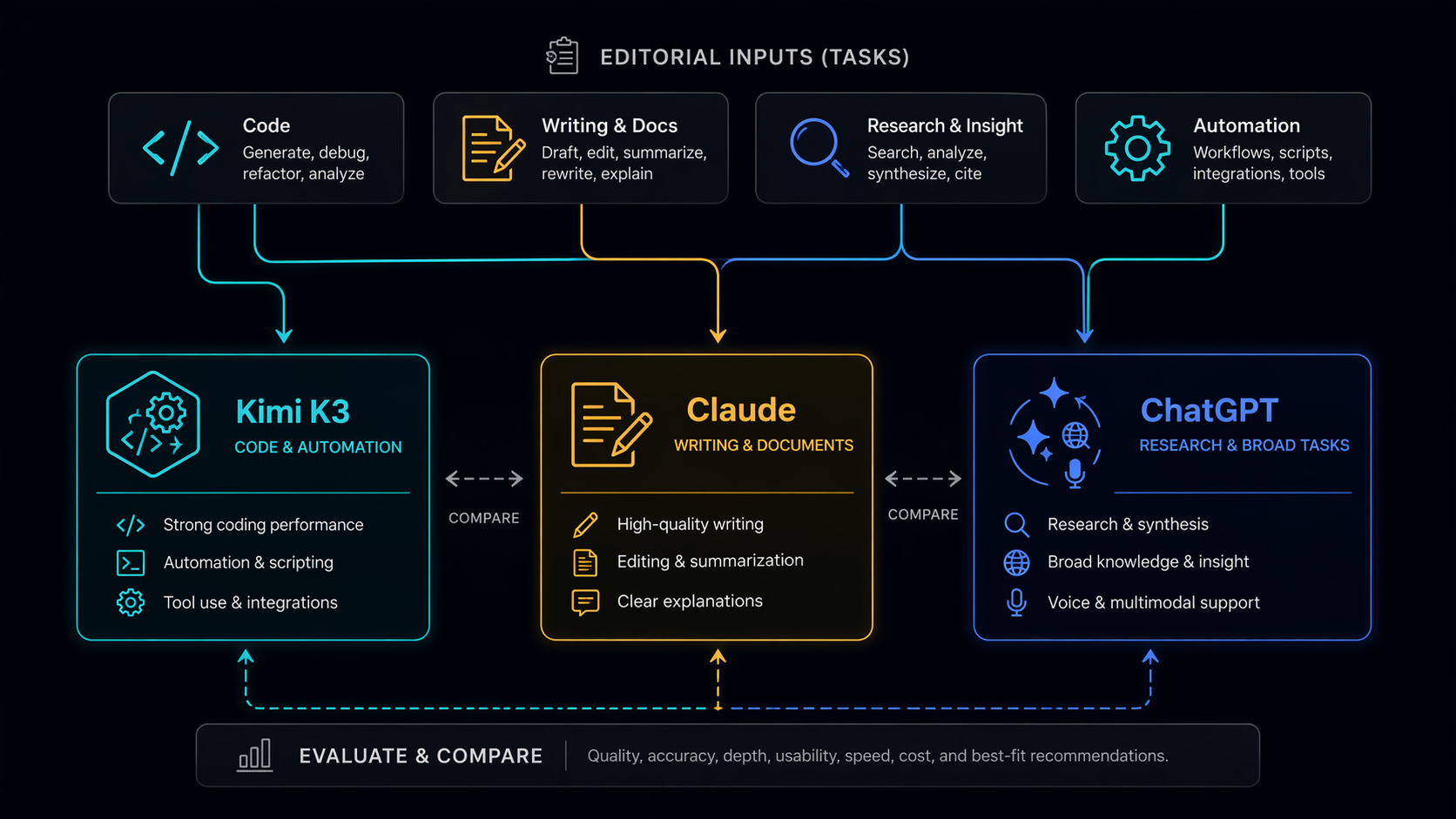
What routed work looks like in practice
The better framing is bottleneck-first, not brand-first, the same logic used in How to build an AI content stack that doesn't fail. Once the work is split by bottleneck, the routing rules become easier to defend.
- Send Kimi K3 to code generation, frontend experiments, scripts, and repetitive automation where the output is measurable and the price gap matters most.
- Keep Claude on brand-sensitive drafts, long-form analysis, and editorial cleanup where a stronger first pass reduces review time.
- Keep ChatGPT on mixed-mode work that moves between text, images, voice, browser tasks, and collaborative prompt editing.
- Set an explicit handoff rule for anything customer-facing so the cheapest model does not create the most expensive cleanup step.
What could still break the decision
Two things keep this from being a neat procurement story. First, Kimi K3 is still extremely new, the open-weight release is scheduled rather than broadly inspected, and some of the benchmark claims are still waiting on independent replication. Second, the trust conversation is not just background noise: Anthropic accused Moonshot in February 2026 of "industrial-scale" distillation through 3.4 million Claude exchanges and 24,000 fraudulent accounts, and some teams will treat that allegation as a procurement risk even if it does not settle the buying question on its own.
The cleanest answer for most marketing teams in 2026 is still to route rather than consolidate: let Kimi K3 handle cost-sensitive coding and automation, keep Claude for high-stakes writing and long documents, and let ChatGPT absorb the broad, mixed-skill work that benefits from one accessible workspace. Kimi K3 is worth testing now, but not yet worth treating as the only model your stack depends on.
References
- Kimi K3 - DataCamp, July 2026
- China's Moonshot AI releases Kimi K3 - VentureBeat, July 16, 2026
- Moonshot Releases 2.8 Trillion Parameter Kimi K3 - Tom's Hardware
- Kimi K3 Benchmarks - NXCode
- The Catch Behind Kimi K3's Benchmark Leap - The Deep View
- Chinese AI startup Moonshot unveils Kimi K3 model - Forbes, July 17, 2026

Comments
Join the discussion with an anonymous comment.