
Humanoid Robots
A practical guide for marketers evaluating humanoid robots for brand activations, events, and retail — covering real dwell time, social sharing, and lead capture metrics, robot pricing, deployment costs, and the discipline required to see results.
Marketing Categories
⚠ Notable Limitations
Requires significant planning and human support; success dependent on script and integration quality; vendor-reported metrics may overstate results
If you are putting AI humanoid robots for marketing in front of leadership, the responsible promise is narrow but real: they can be viable when the job is to pull people in, hold attention, invite sharing, guide visitors, or collect qualified leads. They are weak investments when they are bought as moving decoration and then judged by a photo of a crowd.
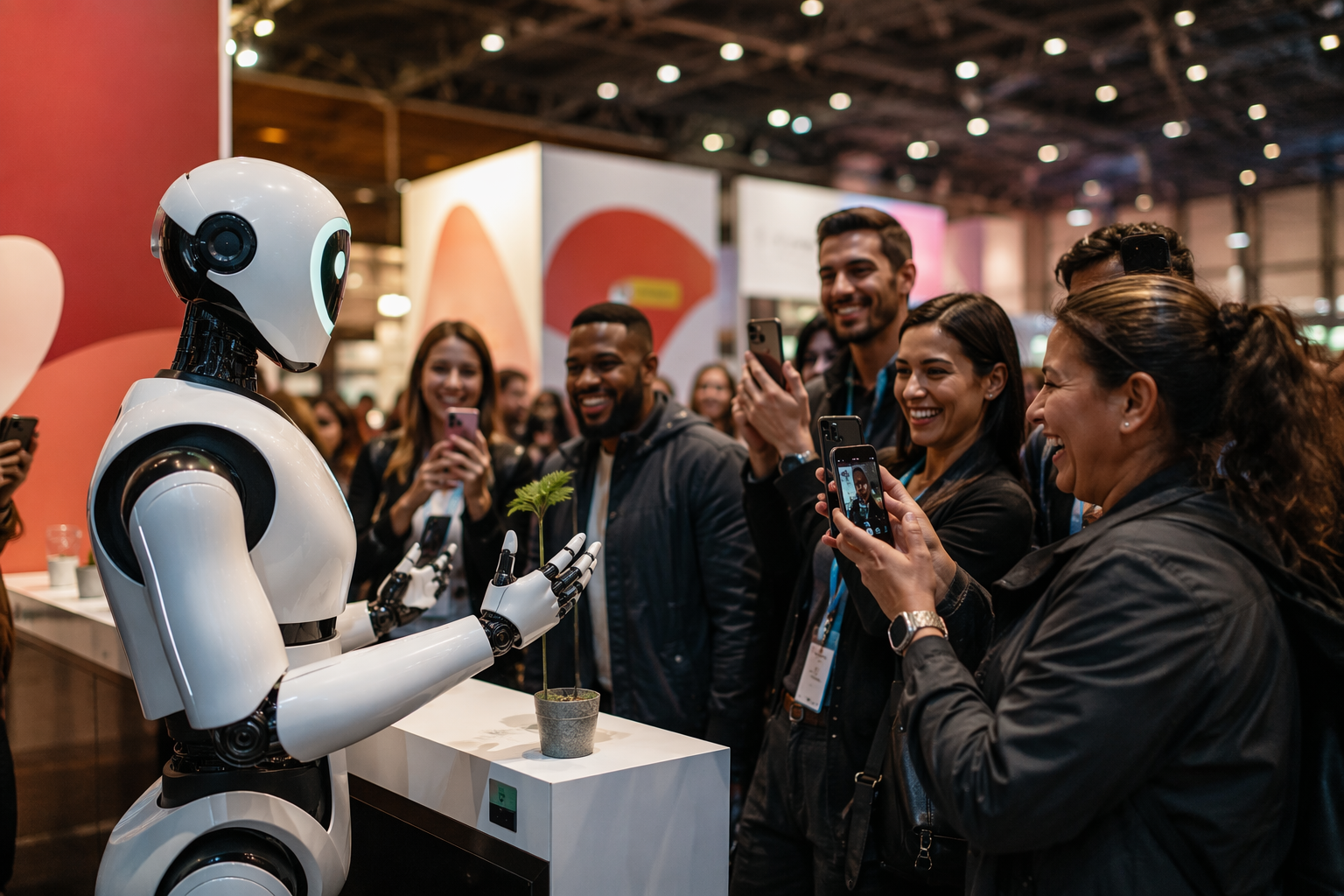
The strongest reported results are attention metrics first. RoboPhil says conventional booth setups often average 45–90 seconds per visitor, while robot-equipped activations reach 4+ minutes, based on hundreds of activations; it also reports 8–12x more social posts per attendee, 65–80% brand recall lift, and 40–60% higher lead capture than human staff alone.[1] RobotLAB describes a Cruzr deployment at a dealership grand opening where average dwell time reached 18 minutes versus 90 seconds at static displays.[2] Those numbers are useful enough to build a proposal around, but they should be labeled for what they are: largely vendor-published activation data, not neutral benchmark research.
The Metrics Worth Defending
Dwell time is the first metric to take seriously because it changes what the rest of the activation can do. A visitor who gives you a minute can notice the booth. A visitor who gives you four minutes can hear a message, answer a question, scan a badge, watch a demo, or wait for a specialist. The robot does not create the whole conversion path, but it can buy the seconds that make the path possible.
| Outcome | Reported Result | How To Read It |
|---|---|---|
| Dwell time | 45–90 seconds for conventional booths versus 4+ minutes for robot activations; one Cruzr dealership case reported 18-minute average dwell time | Useful planning benchmark, but mostly vendor-reported and activation-specific |
| Social amplification | 8–12x more social posts per attendee at robot activations; one unnamed automotive show case reported 8,700 social posts and 2.3M impressions | Strong directional signal, especially for event content, but unnamed cases limit verification |
| Lead capture | 40–60% higher lead capture rates than human staff alone; unnamed automotive case reported a 47% lead capture increase | Promising if the robot is tied to a clear data-capture flow, not just a conversation |
| Brand recall | 65–80% brand recall lift reported in vendor materials | Worth tracking, but should be measured with your own post-event survey rather than assumed |
| Foot traffic and business impact | HSBC reported 5x foot traffic lift and 60% new business increase around its Pepper branch rollout | The strongest named case, but the robot was part of a much larger branch transformation |
The HSBC Pepper rollout is the case that deserves more than a passing mention. Pepper handled more than 300 actions, including routing customers and helping with account-opening flows, and the bank reported roughly 25,000 consumer interactions, 5x foot traffic lift, 1 billion social impressions at 99% positive sentiment, and a 60% new business increase.[3] That is far more interesting than a robot waving at passersby.
It is also the case that punishes lazy attribution. HSBC’s robot program sat inside a broader $400 million branch transformation, so Pepper was not a magic employee in a vacuum.[3] The better read is that the robot gave the branch a visible, approachable interface for a larger phygital strategy. The lesson for marketers is not “buy Pepper, get 5x traffic.” It is “give the robot a job inside a well-funded experience system.”
Nestlé Japan is another useful but bounded example: Pepper-equipped locations across more than 1,000 stores reportedly produced a 15% sales lift.[4] That belongs in the evidence file, with two cautions attached. The result comes through SoftBank-related marketing coverage rather than a recent independent audit, and the use case was retail assistance at scale, not a one-week trade show stunt.
Where a Robot Actually Earns Its Floor Space
A robot makes the most sense when attention is scarce, the environment is crowded, and the brand needs visitors to do more than glance. That includes product launches, trade show booths, dealership openings, retail flagships, mall activations, hospitality concierges, and large-format events where wayfinding is part of the customer experience.
The use case should be stated as an action, not a vibe. “Create an AI moment” is not operational. “Greet visitors, qualify their interest, route hot leads to staff, capture consented contact details, and trigger a follow-up offer” is operational. So is “reduce confusion at check-in by answering repeat questions and sending visitors to the right zone.”
- Brand activations: best when the robot is the hook into a designed interaction, content moment, or product story.
- Trade shows: best when the robot qualifies traffic and hands people to humans before the novelty fades.
- Retail concierge: best when the robot can answer repeat questions, guide shoppers, or support a campaign offer.
- Dealership and showroom events: best when the robot creates dwell time around a launch and supports staff routing.
- Executive demos: best when the goal is to make an innovation strategy tangible, with clear limits on what the demo proves.
Audience matters. In the HSBC reporting, adults over 40 and children under 10 were among the most engaged, while Millennials were less impressed.[3] That detail is easy to overlook because it does not fit the usual assumption that younger audiences always reward new technology. For activation planning, it means the robot’s role should match the room, not the stereotype.
The Shortlist Should Follow the Job
The robot list should not become a gadget parade. For marketing teams, the useful question is less “Which robot is most futuristic?” and more “Which platform can survive this environment, perform this interaction, and integrate with this campaign?” Robots of London’s brand activation overview includes Pepper, Temi, Cruzr, Unitree R1, and Pudu BellaBot among available options for experiential work.[5]
| Robot Type | Best Marketing Fit | Watch Before Buying |
|---|---|---|
| Pepper | Greeting, scripted conversation, branch or retail concierge, photo-friendly brand moments | Older platform history, content quality, current availability, and whether the interaction is deeper than novelty |
| Temi | Mobile concierge, guided navigation, lightweight retail or event assistance | Crowd control, route planning, audio quality, and staff handoff design |
| Cruzr | Dealerships, showrooms, trade shows, guided conversations, and brand ambassador roles | Script design, lead capture integration, and whether the venue supports safe movement |
| Unitree R1 | High-spectacle demos and innovation-led activations where physical movement is part of the draw | Safety perimeter, insurance, handler requirements, and whether spectacle distracts from the offer |
| Pudu BellaBot | Hospitality, food service, sampling support, and service-adjacent brand moments | Whether a service robot fits the brand story or merely feels borrowed from operations |
A wheeled concierge that reliably greets, guides, and captures leads may outperform a more human-looking robot that needs constant rescuing. A bolder humanoid may be worth it when the assignment is press, creator content, or a flagship reveal. The decision is comparative: the robot is competing against better booth architecture, more staff, interactive displays, paid social amplification, creator partnerships, and ordinary lead capture tools.
The Cost Is Not the Robot
The visible price range has moved enough to make the conversation more practical. RoboZaps places entry-level humanoid units from about $5,900, while RaaS models can run from roughly $150 to $8,000 per month depending on the robot and deployment model.[6] McKinsey’s October 2025 analysis says mainstream viability depends in part on reaching a $20,000–$50,000 cost threshold; some models are now entering that zone, even as broader commercial adoption remains uneven.[7]
The budget line that gets people in trouble is the one labeled simply “robot.” A defensible activation budget needs room for programming, conversation design, content scripting, setup and teardown, maintenance, insurance, staff training, human backup, data capture integration, analytics, and content refreshes. If the robot is expected to collect leads, it also needs consent language, CRM routing, badge-scan logic or form capture, and a plan for what happens when Wi-Fi collapses in the middle of the afternoon.
| Cost Area | Why It Matters |
|---|---|
| Rental, RaaS, or purchase | Sets the baseline commitment, but rarely reflects full activation cost |
| Programming and integration | Connects the robot to forms, CRM workflows, badge scanners, screens, offers, or wayfinding |
| Script and content design | Determines whether visitors hear a useful message or just watch a machine repeat greetings |
| Human staffing | Keeps the interaction moving, rescues failed conversations, and converts interest into next steps |
| Insurance and safety | Matters in crowded venues, mobile demos, retail floors, and any activation with children nearby |
| Measurement setup | Creates the denominator: visitors, interactions, dwell time, qualified leads, shares, and follow-up actions |
| Refresh and maintenance | Prevents the second day of the event from feeling like everyone has already seen the whole trick |
Payback expectations should follow the use case. RoboZaps estimates 8–16 months for brand activations using a rental model, 18–24 months for retail concierge deployments, and 12–18 months for warehouse-adjacent demos.[6] Those timelines are not guarantees; they are planning ranges. A one-off launch may justify the spend through earned media, executive visibility, and lead quality. A retail concierge has to earn its place through repeatable assistance, not one opening-weekend crowd.
What Has to Be Designed Before the Robot Arrives
Good robot activations usually look spontaneous from the aisle and heavily planned from behind the booth. The operating model is where the investment either becomes a system or collapses into a prop.
Choose for the environment, not the demo reel
A convention hall has noise, uneven foot traffic, bad connectivity, tight turning radiuses, and people who will step into the robot’s path to film it. A retail floor has children, carts, store associates, accessibility requirements, and managers who care about traffic flow. The selection process should test movement, speech recognition, battery life, screen visibility, remote support, and failure behavior in conditions that resemble the real deployment.
Write the conversation like a conversion path
The worst script is a loop of cheerful greetings. The second-worst script is a technical monologue no visitor asked for. A useful script starts with a low-friction hook, moves quickly into qualification, gives the visitor a choice, and exits cleanly to a staff member, offer, demo station, QR flow, or calendar booking.
For example, a hypothetical trade show robot might greet passersby, ask whether they are evaluating a product this year or just browsing, route evaluators to a specialist, send browsers to a two-minute demo, and capture consented contact details only after there is a reason to follow up. The point is not to make the robot sound human. The point is to remove one awkward step from the visitor journey.
Give the human team real roles
A robot does not replace the event team; it changes their timing. Staff need to know when to let the robot hold the crowd, when to interrupt, when to take a qualified lead, and when to quietly reset the experience. If the human team treats the robot as a mascot, the visitor will too.
Define the denominator before the doors open
Crowd photos are not measurement. “Engagement” screenshots are not measurement unless the team knows how many people passed the booth, how many stopped, how long they stayed, how many interacted, how many shared, how many gave usable contact information, and how many took the next action. If leadership is going to see a 40% lead lift claim, they should also see the baseline it beat.
- Traffic denominator: total passersby, booth visitors, or store visitors.
- Attention metric: average dwell time and distribution, not only peak crowd size.
- Interaction metric: completed conversations, demo starts, wayfinding assists, or product matches.
- Lead metric: consented, usable records that meet a quality threshold.
- Commercial metric: booked meetings, offer redemptions, attributed pipeline, sales lift, or store traffic.
- Content metric: posts, reach, sentiment, earned coverage, and whether the brand was visible in the asset.
A Simple Payback Model
The cleanest way to model the investment is to separate attention value, lead value, and media value. Do not let one inflated number hide weak performance elsewhere. A robot that creates thousands of social posts but no qualified contacts may be a media play. A robot that quietly routes store visitors and lifts conversion may be an operations-assisted marketing play. Those are different cases.
| Value Pool | What To Estimate | What To Avoid |
|---|---|---|
| Attention | Incremental dwell time, demo completion, and staff conversations created by the robot | Counting everyone who photographed the robot as a meaningful prospect |
| Lead generation | Incremental qualified leads versus a comparable booth, campaign, or staff-only setup | Counting incomplete forms, novelty signups, or duplicates as equal to sales-ready leads |
| Earned and social media | Posts, reach, sentiment, publication quality, and brand visibility | Using gross impressions without checking whether the brand or offer was remembered |
| Retail or branch impact | Foot traffic, assisted actions, appointment starts, account openings, offer redemptions, or sales lift | Attributing all gains to the robot when store design, media, staff, and promotions changed too |
| Learning value | Reusable scripts, audience insights, content assets, and future deployment playbooks | Treating every experimental benefit as hard ROI |
This is also where market momentum belongs: as confidence context, not the investment case. Fortune Business Insights projects the humanoid robot market at $6.24 billion in 2026 with a 50.6% CAGR through its forecast period.[8] McKinsey is more cautious about broad commercialization, describing many humanoid efforts as still caught in pilot purgatory and emphasizing the importance of cost thresholds and use-case fit.[7] For marketers, that tension is healthy. Supply is improving, but a bigger market forecast does not make a bad activation good.
The Investment Judgment
Humanoid robots are viable marketing investments for teams with a measurable activation goal, a budget that covers execution rather than just hardware, and the discipline to treat the robot as an interaction system. The best cases use the robot to attract attention, lengthen dwell time, guide visitors, qualify interest, create shareable moments, and hand people into a next step that already exists.
They are not viable when the brief is only “we need something AI,” when no one owns the script, when staff are not trained to work with the robot, when the data path is improvised on-site, or when success will be judged by crowd photos with no baseline. Spectacle can earn its budget. It just has to do more than stand there looking like the future.
References
- Event Robots for Brand Activations – Do They Work? — RoboPhil
- Brand Ambassador Robots — RobotLAB
- Seriously Successful Results From HSBC Bank's Branch Robot Rollout — The Financial Brand
- How to Strengthen Human Brand and Marketing Experiences with AI — Marketing AI Institute
- The Best AI Robots for Brand Activations — Robots of London
- Humanoid Robot ROI Guide [2026] — RoboZaps
- Humanoid robots: Crossing the chasm from concept to commercial reality — McKinsey, October 2025
- Humanoid Robot Market Size, Share, & Growth Report [2034] — Fortune Business Insights

Comments
Join the discussion with an anonymous comment.