
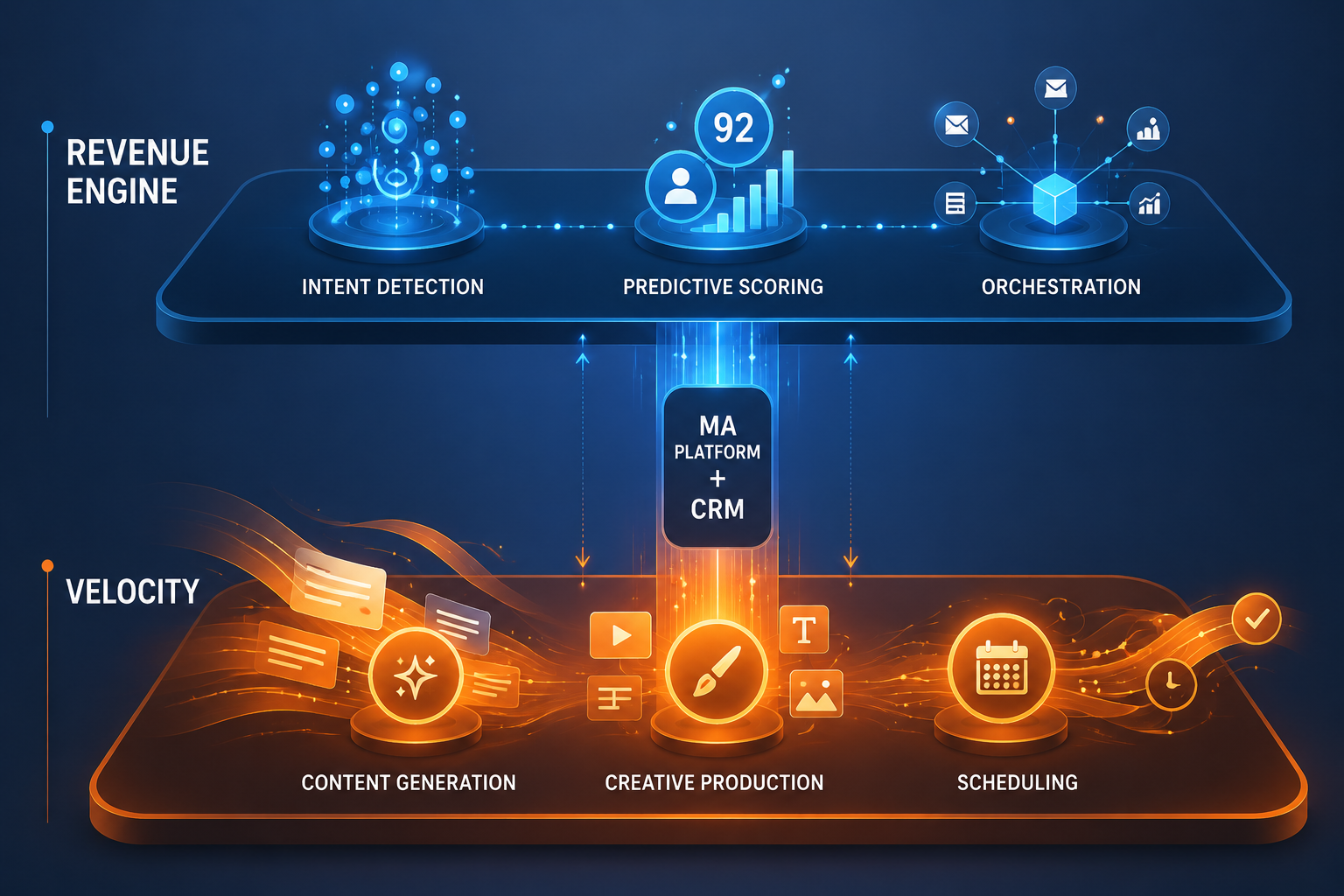
AI Marketing Automation Stack
A framework for marketing operations leaders to architect AI marketing automation tools into two coherent layers—revenue engine and velocity—and integrate them through a single MA platform and CRM to drive measurable pipeline outcomes.
Marketing Categories
The stack usually starts looking broken after it has technically become automated. Content tools are producing more variants than the team can review. Email workflows are live. Lead scoring exists somewhere. A sales rep can see a few engagement notes in the CRM, but pipeline reporting still depends on patched fields, copied spreadsheet exports, and someone in marketing ops explaining why an “AI-qualified” lead did not become an opportunity.
That is the wrong moment to ask for a ranked list of AI marketing automation tools. The first question is architectural: which tools are supposed to make better revenue decisions, which tools are supposed to increase production speed, and where do both layers read from and write back to?
This distinction matters because integration depth is where the ROI gap shows up. Secondary summaries of Forrester benchmarking, compiled by Digital Applied and Revenue Memo, report that top-quartile marketing automation programs return $8.71 per dollar spent, compared with $1.92 for bottom-quartile, disconnected programs.[1][2] Treat those figures as secondary-sourced benchmarks rather than independently verified primary research. They are still useful because they point to the same practical conclusion: automation that compounds through shared systems behaves very differently from automation that creates isolated activity.
Start With Two Jobs, Not One Tool Category
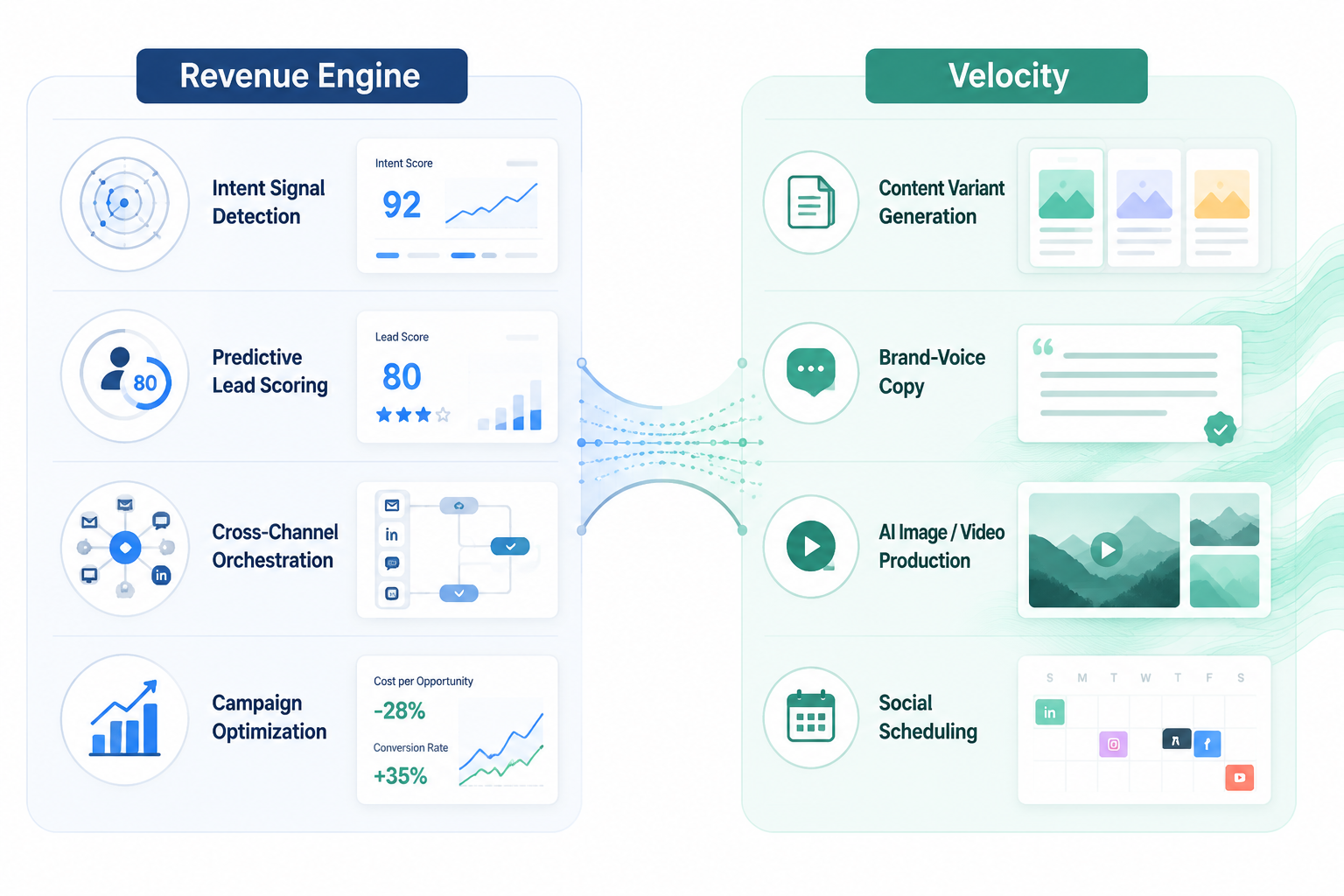
A useful way to organize AI marketing automation tools is to split them into two operating layers. This is a practical model synthesized from current GTM and tool-category research, not an official industry taxonomy. ZoomInfo groups AI marketing automation around GTM functions such as intent detection, lead scoring, orchestration, and campaign optimization, while Samuel J. Woods’ tool taxonomy separates revenue-driving automation from content and execution tools.[3][4]
| Layer | Primary job | Typical AI functions | Failure mode when disconnected |
|---|---|---|---|
| Revenue engine | Improve pipeline decisions | Intent detection, predictive scoring, account prioritization, cross-channel orchestration, campaign optimization | Creates scores and signals sales does not trust or cannot see in time |
| Velocity | Increase output and execution speed | Content variants, brand-voice copy, creative production, AI-assisted email, social scheduling | Creates more assets and campaigns than the team can measure or govern |
Revenue engine tools are closest to pipeline judgment. They decide which accounts deserve attention, which leads should be routed, which audience should receive a sequence, which campaign path should change, and which signal should affect sales prioritization. If these tools are wrong, the consequence is not just inefficient marketing work. Sales wastes time, attribution becomes harder to defend, and the team starts arguing about whether the model is bad or the handoff is broken.
Velocity tools are closer to production capacity. They help teams make more message variants, draft campaign copy, adapt content for segments, generate creative options, and schedule distribution. If these tools are wrong, the consequence is usually different: inconsistent voice, duplicated assets, review bottlenecks, more campaigns than the reporting structure can explain, and a larger cleanup queue for marketing operations.
The same product can touch both layers. A platform may offer predictive scoring and AI copy generation in the same interface. That does not make the jobs interchangeable. Scoring needs clean contact, account, engagement, and opportunity history. Copy generation needs brand guidance, approved messaging, product context, and a review workflow. Buying both because they appear in the same demo does not mean both are equally ready for deployment.
The Spine Is Still the MA Platform and CRM
A coherent AI stack needs a system spine. For most mid-market B2B teams, that spine is the marketing automation platform plus the CRM. The MA platform owns campaign membership, forms, segmentation, email workflows, nurture logic, consent fields, and many engagement events. The CRM owns lead, contact, account, opportunity, owner, stage, and revenue records. AI tools become useful when they strengthen that spine instead of creating a parallel one.
The practical test is simple: when an AI tool makes a decision, where does the decision appear next? If an intent platform identifies an in-market account, does that signal update an account field, trigger a routed task, adjust a campaign audience, or stay trapped in a dashboard? If a predictive model changes a lead score, can sales see the reason code in the CRM? If a content tool creates five nurture variants, are those variants tied to campaign IDs, audience segments, and performance reporting, or are they copied into an email builder with no durable metadata?
This is where tool-by-tool evaluation usually underperforms. A revenue engine product can look impressive in isolation and still create operational drag if its output becomes another field no one trusts. A velocity tool can save hours in creative production and still make reporting worse if campaign naming, asset lineage, and variant performance are not captured inside the systems that already support attribution.
What the Integration Has to Carry
A stack is not integrated just because tools can pass records through a connector. For AI marketing automation, the integration has to carry enough context for the next person or system to act. At minimum, that means identity, source, timing, decision reason, workflow status, and outcome.
- Identity: the lead, contact, account, buying committee, or anonymous visitor record the tool is acting on.
- Source: the campaign, channel, content asset, form, intent provider, or enrichment source that produced the signal.
- Timing: when the signal occurred, when the model evaluated it, and when the workflow responded.
- Decision reason: the score factor, intent category, audience rule, or content input that explains why the action happened.
- Workflow status: whether the record is queued, routed, suppressed, enrolled, paused, reviewed, or completed.
- Outcome: whether the action influenced meetings, opportunities, pipeline stage movement, revenue, unsubscribe behavior, or disqualification.
Without those fields and events, AI outputs become hard to audit. Marketing sees model activity. Sales sees partial context. Finance sees spend. Nobody can cleanly connect the decision to the downstream result.
Revenue Engine Tools Need Data Maturity Before Ambition
Revenue engine AI is tempting because it promises better prioritization. The catch is that prioritization is only as useful as the history it learns from and the fields it can trust. Available research points to a rough readiness threshold: AI predictions become more reliable once a team has at least 500 contacts and three or more months of campaign history. Below that level, teams should prioritize enrichment, field governance, and CRM hygiene before relying on predictive scoring or autonomous optimization.
That threshold should not be treated as a universal law. It is a sizing guide. A team with 700 contacts but inconsistent lifecycle stages, duplicated accounts, missing source fields, and no closed-loop opportunity data may still be a poor candidate for predictive routing. A team with cleaner records and fewer campaigns may be ready for narrower AI assistance, such as recommending nurture paths or flagging likely-fit accounts for human review.
The buying implication is direct: do not start revenue engine procurement with the model. Start with the records the model will read and the workflow it will change. If the current lead score already includes stale form fills, inflated webinar attendance, and job-title rules sales ignores, adding AI scoring may only make a weak process harder to explain.
When Revenue Engine AI Is Ready to Help
A revenue engine tool is a good candidate when the team can name the decision it wants to improve. “Find better accounts for outbound” is a decision. “Route high-fit demo requests faster” is a decision. “Suppress low-fit leads from expensive sales follow-up” is a decision. “Use agentic AI” is not.
- Intent detection fits when the team has defined target accounts, sales can act on account-level signals, and the CRM can store signal category and recency.
- Predictive scoring fits when contact, account, engagement, lifecycle, and opportunity fields are consistently populated.
- Cross-channel orchestration fits when campaign membership, suppression logic, and handoff rules already work across channels.
- Autonomous campaign optimization fits only after the team knows which conversions and revenue outcomes the system is allowed to optimize toward.
Agentic AI is becoming a more explicit buying criterion, but that does not remove the need for this sequencing. Digital Applied reports that 73% of marketing automation buyers now treat native agentic AI capability as a top-three evaluation criterion, up from 18% in 2024, and that 45% of marketing teams use at least one agentic AI system for automation tasks in 2026, up from 15% in 2024.[1] Those figures come through Digital Applied’s composite of G2 grid survey data, with the original G2 methodology not independently verified here. The trend is still relevant: buyers are asking for more autonomous systems. The operational question is whether those systems will have clean instructions, clean data, and controlled places to write back.
Velocity Tools Should Reduce Production Friction Without Creating Measurement Debt
Velocity tools are easier to deploy early because they do not always need deep revenue history to be useful. A team can use AI to draft email variants, repurpose webinar content, build ad copy options, adapt landing page language by segment, or prepare social posts before it has enough data for reliable predictive scoring.
The risk is not that these tools fail to create output. The risk is that they create output faster than the team can approve, organize, and measure it. More variants can improve testing only if variant names, audience definitions, campaign IDs, approval status, and performance data remain attached. Otherwise the team has more content but less knowledge.
Email is the cleanest place to see the difference between useful automation and activity inflation. Revenue Memo cites industry benchmarks showing automated email workflows generate 320% more revenue than non-automated email.[2] That does not mean every AI-written nurture sequence will produce lift. It means automation can work when behavior, workflow logic, and measurement are connected. The value comes from responding to what a contact did, not merely sending more messages.
Velocity procurement should therefore ask a different set of questions than revenue engine procurement. The core issue is not whether the tool can generate a persuasive paragraph. Many can. The issue is whether it can operate inside the team’s review, brand, campaign, and measurement system.
- Can approved brand voice, product messaging, compliance rules, and audience context be reused instead of pasted into every request?
- Can generated assets be tied to campaign, channel, segment, and experiment metadata?
- Can reviewers see what changed between variants and who approved the final version?
- Can performance data flow back into the MA platform, CRM, or reporting layer without manual tagging?
- Can the team archive, suppress, or retire generated assets when messaging changes?
Size the Stack to Workflow Complexity
Workflow count is a better sizing signal than feature appetite. Digital Applied’s summary of G2-derived data reports that the median mid-market team runs 24 active workflows, while enterprise teams run more than 100.[1] The original G2 methodology was not independently verified here, but the benchmark is useful for one reason: it moves the conversation from “Which platform has the most AI?” to “How many decisions are we asking automation to coordinate?”
A team with six simple workflows does not need the same architecture as a team running lifecycle nurture, product-led usage triggers, partner campaigns, renewal motions, webinar follow-up, intent-based outbound, and regional suppression rules. The first team may get more value from a clean MA platform, CRM hygiene, and a few velocity tools. The second team may need deeper orchestration, stronger identity resolution, stricter governance, and revenue engine AI that can prioritize across competing signals.
| Current condition | Likely stack priority | What to avoid buying first |
|---|---|---|
| Few workflows, limited campaign history, inconsistent CRM fields | CRM hygiene, data enrichment, campaign taxonomy, basic MA automation | Predictive scoring or autonomous optimization that depends on weak historical data |
| Clean CRM, growing campaign volume, content bottlenecks | Velocity tools connected to review, campaign metadata, and performance reporting | Standalone content generators with no asset governance |
| Multiple active nurture, routing, and sales handoff workflows | Revenue engine tools for scoring, intent, orchestration, and prioritization | Point solutions that do not write usable signals back to the CRM |
| High workflow count, multiple segments or regions, mature attribution needs | Integrated MA, CRM, data layer, governance, and controlled AI decisioning | Autonomous tools without audit trails, reason codes, or suppression controls |
This is also where implementation timelines should be treated carefully. HyperFX’s 2026 tool comparison describes implementation ranges from days to as long as nine months, depending on platform tier and complexity.[5] That range is not a promise or a universal estimate. It is a reminder that “AI tool” can mean a lightweight production assistant or a system-level change touching CRM fields, routing rules, campaign architecture, and reporting.
A Procurement Sequence That Keeps the Stack Coherent
The safest procurement path is not slow for the sake of being cautious. It is sequenced so the team does not buy a tool before it can absorb the output.
- Name the workflow problem. Start with a routing delay, scoring distrust, content bottleneck, nurture gap, attribution blind spot, or campaign optimization problem.
- Assign the layer. Decide whether the problem belongs primarily to revenue engine intelligence, velocity production, or the integration spine.
- Inspect the source records. Identify the fields, events, audiences, campaign IDs, and opportunity data the tool must read.
- Define the write-back. Specify what the tool will update in the MA platform, CRM, reporting layer, or asset system.
- Set the human review point. Decide who can override, approve, suppress, or audit the AI action.
- Measure the downstream effect. Track the operational and revenue outcome, not only usage or output volume.
A hypothetical example makes the sequence clearer. Suppose a mid-market team wants to improve webinar follow-up. If the real issue is that reps receive attendee lists three days late, the stack problem may be routing and CRM task creation. If the real issue is that every follow-up email sounds generic, the gap may be velocity. If the real issue is that high-intent attendees are mixed with students, vendors, and poor-fit contacts, the gap may be scoring and enrichment. The same campaign symptom can point to three different procurement conversations.
The mistake is buying one tool to cover all three without deciding which system owns each action. A content assistant should not become the de facto campaign taxonomy. An intent platform should not become a shadow CRM. A predictive scoring model should not become the only place where lifecycle logic is understood.
Where Named Platforms Fit
Platform comparisons still matter. HubSpot, Marketo, Salesforce, ZoomInfo, Jasper, and other tools can be the right fit in different stack positions. But the comparison should happen after the architecture is clear. Otherwise a team ends up grading products on the most visible demo feature rather than the most important operational dependency.
A primary MA platform decision should focus on the spine: workflow builder depth, CRM alignment, field governance, segmentation, consent handling, reporting, AI features, marketplace integrations, and admin burden. A revenue intelligence decision should focus on signal quality, model explainability, account and contact matching, CRM write-back, and sales usability. A velocity tool decision should focus on brand controls, review workflow, asset metadata, and performance feedback.
Revenue Memo’s examples, including Smartsheet reporting an 84% increase in MQLs and CreditXpert reporting a 50% lift in click-through rate, are useful as proof that automation programs can produce measurable gains.[2] They should not be read as guaranteed outcomes for every similar purchase. Case examples show what happened in a specific environment; stack architecture determines whether another team has the conditions to reproduce anything close to it.
The Audit Before the Next Demo
Before evaluating another AI marketing automation vendor, map the current stack on one page. Put the MA platform and CRM in the center. Place revenue engine tools on one side and velocity tools on the other. Then draw only the integrations that actually move usable data, not the integrations listed on a vendor page.
- If sales cannot see or trust the signals, the gap is probably revenue engine integration.
- If campaigns take too long to produce, the gap may be velocity.
- If reporting depends on manual exports, the gap is the system spine.
- If predictions are unstable or hard to explain, the gap may be data readiness.
- If workflows collide, duplicate, or suppress each other unpredictably, the gap is orchestration governance.
The better question is not which AI marketing automation tool is best in isolation. Ask which layer it belongs to, what system of record it depends on, what workflow it improves, where it writes back, who reviews the decision, and whether the organization has enough clean data for it to make reliable decisions. That is the conversation that separates a stack from a collection of demos.
References
- Marketing Automation Statistics 2026, Digital Applied
- Marketing automation ROI statistics for 2026, Revenue Memo
- AI Marketing Automation Software: 10 Best Tools, ZoomInfo
- The Best AI Marketing Automation Tools That Drive Revenue, Samuel J. Woods
- Best AI Tools for Marketing Automation 2026, HyperFX

Comments
Join the discussion with an anonymous comment.