
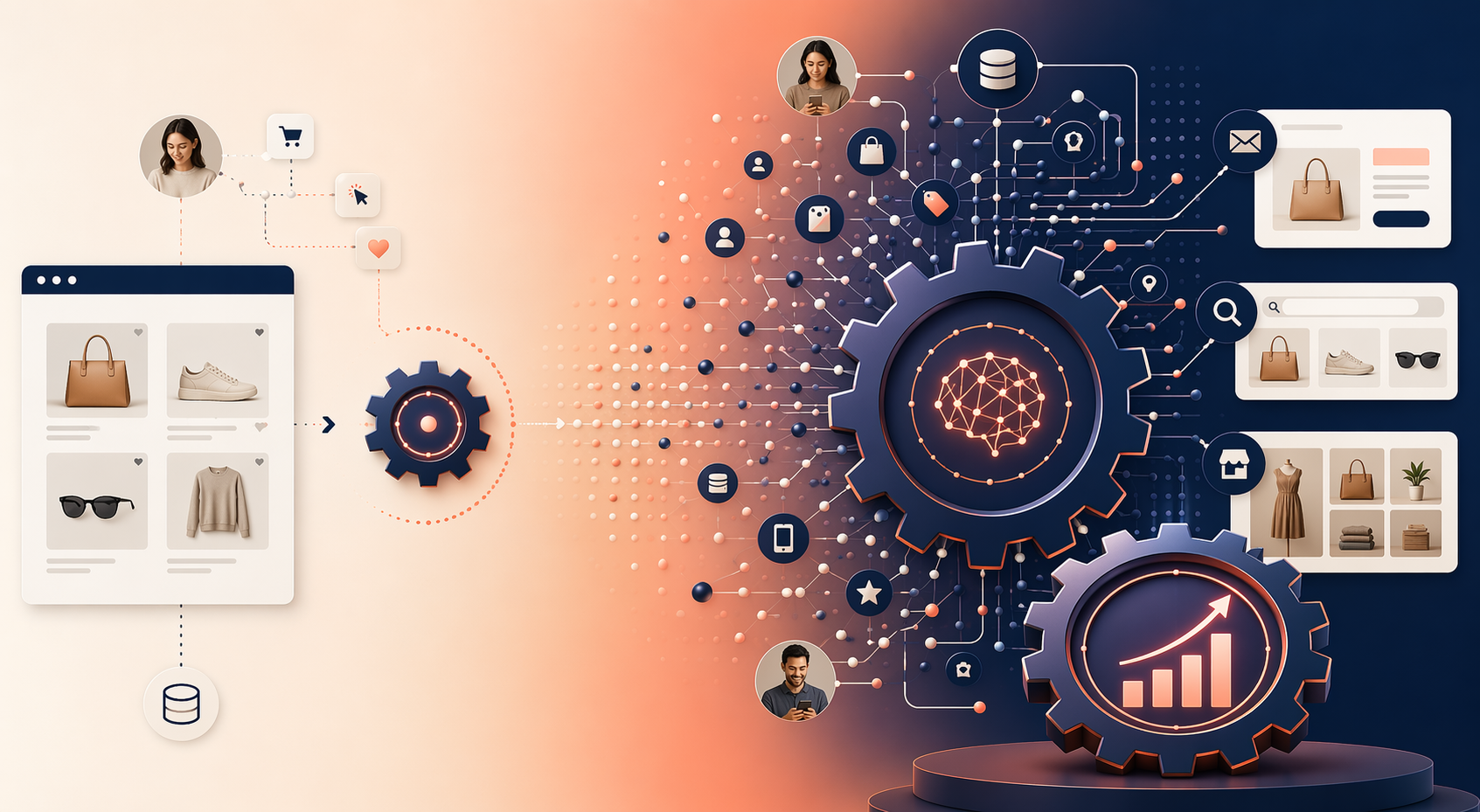
Ecommerce AI Recommendation Engine (overview)
This article examines nine real brands — from Amazon to Best Buy — to show what measurable outcomes AI recommendation engines have delivered in ecommerce, with honest caveats on data sources and implementation complexity.
Key Integrations
Marketing Categories
⚠ Notable Limitations
Vendor-reported outcomes may overstate impact; results vary by data depth and integration
The useful question is not whether an ecommerce AI recommendation engine can lift performance. The record is too mixed, and too interesting, for that. In real examples, recommendations have been credited with anything from a 12% revenue uplift to 35% of total revenue, while other systems show their value through fewer returns, stronger email engagement, or more customers brought back into purchase behavior.[1][2][3][4]
That spread matters. A product carousel on a category page, a fit assistant that changes size selection, and an omnichannel personalization layer that follows a customer across web, app, email, and store are all called recommendation engines. They do not carry the same operating burden, and they should not be judged by the same metric.
| Brand | Recommendation use case | Reported outcome | Source caveat | Practical takeaway |
|---|---|---|---|---|
| Amazon | Deep product personalization across shopping surfaces | 35% of revenue attributed to recommendations | Indirectly cited through Firney as McKinsey-attributed, not a direct Amazon disclosure | Useful as a strategic benchmark, weak as a copy-paste expectation |
| Netflix | Algorithmic content recommendations | 75-80% of viewing hours driven by recommendations | Older 2012-era figure; ecommerce analogy, not retail revenue data | Shows what recommendations can do when the product experience is built around them |
| Total Tools | Personalized ecommerce recommendations | 12% revenue uplift | Emarsys/SAP vendor-reported case study | A more realistic mid-market reference point than Amazon |
| Petco | Personalized customer engagement and win-back | 31% revenue increase and 15% won-back customers | Emarsys/SAP vendor-reported case study | Recommendations can support retention, not only discovery |
| Sephora | Personalized product recommendations | 6x more completed purchases | Emarsys vendor-reported case study | High intent moments can amplify recommendation impact |
| Feel Good Contacts | Personalized customer messaging and recommendations | Reported performance lift in vendor case material | Vendor-reported; no precise lift figure available in the source material | Useful mainly as an implementation pattern, not a quantified benchmark |
| & Other Stories | AI fit recommendations | 32% reduction in returns | Outcome reported for fit assistance rather than revenue lift | Return reduction is a different value path from more clicks |
| AO | Newsletter personalization and recommendations | 150% growth in newsletter engagement | Vendor-reported engagement outcome | Email can be a practical first surface for recommendation work |
| Best Buy | Omnichannel recommendation engine | No precise outcome figure available | Implementation noted without quantified result | The operating model matters even when public metrics are limited |
What Counts As a Recommendation Engine Here
Here, a recommendation engine is any system that uses customer, product, behavioral, or contextual data to decide what item, content, offer, size, or message to show next. That can include familiar product modules such as “you may also like,” replenishment reminders, personalized email blocks, fit guidance, win-back campaigns, or omnichannel recommendations that carry across store and digital interactions.
The distinction is not academic. A store can improve email engagement with a lighter setup than Amazon needs to personalize a marketplace. A fashion brand can save margin by reducing returns without necessarily increasing click-through rate. A pet retailer can use recommendations to bring lapsed customers back, which is a different business problem from helping first-time visitors find a product.
Two broader statistics help frame the examples. McKinsey has reported that 76% of consumers get frustrated when personalization does not happen, which explains why recommendation work often gets leadership attention.[5] Salesforce, meanwhile, has reported that recommendations can represent only 7% of clicks while driving 26% of revenue, a useful warning against judging the whole system by engagement volume alone.[6]
Amazon: The Famous 35% Figure Is Powerful, but Handle It Carefully
Amazon is the example everyone reaches for because its recommendation layer is not a decorative add-on. It appears throughout the buying journey: product pages, home page modules, cart-adjacent suggestions, browsing history, email, and post-purchase discovery. The widely repeated claim is that 35% of Amazon revenue is attributable to recommendations.[1]
The caveat is important. In the sources used here, that figure is available through Firney as a McKinsey-attributed claim, not as a directly published Amazon disclosure.[1] It is still strategically useful because it captures the scale of recommendation-driven commerce at a company that has spent years building the data, testing culture, catalog structure, and surfaces needed to make recommendations commercially central. It is not a promise that a retailer installing a recommendation widget should expect a third of revenue to move through that widget.
The practical lesson is less glamorous than the headline. Amazon’s system can draw from repeat behavior, large-scale product relationships, inventory breadth, search behavior, purchase history, and dense interaction data. The engine is allowed to know a lot, and it appears at moments where the customer is already deciding what to buy. That combination is the real benchmark.
Netflix: A Strong Personalization Benchmark, Not a Retail Revenue Model
Netflix is not ecommerce in the usual retail sense, but it remains a useful example because the product experience is organized around recommendations. Older 2012-era sources credited algorithmic recommendations with driving 75-80% of viewing hours.[2] That is a large claim, and it belongs in a different category from a product recommendation block added to an existing store template.
The date matters. A 2012-era viewing-hours figure should not be treated as a current audited statement about how Netflix works in 2026.[2] The platform, catalog, interface, and methodology may have changed. What still travels well is the operating principle: recommendations matter more when the customer must choose from a huge catalog and when the interface gives the algorithm repeated opportunities to shape that choice.
For ecommerce teams, the analogy is strongest in categories with large assortments and high discovery friction: marketplaces, beauty, apparel, home goods, electronics accessories, grocery, and replenishment-heavy pet or health categories. If the catalog is shallow or customers usually arrive knowing the exact SKU they need, the Netflix comparison does not do much useful work.
Total Tools: A 12% Revenue Uplift Is the Kind of Number Many Teams Should Study
Total Tools is a more grounded reference point for ecommerce operators because the reported outcome is a 12% revenue uplift from personalized recommendations, published in Emarsys/SAP case material.[3] That is still a meaningful number, but it is not so large that it requires pretending every retailer can become Amazon.
The vendor source caveat should stay attached to the result. Vendor case studies are useful for understanding what a platform says it helped a client achieve, but they are not the same as an independent audit. They often compress implementation work, data cleanup, campaign design, and attribution choices into a cleaner story than the team experienced internally.
Still, a 12% uplift is commercially legible. It suggests recommendation systems can improve performance when they help shoppers navigate a practical catalog and when the use case is close to buying intent. For a marketing manager building a business case, this kind of moderate lift may be more defensible than leading with extreme platform examples.
Petco: Recommendations as Retention Infrastructure
Petco’s reported results point to a broader role for recommendation engines: not just getting a visitor to click another product, but reactivating known customers. The Emarsys/SAP case material reports a 31% revenue increase and 15% won-back customers.[4]
Pet retail has a natural advantage for this kind of work. Many purchases are repeatable, tied to pet type, size, age, dietary preference, or replenishment timing. If the retailer has usable customer history, recommendations can arrive as reminders, substitutes, complementary items, or relevant offers rather than generic cross-sells.
The result is vendor-reported, so it should not be generalized too aggressively.[4] The useful takeaway is the decision context. A lapsed customer does not need the same recommendation as a first-time browser. Win-back recommendations work when the system can recognize prior behavior and intervene before the customer quietly replaces the retailer with another option.
Sephora: High-Intent Beauty Shopping Gives Personalization More Room to Work
Sephora’s vendor-reported case result is striking: Emarsys case material says personalized recommendations drove 6x more completed purchases.[7] The wording matters here. “Completed purchases” is not the same metric as total revenue share, click-through rate, or average order value, so it should be read as a conversion-related outcome rather than a full-store revenue attribution.
Beauty is a strong category for recommendations because customers often balance shade, skin type, replenishment, routine-building, gift intent, brand preference, and price. The recommendation does not merely say “people also bought this.” In a good implementation, it narrows an overwhelming choice set to a plausible next product.
This is one of the clearest places where catalog quality and customer data quality become part of the engine. If product attributes are thin, shade families are inconsistent, or customer preferences are not captured, the algorithm has less to work with. The brand strength may create the visit, but the recommendation layer needs structured information to reduce hesitation at the point of purchase.
& Other Stories: Fewer Returns Can Be the Main Win
& Other Stories belongs in this list because the value path is different. The reported outcome is a 32% reduction in returns through AI fit recommendations.[8] That is not the same as lifting recommendation clicks, and it may be more important for apparel economics.
Fit assistance changes a decision that happens before the order is placed: which size, whether to buy two sizes, whether to abandon, and whether the customer trusts the product detail page. A better size recommendation can protect margin after checkout by reducing reverse logistics, restocking, discounting, and customer service pressure.
This is also where a recommendation engine becomes less like a merchandising carousel and more like operational risk management. The customer may never think, “I clicked an AI recommendation.” They simply order the size that fits. If the measurement lens only looks for extra clicks, this kind of system will be undervalued.
AO: Email Engagement Is a Legitimate Recommendation Surface
AO’s reported result is a 150% increase in newsletter engagement.[9] That is an engagement metric, not a revenue metric, and it should be treated accordingly. But email is often where a recommendation project becomes operationally practical for a mid-market team.
A retailer does not need to rebuild every product page before testing whether better product selection improves a message. Email can use known customer history, browsing signals, recent categories, service plans, or replenishment windows. It can also be measured in a contained way: opens, clicks, downstream sessions, purchase rate, and unsubscribe behavior.
The caution is that engagement is only the first layer. A 150% increase in newsletter engagement can be commercially valuable, but only if the next step connects to qualified traffic, conversion, repeat purchase, or retention. More clicks into weak landing pages will not make the recommendation engine look smart for long.
Feel Good Contacts: Useful Pattern, Limited Public Quantification
Feel Good Contacts appears in the case set as an example of personalized customer messaging and recommendations, but the available source material does not provide a precise outcome figure. That limits how much weight it should carry as proof.
The pattern is still relevant. Contact lenses and eye-care products often involve repeat purchase behavior, known prescriptions, brand preference, and replenishment cycles. Those conditions make recommendations more actionable than they would be in a category where purchases are rare and customer needs change completely each time.
For teams comparing ecommerce AI recommendation engine examples, this is a useful reminder that not every case has to be used as a benchmark. Sometimes the best use of a case is to identify whether the category mechanics resemble your own: repeatability, customer memory, and timing.
Best Buy: Omnichannel Recommendations Raise the Integration Bar
Best Buy’s example is less useful as a quantified lift story because the available sources do not provide a specific outcome figure. Its value is in the operating model: an omnichannel recommendation engine has to account for customers who research online, compare products, visit stores, use services, and buy accessories or protection plans around a primary purchase.
Electronics recommendations can be powerful, but they can also go wrong quickly. A customer buying a laptop may need compatible accessories, not random bestsellers. A customer replacing an appliance may care about delivery, installation, haul-away, and availability. Omnichannel recommendations require more than product similarity; they need inventory awareness, service context, purchase stage, and channel continuity.
That makes Best Buy a good reminder that the harder recommendation problem is often organizational. The engine needs clean product data, reliable customer identity, store and digital coordination, and rules for when a recommendation should defer to availability, service constraints, or associate guidance.
Why Clicks Can Look Small While Revenue Impact Looks Large
The Salesforce finding that recommendations accounted for 7% of clicks but 26% of revenue is one of the most useful pieces of framing for this entire topic.[6] It explains why recommendation systems can look underwhelming in surface engagement reports while still influencing commercially important behavior.
A recommendation click is often closer to purchase intent than an ordinary navigation click. It may happen on a product detail page, in a cart-adjacent module, in a replenishment email, or inside a personalized offer. The click count is smaller because the surface is narrower. The revenue share can be larger because the moment is better qualified.
This is where measurement choices can mislead. If a team only asks whether recommendations produced a lot of clicks, it may miss high-value interventions. If it only asks whether revenue rose after launch, it may over-credit the engine for changes caused by promotions, seasonality, or traffic mix. The better question is which decision the recommendation was designed to influence and which metric proves that decision changed.
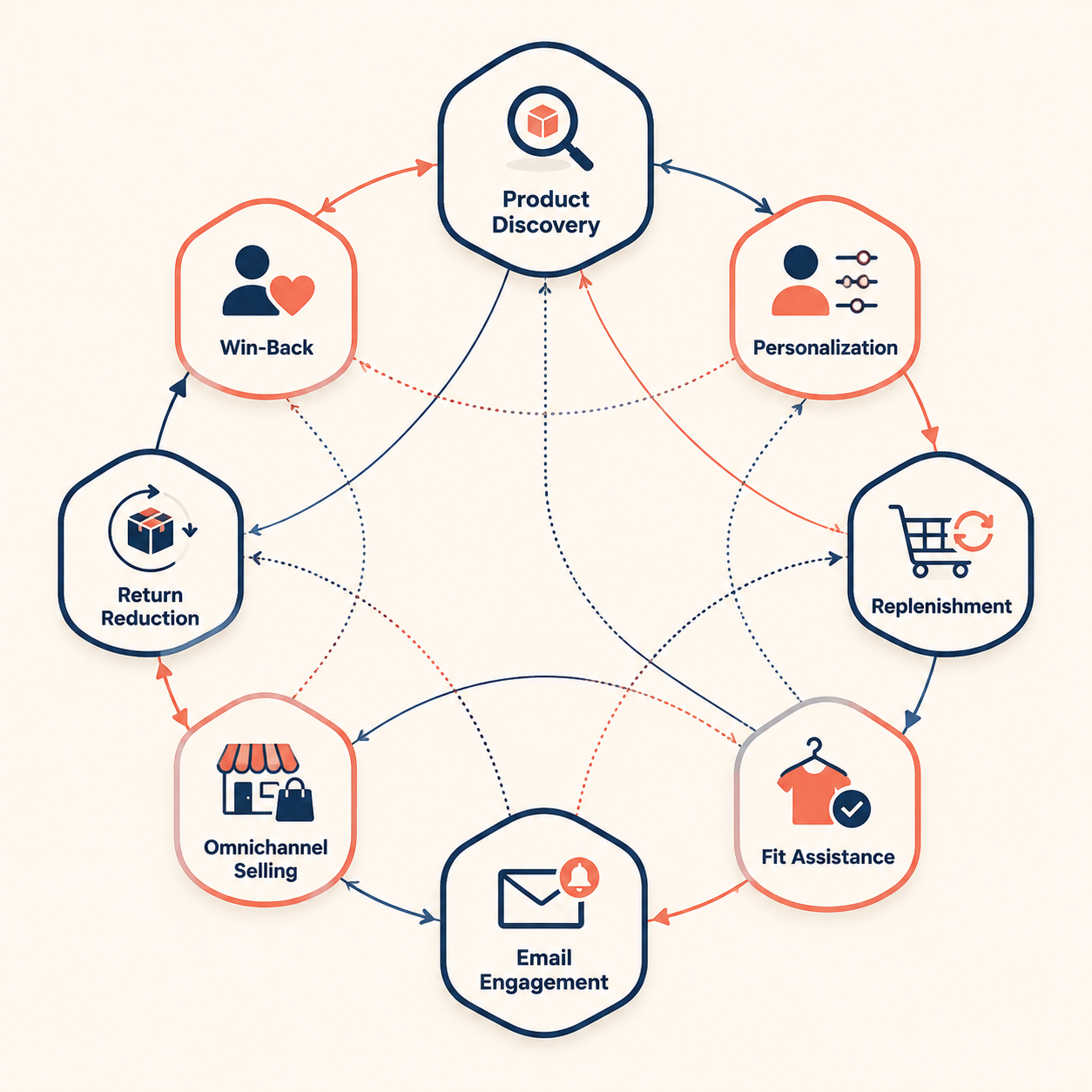
| Decision context | Better metric than raw clicks |
|---|---|
| Product discovery | Product detail views, add-to-cart rate, conversion rate, revenue per session |
| Replenishment | Repeat purchase rate, time between orders, retained customers |
| Fit assistance | Return rate, size exchange rate, customer service contacts |
| Win-back | Reactivated customers, repeat purchase, margin after discount |
| Email engagement | Click quality, downstream conversion, unsubscribe rate |
| Omnichannel selling | Cross-channel conversion, attach rate, inventory-aware fulfillment |
Customer Response Also Varies by Audience
Audience composition affects how much lift a recommendation system can plausibly deliver. Stord’s 2026 generational data reported that Gen Z shoppers were 38% likely to convert from AI recommendations, compared with 7% for Boomers.[10] That does not mean every Gen Z shopper wants every AI-driven prompt, or that older shoppers reject personalization altogether. It does mean that customer mix can change the ceiling.
The implication for planning is straightforward: do not borrow another brand’s lift number without asking whether its audience behaves like yours. A beauty retailer with frequent, digitally comfortable shoppers and rich preference data is operating in a different environment from a retailer with infrequent purchases, thin customer profiles, and a high share of anonymous traffic.
What a Typical Ecommerce Store Can Realistically Expect
The pattern across these examples is not that better AI automatically creates bigger numbers. Amazon and Netflix sit at the high end because recommendations are deeply embedded into the product experience and supported by unusually rich behavioral data.[1][2] Total Tools, Petco, Sephora, AO, and similar vendor-published cases are more useful for seeing how contained personalization projects can affect revenue, purchases, win-back, or engagement, while still requiring caution about source provenance.[3][4][7][9]
A store with frequent repeat purchases, known customers, a broad catalog, and multiple recommendation surfaces has a stronger case for expecting recommendations to influence a meaningful share of revenue. That is especially true when the system can operate across email, onsite merchandising, search, loyalty, and post-purchase flows.
A store with lighter infrastructure should usually start with a narrower target: better product discovery on high-traffic pages, replenishment prompts, personalized email blocks, fit assistance, or win-back campaigns. These use cases are easier to isolate and easier to explain to leadership because the metric can be tied to a recognizable customer decision.
- Use Amazon as a benchmark for strategic ambition, not as a forecast.
- Use Netflix to understand catalog navigation, not ecommerce revenue attribution.
- Use vendor case studies for implementation clues, while labeling them as vendor-reported.
- Use return reduction, repeat purchase, and win-back metrics when those are the decisions the recommendation actually changes.
- Treat customer data depth, product data quality, and channel integration as part of the engine, not as background plumbing.
The gap between a 12% revenue uplift, a 32% return reduction, and a 35% revenue attribution is not mainly a contest of algorithm names.[1][3][8] It is the difference between what the system knows, where it is allowed to act, and whether the recommendation arrives at a moment when the customer is still deciding.
References
- Amazon revenue attribution to recommendations, Firney citing McKinsey
- Netflix algorithmic recommendation viewing-hours figure, 2012-era sources
- Total Tools personalized recommendations case study, Emarsys/SAP
- Petco personalized customer engagement case study, Emarsys/SAP
- Consumer personalization frustration statistic, McKinsey
- Recommendation click-through and revenue contribution statistic, Salesforce
- Sephora personalized recommendations case study, Emarsys
- & Other Stories AI fit recommendations return-reduction case
- AO newsletter engagement personalization case study
- 2026 generational conversion likelihood from AI recommendations, Stord

Comments
Join the discussion with an anonymous comment.