
AI Email Marketing Tools
Email marketers face a flood of vendor claims about AI. This article separates the four AI capabilities with consistent, measurable results from those that remain aspirational, drawing on 2026 data and real benchmarks to help you focus your budget and strategy.
Marketing Categories
⚠ Notable Limitations
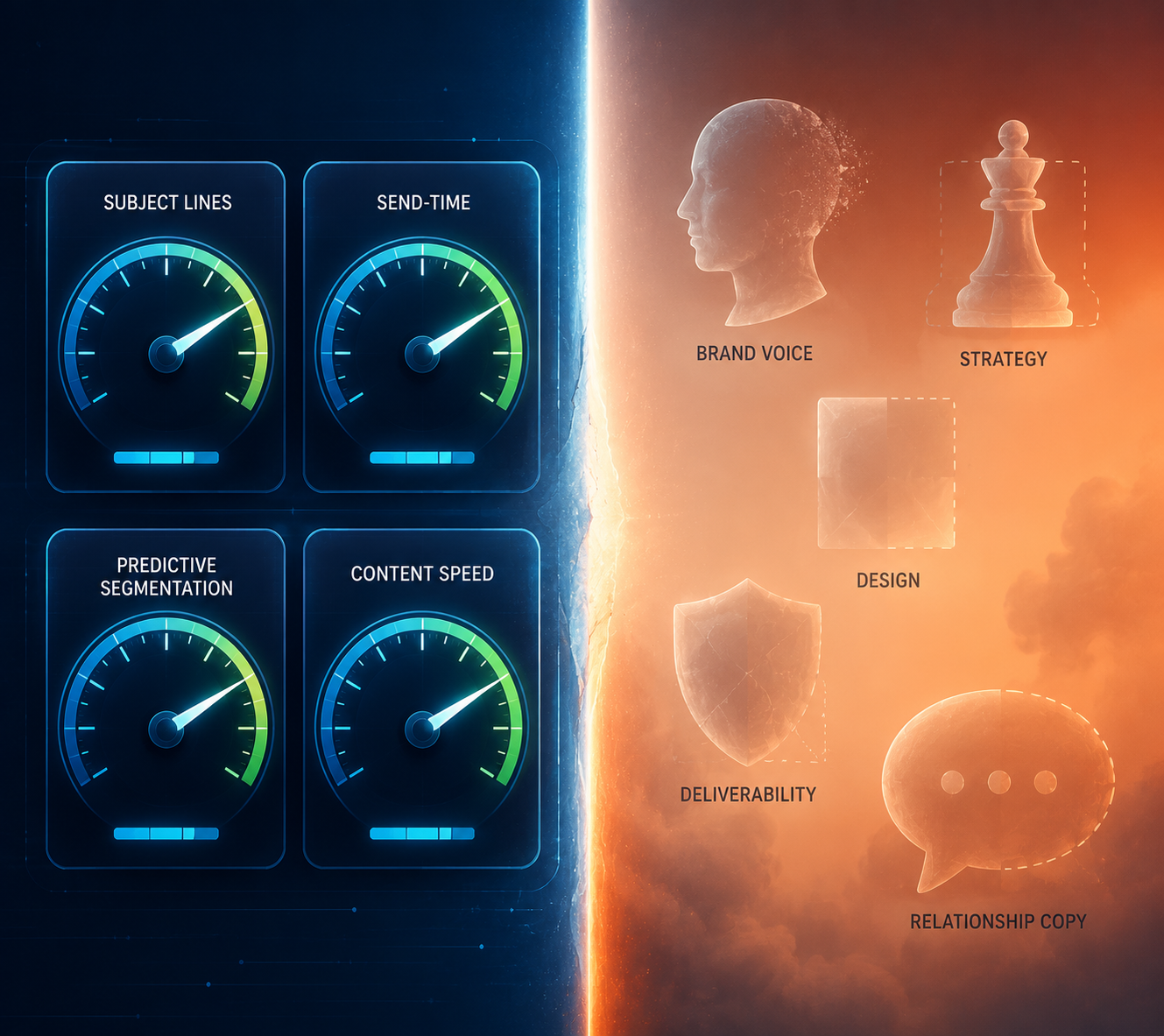
AI underperforms for brand voice consistency, creative strategy, email design, deliverability management, and relationship-driven copy
The useful question in 2026 is not whether AI tools for email marketing can generate copy. They can. The harder question is which AI capabilities improve an actual send without handing the lifecycle team a new pile of brand edits, measurement disputes, deliverability concerns, and post-pilot explanations.
The cleanest verdict is uneven. AI is proving itself in bounded email decisions where the system has feedback data: subject line optimization, send-time optimization, predictive segmentation, and campaign production speed. It is much less reliable when vendors imply that the same layer can own brand voice, creative strategy, email design, deliverability management, or relationship-driven copy.
| Capability | 2026 Verdict | What To Measure |
|---|---|---|
| Subject line optimization | Works as a narrow testing and prediction layer | Open rate with Apple MPP context, clicks, downstream conversions |
| Send-time optimization | Works with caveats | Clicks, conversions, purchase timing, not opens alone |
| Predictive segmentation | One of the strongest revenue cases | Revenue per send, conversion rate, churn or purchase propensity |
| Content generation speed | Works as a production accelerator | Campaign creation time, review burden, error rate, throughput |
| Brand voice consistency | Still needs human ownership | Revision rate, legal or brand escalations, customer reaction |
| Creative strategy | Overstated when treated as autonomous | Brief quality, offer selection, test design, business judgment |
| Email design | Useful for variants and support, weak as final authority | Rendering quality, accessibility, hierarchy, template governance |
| Deliverability management | Not a substitute for fundamentals | Inbox placement, complaint rate, list quality, authentication |
| Relationship-driven copy | High-risk when scaled without review | Unsubscribes, replies, complaint sentiment, account context |
What Counts As Evidence
Email AI claims get slippery because the same words are used for very different things. “Optimization” might mean a model selecting among tested subject line options. It might also mean a chatbot drafting three versions of a campaign. Those are not the same capability, and they should not be budgeted or judged the same way.
A serious evaluation separates four layers: the task being automated, the signal the model learns from, the metric being reported, and the part of the workflow where humans still make the call. That matters most when a vendor cites a revenue lift from a full AI workflow and presents it beside a single feature such as subject line generation.
It also matters because email measurement is not as clean as it used to be. Apple Mail Privacy Protection changed the reliability of open-rate signals, which means open-heavy claims need more context than they did before. Mailjet’s 2026 email analysis describes strong email ROI and rising AI adoption, but also calls out a measurement problem that marketers have not fully solved.[1]
So the standard here is deliberately narrow: a capability looks proven when it improves a specific decision, can be measured against a control or benchmark, and does not require the reader to pretend that a production metric is automatically a revenue metric.
Subject Line Optimization Is The Clearest Single-Feature Win
Subject line optimization is the easiest place to defend AI spend because the decision is narrow, the variants are cheap, and the feedback loop is familiar. The model is not being asked to understand the entire customer relationship. It is being asked to predict which short line is more likely to earn attention from a defined audience.
That is why subject lines show up so often in the stronger benchmark set. Digital Applied reports a 26% improvement for AI-generated subject lines over human-written subject lines in its 2026 email marketing statistics roundup.[2] Hustler Marketing describes subject line optimization as one of the highest-ROI AI applications in email and places observed open-rate improvement in a 10% to 26% range.[3]
Those numbers should not be blended into a generic “AI improves opens by 26%” claim. Forbes Advisor cites a separate personalization-related finding: personalized emails have 26% higher open rates than non-personalized emails.[4] That supports personalization as an email principle, but it does not prove that an AI subject line generator caused a 26% lift. Different comparison, different mechanism, different budget implication.
The practical value of AI subject line tools is that they can increase the number of plausible variants, score them against past engagement patterns, and help teams test faster. The risk is that teams stop reading the line like a customer. A model can favor urgency, novelty, or emotional pressure because those patterns have performed before. A brand still has to decide when a subject line earns attention and when it borrows trust.
The reporting view should include more than opens. Opens can still be useful directionally inside a consistent measurement environment, but Apple MPP means they are no longer a clean universal proxy for human attention. A subject line test that wins opens and loses clicks, conversions, replies, or complaint rate did not really win.
Send-Time Optimization Works Only If The Signal Changed
Send-time optimization is a real AI use case, but it is also one of the easiest to overstate. The idea is sensible: instead of blasting every subscriber at the same hour, the platform predicts when each person is most likely to engage. Hustler Marketing places the lift from AI send-time optimization in the 5% to 15% range.[3]
The caveat is not cosmetic. If a platform is still leaning heavily on opens as the primary timing signal, Apple MPP has weakened the foundation. Litmus explicitly warns marketers to evaluate AI email tools around measurement quality and the signals behind the recommendation, rather than accepting the AI label at face value.[5]
The better evaluation question is simple: what does the model optimize for now? If the answer is clicks, conversions, purchase timing, reply behavior, or other first-party engagement signals, the capability is more defensible. If the answer is still mostly opens, the lift may reflect a measurement artifact as much as a customer behavior pattern.
Send-time AI is most useful when it removes a low-value manual decision. No strategist should be spending serious time debating whether a large audience should receive a message at 9 a.m. or 11 a.m. if the platform has enough behavior data to personalize timing. But the team still owns cadence, suppression, frequency, and the choice of whether the message should be sent at all.
Predictive Segmentation Is Where AI Starts To Look Like Revenue Infrastructure
Predictive segmentation deserves more attention than it usually gets because it explains why AI works best in email. The strongest systems are not merely writing more messages. They are deciding which customers are likely to buy, lapse, upgrade, churn, or ignore the next send.
Hustler Marketing reports that predictive segmentation can produce 2x to 3x revenue per send compared with behavioral-only segmentation.[3] That is a more meaningful claim than a generic engagement lift because revenue per send forces the analysis closer to business outcome: how much value came from this audience decision, not just how many people opened the email.
The mechanism is also more durable. Behavioral segmentation usually says, “This person did X.” Predictive segmentation asks, “Given what similar customers did after X, what is this person likely to do next?” That lets a team change more than copy. It can change audience inclusion, offer depth, product emphasis, discount exposure, replenishment timing, and suppression logic.
A hypothetical example makes the distinction clear. A behavioral rule might send the same winback offer to everyone who has not purchased recently. A predictive model might separate likely full-price returners from discount-dependent returners and from people who should not receive another sales email this week. The first approach automates a rule. The second changes the economic logic of the send.
This is also where AI can create governance problems if the team treats the model as a black box. Predictive segmentation should come with holdout groups, segment-level revenue reporting, and visibility into who is being excluded as well as included. A lift among recipients can hide a missed opportunity among suppressed customers if the test design is weak.
Content Generation Speed Is A Production Gain Before It Is A Revenue Gain
AI copy and content tools are valuable, but the cleanest evidence is operational. Digital Applied reports 72% time savings on campaign creation from AI use.[2] Litmus describes AI-assisted email production cycles collapsing from more than two weeks to days.[6]
That is meaningful. A lifecycle team that can draft variants, localize copy, assemble briefs, generate QA checklists, and prepare test ideas faster has more room to improve the program. Agencies can get more first drafts in front of strategists. In-house teams can stop burning senior hours on blank-page work.
But speed is not the same as performance. Faster production can increase revenue if it enables better segmentation, more timely campaigns, cleaner testing, or more complete lifecycle coverage. It can also increase review burden if the drafts arrive off-brand, repetitive, legally risky, or mismatched to the customer moment.
The metric to watch is not just “emails created.” It is cycle time after review, number of revision rounds, QA defects, time from brief to approved build, and incremental campaigns shipped without reducing quality. If AI saves the copywriter two hours and costs brand, legal, and CRM operations four hours, the dashboard is lying.
The 41% Revenue Benchmark Is A Workflow Claim, Not A Feature Claim
The most tempting number in the current AI email discussion is the 41% revenue increase associated with AI-driven email marketing. Digital Applied and Hustler Marketing both cite this Salesforce-sourced benchmark in the context of AI email performance.[2][3]
It is a useful benchmark, but it is easy to misuse. The number should be read as a full-workflow deployment claim: AI applied across segmentation, content, timing, personalization, and learning loops. It should not be attached to a single feature toggle in a proposal, especially not a subject line generator or copy assistant alone.
That distinction affects the budget conversation. A full-workflow AI program requires data access, integration work, testing discipline, audience governance, content review, and reporting alignment. The lift comes from improving several decisions together. A single-feature pilot may still be worthwhile, but it should be judged on the decision it actually changes.
| If The AI Feature Is... | Do Not Attribute... | Attribute Only... |
|---|---|---|
| Subject line scoring | Total email revenue lift | The tested change in opens, clicks, and conversions for that subject line test |
| Send-time optimization | Overall lifecycle performance | The incremental effect of timing changes against a timing control |
| Predictive segmentation | All gains from better creative or offer strategy | Revenue per send or conversion change caused by audience selection |
| Content generation | Revenue growth by default | Time saved, throughput gained, and performance changes from campaigns that shipped because of the speed gain |
| Full AI workflow | A single feature’s isolated impact | The combined effect of data, segmentation, content, timing, and learning loops |
This is where many AI pilots get into trouble. The team buys a platform because leadership heard a revenue benchmark, then the pilot measures only draft speed or subject line lift. Six weeks later, nobody is wrong exactly, but nobody is measuring the same promise.
Where AI Email Tools Still Overreach
The weaker areas have a common pattern: they require judgment that is hard to reduce to a single feedback signal. That does not mean AI has no role. It means the tool should assist the work, not own the decision.
Brand Voice Consistency
AI can imitate surface-level voice markers: sentence length, product vocabulary, tone labels, and common phrases. It is weaker at knowing when a brand should break its own pattern because the customer context has changed. A renewal notice, apology, loyalty offer, and product launch should not all sound like the same polished assistant.
This matters because consumer trust is a real constraint on AI-written email. The safest operating model is not to ban AI drafting; it is to keep human approval over sensitive moments, high-value segments, regulated claims, and messages that depend on relationship history.
Creative Strategy
Creative strategy is where vendor language often gets too ambitious. AI can suggest angles, summarize past performance, cluster themes, and generate testable hypotheses. It cannot be trusted to decide the business trade-off behind an offer, the customer promise behind a campaign, or the reason a brand should stay quiet.
The danger is not that AI produces a bad idea. Teams have always produced bad ideas. The danger is that AI produces a plausible idea quickly enough that nobody notices the brief is thin.
Email Design
AI can help generate layout concepts, resize assets, assemble modules, and speed up variant creation. It should not be treated as the final authority on hierarchy, accessibility, rendering behavior, or whether the design fits the campaign’s job.
Email design lives inside constraints that general-purpose creative tools often flatten: dark mode, mobile truncation, image blocking, accessibility, dynamic content, template governance, and QA across clients. A design that looks good in an AI-generated mockup can still create operational debt in the email build.
Deliverability Management
Deliverability is another area where AI can assist but should not be oversold. It can flag anomalies, summarize reputation signals, identify risky content patterns, or help prioritize investigation. It cannot replace authentication, consent discipline, list hygiene, complaint management, frequency control, and a sending strategy that respects recipient behavior.
The risk is rising because AI makes it easier to create more email. More volume is not automatically a problem, but more volume with weak segmentation, repetitive copy, or loose suppression is exactly the kind of efficiency that inbox providers and customers punish.
Relationship-Driven Copy
Some email copy carries more relationship weight than performance dashboards make obvious. Enterprise renewal notes, apology emails, high-value account outreach, donor communications, partner messages, and sensitive lifecycle triggers depend on context that may not be fully represented in the data available to the tool.
AI can prepare a draft or summarize account history. The accountable human still has to decide what should be said, what should be left unsaid, and whether the message sounds like it came from a team that understands the relationship.
How To Fund AI Tools For Email Marketing Without Buying The Hype
A good AI email budget should be built around capabilities, not the size of the vendor’s feature menu. The more bounded the decision and the cleaner the feedback loop, the stronger the case for automation. The more the task depends on judgment, trust, taste, relationship context, or inbox fundamentals, the stronger the case for human authority with AI support.
- Fund subject line AI when it is tied to controlled testing and downstream performance, not open-rate screenshots alone.
- Fund send-time optimization when the platform uses clicks, conversions, or first-party behavior signals rather than opens alone.
- Fund predictive segmentation when the model changes audience decisions and can report revenue per send against a holdout or control.
- Fund content generation when the team measures approved production speed, review load, QA defects, and incremental campaigns shipped.
- Keep brand voice, creative strategy, design approval, deliverability governance, and relationship-sensitive copy under human accountability.
The best AI tools for email marketing in 2026 behave less like autonomous marketers and more like instrument panels, testing assistants, and production accelerators. They improve decisions that were already measurable, and they make controlled work faster. That is enough to justify real investment. It is not enough to hand them the parts of email where customers, executives, and inbox providers notice when judgment fails.
References
- Email in 2026: Strong ROI, rising AI adoption, and a measurement problem nobody's fixing — Mailjet
- Email Marketing Statistics 2026: 200+ Essential Data — Digital Applied
- AI for Email Marketing in 2026: What Works & What Doesn't — Hustler Marketing
- 49 Top Email Marketing Statistics — Forbes Advisor
- Guide to Evaluating AI Tools for Email Marketing — Litmus
- How to Use AI in Email Marketing in 2026 — Litmus

Comments
Join the discussion with an anonymous comment.