

Perplexity SEO: A Technical Guide to Getting Your Site Cited
This guide walks through the specific robots.txt, schema markup, content structure, and performance configurations that influence Perplexity AI's source selection, giving SEO specialists a repeatable checklist for earning citations.
Perplexity SEO optimization starts with a hard gate: can Perplexity fetch, parse, and trust the page well enough to cite it? For an seo team, the useful version of the answer is inspectable. Allow PerplexityBot. Keep important pages renderable without JavaScript dependency. Add valid Article, FAQPage, or HowTo schema where the page genuinely supports it. Put the direct answer in the first 100 words. Structure H2 and H3 sections so each one can be lifted as a standalone passage. Keep the technical floor clean enough that page quality does not become the reason you were skipped.
This guide is current as of Q3 2026. Perplexity publishes crawler documentation, but it does not publish its ranking algorithm. Anything beyond official crawler behavior is therefore a working model built from third-party studies, observed citations, and reverse-engineering analyses. That is still enough to build a repeatable audit; it is not enough to promise citations on demand.
The citation-readiness checklist
Before touching copy or schema, run the audit in this order. The sequence matters because later improvements do not help if an earlier layer blocks discovery.
| Checkpoint | What to verify | Why it matters |
|---|---|---|
| Crawler access | PerplexityBot is allowed in robots.txt, WAF rules, CDN bot controls, and IP validation workflows. | A blocked crawler cannot retrieve the page for citation consideration. |
| Rendering | Primary content appears in server-rendered or otherwise crawlable HTML, not only after client-side JavaScript execution. | Extractors need stable text, headings, links, and markup. |
| Structured data | Article, FAQPage, and HowTo schema are valid only where they match visible content. | Schema can clarify authorship, page type, questions, steps, and topical scope. |
| Answer placement | The direct answer, definition, comparison, or procedure appears in the first 100 words. | Reverse-engineering analyses suggest early placement and standalone headings carry meaningful weight. |
| Passage structure | Each H2 or H3 section answers one identifiable sub-question without relying on the previous section. | Perplexity-style retrieval works at passage level, not only at whole-page level. |
| Technical quality | LCP is under 2.5 seconds, CLS is under 0.1, mobile rendering is stable, and semantic heading hierarchy is intact. | Performance and accessibility problems can reduce extraction quality and source usability. |
Start with PerplexityBot, not content polish
PerplexityBot is not GPTBot, ClaudeBot, Googlebot, or a generic AI crawler. Perplexity documents its own crawler user agent and publishes IP ranges at perplexity.com/perplexitybot.json, which gives technical teams a concrete allowlist target for robots.txt, WAFs, CDNs, and bot-management tools.[1]
That distinction is where many AI-search checklists get too soft. A site can have excellent explainers, clean schema, and real subject-matter expertise, then silently exclude the crawler through a copied AI-bot block, a managed firewall rule, or an IP validation policy that treats unfamiliar bots as hostile. The first task is not to make the page sound more authoritative. It is to confirm that PerplexityBot can request the URL and receive the same meaningful content a user would see.
User-agent: PerplexityBot
Allow: /

# Keep private or low-value paths blocked explicitly if needed.
User-agent: PerplexityBot
Disallow: /account/
Disallow: /cart/
Disallow: /checkout/
Disallow: /internal-search/
Do not paste that rule blindly over a production robots.txt file. Check whether a broader group already blocks AI crawlers, whether a later directive conflicts with the allow rule, and whether staging, faceted navigation, internal search, or account paths need to remain excluded. The goal is not to open the whole site. The goal is to make citation-worthy public URLs fetchable while keeping low-value and private surfaces closed.
Where crawler access usually fails
- Robots.txt blocks a broad AI-crawler group and PerplexityBot inherits the disallow rule.
- A CDN bot-control setting challenges or blocks PerplexityBot before it reaches the origin.
- The WAF allowlist includes Googlebot and Bingbot but not Perplexity’s documented crawler IP ranges.
- Important content requires logged-in cookies, location prompts, age gates, or heavy client-side rendering.
- Canonical tags point citation-worthy pages toward thinner variants, parameter URLs, or unrelated hub pages.
After changing crawler rules, verify with server logs rather than assuming the file is correct. Look for requests from the documented user agent, confirm status codes, inspect whether the response is 200 rather than 403 or 5xx, and compare the HTML returned to a normal browser request. If your security team validates bots by IP, use Perplexity’s published IP range file instead of hard-coding addresses into a rule that nobody revisits.[1]
Use the reranking model as a map, not a myth
A useful Perplexity SEO optimization guide needs a model for why these checks matter. One reverse-engineering analysis describes a three-layer system: initial retrieval using BM25 and embeddings, cross-encoder reranking, and an ML reranker that incorporates entity and authority signals.[2] That model is not official Perplexity documentation, but it explains why traditional SEO habits only cover part of the job.
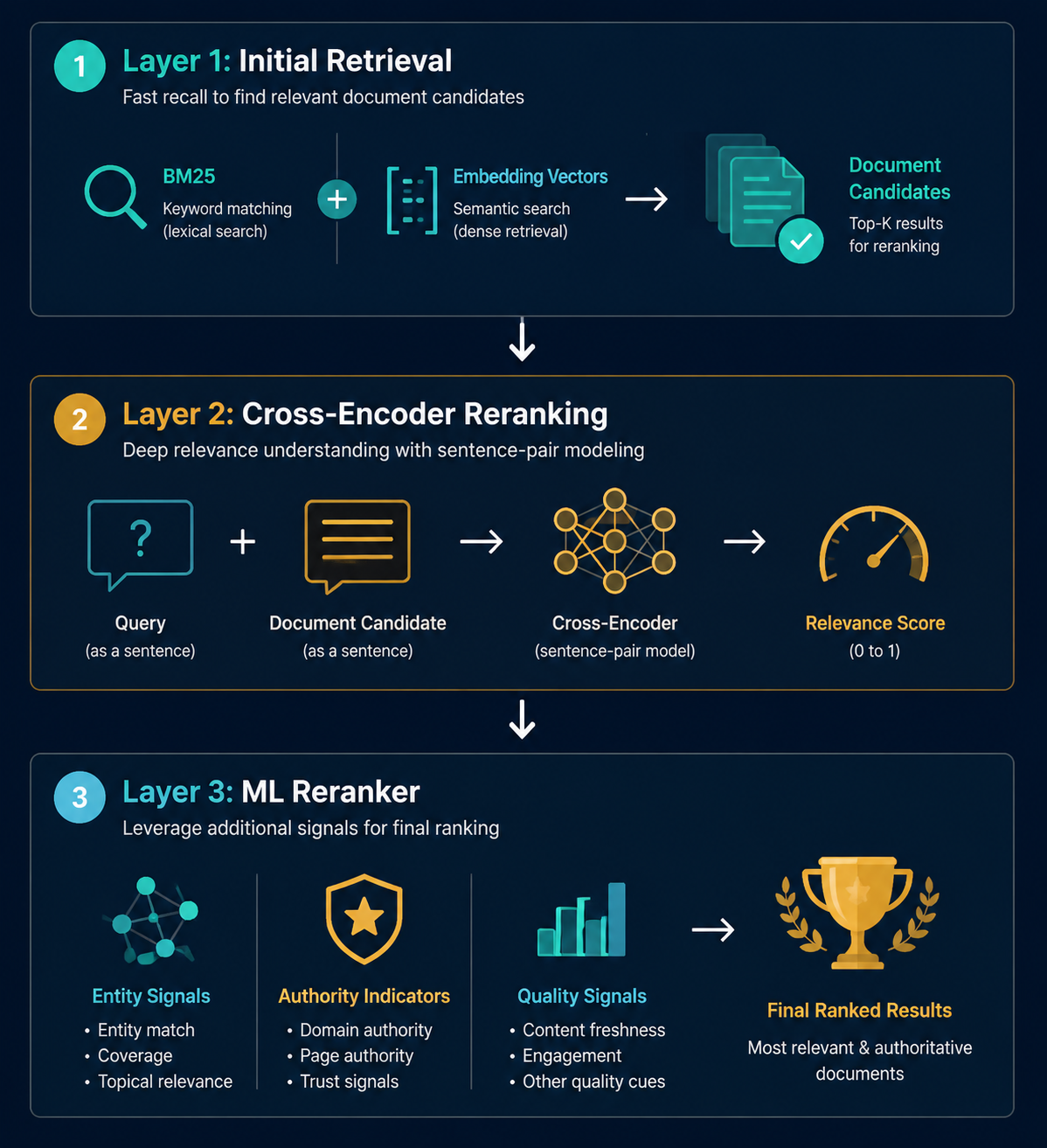
Initial retrieval rewards lexical and semantic match. That is where clear titles, headings, entities, and topical coverage still matter. Cross-encoder reranking raises the bar from keyword match to contextual usefulness: the passage has to answer the query, not merely contain similar terms. The ML and entity layer is where source reputation, author signals, freshness, and broader authority can affect which eligible source becomes citable.
The practical implication is uncomfortable but helpful: citation optimization is not one task. Crawl access gets the URL into play. Structured data helps machines understand what the page is. Passage architecture helps the answer survive extraction. Authority and entity signals influence whether the page beats other eligible sources. A smaller site can improve several of those layers this week, even if it cannot manufacture inherited domain strength.
Make the page extractable before making it clever
Perplexity-style citation behavior is closer to passage selection than whole-page appreciation. OpenHelm’s guide describes Perplexity as extracting content as passages rather than evaluating pages only as complete documents.[4] That should change how an SEO lead reviews templates. The question is not just whether the article is comprehensive. It is whether a single section can be lifted cleanly and still make sense next to a cited answer.
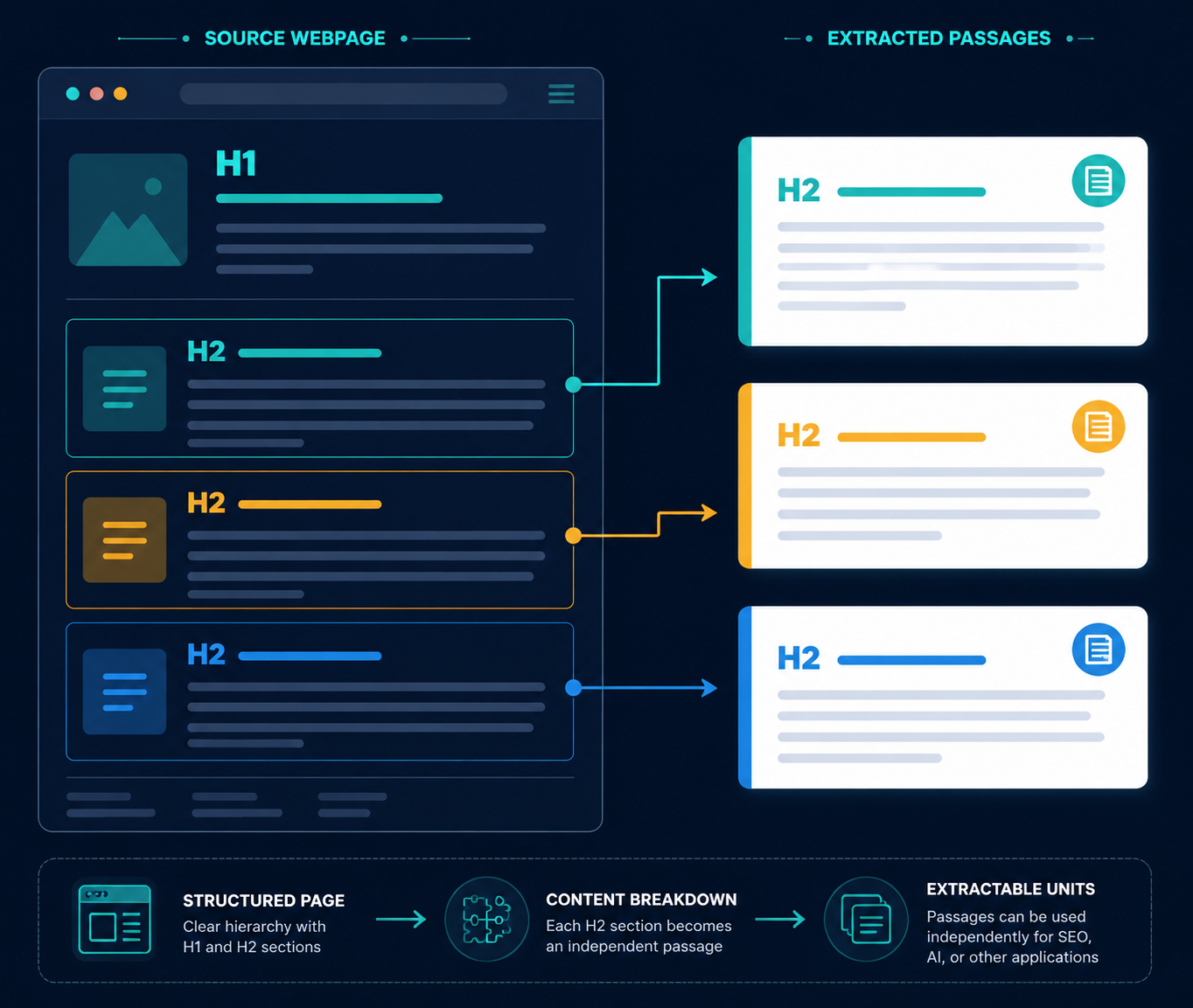
The first 100 words deserve special attention. Stackmatix’s reverse-engineering analysis assigns meaningful weight to key information placement and descriptive standalone headings, estimating that these elements account for about 20% of ranking weight.[2] Treat that estimate as directional rather than canonical. Even with that caveat, the operational advice is sound: do not bury the answer below a brand story, a market overview, or a paragraph that exists only to warm up the reader.
A citation-ready opening
For a page targeting “best CRM for small law firms,” the opening should identify the recommendation criteria immediately: practice-management integrations, intake workflows, conflict checks, trust-account considerations, reporting, and pricing fit. A vague opening about how law firms need better client relationships delays the extractable answer. It may read like acceptable blog copy, but it does less work for retrieval and passage selection.
The same principle applies to technical and commercial pages. If the page answers “how to migrate from Universal Analytics data exports to GA4 reporting,” the opening should state the migration path and the main constraint. If it compares vendors, the opening should name the comparison basis. If it explains a regulation, the opening should state who is affected and what action changes. The first paragraph is not a throat-clearing area; it is a candidate passage.
Headings should survive outside the page
A heading like “What this means” is fine for human continuity and poor for machine extraction. “What PerplexityBot needs in robots.txt” is better because the section carries its own context. The content under that heading should answer the implied question directly before adding nuance. If a section needs three previous paragraphs to be understood, it is probably not a strong citation candidate.
| Weak section pattern | Citation-ready section pattern |
|---|---|
| Why it matters | Why PerplexityBot access affects citation eligibility |
| Best practices | How to structure FAQPage schema for Perplexity extraction |
| Things to avoid | Robots.txt rules that accidentally block AI crawlers |
| Final thoughts | How often to recheck Perplexity crawler access and schema validity |
This does not mean every heading has to be a keyword-stuffed question. It means each section needs a visible job. Perplexity cannot cite the helpfulness you intended; it can only work with the text, structure, and source signals available to it.
Add schema where it clarifies the page, not where it decorates it
Schema is one of the few Perplexity-related recommendations with a measurable study behind it, but the number needs careful handling. Analyze AI reported that pages using FAQPage, HowTo, or Article-with-author schema had a 47% Top-3 citation rate versus 28% for pages without schema, based on an 83,670-citation multi-engine study over 54 days.[3] That is a strong enough signal to justify implementation. It is not proof that adding JSON-LD to a weak page creates citations.
The cleanest use is to match schema type to the actual page format. Use Article schema for editorial pages with a clear headline, author, date, publisher, and main entity. Use FAQPage only when the page visibly contains question-and-answer content. Use HowTo only when the page gives a real sequence of steps. Misaligned schema may pass a syntax check and still add no useful confidence.
Article schema for authorship and source clarity
{
  "@context": "https://schema.org",
  "@type": "Article",
  "headline": "Perplexity SEO: A Technical Guide to Getting Your Site Cited",
  "author": {
    "@type": "Person",
    "name": "Author Name"
  },
  "publisher": {
    "@type": "Organization",
    "name": "Publisher Name",
    "logo": {
      "@type": "ImageObject",
      "url": "https://example.com/logo.png"
    }
  },
  "datePublished": "2026-07-05",
  "dateModified": "2026-07-05",
  "mainEntityOfPage": {
    "@type": "WebPage",
    "@id": "https://example.com/perplexity-seo-guide"
  }
}
The author field matters most when the author is also supported on the visible page: byline, bio, credentials, editorial policy, and links to relevant profiles. A JSON-LD object cannot compensate for an anonymous page in a sensitive topic. It can, however, remove ambiguity from a page that already shows responsible authorship.
FAQPage schema for concise answer blocks
FAQPage schema is useful when the page contains natural question blocks that answer discrete sub-intents. The visible answer should be short enough to extract and specific enough to stand alone. A page that hides all important nuance in accordion content, injects answers through JavaScript, or marks up promotional copy as FAQs is less useful than one with direct, visible Q&A sections.
{
  "@context": "https://schema.org",
  "@type": "FAQPage",
  "mainEntity": [
    {
      "@type": "Question",
      "name": "Should PerplexityBot be allowed in robots.txt?",
      "acceptedAnswer": {
        "@type": "Answer",
        "text": "Yes, public pages that you want considered for Perplexity citations should allow PerplexityBot, while private, account, checkout, and low-value internal paths can remain blocked."
      }
    }
  ]
}
HowTo schema for real procedures
HowTo schema fits pages that explain a sequence: configure a crawler rule, validate schema, migrate a setting, compare an audit result. It should not be used just because the article has advice. A useful HowTo block names the task, lists steps in order, and mirrors visible page content.
{
  "@context": "https://schema.org",
  "@type": "HowTo",
  "name": "How to verify PerplexityBot access",
  "step": [
    {
      "@type": "HowToStep",
      "name": "Check robots.txt",
      "text": "Confirm that PerplexityBot is not blocked from public citation-worthy URLs."
    },
    {
      "@type": "HowToStep",
      "name": "Review WAF and CDN rules",
      "text": "Allow PerplexityBot using the documented user agent and published IP range file."
    },
    {
      "@type": "HowToStep",
      "name": "Confirm successful fetches in logs",
      "text": "Look for 200 responses and crawlable HTML on target URLs."
    }
  ]
}
Validate schema after deployment, then check rendered HTML rather than the CMS preview. Template-level schema bugs are common: missing author objects, stale dateModified values, duplicate FAQ entities, empty image fields, and markup applied to pages that do not contain the corresponding visible content. Those are not Perplexity-specific problems, but Perplexity citation work exposes them quickly.
Keep rendering and Core Web Vitals above the floor
Technical performance is not the most glamorous part of AI-search optimization, but it is easy to inspect and hard to excuse. OpenHelm and First Page Sage both point to a technical baseline that includes LCP under 2.5 seconds, CLS under 0.1, mobile rendering without JavaScript dependency, and semantic HTML heading hierarchy.[4][5]
The JavaScript dependency point deserves more attention than it usually gets. If the body copy, FAQ answers, product specs, author details, or table data appear only after a client-side request, you have created one more failure mode for extraction. Server-rendered HTML, static rendering, or reliable hydration is not just a performance preference. It is part of making the answer available to systems that may not behave like a full user browser session.
- View source and rendered HTML for target URLs; confirm the main answer, headings, author, dates, and schema are present.
- Test mobile templates separately from desktop templates; many extraction problems are template-specific.
- Check whether cookie banners, interstitials, geo prompts, or personalization blocks obscure the primary content.
- Keep one H1, then use H2 and H3 elements for real section structure rather than styling divs to look like headings.
- Audit canonical, hreflang, pagination, and noindex tags on pages you expect Perplexity to cite.
Core Web Vitals should be treated as a floor, not a moat. Passing LCP and CLS thresholds will not make a thin page citation-worthy. Failing them can make a good page harder to retrieve, render, or trust consistently.
Freshness and authority still constrain the outcome
The technical checklist is partially independent of domain authority, not immune to it. The retrieval layer still has to choose among sources, and known domains often have more links, entity recognition, citations, and historical trust. Nick Lafferty’s synthesis and Stackmatix’s analysis both describe ranking-weight estimates such as relevance, placement, freshness, and cross-platform signals, but those estimates are directional rather than official Perplexity weights.[2][6]
That caveat should not paralyze smaller publishers. It should sharpen the work. A newer site cannot instantly become the default source for every broad query, but it can become the clearest source for a narrow, well-maintained answer: a specific integration issue, a current pricing comparison, a local regulation, a workflow, a dataset explanation, or a technical procedure that larger sites cover lazily.
Freshness is especially practical. If a page makes claims about tools, interfaces, laws, prices, or platform behavior, the visible modified date should reflect real review. Update the passage that changed, not just the timestamp. Perplexity users often ask current, task-oriented questions; a page with stale screenshots, deprecated product names, or pre-2026 assumptions creates avoidable doubt.
A repeatable Perplexity SEO audit
Run this audit on a small set of pages first: one high-intent guide, one comparison page, one how-to page, and one page that already earns organic traffic. The point is to find template-level problems before turning the work into a content program.
- Check robots.txt for PerplexityBot-specific access and conflicting AI-crawler blocks.
- Review WAF, CDN, and bot-management rules against Perplexity’s documented user agent and IP range file.
- Confirm successful 200 responses for target URLs in server logs.
- Fetch the page as HTML and verify that the main content, author, dates, links, and headings are present without relying on a user interaction.
- Validate Article, FAQPage, or HowTo schema only where the visible page supports that schema type.
- Rewrite the first 100 words so the direct answer appears before context, brand positioning, or narrative setup.
- Review every H2 and H3 as a standalone passage; rename vague headings and split sections that answer multiple unrelated questions.
- Check LCP, CLS, mobile rendering, canonical tags, noindex rules, and semantic heading hierarchy.
- Update time-sensitive passages and make the review date visible when freshness affects the answer.
- Monitor Perplexity citations manually for priority queries and record which pages, passages, and competitors appear.
Manual monitoring is still necessary because Perplexity does not provide the same mature reporting surface that search teams expect from Google Search Console. Track a stable query set, save the cited sources, note whether your page appears, and record which passage Perplexity seems to use. The output will be imperfect, but it is better than treating AI citations as a mood.
What to fix first
If the audit produces a long list, prioritize by gatekeeping effect. Crawler blocks come first. Rendering and indexability come next. Then schema and passage structure. Then freshness, author clarity, and performance cleanup. A beautifully rewritten answer on a blocked URL is wasted effort; a crawlable page with vague headings is at least eligible for improvement.
| Finding | Priority | First fix |
|---|---|---|
| PerplexityBot receives 403, challenge, or disallow | Critical | Update robots.txt, WAF, CDN, and IP validation rules. |
| Main content only appears after JavaScript execution | High | Server-render or statically expose the primary answer and schema. |
| No valid Article, FAQPage, or HowTo schema on eligible pages | High | Add schema that matches visible content and validate it after deployment. |
| Opening paragraph delays the answer | High | Move the direct answer, criteria, or procedure into the first 100 words. |
| H2 and H3 sections depend on previous context | Medium | Rename headings and rewrite sections as independently extractable passages. |
| LCP or CLS fails the technical floor | Medium | Reduce layout shifts, optimize hero media, and remove render-blocking template bloat. |
Perplexity citation optimization is not a new label for vague authority-building, and it is not a shortcut around reputation. It is a readiness layer: crawler access, extractable HTML, valid schema, direct answer placement, passage-level structure, and technical health. Those controls are measurable enough to audit and improve, including on sites that do not already dominate their category.
Keep the maintenance posture simple. Recheck PerplexityBot access when security rules change. Validate schema after template releases. Refresh passages where the facts age quickly. Monitor citations for priority queries. Revisit the setup when Perplexity updates its crawler documentation or when better evidence changes the weighting assumptions.
References
- Perplexity crawlers, Perplexity
- Perplexity AI Optimization Strategy, Stackmatix
- How to Rank on Perplexity, Analyze AI
- Perplexity SEO Optimization Guide, OpenHelm
- Perplexity AI Optimization: Ranking Factors and Strategy, First Page Sage
- How to Rank Higher in Perplexity, Nick Lafferty

Comments
Join the discussion with an anonymous comment.