

An Evidence-Annotated GEO Checklist: Prioritize Tactics by Impact
A GEO checklist where every tactic is paired with the specific study, benchmark, or dataset that supports it — so SEO specialists can prioritize by impact size, not sequence, and justify each move to stakeholders with sourced evidence.
A generative engine optimization checklist is useful only if it helps a team decide what to do first. A flat list of 60 plausible tactics does not solve the sprint problem; it just moves the anxiety from a slide deck into a backlog. The better version annotates each item with the evidence behind it: measured lift where available, benchmark source, implementation dependency, and confidence level.
The matrix below is not a sequence. It is a sorting tool. If a page is JavaScript-dependent and its core answer is buried halfway down the article, do not spend the next two weeks debating whether to add three new schema types. Fix extraction first.
The Evidence-Annotated GEO Checklist
| Priority | Action | Evidence signal | Evidence strength | Do it when |
|---|---|---|---|---|
| High | Make the answer clear, concise, and easy to summarize | Onely reports Aggarwal et al.'s KDD 2024 study of 10,000 queries as finding that clarity and summarizability correlate with +32.83% AI citation likelihood. Verify against the original paper before treating the exact percentage as final. [1] | Promising, but exact effect size is secondhand in the available brief | The page targets a question, comparison, definition, process, or decision where an AI system could quote a compact answer |
| High | Front-load the direct answer in the first 30% of the page | Onely cites a CXL study associating answers placed in the first 30% of page content with an approximately 55% AI Overview citation rate. The original CXL source should be checked before publication. [1] | Promising, needs original-source verification | The page currently opens with brand positioning, history, or a long setup before answering the query |
| High | Expose core body content in crawlable raw HTML | Appfire/Onely reports that 88% of text fragments in AI Overviews come from raw HTML body content rather than JavaScript-dependent content. [1] | Strong practical benchmark | The rendered experience looks good, but source HTML is thin, delayed, gated, or dependent on client-side rendering |
| High | Protect organic ranking fundamentals | Search Engine Land reports Botify's benchmark that 75% of domains cited in AI Overviews also appeared in the top 12 organic results. [2] | Strong directional benchmark | A proposed GEO task competes with technical SEO, internal linking, crawlability, or ranking work |
| High | Add visible E-E-A-T signals where they help verification | Onely reports Aggarwal et al. as finding that E-E-A-T-style signals correlate with +30.64% AI citation likelihood. [1] | Promising, but exact effect size is secondhand | The content makes claims that need author expertise, sourcing, editorial review, or organizational credibility |
| Medium-high | Reduce promotional tone in informational content | Onely reports Aggarwal et al. as finding that promotional tone suppresses AI citation likelihood by -26.19%. [1] | Promising, but exact effect size is secondhand | The page is meant to answer a category, problem, or comparison query but reads like sales copy |
| Medium-high | Repair existing structured data before adding new schema types | Onely's 2026 audit of 5,000 sites found that 71% deploy schema, but only 22% pass Google's Rich Results Test cleanly. [1] | Strong implementation benchmark | Schema exists but contains validation errors, mismatched visible content, missing required properties, or inconsistent entity data |
| Medium | Build or improve presence on major citation surfaces | Onely reports that Wikipedia accounts for about 11.22% of AI Overview citations, and Wikipedia, YouTube, Reddit, and Amazon together account for 38%. [1] | Useful citation-distribution benchmark | The brand or topic has legitimate reasons to appear on third-party surfaces and the team can support them without astroturfing |
| Medium | Use official crawlability and content-access guidance as a guardrail | Google's AI optimization guidance emphasizes making content accessible to Google Search and managing preview controls through standard search mechanisms. [3] | Official platform guidance | A team proposes blocking, cloaking, hiding, or radically changing content for AI search without understanding search-system consequences |
| Low-contextual | Track AI referral traffic by platform, but do not forecast from one case | Moz describes Exposure Ninja's single-client finding that ChatGPT generated 52% of that client's AI referral traffic. [4] | Illustrative single-client evidence | Leadership asks whether ChatGPT, Gemini, Perplexity, or AI Overviews deserve separate reporting |
The quickest way to misuse this checklist is to treat every row as equal. The clarity, front-loading, crawlable-content, organic-overlap, and schema-repair rows deserve more immediate attention because they change whether an AI system can identify the answer, retrieve it, trust it, and cite it. The platform-distribution and referral rows are still useful, but they are better suited to reporting, monitoring, and channel planning than to page-level remediation.
Start With the Answer Zone, Not the Intro
Traditional SEO advice often says to satisfy search intent. GEO work needs a sharper version of that instruction: make the answer easy to extract without forcing the system to infer it from surrounding prose. That means the page should contain a compact, self-contained answer near the top, followed by enough explanation, caveats, examples, and sourcing to make the answer worth citing.
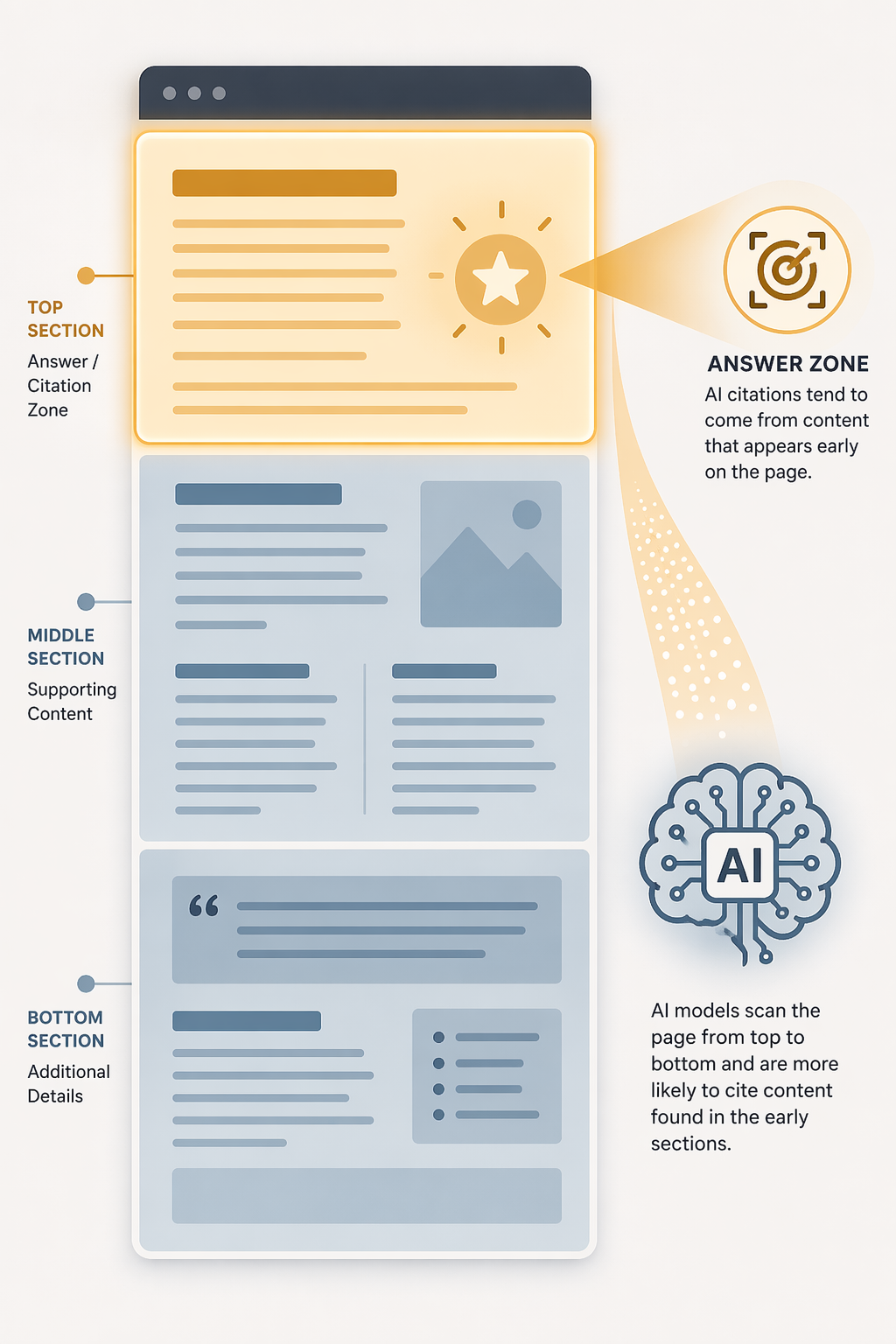
The front-loading benchmark is useful because it turns a familiar editorial instinct into a prioritization argument. If the answer appears in the first 30% of the page and that placement is associated with an approximately 55% AI Overview citation rate, then moving the answer is not cosmetic housekeeping. It is a candidate for the first sprint, especially on pages that already rank or receive meaningful impressions. The number should still be checked against the original CXL source before being presented as verified fact; in the available evidence stack, it is reported through Onely. [1]
A workable answer zone usually has three parts. First, it gives the direct answer in plain language. Second, it names the condition or audience the answer applies to. Third, it gives the reader enough structure to understand where the rest of the page is going. That is different from placing a generic summary box at the top of every article. A summary box that says little more than "this guide explains X" does not create a citable answer.
For example, a page targeting "what is generative engine optimization" should not open with three paragraphs about how search is changing. It should define GEO, explain how it differs from ordinary SEO, and state what kind of optimization work it includes. The trend context can follow. The machine does not need suspense; the reader probably does not either.
What to Change on a Page
- Move the direct answer above background, brand framing, and long narrative setup.
- Use headings that identify the question being answered rather than only teasing a theme.
- Write one or two extractable paragraphs that can stand alone without losing essential context.
- Keep caveats close to the claim they qualify, especially for comparisons, benchmarks, and recommendations.
- Avoid hiding the operational answer behind a downloadable asset, tab, accordion, or script-rendered component unless the content is also available in crawlable HTML.
Clarity and Summarizability Are Citation Work
The strongest content-side signal in the brief is the reported Aggarwal et al. finding: clarity and summarizability correlate with a +32.83% lift in AI citation likelihood across a 10,000-query KDD 2024 study, as reported by Onely. That is exactly the kind of number teams want, and exactly the kind of number that should be labeled carefully until the original proceedings are checked. [1]
Even with that caveat, the direction is useful. AI-generated answers need source material that can be compressed without distorting it. A paragraph that depends on tone, implication, or a long build-up is harder to cite cleanly than a paragraph that states the claim, the scope, and the reason in a few lines.
This is where GEO overlaps with good editing, but the acceptance criteria are different. "Better writing" is too vague for a work queue. A stronger ticket says: rewrite the opening answer so it can be quoted independently; split mixed-intent sections into separate answer blocks; replace soft claims with sourced, qualified statements; remove adjectives that do not change the decision.
| Weak GEO Ticket | Defensible GEO Ticket |
|---|---|
| Improve the intro | Move the direct answer into the first section and state the applicable audience, limitation, and next decision |
| Make the page more authoritative | Add author credentials, editorial review notes, primary sources, and date-sensitive update information where the page makes factual claims |
| Optimize for AI Overviews | Rewrite the top answer block to be independently quotable and verify that the same text appears in raw HTML |
| Add more schema | Run the current structured data through Rich Results Test and fix validation errors before expanding markup |
The point is not to flatten every page into a sterile encyclopedia entry. Product pages, category pages, and thought-leadership articles still have jobs to do. But when the target query expects an answer, the page needs a section that behaves like a source, not a pitch.
E-E-A-T Signals Need to Be Visible, Specific, and Close to the Claim
The reported E-E-A-T signal lift, +30.64% in Onely's summary of Aggarwal et al., is large enough to earn a place near the top of the checklist. It should not be translated into vague reputation advice. A model cannot cite a brand's general aura of credibility; it can process names, credentials, sources, dates, review processes, and corroborating references that appear on or around the content. [1]
For content strategists, the practical question is where verification friction appears. If a medical, legal, financial, or technical page makes a recommendation, who reviewed it? If a benchmark is used, where did it come from? If a page compares tools, what criteria were applied? If a claim depends on current platform behavior, when was it last checked?
That is also where internal editorial systems matter. A page can say "reviewed by experts" and still be weak if the expert is unnamed, the review date is missing, or the sources are generic. For a broader workflow around quality control and edited AI-assisted content, the AI content quality threshold is a useful companion to the page-level GEO checklist.
Promotional Tone Is Not Just a Brand Problem
Onely reports Aggarwal et al. as finding that promotional tone suppresses AI citation likelihood by -26.19%. Again, the exact figure needs original-source verification, but the operational lesson is straightforward: when a page is meant to answer an informational query, sales language can make the content less useful as source material. [1]
This does not mean removing commercial intent from commercial pages. It means separating the answer from the pitch. A software category page can explain evaluation criteria before introducing the product. A consulting page can describe the problem and decision framework before making the case for its service. A comparison article can state where each option fits instead of turning every paragraph into a disguised objection-handling sequence.
The review pass is simple: highlight adjectives, superlatives, unsupported superiority claims, and brand-first phrasing in the answer zone. If removing them makes the paragraph more quotable and no less accurate, they were not doing GEO work.
Extraction Fails When the Body Content Is Not Actually There
The raw HTML finding is the kind of benchmark that should change prioritization immediately. Appfire/Onely reports that 88% of text fragments in AI Overviews come from raw HTML body content, not JavaScript-dependent content. If the content is not present in the HTML that crawlers can reliably access, the page may look finished to a user and still be a poor citation candidate. [1]
This is why technical and content teams should not split GEO into separate universes. The strategist can write a perfect answer block, but if it only appears after client-side rendering, personalization, interaction, or delayed hydration, the extraction problem remains. Google's own guidance also keeps the baseline practical: make content accessible to Google Search and use standard search controls to manage previews and access. [3]
- Check whether the primary answer appears in view-source HTML, not only in the rendered browser.
- Confirm that important copy is not locked behind scripts, consent states, tabs, or interactions that crawlers may not process consistently.
- Avoid replacing body copy with images, embedded widgets, or downloadable PDFs when the page itself needs to be cited.
- Test templates, not just individual URLs, because one rendering pattern can affect hundreds of pages.
This is also the place to defend old-fashioned organic SEO work inside a GEO plan. Search Engine Land reports Botify's benchmark that 75% of domains cited in AI Overviews also appeared in the top 12 organic results. That does not prove that ranking causes citation, but it does argue against treating GEO as a separate checklist that can outrank crawlability, internal linking, indexation, and page quality. [2]
Fix Broken Schema Before Chasing New Markup
Structured data belongs in the checklist, but not as a schema shopping spree. Onely's 2026 audit of 5,000 sites found that 71% deploy schema while only 22% pass Google's Rich Results Test cleanly. That contrast is the whole judgment point: implementation quality is the bottleneck more often than schema novelty. [1]
A defensible schema sprint starts with validation. Find markup that conflicts with visible content, omits required properties, duplicates entities inconsistently, or uses page types that do not match the actual page. Then fix the existing entity graph before adding more types. A director may not care whether the team added FAQPage, Product, Article, Organization, or Person markup this week; they will care if the site already had structured data and most of it failed testing.
The priority order is boring but reliable: validate, repair, align with visible content, then extend. If a site has no structured data at all, adding the obvious page-appropriate types can make sense. If it already has markup, the audit numbers argue for repair first.
Third-Party Citation Surfaces Matter, but They Are Not Page Fixes
Citation concentration is useful for planning, but it can mislead a page-level checklist. Onely reports that Wikipedia accounts for about 11.22% of all AI Overview citations, and that Wikipedia, YouTube, Reddit, and Amazon together account for 38%. That does not mean every brand should try to manufacture a Wikipedia page or flood Reddit. It means AI citation ecosystems lean heavily on a small set of highly visible surfaces. [1]
For some teams, the right action is to improve legitimately useful YouTube explainers, maintain accurate product data, participate transparently in communities, or make sure public documentation is consistent across owned and third-party profiles. For others, this row belongs on the backlog because the product, topic, or brand does not have a credible path into those surfaces.
For platform-specific tactics beyond the checklist items here, see the GEO and AEO playbook for ChatGPT discovery. Keep that work separate from the page remediation queue, because it usually involves different owners, timelines, and evidence standards.
Use Growth Numbers for Urgency, Not for Task Selection
AI Overview visibility has grown quickly enough that teams are right to pay attention. Search Engine Land reports that AI Overviews expanded from covering 1.5% of organic keywords to about 32% within 12 months, a roughly 20x increase. [2]
That number justifies making room for GEO work. It does not tell a team whether to rewrite introductions, fix schema, build YouTube assets, or change rendering. Growth establishes urgency; the checklist still needs page-level evidence to choose the next move.
The same caution applies to AI referral data. Moz describes Exposure Ninja's single-client case in which ChatGPT generated 52% of AI referral traffic. That is worth watching, especially for reporting design, but it is not a general channel forecast. A single-client distribution should not decide how every site allocates content, technical SEO, and analytics resources. [4]
A Practical Scoring Method for This Quarter
When the backlog is crowded, score each GEO recommendation before it enters a sprint. The score does not need false precision. It needs enough structure that a content strategist, SEO lead, developer, and director can see why one task beats another.
| Question | How To Score It |
|---|---|
| Is there measured or benchmarked support? | High if supported by a study, audit, or benchmark; medium if supported by official guidance or strong directional evidence; low if based mainly on expert opinion or a single case |
| Does it affect extraction? | High if it changes whether the answer can be found, parsed, rendered, or quoted |
| Does it affect trust? | High if it adds visible sourcing, review, credentials, entity consistency, or claim qualification |
| Does it protect existing organic performance? | High if the page already ranks, receives impressions, or sits in a template that affects many ranking URLs |
| Is implementation contained? | High if the change can be made on a template, section, or defined page set without cross-functional dependency delays |
| Is the evidence properly labeled? | High if the ticket names the source, evidence type, and uncertainty instead of presenting every tactic as proven |
A high-priority GEO ticket might read like this: "Rewrite the top answer block on the five highest-impression comparison pages so the direct answer appears in the first 30% of content; verify the text appears in raw HTML; add reviewer and source details where claims are made. Evidence: Onely-reported CXL front-loading benchmark, Appfire/Onely raw HTML finding, and Onely-reported Aggarwal E-E-A-T correlation."
A lower-priority ticket might read: "Explore additional third-party community visibility for the category." That may be worth doing, but unless the path is credible and the owner is clear, it should not outrank a fix that makes existing ranking pages easier to extract and cite.
The checklist becomes defensible when every line carries its evidence label. Measured lift, audit benchmark, official guidance, correlation, forecast, and single-client case are not the same thing. Treating them differently is what turns GEO from a trend response into a work plan.

Comments
Join the discussion with an anonymous comment.