
What the EU Digital Markets Act Means for AI Search Marketing
Google's AI Overviews face an uncertain future in Europe as EU regulators pursue multiple enforcement tracks under the Digital Markets Act and competition law. This article explains the regulatory collision, what it means for organic search visibility, and how SEO practitioners should monitor and plan around the risk.
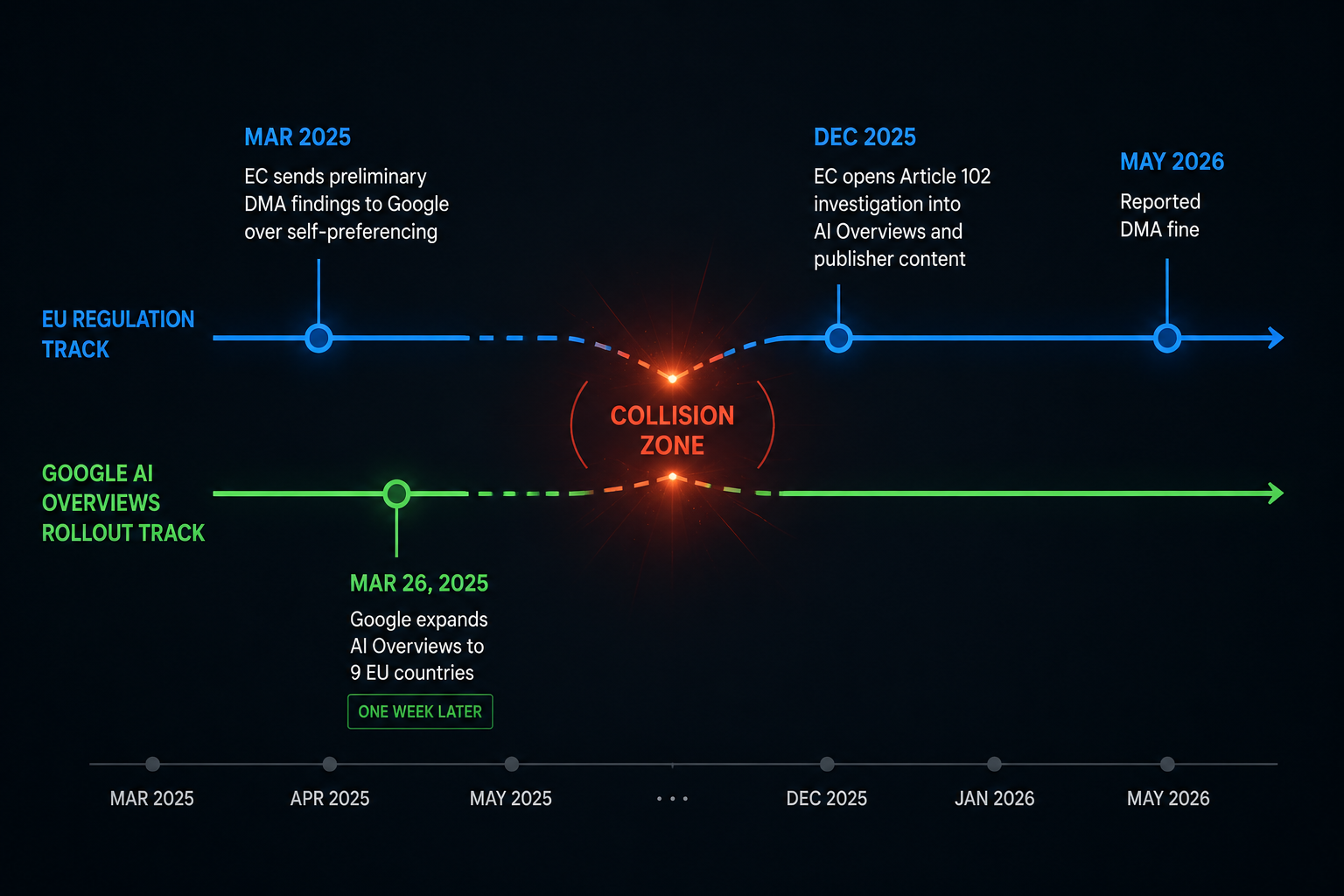
The European risk around AI search marketing is no longer theoretical. In mid-March 2025, the European Commission sent Alphabet preliminary findings that Google Search may be breaching Article 6(5) of the Digital Markets Act, the rule aimed at self-preferencing by gatekeepers. On March 26, 2025, Google expanded AI Overviews to nine EU countries. That one-week gap is the collision SEO teams need to understand: the same search interface that regulators were already scrutinizing for preferential placement gained a new Google-generated answer layer above the results many publishers and brands rely on for traffic.[1]
By Q3 2026, the situation has become less settled, not more. The Commission has opened a separate Article 102 competition-law investigation into Google’s use of publisher content for AI Overviews, Reuters has reported that the EU plans to fine Google a high triple-digit million euro sum for DMA non-compliance, and the unresolved question of whether AI services should receive clearer DMA treatment still hangs over AI Overviews, AI Mode, and agent-like search intermediaries.[2][3]
For search marketers, the practical question is not whether AI Overviews are useful, impressive, or inevitable. It is whether they can be treated as stable infrastructure in European organic search planning. Right now, they cannot.
The Rollout Is Real, but the Legal Ground Is Moving
The Digital Markets Act does not ban Google from improving Search, adding AI features, or answering questions directly. The harder issue is placement and leverage. Article 6(5) is concerned with a gatekeeper ranking its own services or products more favorably than similar third-party services. In a classic shopping, travel, or local-search dispute, that question often turns on whether Google gives its own vertical results privileged treatment inside the search results page.
AI Overviews complicate that structure. They are not simply another blue link, and they are not a neutral crawler result. They are a Google-generated layer inserted into Google Search, often before the user reaches organic listings. If the answer is produced with help from publisher content, and if that answer satisfies enough of the user’s need that fewer visits flow to the underlying pages, the feature starts to look like more than a design update. It becomes a distribution decision by the gatekeeper.
That is why the March 2025 timing matters. The Commission’s preliminary DMA findings and Google’s EU AI Overviews expansion were not part of the same proceeding, but they landed on the same dashboard. One track says Google Search may be giving Google-controlled results preferential treatment. The other introduces a Google-controlled AI answer unit into more European SERPs one week later.[1]
That does not prove AI Overviews will be removed from Europe. It does mean the feature sits inside a live compliance dispute rather than outside it.
Three Enforcement Tracks, Three Different SEO Risks
The mistake is to collapse every European action against Google into one generic “DMA risk.” For planning purposes, the tracks matter because they can lead to different remedies, different timing, and different kinds of SERP change.
| Track | What it concerns | Why SEO teams should care |
|---|---|---|
| DMA Article 6(5) | Whether Google gives preferential treatment to its own services or products in ranking and presentation | Could affect how Google places AI-generated units, vertical modules, or Google-controlled result features in EU SERPs |
| Article 102 competition investigation | Google’s use of publisher content for AI Overviews and broader competition-law concerns | Could focus more directly on the relationship between content extraction, answer generation, and lost publisher visits |
| DMA Article 53 review and AI designation debate | Whether generative AI services should be addressed more explicitly as core platform services or new intermediaries | Could shape how future features such as AI Mode and AI agents are regulated, not just the current AI Overviews unit |
The Article 102 investigation is especially important because it narrows the focus from general search self-preferencing to publisher content and AI answers. In December 2025, the Commission opened a separate investigation into Google’s use of publisher content for AI Overviews. Commissioner Teresa Ribera described competition law as offering “a more holistic framework” than the DMA for addressing AI search concerns.[2]
That wording matters. The DMA can move quickly against gatekeeper conduct, but AI Overviews raise questions that are not only about placement. They also involve input material, attribution, substitution, bargaining power, and the effect on markets that depend on search referrals. Article 102 gives the Commission a broader competition-law lane for those issues.
The reported fine is a separate signal and should be handled carefully. Reuters reported on May 25, 2026, citing Handelsblatt and unnamed Commission sources, that the EU planned to fine Google a high triple-digit million euro sum for DMA non-compliance. As of the source material used here, that amount and timing had not been formally confirmed.[3]
For forecasting, the difference between confirmed enforcement and reported enforcement is not pedantic. A confirmed remedy can change product behavior. A reported fine can still move internal risk calculations, but it should not be modeled as if the final order already exists.
Why AI Overviews Put Article 6(5) Under Pressure
The structural tension is straightforward: Google controls the search gateway, Google generates the AI Overview, and Google decides how prominently that generated answer appears relative to third-party results. If the AI Overview competes with the pages it summarizes, then the old distinction between “ranking results” and “answering the query” becomes less useful operationally.
A publisher or brand page may still be cited, but citation is not the same thing as traffic. A user can read the generated response, absorb the key facts, and never click. That behavior is not new to search; featured snippets, knowledge panels, and local packs have long absorbed some demand. The AI Overview expands the surface area because it can synthesize across sources, answer multi-part questions, and occupy attention before the organic stack has a chance to compete.
That is where the impact of the EU Digital Markets Act on AI search marketing becomes different from the US discussion. In the US, most SEO teams look first at query coverage, click-through rate, and ranking displacement. In the EU, those metrics still matter, but they sit beside a regulatory question: can this Google-generated layer remain in its current form if the Commission concludes that it advantages Google’s own search product, AI interface, or answer experience over the third-party sites that supply the underlying information?
The answer is not visible in a keyword tool. It will emerge through enforcement, compliance design, litigation posture, and product tests. That is why EU AI Overview data should be treated as a volatile SERP condition rather than a settled ranking feature.
Do Not Import US Traffic Assumptions Wholesale
There is enough traffic-loss evidence to justify caution, but not enough to justify lazy extrapolation. PPC Land reported that early US markets where AI Overviews launched showed traffic reductions of 15% to 67% for pages whose queries triggered AI Overviews, citing multiple industry studies. The same source also noted that European restrictions, including signed-in account requirements and an age 18+ limit, may partially limit exposure in the short term.[1]
That range is a warning signal, not a forecast. It describes affected queries in early-launch markets and draws on industry studies rather than one standardized public dataset. It should push teams to measure the risk, not to tell a German, French, or Spanish country manager that a US traffic-loss percentage will appear on the same timeline.
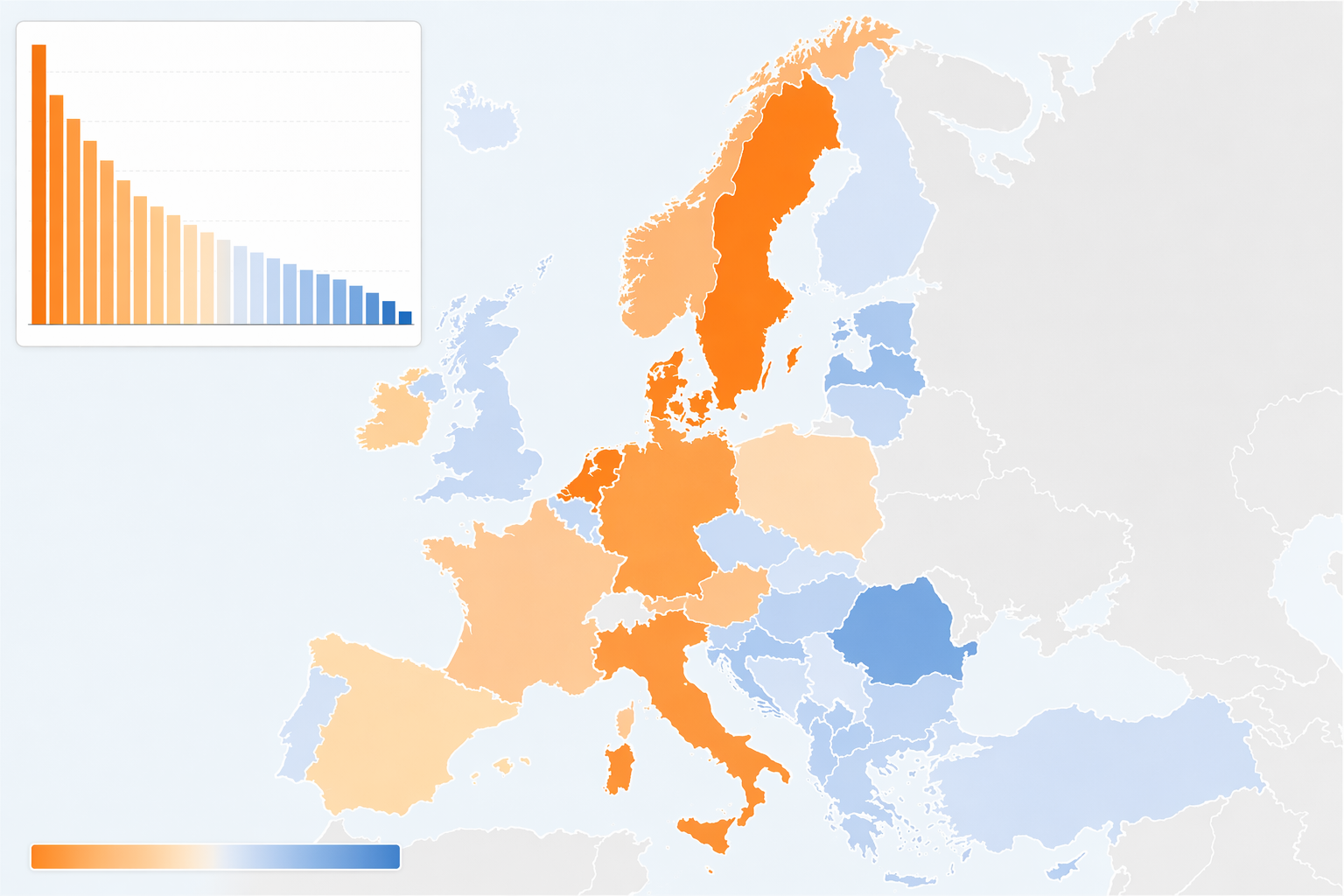
Country-level behavior matters. A query class that triggers AI Overviews frequently in the US may be less exposed in an EU market because of rollout limits, language coverage, user eligibility, or compliance testing. The reverse can also happen over time if Google expands eligibility or adjusts the product. The only safe assumption is that EU markets need their own monitoring.
What to Monitor in EU SERPs
AI Overview tracking should be separated from ordinary rank tracking. A ranking report that says a page remains in position three is incomplete if an AI-generated block has appeared above it and absorbed the task the page used to perform.
- Track AI Overview presence by country, language, device, and signed-in versus signed-out visibility where your tools allow it.
- Segment query classes instead of averaging everything together: informational, comparison, troubleshooting, health, finance, local, ecommerce, and branded queries will not carry the same exposure.
- Record whether your domain is cited in the AI Overview, but keep that metric separate from clicks, assisted conversions, and downstream revenue.
- Compare EU markets against the US as a control group, not as a template. The useful question is where behavior diverges after a rollout, restriction, or enforcement milestone.
- Annotate dashboards with regulatory events, including preliminary findings, formal investigations, reported fines, confirmed remedies, and major Google compliance updates.
The dashboard should make it obvious when a traffic movement is happening only where AI Overviews appear. If impressions hold steady, average rank looks stable, and clicks fall on affected informational queries, that is a different problem from a ranking loss. If the same pattern appears in the US but not in France or Germany, that is also a planning signal.
This is not just measurement hygiene. It changes resourcing. Content teams should know which pages are being asked to perform in a shrinking click environment and which pages still earn demand after the AI layer appears.
Optimization Inside the AI Layer Is Not a Stable EU Strategy
There will be pressure to optimize for AI Overview inclusion the way teams optimized for featured snippets. Some of that work is sensible: clear structure, accurate entities, original evidence, strong sourcing, and pages that answer the user’s task cleanly are still good search assets. The risk is building an EU roadmap around the assumption that Google’s current AI answer format will stay intact.
A stable strategy cannot depend on being surfaced inside a feature whose eligibility, placement, and legal treatment may change. If a remedy forces Google to alter placement, attribution, opt-out handling, publisher consent, or presentation in Europe, the winners and losers of today’s AI Overview citations could change without any underlying content quality shift.
The better posture is to protect content that can earn demand outside the generated answer. That usually means assets with proprietary data, tools, calculators, product depth, community signals, expert interpretation, inventory, pricing, or workflows that the AI summary cannot fully replace. Informational pages still matter, but they need a job beyond supplying extractable prose.
For cross-border teams, this may require different targets by market. A US plan might prioritize AI Overview citation share for high-volume informational terms. An EU plan may still track those citations but put more weight on non-AI surfaces, branded demand, comparison content, commercial pages, local landing pages, and email or community capture from visits that still arrive.
Google’s Compliance Posture Deserves Its Own Watchlist
Search teams do not need to become antitrust lawyers, but they should pay attention to how Google describes its own compliance. Near Media criticized Google’s 2025 DMA compliance report for “materially misrepresenting” Business Profiles as “SERP Previews” in an argument that they fall outside Article 6(5) obligations.[4]
That dispute is about local search, not AI Overviews. Its usefulness here is as a posture signal. Google’s compliance arguments may draw narrow product boundaries around features that publishers, competitors, and regulators experience as part of the same search results page. If similar boundary-drawing appears around AI Overviews, marketers should expect more volatility rather than a clean settlement.
This is also why product labels can be misleading in SEO planning. Whether Google calls something an overview, preview, answer, mode, snapshot, or assistant interface matters less than where it appears, what content it uses, how it changes clicks, and whether regulators treat it as part of the gatekeeper service.
The AI Designation Question Could Widen the Problem
The current fight may not stop at AI Overviews. The Commission’s Article 53 DMA review was due by May 3, 2026, and one open issue is whether generative AI features should be addressed more explicitly under the DMA’s core platform service framework. The source materials used here do not confirm the review’s final outcome, so teams should verify whether the Commission has since published new designations or amendments.[5][6]
Legal analysis from Tech Policy Press and WilmerHale has explored whether AI-based services could be designated under the DMA, with implications for AI Overviews and AI Mode. That question matters because Google Search may be only one route through which AI becomes a gatekeeping layer. If AI assistants, answer engines, or agentic interfaces become the place where users choose products, publishers, services, and marketplaces, regulators may need to decide whether the existing gatekeeper framework is wide enough.[5][6]
The Law & Economics Center frames this as a broader intermediary shift: AI agents may create a new category of intermediaries that fall outside current gatekeeper designations, potentially reshaping the regulatory landscape beyond today’s search results page.[7]
For SEO teams, the near-term implication is simple enough. Do not treat the current AI Overview box as the final form of AI search in Europe. It may be changed by Google, constrained by the DMA, examined through competition law, or overtaken by another AI interface that raises a new version of the same distribution problem.
A Planning Stance for EU AI Search
The disciplined position is not to predict that Europe will kill AI Overviews. It is also not to behave as if the feature is now a permanent layer above organic results. The evidence supports a narrower and more useful conclusion: AI Overviews in Europe are real enough to measure, risky enough to segment, and unstable enough that content strategy should not depend on them.
That means EU SEO plans should carry separate assumptions for AI Overview presence, organic rank, click-through rate, and conversion impact. They should document country differences instead of smoothing them into a European average. They should compare against US markets carefully, with the eligibility restrictions and enforcement environment kept visible. And they should prioritize assets that retain value when the answer layer changes, shrinks, expands, or disappears for a class of queries.
The regulatory outcome is not forecastable from a search console chart. The search impact, however, is observable. In Europe, that is where the work belongs for now: monitor the feature, isolate the query classes, protect the channels that do not rely on Google’s generated answer, and keep the content roadmap flexible enough to survive the next compliance adjustment.
References
- Google expands AI Overviews to more European markets, PPC Land
- Regulating artificial intelligence: Between the EU Digital Markets Act and competition law, Hausfeld
- EU plans to fine Google high triple-digit million euro sum for DMA non-compliance, Reuters, May 25, 2026
- Why Google's typical local search results do not comply with DMA Article 6(5), Near Media
- Will the EU Designate AI Under the Digital Markets Act?, Tech Policy Press
- AI and the EU Digital Markets Act, WilmerHale
- The DMA Meets the New Intermediaries, Law & Economics Center

Comments
Join the discussion with an anonymous comment.