
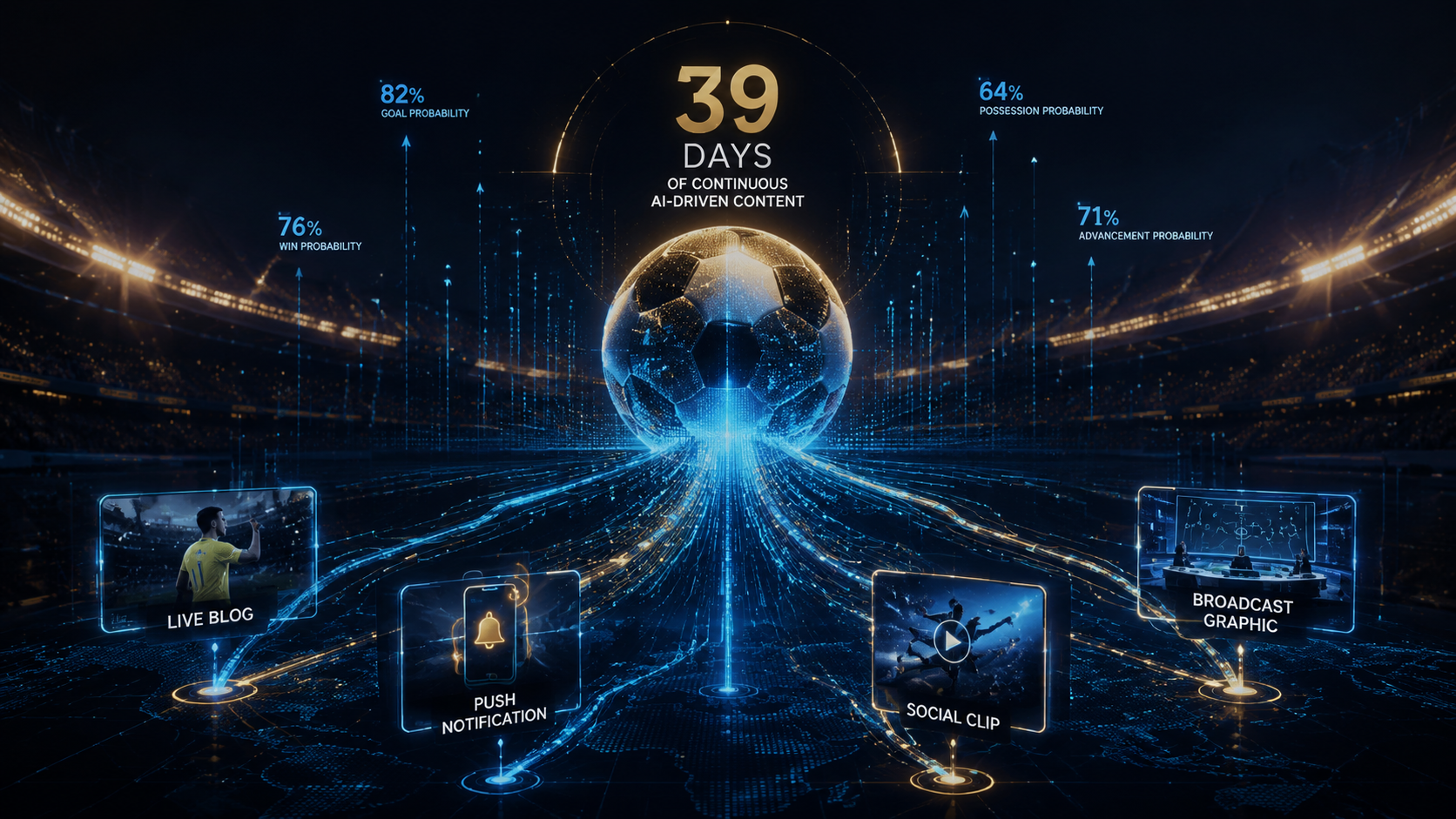
How AI World Cup Predictions Became a 39-Day Content Engine
Media brands and AI companies used prediction models to sustain audience engagement throughout the 2026 World Cup. This article examines how the Opta supercomputer and others turned raw simulations into a continuous content franchise, and what content teams can learn about building data-driven products that keep audiences returning.
Search for ai sports predictions world cup 2026 and the obvious expectation is a winner, a bracket, or a postmortem on which model embarrassed itself. By July 20, 2026, the final has been played, so some forecasts can now be checked against reality. But treating this as a leaderboard of machines misses the more useful story: World Cup prediction models became a publishing system. They gave editors, broadcast producers, social teams, and notification desks a steady supply of legitimate updates during a 39-day tournament in which nothing could be left quiet for long.
The best version of that system was not the loudest public forecast. It was the Opta supercomputer, as used inside BBC Sport coverage: 25,000 pre-tournament simulations, then live probability changes after match events such as goals and red cards, packaged into graphics and explainers that could move with the game rather than wait for the whistle [1].
The prediction was only the first asset
A pre-tournament forecast is a headline. A model that updates after every meaningful event is an editorial engine. That distinction matters because the 2026 World Cup was built at a scale that punishes one-off content planning: 48 teams, 104 matches, and 39 days of coverage to keep alive across search, homepage modules, live blogs, apps, social feeds, broadcast graphics, and betting-adjacent products [2].
In that environment, the useful question is not simply whether the model picked the eventual champion. It is whether the model created publishable movement. A probability shift after a goal gives a live blogger a line. A red card changing qualification odds gives a graphics producer a reason to update the lower third. A pre-match simulation table gives SEO editors a landing page. A late swing gives the alerts desk a push notification that does not have to pretend the match itself is over.
That is why the Opta/BBC example is more instructive than a loose list of AI picks. The model had three things a publishing operation needs: a recognizable data brand, repeatable updates, and outputs that could be translated into editorial formats without inventing drama. Opta also reportedly called all four semifinalists correctly, which gave the system a neat accuracy credential after the fact [1]. Still, the accuracy claim is not the whole product. The product was the ability to keep turning match events into audience-facing context.
BBC Sport showed what a second-screen prediction product looks like
The clearest scene came during Scotland’s decisive Group C fixture, when BBC Sport viewers could watch qualification probabilities change in real time as goals were scored [1]. That is the sort of integration that sounds small until you have had to keep a live page useful during the long middle of a match, when the scoreline is known, the same clips are circulating, and the audience still wants to know what the result means.
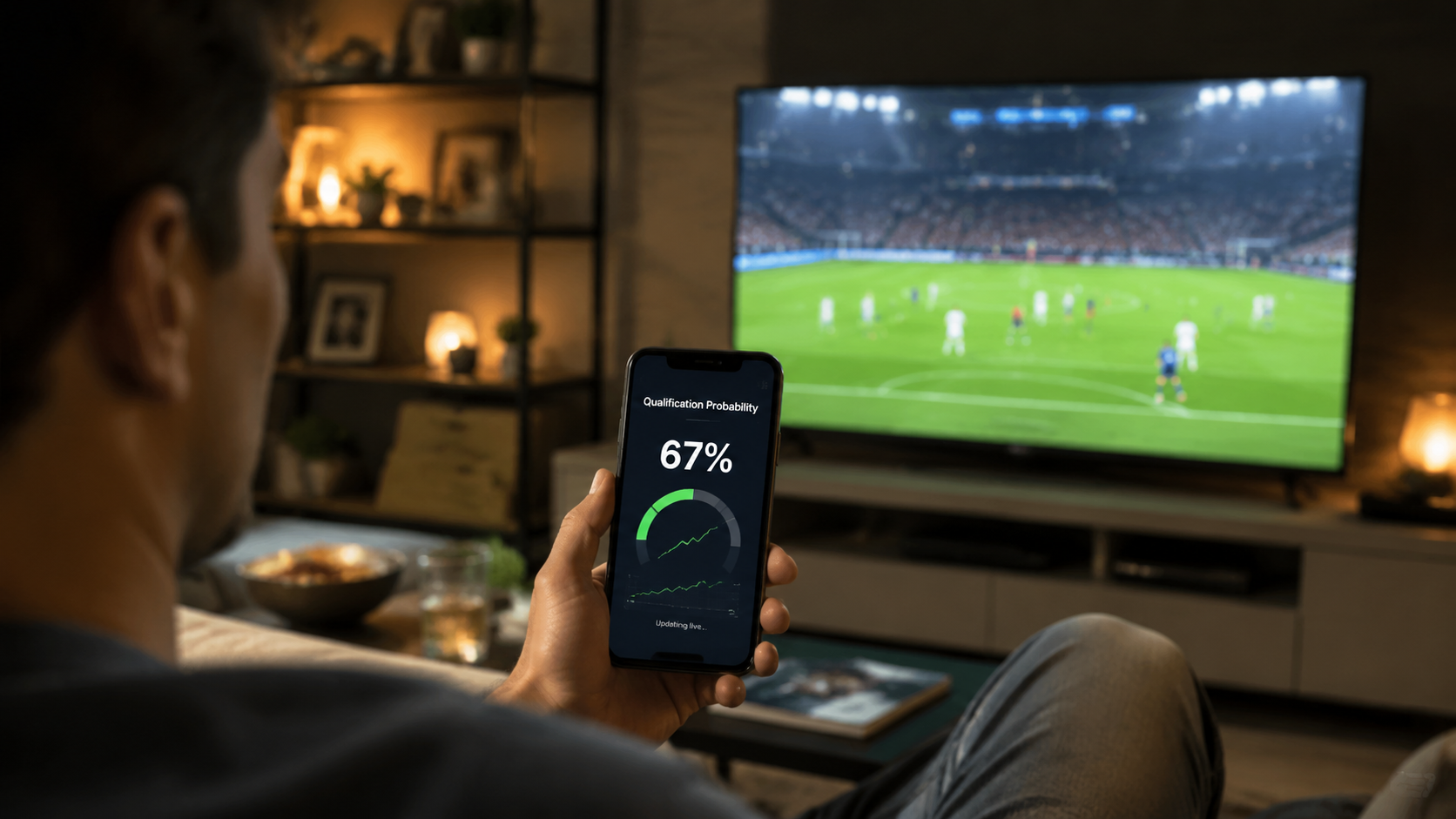
A probability meter changes the job of the second screen. The phone is no longer just where a fan checks the group table or argues about substitutions. It becomes a companion layer to the match. The audience can see the consequence of a goal before the pundit has finished explaining it. If another match in the group is moving at the same time, the model can absorb that too, giving the producer something more precise than “as things stand.”
That fit the way younger sports audiences already watch. Deloitte data cited in the Observer reported that 93% of Gen Z use a second screen while watching sports [1]. FanBase’s 2026 engagement report added another layer of demand: 54% of fans said they use AI as their primary source for sports information, while 59% said they trust AI tools [3]. Those figures do not prove that every fan wanted a probability chart during Scotland’s match. They do show why a live prediction layer had a plausible audience habit to attach itself to.
For an editor, that is the attraction. The model does not need to replace the match report, the tactical piece, or the pundit segment. It sits underneath them and keeps producing fresh context. A goal is still a goal. The model supplies the next sentence: what that goal did to the tournament shape.
Why Opta had an advantage over general AI forecasts
The public AI prediction race around the tournament was crowded. Kimi, Qwen, DeepSeek, Doubao, ERNIE Bot, ChatGPT, Claude, and Gemini all appeared in public prediction coverage, with varying levels of explanation and confidence [4][5]. That was useful as a marketing spectacle. It was less useful as a durable editorial product unless the output could be trusted, updated, and repackaged at speed.
Kimi was the most interesting counterexample because it showed both ambition and fragility. Global Times reported that Kimi used 300 sub-agents and a dedicated counter-agent to challenge its own forecasts, and that it publicly warned its predictions “could very well be wrong” [4]. That transparency is better than pretending a model has seen the future. But the same coverage also noted that Kimi hallucinated a team that had not qualified [4]. For a casual social post, that may become a joke. For a prediction product that asks an audience to return repeatedly, it is a crack in the data spine.
Opta’s advantage was not that it sounded more futuristic. It was that its forecasts sat on a long sports data operation with a known role in football coverage. Gianni Infantino publicly referenced Opta’s predictions, a legitimacy signal that moved the model beyond niche analytics chatter [1]. But the important caveat is that the trust did not come from the letters AI. It came from provenance: data history, sporting context, and a format broadcasters could use without first explaining why the source should be believed.
There is also a commercial caveat. Stats Perform, Opta’s parent company, positioned the 2026 World Cup’s expanded scale as an engagement opportunity and is FIFA’s first official betting data partner [2]. That does not invalidate the editorial usefulness of the model. It does mean content teams should read success stories with the normal caution applied to vendor-backed categories: adoption, visibility, and commercial utility are not the same as independently audited predictive performance.
Accuracy mattered, but cadence did more work
Prediction accuracy is the easiest thing to argue about because it produces a tidy scorecard. The research around public AI World Cup forecasts also carried broad accuracy claims in the 60% to 85% range, depending on source and method. That range is too wide to treat as a single conclusion, and it mixes different types of predictions: match outcomes, tournament progression, finalists, champions, and probabilistic calls are not the same editorial object.
For content strategy, a narrower distinction is more useful.
| Question | What it measures | Why it mattered in 2026 |
|---|---|---|
| Was the model right? | Forecast performance against actual results | Useful for credibility, especially after the tournament |
| Was the model useful? | Whether fans got clearer context during a match or group scenario | Useful for second-screen behavior and live coverage |
| Was the model publishable? | Whether outputs changed often and cleanly enough for editorial teams | Useful for sustaining a 39-day content calendar |
The third question is the one many AI prediction launches skip. A model can be impressive in a demo and still fail a newsroom if it does not create clean update moments. Editors need triggers: goal, red card, lineup change, injury, group-table swing, knockout path shift. Social producers need formats: card, clip, carousel, short caption, notification line. SEO teams need persistent pages that can be refreshed without becoming thin rewrites. Broadcast teams need numbers that can be explained in one sentence before the match moves on.
That is where live probability models earn their keep. They make change visible. They turn “Germany scored” or “Scotland conceded” into “the route out of the group just narrowed,” with a number attached and a source behind it. The number is not a replacement for judgment. It is a usable unit of cadence.

The repeatable content framework
The sports context is specific, but the content mechanics travel. A prediction-based product does not have to be about football. Weather risk, election modeling, product demand, travel disruption, award races, and market scenarios can all generate repeat visits if the underlying system has credible inputs and visible movement. The mistake is copying the surface — “AI predicts X” — without copying the operating model.
A workable version starts with four decisions.
- Choose a live variable people already care about: qualification odds, disruption risk, demand pressure, ranking movement, or another outcome that naturally changes over time.
- Define the update triggers before launch: events, data releases, threshold changes, or scheduled recalculations that create a valid reason to publish.
- Attach provenance visibly: source data, method limits, update frequency, and any commercial relationship that affects how readers should interpret the output.
- Design the format stack early: search page, live module, social asset, push notification, email block, video graphic, and internal explainer.
- Separate confidence from certainty: show probability movement without implying that a model has eliminated uncertainty.
The format stack matters because prediction content rarely lives in one place. The same probability change can become a live-blog update, a social card, a short video overlay, and a refreshed SEO paragraph. That reuse is not lazy if the formats serve different audience moments. A fan in the stadium queue needs a notification. A search visitor wants the full scenario. A broadcast viewer needs a graphic that makes sense in five seconds.
For SEO teams, the strongest page is usually not the one that screams the model’s champion pick. It is the one that keeps answering the current version of the question. Before the tournament, that might be projected group winners. During the group stage, it becomes qualification odds. Before the knockouts, it becomes path difficulty. After the semifinal, it becomes how the model changed and why. The URL can remain stable while the editorial job changes.
What content teams should not copy
The public model race is tempting because it is cheap to reproduce: ask five AI tools for a winner, quote the outputs, publish the disagreement. CNET did a version of that by asking ChatGPT, Claude, Gemini, and other models to predict the 2026 World Cup final [5]. As a snapshot, that kind of article can be entertaining. As a returning product, it usually runs out of oxygen quickly unless the team keeps testing, updating, and explaining why the answers changed.
The other weak copy is the confidence theater: a polished bracket, a bold winner, and no visible mechanism. That may win a click before kickoff. It gives the homepage very little on matchday 18, when two simultaneous results are changing a group table and the audience wants to know which version of chaos matters.
A prediction product needs an editorial owner
The hidden labor in AI sports predictions is not just modeling. It is deciding what deserves to become content. If every one-point probability move triggers a post, the product becomes noise. If only the final prediction is published, the model becomes a press release. Someone has to set thresholds, write explainers, keep caveats consistent, and decide when the audience has already had enough of the same chart.
That role is editorial, even when the data source is technical. The editor decides whether a swing is meaningful. The producer decides where it travels. The social lead decides whether the moment needs a clip, a card, or silence. The SEO lead decides whether an update belongs on a live page, a standing explainer, or a new article. The model supplies motion; the publishing team turns motion into judgment.
This is also where transparency becomes practical rather than ornamental. Kimi’s counter-agent disclosure was useful because it showed process, not just output [4]. Opta’s strength was different: a data operation with enough history for broadcasters and sports audiences to recognize the brand [1]. Both point to the same requirement. If prediction content asks people to keep coming back, it has to show why the next update deserves more trust than a random confident answer.
What the 2026 World Cup really proved
The 2026 World Cup did not prove that AI predictions are now reliable enough to settle sports arguments. It proved something more operationally useful: prediction models can become live editorial infrastructure when the data is credible, the updates are frequent, and the outputs are built for distribution.
Opta’s 25,000 simulations gave BBC Sport a starting point. Match events gave the model movement. BBC’s live coverage gave the movement a place to be seen. Second-screen behavior gave the format a natural audience habit. The expanded tournament gave everyone involved enough time and surface area to turn the whole thing into a content franchise rather than a one-day prediction stunt [1][2].
That is the lesson worth carrying outside football. Prediction-based content works when it is built as a returning audience product: credible data, visible updates, clear caveats, and reusable formats across search, live coverage, social, video, email, and notifications. A one-off forecast headline can still travel. It just does not feed the calendar for 39 days.
References
- How A.I. Prediction Models Changed Sports Broadcasting, Observer, July 2026.
- World Cup 2026: Turning Unprecedented Scale Into Continuous Engagement, Stats Perform, 2026.
- The State of Fan Engagement in 2026, FanBase, January 2026.
- AI's World Cup crystal ball: marketing stunt or genuine breakthrough?, Global Times, June 2026.
- Which AI Best Predicts the 2026 World Cup Final? We Asked 5 Models, CNET, July 2026.

Comments
Join the discussion with an anonymous comment.