
Why Being Cited in AI Overviews Is the New Competitive Advantage in SEO
As AI Overviews drive zero-click rates past 68%, the SEO goal is shifting from ranking first to being cited inside AI-generated answers. Drawing on new research from Seer Interactive, Ahrefs, and AirOps, this article explains why cited brands earn significantly more clicks, what factors predict citations, and how to measure and report on this new performance metric.
The uncomfortable part of AI Overviews’ zero-click impact is not that organic traffic is getting harder to defend. Most SEO teams already feel that in Search Console. The uncomfortable part is that many reporting decks still behave as if the search results page is mostly a ranked list, and that a higher position should translate cleanly into more visits.
That assumption is now too thin to manage against. SparkToro reported that 68.01% of Google searches ended without a click in early 2026, while Ahrefs found that AI Overviews reduced position-one click-through rate by 58% in its December 2025 analysis of 300,000 keywords.[1][2] On mobile, where the AI answer consumes even more of the first screen, Digital Applied reported a 77.2% zero-click rate versus 50.6% on desktop in 2026.[3]
The boardroom version of that problem is usually blunt: “Are we still ranking?” The operating question for an SEO team in Q3 2026 has to be more specific: when an AI Overview appears, is our brand cited, named, or absent from the answer that now frames the searcher’s next move?
This is where the measurement gap becomes a management problem. Goodfirms’ 2026 survey of more than 100 practitioners across more than 20 countries found that 43% named AI optimization as a core strategy, but only 14% tracked AI or LLM citation visibility and only 11% monitored branded search volume.[4] The sample is small and self-selected, so it should not be treated as a market census. It is still directionally believable because it matches what many teams are living: the strategy conversation has moved faster than the dashboard.
Ranking First Is No Longer the Cleanest Proxy for Being Chosen
Rank tracking still matters. It tells you whether Google can understand, trust, and surface your pages for a query set. But it no longer tells you enough about visibility, influence, or demand capture when an AI Overview sits above the traditional results.
A team can hold strong blue-link positions and still lose attention to a synthesized answer. A team can also appear lower in the organic results and still win visibility if its page, brand, or third-party mention is pulled into the AI-generated response. That changes what the SEO lead needs to prove. The target is not simply “we rank.” It is “we are part of the answer the searcher sees before they decide whether to click.”
That distinction matters for budget conversations. If organic sessions decline while rankings look stable, leadership may read the gap as execution failure. In many cases, it is a SERP format problem. But “the SERP changed” is not enough of a defense. The more useful response is to show whether the brand is gaining or losing citation visibility inside the new SERP format.
| Old reporting question | Better Q3 2026 question |
|---|---|
| Do we rank in position one? | Are we cited or named inside the AI Overview? |
| Did organic sessions increase? | Did cited queries produce stronger organic, paid, or branded-search behavior? |
| How many links did we build? | Where is the brand mentioned across trusted third-party sources? |
| Which page owns the keyword? | Which source is shaping the machine-generated answer? |
The Commercial Case for Citation Visibility
Seer Interactive’s September 2025 update gives SEO teams the strongest business reason to treat AI Overview citation as a performance metric rather than a curiosity. In a 15-month study across 42 client organizations and 3,119 search terms, Seer compared brands that appeared on the same SERP and separated those cited in AI Overviews from those present but not cited.[5]
The gap was large enough to change how organic and paid teams should read the same results page. Cited brands earned 35% more organic clicks and 91% more paid clicks than brands present on the same SERP but not cited.[5]
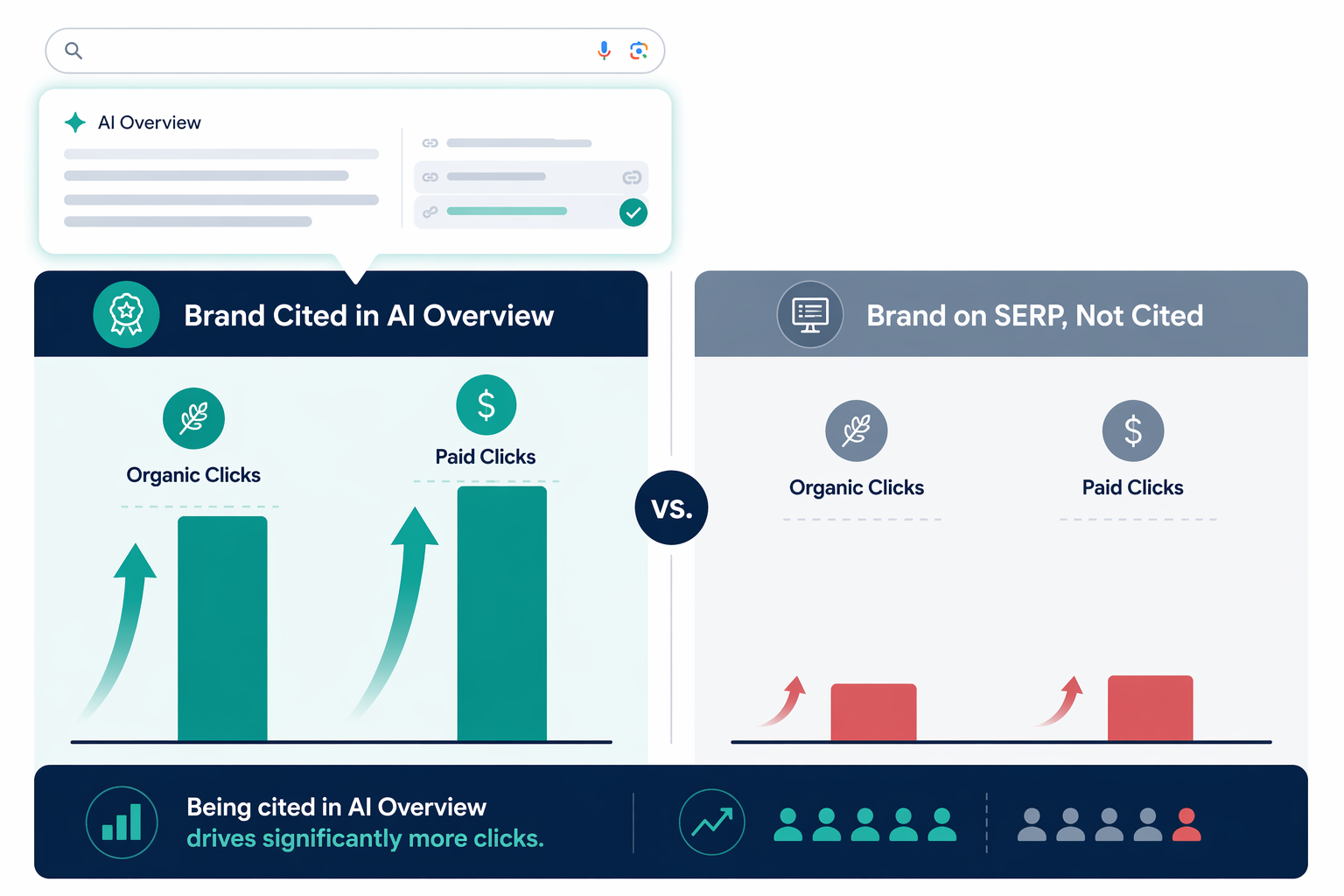
The paid-search lift is the part that should stop the usual channel-silo conversation. AI Overview visibility is not only an organic reporting issue. If cited brands also see materially stronger paid click behavior on the same SERP, then citation inclusion may be affecting brand recognition, trust, or selection before the user reaches the ad block. Seer’s data does not prove which mechanism is doing the work, but it gives organic and paid teams a shared SERP-level signal to investigate.[5]
The caveat is important. This is correlational evidence. Brands cited in AI Overviews may already have stronger awareness, better content, more authority, larger paid budgets, or more recognizable names. Citation may contribute to stronger click behavior, but the study does not prove that citation alone caused the lift.[5]
That does not make the metric less useful. SEO teams make decisions from imperfect signals all the time. The practical question is whether citation visibility is more actionable than staring at a position-one ranking that no longer produces the expected traffic. For many query sets, it is.
AI Overview Citations Do Not Simply Mirror the Top 10
The old reflex is to assume that earning citations means ranking higher. That is partly true, but not enough. Ahrefs analyzed 146 million SERPs and found that 38% of AI Overview citations came from outside the top 10 organic results.[6] That finding is a direct challenge to the lazy version of AI SEO, where the plan is just to keep optimizing the same page for the same ranking target and wait for the model to notice.
Ahrefs also found that external brand mentions correlated with AI Overview appearance at 0.664, while backlinks correlated at 0.218.[6] Correlation is not causation, and a brand that earns more mentions may also be stronger in many other ways. Still, the difference between those two correlations is too large to ignore. It suggests that the machine-readable reputation layer around a brand may matter more than the backlink profile SEOs are used to treating as the center of gravity.
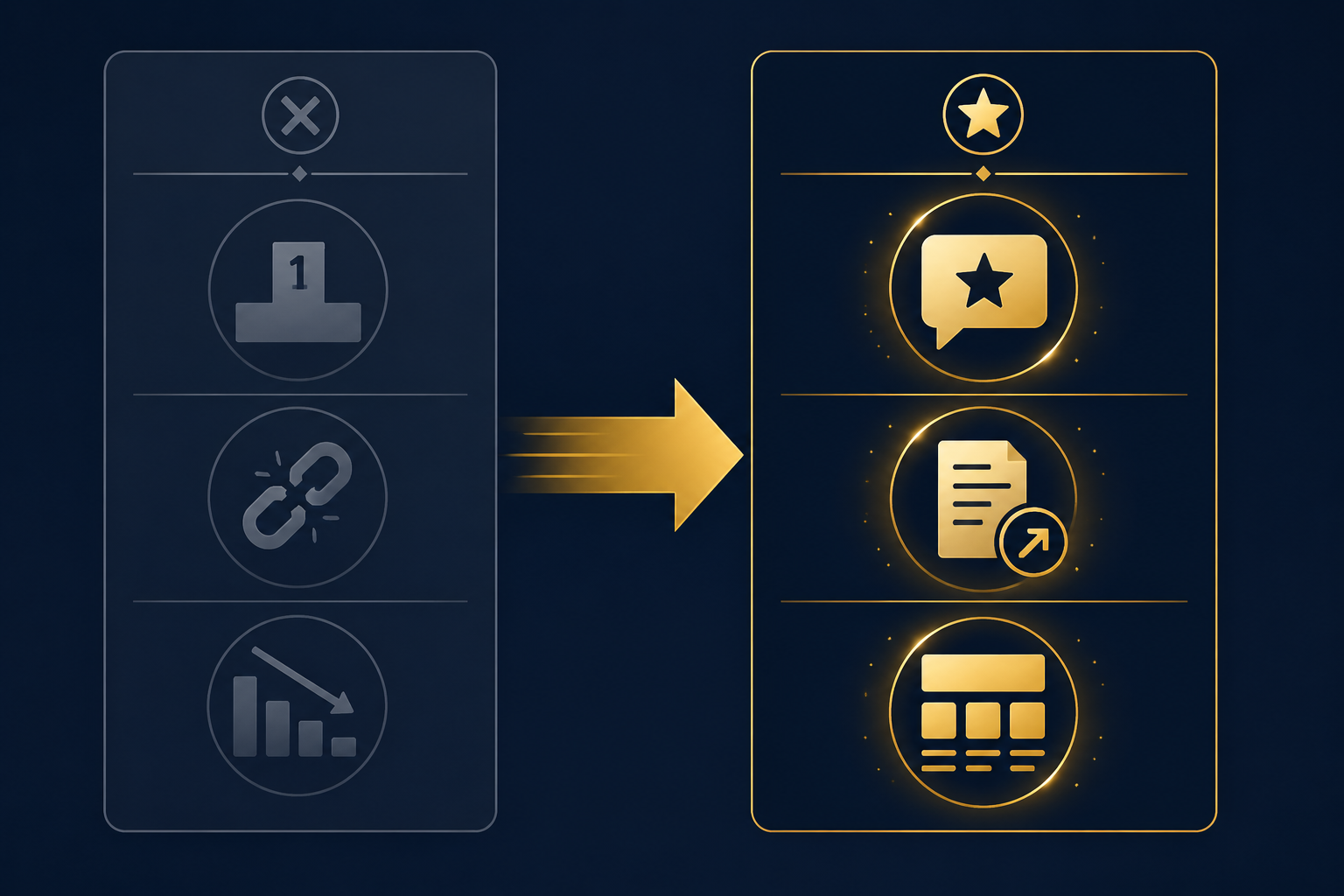
This changes the work. A page still needs to be crawlable, useful, and aligned to search intent. But citation earning expands the field of play from “our page versus their page” to “which sources does the AI system trust enough to synthesize, and where does our brand appear in that source set?”
Where Citation Work Actually Happens
The tactical playbook starts with a different inventory. Instead of only mapping target keywords to owned URLs, map the sources that appear to feed the AI answer: your page, competitor pages, review sites, comparison pages, forums, trade publications, documentation, analyst-style roundups, and other third-party sources that name brands in context.
AirOps’ research, as covered in 2026 AI SEO statistics reporting, found that brands were 6.5 times more likely to be cited through third-party sources than through their own domains.[4] That does not mean owned content is optional. It means owned content is only one surface. If the AI Overview is leaning on independent pages, directories, or category explainers, a technically perfect product page may still be absent from the answer.
For an in-house SEO team, that creates a practical split in the work:
- Owned content: make the page easy to parse, specific enough to cite, and aligned to the question the AI Overview is answering.
- Third-party presence: identify the external pages that already influence the answer and work toward accurate brand inclusion there.
- Brand evidence: build consistent mentions around category fit, use cases, comparisons, limitations, and proof points.
- SERP monitoring: track whether citations change after content updates, PR placements, review updates, or partner-page improvements.
This is not traditional digital PR with a new label. The goal is not just a link. The goal is to increase the number and quality of places where the brand is described in ways that a search system can use when composing an answer.
Owned Pages Need Better Extraction, Not Just Better Copy
AI systems reward pages they can interpret cleanly. That does not mean every page should be reduced to a fact sheet. It does mean the important claims, comparisons, data points, definitions, and constraints should not be buried in decorative copy or vague positioning.
AirOps’ cited findings are useful here, with caveats. The research found that content containing 5 to 7 statistics had a 20% higher AI citation likelihood, and pages averaging 10 or fewer words per sentence earned 18.8% more ChatGPT citations.[4] Because those structure findings come from ChatGPT citation behavior, they should not be treated as guaranteed Google AI Overview rules. They are better used as testing prompts: make pages more extractable, then monitor whether citation presence changes.
For a commercial page, that may mean adding a concise comparison table, a sourced methodology note, a short limitations section, or a clearer answer block near the top of the page. For an informational page, it may mean replacing broad advice with specific criteria, evidence, examples, and definitions that can stand alone when summarized.
Third-Party Mentions Need to Be Managed Like Search Assets
The third-party layer is harder because it sits outside the CMS. It is also where many citation opportunities live. If the AI Overview for a category query repeatedly cites a software directory, industry guide, review page, or comparison article, then that page becomes part of the search asset base whether or not the SEO team owns it.
The work is unglamorous: audit whether the brand is present, whether the description is accurate, whether category language matches how buyers search, whether competitors are framed more clearly, and whether proof points are stale. Some fixes may belong to PR, partnerships, customer marketing, analyst relations, or product marketing. SEO should still coordinate the opportunity because the consequence shows up in search visibility.
A useful internal rule is simple: if a third-party page is cited in an AI Overview for a revenue-relevant query, treat that page as if it were ranking on your behalf or against you. It may be doing both.
A Reporting Framework Leadership Can Understand
Citation visibility will not replace rankings, organic clicks, or revenue reporting. It should sit beside them so leadership can see how AI search is redistributing attention before the traffic result arrives. The cleanest version is a SERP-level dashboard organized by query groups, not by isolated keywords.
| Metric | What it answers | Why it matters |
|---|---|---|
| AI Overview presence | Does the query trigger an AI-generated answer? | Separates normal ranking movement from SERP-format pressure. |
| Citation inclusion | Is our domain, brand, or third-party mention cited? | Shows whether we are part of the answer, not just present below it. |
| Citation source type | Does the citation come from owned content or an external source? | Directs work toward content, PR, partnerships, or profile cleanup. |
| Organic clicks and CTR | What traffic still arrives from the SERP? | Keeps the team anchored to business outcomes. |
| Paid click behavior | Do cited query groups behave differently in paid search? | Connects AI visibility to cross-channel demand capture. |
| Branded search volume | Are more people searching for the brand after exposure? | Captures influence that may not appear as an immediate organic click. |
| Third-party mention coverage | Where are we accurately included across influential sources? | Tracks the reputation layer that may feed citations. |
The first version does not need to be elegant. Pick a revenue-relevant keyword set, label which queries trigger AI Overviews, record whether the brand is cited, record the cited source, and compare click behavior across cited and uncited query groups. Tools such as Otterly.ai, Promptmonitor, and Peec AI can help automate parts of citation monitoring, but the strategic work is deciding which query groups deserve attention and how the team will act on absence.
For leadership, avoid presenting citation tracking as a replacement traffic forecast. Present it as a visibility control system. If a high-intent query now produces fewer organic clicks because the AI Overview answers more of the question, the team still needs to know whether the brand is visible inside that answer, whether competitors are being named instead, and whether paid or branded search behavior changes when citation status changes.
How to Start Without Pretending the Model Is Solved
The wrong response is to announce a universal AI Overview optimization formula. The available evidence does not support that. Google’s systems shift, citation behavior varies by query type, and several of the useful findings are correlations or come from adjacent AI search environments rather than Google AI Overviews directly.
The right response is a controlled operating cadence:
- Build a priority query set from terms tied to pipeline, revenue, or strategic category ownership.
- Mark which queries trigger AI Overviews and which brands or domains are cited.
- Classify each citation as owned content, competitor content, neutral third party, review source, forum, publication, or other source type.
- Compare cited versus uncited query groups against organic clicks, paid clicks, branded search, and conversion behavior.
- Update owned pages where the answer needs clearer facts, structure, comparisons, or sourcing.
- Work with PR, partnerships, customer marketing, and product marketing to improve accurate third-party brand presence.
- Review changes monthly, but avoid overreacting to a single citation fluctuation.
This cadence gives the SEO lead something more defensible than “traffic is down because AI.” It shows where the brand is absent, where competitors are being used as source material, where third-party pages need attention, and where citation visibility appears to coincide with better click behavior.
What Should Become a Core SEO KPI in Q3 2026
Citation visibility should become a core SEO KPI in Q3 2026. Not the only KPI, and not a magic replacement for lost organic traffic. It belongs alongside rankings, organic clicks, paid-search interaction, branded search, and third-party mention coverage.
The reason is practical. AI Overviews have made the search result less linear. A brand can rank and still be ignored. A brand can be cited and shape the decision before the click. A brand can be absent from its own category’s synthesized answer and not know it if the dashboard stops at position and sessions.
The advantage is not guaranteed traffic recovery. It is earlier visibility into where AI search is reallocating attention. Teams that start tracking and optimizing for citations now will see which answers they are shaping, which sources they need to influence, and which competitors are being handed visibility before everyone else realizes the old report stopped explaining the market.
References
- In 2026, Less than One-Third of Google Searches Still Send a Click, SparkToro, 2026
- Update: AI Overviews Reduce Clicks by 58%, Ahrefs, Dec. 2025
- Zero-Click Search Statistics 2026: Complete Data Guide, Digital Applied, 2026
- AI SEO Statistics 2026: 35+ Verified Stats & 9 Research Findings, Goodfirms, 2026
- AIO Impact on Google CTR: September 2025 Update, Seer Interactive, Sept. 2025
- What Triggers AI Overviews? 86 Factors and 146 Million SERPs Analyzed, Ahrefs, 2026

Comments
Join the discussion with an anonymous comment.