
AI in Digital Marketing 2026: Adoption Benchmarks, ROI by Use Case, and What Actually Works
A data-driven guide for marketing managers and senior leaders evaluating AI investment. Covers the current state of adoption, ROI variation across use cases, productivity and headcount impacts, the rise of agentic AI, and governance gaps — with actionable benchmarks for planning and budgeting.
AI Adoption Is Now Default, Not Experimental
The question for marketing leaders in mid-2026 is no longer whether to adopt generative AI. That decision has been made. According to the Salesforce State of Marketing 2026, 87% of marketers now use generative AI in at least one recurring workflow, up from 51% in 2024. The conversation has shifted from "should we?" to "where should we invest for maximum return, and what are we missing?"
This article is a data-driven reality check for that conversation. It draws on the most recent large-scale surveys — Salesforce, McKinsey, HubSpot, and Gartner — to provide a benchmarked view of adoption, ROI by use case, productivity impact, the emerging agentic AI frontier, and the governance gaps that most teams have not yet addressed. The goal is not to sell you on AI. It is to give you the numbers you need to allocate budget, structure teams, and set realistic expectations for the next 12 to 18 months.
The State of AI Adoption in Marketing: 2026 by the Numbers
Adoption is not uniform across team size, region, or role. The aggregate 87% figure from Salesforce masks meaningful variation that matters for benchmarking your own organization. Mid-market teams (50–500 employees) have closed the gap with enterprises faster than many expected, driven by the availability of affordable, API-accessible tools. Enterprise teams, meanwhile, are moving from point solutions toward platform-level orchestration.
| Dimension | Adoption Rate | Source & Notes |
|---|---|---|
| Overall marketer adoption (gen AI in ≥1 workflow) | 87% | Salesforce State of Marketing 2026; up from 51% in 2024 |
| Content marketers | 96% | Highest adoption by function; Salesforce 2026 |
| SEO specialists | ~85% | Estimated from HubSpot AI Trends 2026 data; high tool saturation |
| Demand generation | ~78% | Moderate adoption; lead scoring and analytics lag behind content |
| Event marketers | 68% | Lowest adoption by function; Salesforce 2026 |
| Enterprise teams (AI-specific line item budget) | 74%+ | Gartner CMO Spend Survey 2026; revenue-generating AI adoption |
| Mid-market teams (monthly AI spend) | ~60% | Median spend tripled from $1,200/mo (Q1 2025) to $3,400/mo (Q1 2026) |
The mid-market spending surge is one of the most telling signals in the data. Median monthly AI tool spend for mid-market teams rose from $1,200 in Q1 2025 to $3,400 in Q1 2026 — a 183% increase in twelve months. Enterprise budgets are larger but growing more slowly, with most organizations spending between $24,000 and $48,000 per month on AI-specific line items. The gap is narrowing not because enterprises are slowing down, but because mid-market teams are adopting faster from a lower base.
ROI by Application: Where AI Delivers and Where It Falls Short
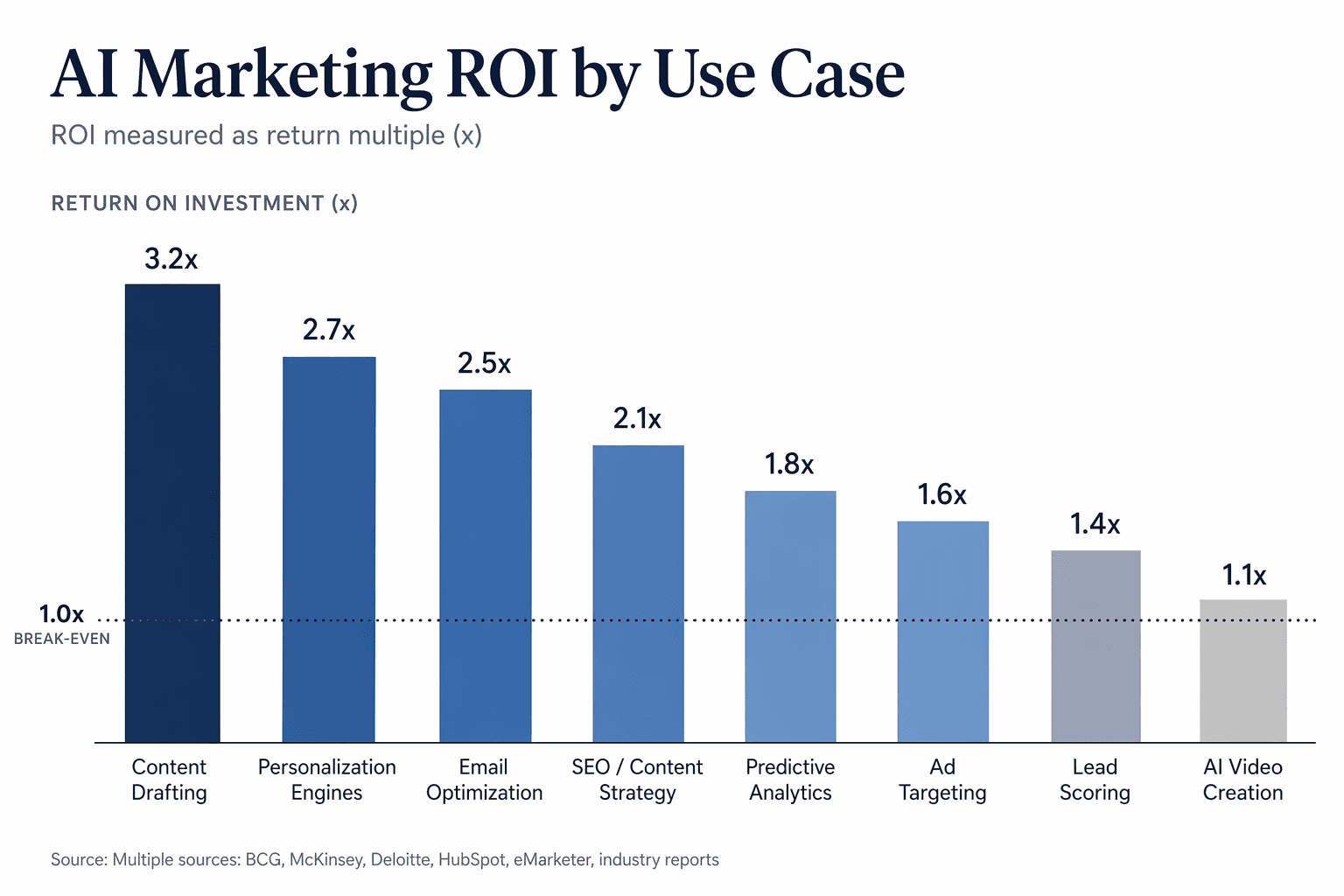
The most useful data for budget allocation comes from the McKinsey Global AI Survey 2026, which provides ROI estimates for twelve distinct AI marketing use cases. The range is wide — from 3.2x for content drafting down to 1.1x for AI video creation — and the interquartile ranges (IQR) reveal which applications have consistent returns versus high variance.
| AI Application | Median ROI | IQR Range | Maturity Signal |
|---|---|---|---|
| Content drafting | 3.2x | 2.4x – 4.1x | Mature; high consistency |
| Personalization engines | 2.7x | 2.0x – 3.6x | Mature; moderate variance |
| Audience research | 2.4x | 1.8x – 3.1x | Growing; tool-dependent |
| Ad copy generation | 2.3x | 1.7x – 3.0x | Mature; platform-specific |
| SEO briefs & content strategy | 2.1x | 1.5x – 2.8x | Growing; requires human review |
| Campaign analytics | 1.9x | 1.4x – 2.5x | Growing; integration-dependent |
| Email subject lines | 1.8x | 1.3x – 2.4x | Mature; diminishing returns at scale |
| Video scripts | 1.6x | 1.2x – 2.1x | Early; high variance |
| Lead scoring | 1.4x | 1.0x – 1.9x | Early; data-quality dependent |
| AI-generated paid social creative | 1.2x | 0.8x – 1.7x | Early; brand-safety risks |
| AI video creation | 1.1x | 0.7x – 1.6x | Experimental; quality ceiling |
The top three applications — content drafting, personalization, and audience research — account for the majority of AI budget allocation in most teams. Content and copy tools receive 42% of AI spending, personalization receives 23%, and analytics receives 18%, according to Gartner data. This concentration makes sense given the ROI data: the highest-return applications are also the most mature and the easiest to integrate into existing workflows.
For readers evaluating specific platforms, the Salesforce Marketing Cloud AI ROI article on this site provides a deeper look at implementation costs, payback periods, and real-world outcomes for one of the major enterprise platforms.
Where ROI Disappoints: AI Video and Paid Social Creative
Honesty about underperformance is a core part of Signal & Convert's editorial stance, and the data demands it. Two use cases stand out for their disappointing returns: AI video creation (1.1x median ROI) and AI-generated paid social creative (1.2x median ROI). Both are heavily marketed by vendors, but the evidence does not support the hype.
AI video creation suffers from a quality ceiling that current models have not突破. The output is adequate for internal communications, social snippets, and low-stakes testing, but it consistently underperforms human-produced video for brand campaigns, product demos, and any context where production value signals trust. The IQR of 0.7x to 1.6x means a significant minority of teams report negative returns after accounting for tool costs and human editing time.
AI-generated paid social creative faces a different problem: brand safety and differentiation. Platforms like Meta and TikTok have not solved the issue of AI-generated ad creative blending into the visual noise of the feed. Early adopters report that AI-generated static images and short-form video produce lower click-through rates than human-created alternatives, particularly for brands with established visual identities. The 1.2x median ROI reflects the fact that these tools save production time but often require extensive human revision to achieve acceptable performance.
Productivity Gains and the Changing Shape of Marketing Teams
The productivity story is clearer than the ROI story. The HubSpot AI Trends 2026 survey of 14,000 respondents found that the average marketer saves 6.1 hours per week using AI tools. But this average masks significant variation by role, and the implications for team structure are more complex than a simple efficiency gain.
| Role | Average Hours Saved / Week | Primary AI Use Case |
|---|---|---|
| Content marketer | 7.8 | Drafting, editing, content briefs |
| SEO specialist | 6.9 | Keyword research, brief generation, SERP analysis |
| Demand generation | 5.7 | Campaign analytics, audience segmentation |
| Product marketing | 5.4 | Competitive analysis, messaging drafts |
| Brand marketing | 4.4 | Creative briefs, brand guideline enforcement |
| Event marketing | 3.2 | Email sequences, landing page copy |
The headcount implications are already visible. According to the Gartner CMO Spend Survey 2026, 23% of agencies reduced junior copywriter headcount in 2025, and 31% plan further reductions in 2026. The roles being cut are the ones where AI substitution is most straightforward: first-draft writing, basic research, and template-based content production.
At the same time, demand for senior strategists, editors, and AI workflow architects is growing. The same Gartner survey shows that teams are reallocating the hours saved toward higher-value activities: strategy development, cross-channel orchestration, and performance analysis. The net effect is not a reduction in marketing headcount overall, but a shift in the composition of teams toward more experienced, higher-cost talent.
Agentic AI: The 2026 Frontier with High Reward and Real Risk
The most significant development in AI marketing in 2026 is the rise of autonomous agents. These are not chatbots or content generators — they are persistent, goal-oriented AI systems that execute multi-step workflows without human intervention at each step. Gartner reports that 34% of enterprise marketing teams now run at least one autonomous agent in production, up from just 14% in Q4 2025.
The average enterprise team operates 2.8 distinct agents, up from 1.1 six months ago. The most common applications are automated campaign optimization, cross-channel budget reallocation, and real-time audience segmentation. Successful deployments report ROI between 4.1x and 5.3x — significantly higher than any single-use AI application.
| Metric | Value | Source |
|---|---|---|
| Enterprise teams running ≥1 agent in production | 34% | Gartner, Q2 2026 |
| Adoption in Q4 2025 | 14% | Gartner |
| Average agents per enterprise team | 2.8 | Gartner, Q2 2026 |
| ROI for successful agent deployments | 4.1x – 5.3x | Gartner |
| Agent failure rate (abandoned within 90 days) | 29% | Gartner |
| Median payback period | 4.2 months | Gartner; down from 7.8 months in 2024 |
The 29% failure rate is the counterweight to the high ROI. Gartner identifies three primary causes: unclear success criteria (41% of failures), poor tool or data access (33%), and brand-voice drift (19%). These are not technical failures — they are governance failures. Teams that deploy agents without defining what success looks like, without giving them access to clean data, and without guardrails for brand consistency are the ones that abandon the effort within three months.
The Governance Gap: Why Only 31% of Enterprises Have AI Ethics Tools
The most uncomfortable statistic in this entire article is this: 74% or more of enterprises have adopted revenue-generating AI, but only 31% have deployed AI ethics tools. The gap between adoption and governance is not narrowing — it is widening as agentic AI accelerates.
The risks are not theoretical. Gartner's data on agent failures shows that unclear success criteria and brand-voice drift are already costing teams real money. Beyond agents, the broader governance challenges include:
- Unclear success criteria: Teams deploy AI tools without defining what "good" looks like, making it impossible to measure ROI or identify underperformance early.
- Poor tool and data access: AI tools are only as good as the data they can reach. Teams that restrict API access or fail to clean their data pipelines see significantly lower returns.
- Brand-voice drift: As AI-generated content scales, maintaining a consistent brand voice becomes harder. The 19% of agent failures attributed to brand drift will likely increase as multi-agent systems proliferate.
- Consumer trust erosion: YouGov data from 2026 shows that 80% of users report skepticism toward AI-generated answers. Brands that do not disclose AI use risk accelerating this trust decline.
- Regulatory exposure: FTC guidelines on AI disclosure in advertising are evolving. Teams without governance infrastructure are exposed to enforcement actions as regulators catch up to adoption rates.
The governance gap is not a technology problem — it is a prioritization problem. AI ethics tools receive only 3% of AI marketing budgets, according to Gartner, while content and personalization tools receive 65% combined. The imbalance is unsustainable. As one Gartner analyst noted, teams are building the engine before installing the brakes.
A Practical Action Framework for Mid-Market Marketing Teams
The data in this article is only useful if it translates into decisions. For mid-market marketing teams — the segment that has seen the fastest spending growth and faces the most acute resource constraints — here is a concrete action framework based on the benchmarks above.
1. Budget Allocation by ROI Band
Use the McKinsey ROI data to guide your spending mix. The median mid-market team spending $3,400 per month should consider this allocation:
| Category | Share of Budget | Rationale |
|---|---|---|
| Content & copy tools | 42% | Highest and most consistent ROI (3.2x); mature tool ecosystem |
| Personalization & audience tools | 23% | Strong ROI (2.7x); growing fast; requires clean data |
| Analytics & attribution | 18% | Moderate ROI (1.9x); enables measurement of all other investments |
| Agentic orchestration | 17% | High potential ROI (4.1x–5.3x) but high failure rate; start small |
2. Governance Investment (Non-Negotiable)
Reallocate 5–7% of your total AI budget to governance infrastructure. This includes:
- AI output review workflows (human-in-the-loop for all customer-facing content)
- Brand voice monitoring tools that flag deviations in AI-generated copy
- Disclosure templates for AI-generated ad creative and content
- Success criteria documentation for every AI deployment, including agents
3. Team Structure Adjustments
The Gartner headcount data signals a clear direction: reduce reliance on junior production roles and invest in senior editorial and strategic positions. For a mid-market team of 10–15 marketers, this means:
- One dedicated AI workflow architect (new role) to manage tool selection, integration, and agent deployment
- One senior editor per content team to handle AI output review and brand voice consistency
- Cross-training for existing team members on prompt engineering and output evaluation
4. Agentic AI: Start Small, Measure Tightly
The 29% failure rate for agent deployments is a warning, not a prohibition. The teams that succeed share three practices: they start with a single, bounded workflow; they define success criteria before deployment; and they maintain human oversight for the first 90 days. The 4.2-month median payback period means you can afford to experiment, but only if you are disciplined about measurement.
The landscape in mid-2026 is defined by a paradox: AI adoption is near-universal, but the variance in outcomes is wider than ever. Teams that invest based on data rather than hype, that build governance alongside capability, and that restructure their teams to emphasize strategic oversight over production volume will be the ones that see the 3x returns rather than the 1.1x disappointments.


Comments
Join the discussion with an anonymous comment.