
Beyond the publish date: What AI systems actually check when evaluating whether your content is 'fresh enough' to cite
Learn how AI search platforms (ChatGPT, Perplexity, Google AI Overviews) evaluate content freshness through a multi-layered framework—technical signals, semantic changes, user engagement, and external validation—and why updating only the date fails. This guide provides SEO professionals with a diagnostic model to maintain and improve AI citation visibility.
Introduction: Why publish dates are not enough for AI freshness
For years, the standard advice for maintaining content freshness was simple: update the publish date. That advice, inherited from a search era where Google’s Query Deserves Freshness algorithm was the primary freshness gatekeeper, no longer works in a world where AI systems extract and cite information from your pages. The evidence is now concrete. Ahrefs analyzed 17 million citations across seven AI platforms and found that AI assistants prefer content that is 25.7% fresher than organic search results — the average cited URL is 1064 days old versus 1432 days for organic results. But the article’s age alone doesn’t tell the full story. ChatGPT, for example, cites URLs that are 393 to 458 days newer than the organic SERP baseline, while Perplexity and ChatGPT both order in-text references from newest to oldest. The signal is real, and it’s layered.
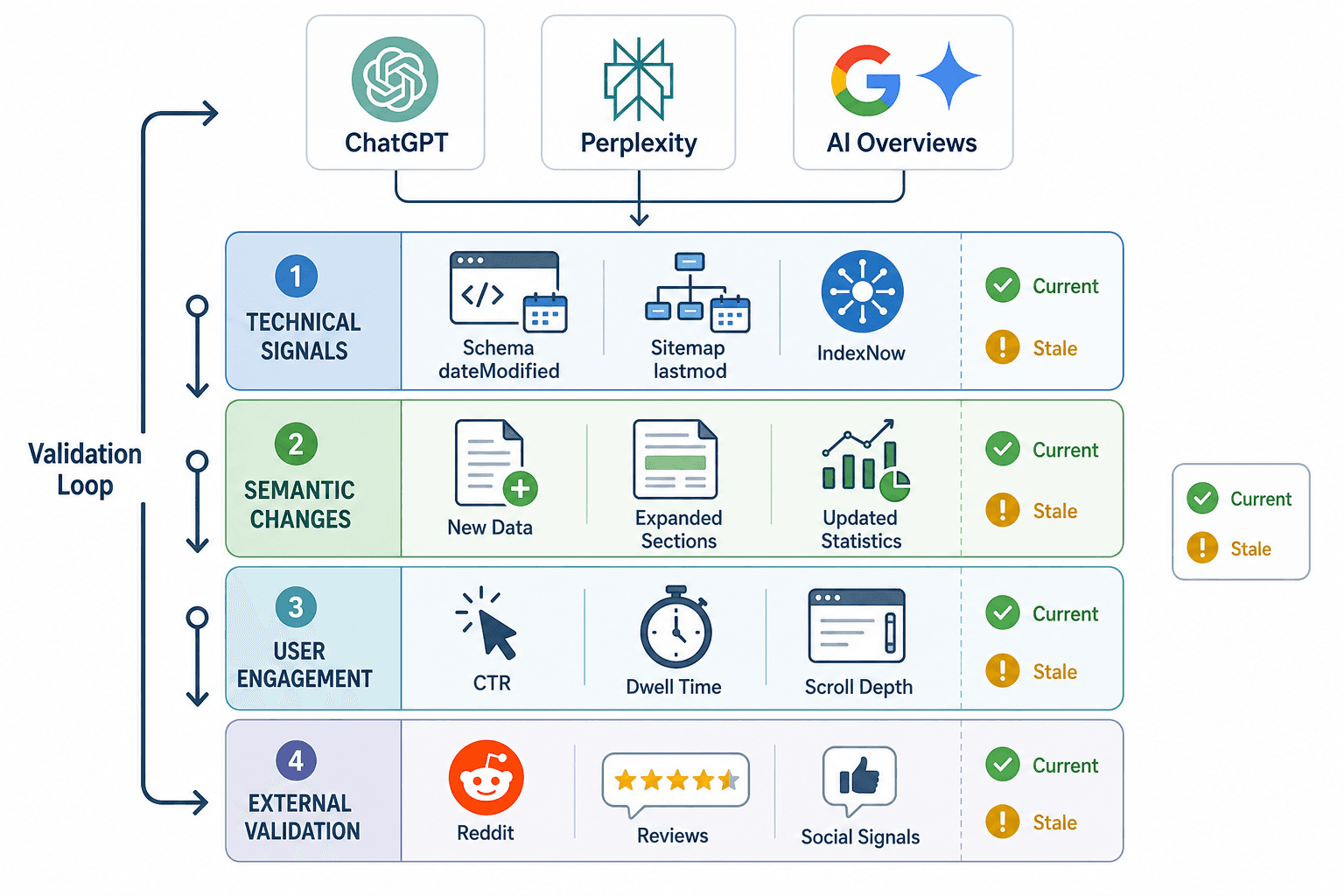
This article presents a four-layer framework that explains what AI systems actually check when deciding whether your content is fresh enough to cite. Each layer serves as a filter: if one layer fails, the system may deprioritize your page even if the others are strong. Understanding the stack allows you to diagnose why your content might be invisible to AI answer engines and to plan updates that produce durable visibility.
Layer 1: Technical signals — schema, sitemaps, and crawl frequency
The first checkpoint is purely infrastructural. AI retrieval systems — most of which rely on search engine indexes — need explicit technical indicators that a page has been updated. Without these signals, even a heavily revised page may be treated as stale.
The critical signals are three:
- dateModified schema markup — A structured data property that explicitly communicates the last time a page was substantially updated. Google and Bing both use this signal. It must update automatically when content changes, not on a fixed schedule.
- XML sitemap lastmod entries — The
<lastmod>tag in your sitemap must reflect actual content changes. Research from Discovered Labs found that most sitemaps are set incorrectly — Bing seeslastmoddates that match the sitemap generation date rather than the page’s last edit, which breaks the signal entirely. - IndexNow push notifications — A protocol supported by Bing, Yandex, and increasingly by other indexers. When you update a page, sending an IndexNow ping immediately signals the change. Because ChatGPT uses Bing’s index, accelerating your IndexNow pipeline can directly reduce the delay between an update and AI citation.
These technical signals act as the first-pass filter. If your lastmod is inaccurate or missing, the AI system may never crawl the updated version. But even if the technical layer is clean, the next layer — semantic analysis — will determine whether the update counts as substantial.
Layer 2: Semantic content change analysis — substantial vs. cosmetic edits
Once the technical signal passes, AI systems apply natural language processing to evaluate whether the page’s content has changed in a meaningful way. This is where the distinction between cosmetic and substantive updates makes or breaks your freshness score.
Google’s own guidance, cited by multiple analysts including Quattr, states that a substantial content update should involve a 20–30% textual change. This percentage is not a strict rule — Google has never published an exact threshold — but it aligns with what SEO practitioners consistently observe. Changes below that range, such as correcting a typo or rewording a single sentence, are treated as cosmetic and do not trigger positive freshness signals.
The semantic layer works by comparing the new version of a page against its previous version using techniques like cosine similarity and entity extraction. If the core answers, statistics, or arguments remain unchanged, the system infers that the page’s freshness is stagnant regardless of the date stamp. This explains why “date-only” updates are easily detected and ignored.
What qualifies as substantial? Adding a new section that addresses a recent industry development, updating statistical data from 2023 to 2025, incorporating new research findings, or rewriting a third of the page to reflect changed circumstances. The goal is not to swap words but to demonstrate that the page has been actively maintained in response to new information.
Layer 3: User engagement as a freshness validator
AI systems do not evaluate freshness in isolation. They also look at how real users interact with your page. High engagement metrics — click-through rate, dwell time, scroll depth — serve as second-order freshness signals. If users find your page valuable enough to spend time on, the system infers that the content is likely still relevant and up to date.
This layer can compensate for older timestamps. A page published two years ago that consistently earns a high time‑on‑page and low bounce rate may be cited over a freshly published page that users abandon quickly. Conversely, a page with a fresh date but poor engagement signals will struggle to gain AI visibility.
Key engagement metrics to monitor:
- Click-through rate (CTR) from search results. Fresh titles that match current user intent improve CTR, which Google uses for re‑ranking.
- Dwell time — the time a user spends on your page before returning to search results. Longer dwell time signals that the content satisfies the query.
- Scroll depth — how far down the page users scroll. AI systems favor content that is consumed thoroughly, not just skimmed at the top.
Adobe’s data adds a useful context: AI‑referred visitors browse 12% more pages per visit and show a 23% lower bounce rate than non‑AI referrals. This suggests that pages that already perform well with AI‑driven traffic have a structural engagement advantage that further reinforces their freshness signal.
Layer 4: External cross‑referencing — Reddit, reviews, and social proof
Perhaps the most overlooked layer is external validation. AI systems do not just trust what a page says about itself; they cross‑reference the page’s claims against external sources of recency. If your page claims to contain 2026 data but the surrounding web — Reddit threads, product reviews, social media mentions — shows no activity around your topic in the same period, the AI interprets your page as potentially stale.
The CITABLE framework from Discovered Labs formalizes this: freshness is a dataset property, not a page property. AI systems compare the timestamps on your page against the timestamps on external discussions. Reddit, in particular, has become a dominant freshness validator — it appears in 97.5% of product review queries across answer engines. Google’s reported $60 million deal with Reddit for AI training data underlines how seriously platforms take this signal.
Other external signals include review platform timestamps (e.g., recent G2 or Trustpilot reviews mentioning your product), blog comments that are actively moderated and date‑stamped, and backlinks that accrue after the page update. A spike in fresh backlinks following an update is a strong third‑party signal that the content is newly relevant.
The validation loop: How the four layers interact
These four layers do not operate independently. They form a validation loop: the technical signal gives the AI system permission to recrawl, the semantic analysis confirms substance, user engagement provides behavioral evidence of relevance, and external recency closes the loop by confirming that the update is recognized outside your own site. If any layer fails, the loop breaks.
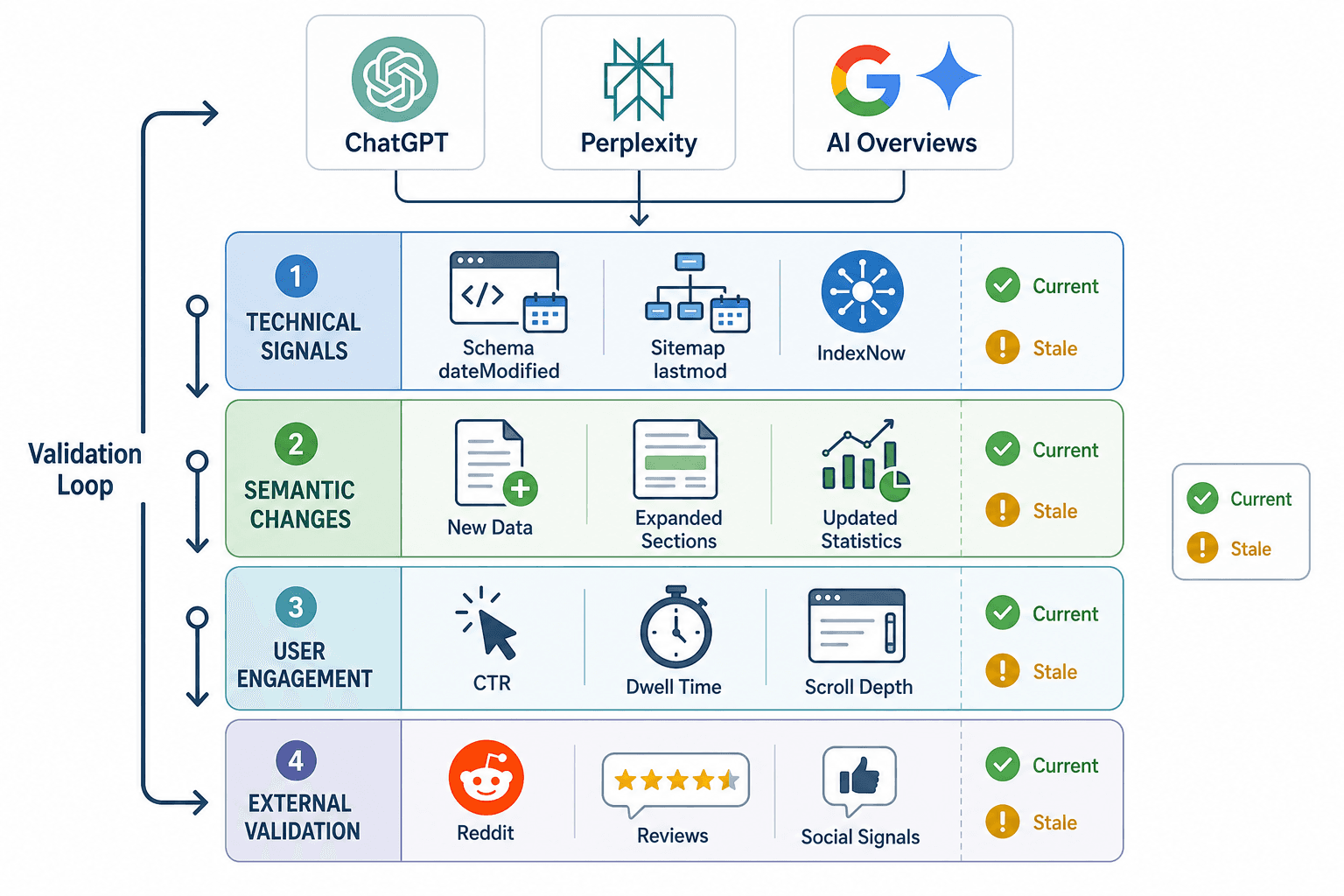
Consider a typical surface‑level update: you change the date but make no semantic change. The technical signal updates the lastmod and dateModified schema, but the NLP analysis finds near‑identical content. User engagement does not improve because the page offers nothing new. External recency shows no corresponding social or community activity. The AI system registers the date change, compares it against the other layers, and determines that nothing has genuinely changed. That is why John Mueller’s “just noise” comment is not just a quip — it describes a real failure in the validation loop.
Conversely, when all four layers align — a substantial rewrite with updated data, reflected in accurate technical metadata, followed by improved user engagement and fresh external mentions — the AI system has strong convergent evidence that the page is genuinely current. This is the state that produces the 3.2x citation uplift for content refreshed within 30 days that Quattr’s internal analytics observed.
Platform weighting differences: ChatGPT vs. Perplexity vs. Google AI Overviews
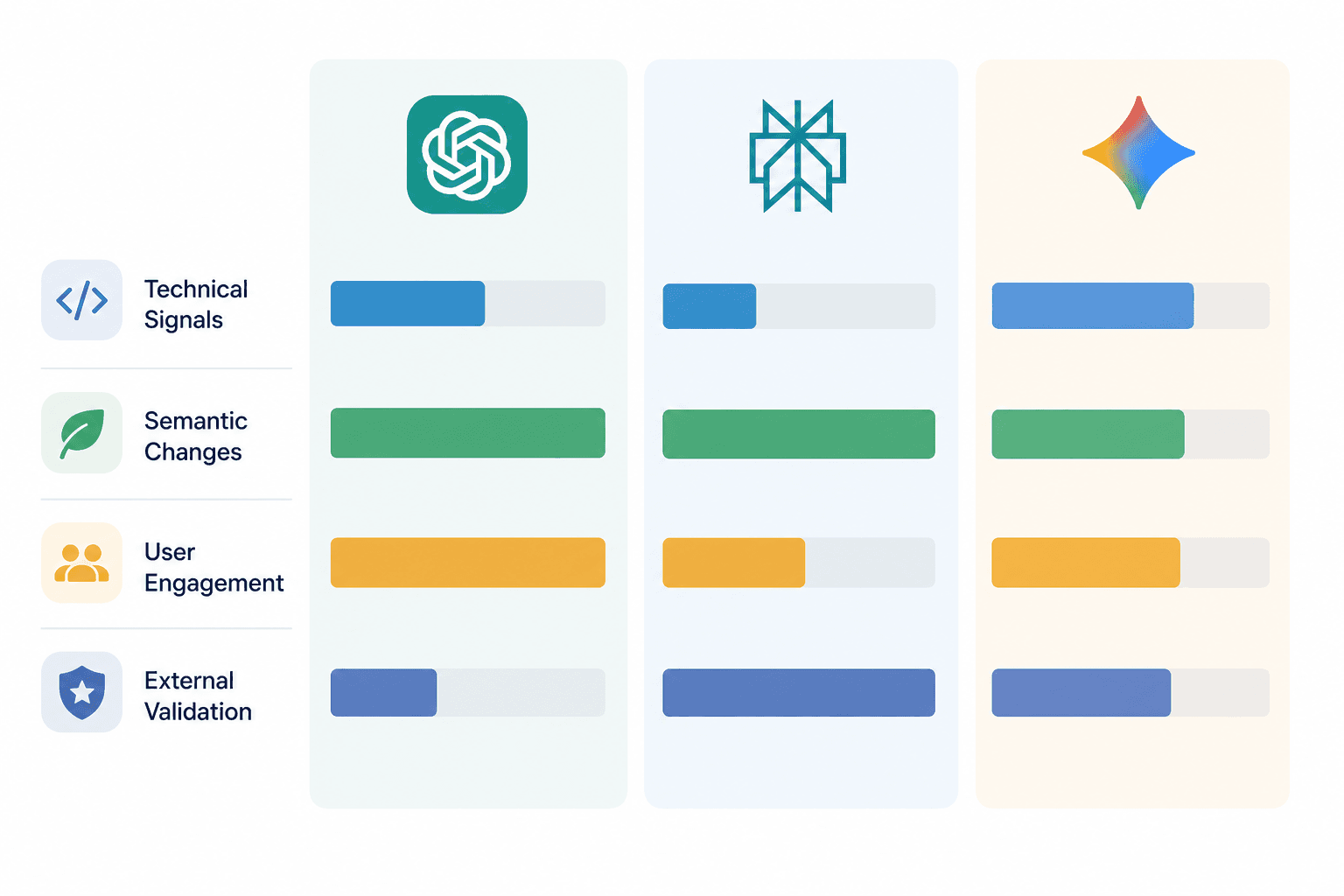
Although all AI platforms share the same four‑layer framework, they weight each layer differently. These differences matter because a strategy that works for ChatGPT may fail for Perplexity or Google AI Overviews. The table below summarizes the available evidence.
| Platform | Freshness preference | Key evidence | Decay pattern |
|---|---|---|---|
| ChatGPT | Strongest: cites URLs 393–458 days newer than organic SERP baseline | Ahrefs 17M citation study; prefers newest URLs | Over 70% of cited pages updated within 12 months; best performance in last 3 months (Stackmatix) |
| Perplexity | Strong, but with fast decay | Orders in-text references newest to oldest (Ahrefs); visibility drops 2–3 days after publication without refresh (Stackmatix) | Rapid decay: must refresh every 2–3 days for sustained visibility |
| Google AI Overviews | Moderate: cites slightly older content than organic SERPs | Ahrefs 17M study; content updated within 30 days sees 3.2x citation rate (Quattr internal analytics) | Slower decay than Perplexity, but pages not updated in 12 months risk disappearing from AI summaries (Marcel Digital) |
The differences have practical consequences. For ChatGPT, investing in substantial quarterly updates with strong semantic changes and accurate technical signals is likely sufficient. For Perplexity, a faster cadence — bi‑weekly or even weekly refreshes on high‑priority pages — may be necessary. For Google AI Overviews, the priority should be ensuring that pages updated within a 30‑day window carry all four layers intact, because that platform’s validation loop seems to reward coordinated freshness more than raw age.
Practical diagnostics: Auditing your content’s freshness signals
Theory is useful only if it leads to action. Below is a diagnostic checklist that walks you through each layer, identifies common failure points, and prescribes next steps. Use it quarterly for your highest‑value pages — the top 20% that drive the most AI referral traffic or rank for high‑visibility queries.
- 1. Audit technical signals. Check that
dateModifiedschema is present and accurate for every page. Use Google Search Console’s URL inspection tool to verify the indexed date. Compare your XML sitemaplastmodvalues against actual page edit times — they should match. Set up IndexNow push for immediate recrawl on update. - 2. Measure semantic depth. For each page you plan to refresh, calculate the word count change ratio. Aim for at least 20–30% new or substantially rewritten text. Use version‑control tools or content audit spreadsheets to track changes over time.
- 3. Review engagement metrics. In your analytics platform, look at CTR, average time on page, and scroll depth for pages you have recently updated. If engagement has not improved 4–6 weeks after an update, the semantic change may have been insufficient.
- 4. Check external recency. Search your topic on Reddit, review sites, and social platforms. Do recent discussions reference your page or similar information? If not, consider amplifying your update with a social post, community contribution, or outreach to generate fresh signals.
- 5. Set update cadences by page tier. Tier 1 (highest‐value pages that rank for high‐volume AI queries): refresh every 2–3 days for Perplexity, weekly for ChatGPT/Google AI Overviews. Tier 2 (industry trends): bi‑annual. Tier 3 (evergreen): annual, with a full validation loop check.
For a deeper walkthrough on structuring pages for AI answer engines, including how to write extractable content and optimize for citation, see our AEO Tactics for Marketers guide.
Conclusion: Next steps and related resources
AI freshness is a system, not a single signal. The four‑layer framework — technical infrastructure, semantic substance, user engagement, and external validation — provides a diagnostic language for understanding why your content is or is not being cited. Surface‑level tactics fail because they only address one layer, leaving the validation loop broken.
Start with the diagnostic checklist above. Identify the layer where your pages are weakest — it is often the semantic layer, because it requires real editorial work rather than a date change. Then set a tiered refresh cadence based on the platform where you most need visibility.
For continued reading, the AEO Tactics guide covers page structure and extractability, which complement the freshness signals discussed here. Together, these resources provide a complete playbook for maintaining AI citation visibility in a search landscape where freshness is no longer optional.


Comments
Join the discussion with an anonymous comment.