

What Micron's Stock Surge Tells Us About AI Marketing Costs
Marketing leaders can use Micron's stock performance and semiconductor supply-chain data as leading indicators to predict AI tool pricing shifts and investment timing, cutting through vendor hype with real-market signals.
Micron’s most useful signal for marketing leaders was not the stock chart. It was the product line it abandoned.
In December 2025, Micron stopped selling memory to consumers through its Crucial business after 29 years, saying demand from AI chips had made data center memory the better use of capacity. [1] That is a cleaner indicator than another survey saying executives are excited about AI. A major supplier looked at constrained production, compared consumer memory with AI infrastructure demand, and chose the latter.
For marketers, the point is not to become semiconductor analysts. It is to recognize when AI software pricing is being shaped upstream, before the increase shows up as a new platform tier, a usage cap, or a vague “AI add-on” line in a renewal.
The practical question behind Micron’s stock surge and the AI chip rally is simple: if AI tools already feel expensive, which upstream signals help a marketing leader judge whether pricing pressure is temporary, structural, or likely to ease later?
The useful signal is capacity allocation, not enthusiasm
AI adoption language is cheap. Capacity allocation is expensive. When a memory supplier exits a consumer channel to direct supply toward AI data centers, the decision has already passed through forecasts, purchase commitments, factory planning, customer concentration risk, and margin expectations.
That does not mean every AI product will justify its price. It does mean the infrastructure market is behaving as if AI demand is durable enough to pull scarce components away from established consumer categories.
The demand mix has changed quickly. Data centers accounted for about 50% of global DRAM consumption in 2025, up from 32% five years earlier, according to Bloomberg Intelligence reporting cited in Bloomberg’s coverage of the AI-driven memory shortage. [2] That shift matters because DRAM is not an abstract input. It is part of the physical stack behind model training, inference, cloud capacity, and the AI features now being packaged into marketing software.
The pricing signal has been just as blunt. DRAM spot prices surged more than 10x since early 2025, and Bloomberg reported that HP’s memory bill-of-materials share rose from 15%–18% to 35% in three months. [2] Those numbers are not about marketing software directly. They are about the upstream cost environment that cloud and AI vendors buy into before martech vendors buy from them.
How memory pressure reaches the marketing software budget
There is no single public dataset that says, “DRAM rose by X, therefore your campaign automation platform will charge Y more next quarter.” The chain is observable in pieces, and the final link is partly synthesized. That distinction matters when presenting the case to a CFO.
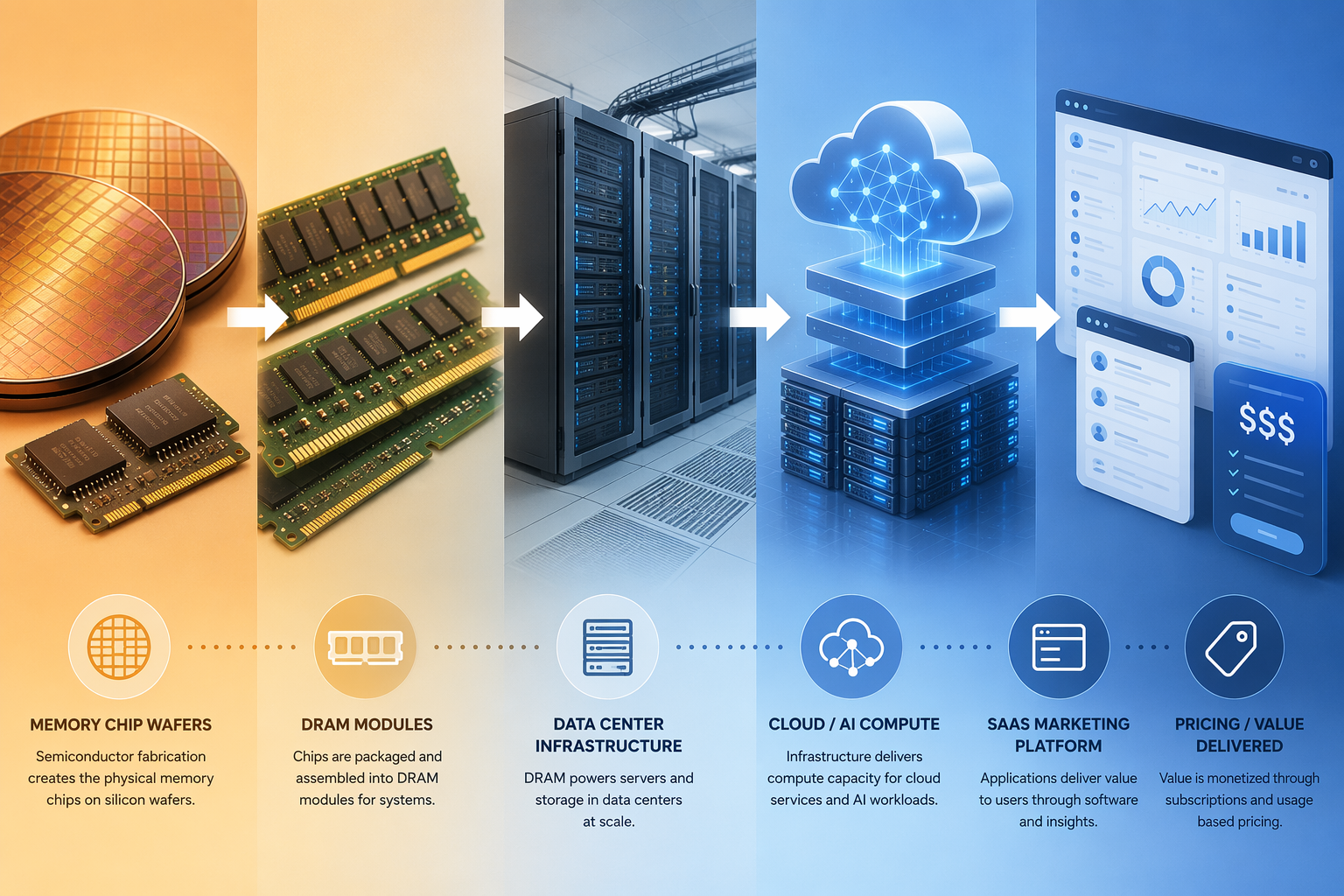
| Layer | What is observed | Marketing budget implication |
|---|---|---|
| Memory chips | DRAM demand has shifted toward data centers, and spot prices surged more than 10x since early 2025. | AI infrastructure remains expensive to expand. |
| Cloud and GPU capacity | Big tech is committing hundreds of billions of dollars to AI infrastructure. | Cloud providers have less incentive to discount scarce compute aggressively. |
| AI APIs and inference | AI inference becomes a recurring variable cost for SaaS vendors using models in production. | Vendors manage usage with caps, credits, overage fees, or premium packaging. |
| Marketing SaaS | AI features are increasingly sold as add-ons, enterprise bundles, or higher-priced tiers. | Marketing teams may see higher renewal pressure even when base seats do not change. |
The first two layers are the clearest. DRAM prices and data center consumption are directly reported. Big tech capital spending is also visible: Bloomberg reported that major technology companies were expected to spend about $650 billion on AI infrastructure in 2026, up 80% year over year. [3] That is the cash commitment behind the AI feature race marketers see downstream.
The later layers require more care. A martech vendor’s AI price increase may reflect higher compute costs, but it may also reflect margin strategy, packaging discipline, sales segmentation, or simple opportunism. Hardware pressure gives vendors a credible reason to charge more; it does not prove every increase is cost-based.
Still, the direction of travel is hard to ignore. Digital Bridge argued that AI API inference has become the largest variable cost for SaaS products using AI in production, estimating costs at $200 to more than $5,000 per month per product. [4] Vertice, in industry reporting published via Medium, put SaaS AI feature premiums at 49%–63% above base pricing. [5] Those figures are not a universal law of SaaS pricing, but they are consistent with what procurement teams are seeing: AI rarely arrives as a free feature once real usage begins.
Micron’s stock surge is confirming evidence, not the whole argument
The stock market is useful here, but only after the operating signal. Micron’s market performance and the broader chip rally show that investors are assigning value to AI memory demand, but a stock price is never a clean referendum on one business trend.
Reuters reported that June 2026 forecasts from Micron and Qualcomm helped ignite a $400 billion rally in AI chip stocks, while the PHLX chip index surged 90% in 2026. [6] That is a meaningful market signal. It also absorbs a lot besides end-customer AI demand: the three-company DRAM market structure, expectations around pricing power, U.S. industrial policy, geopolitics, investor momentum, and the scarcity premium attached to anything plausibly tied to AI infrastructure.
For a marketing leader, the lesson is not “Micron is up, so buy AI tools now.” The lesson is narrower and more useful: the equity market is validating what the supply chain is already showing. Memory capacity is being repriced around AI data center demand, and that repricing can travel into the cloud and software contracts marketers negotiate.
Four semiconductor indicators worth watching before the next AI renewal
A marketing team does not need a semiconductor dashboard with 40 charts. Four indicators are enough to improve timing and negotiation discipline.
1. DRAM contract and spot prices
Spot prices move faster; contract prices matter more for vendor economics. When both remain elevated, cloud providers and AI infrastructure buyers are still absorbing expensive inputs. That makes aggressive AI discounting less likely, especially for features that trigger real inference usage rather than simple workflow automation.
This is the indicator to watch before assuming AI add-ons will get cheaper just because more vendors offer them. Broad availability can coexist with high unit costs. A platform may roll out more AI features while tightening prompt credits, limiting included usage, or reserving advanced models for enterprise plans.
2. Data center share of DRAM consumption
The data center share is more strategic than a single monthly price move. If data centers continue consuming around half of global DRAM, AI infrastructure is not merely adding demand at the margin; it is competing with consumer electronics for the center of the memory market. [2]
That matters for martech because software vendors build pricing architectures around expected costs, not just current invoices. If the market believes AI infrastructure will continue taking a large share of memory output, vendors have more reason to create durable AI monetization structures: separate AI modules, metered usage, premium support, model-choice tiers, and enterprise-only governance features.
3. Big tech AI CapEx
CapEx is not the same as adoption, but it is better than sentiment. A company can say AI is strategic; spending on data centers, accelerators, networking, power, and memory shows how much capacity it is willing to finance.
The reported $650 billion AI infrastructure spend expected from big technology companies in 2026 gives marketers a way to separate product-demo enthusiasm from industrial commitment. [3] If that spending remains high, AI platforms will likely improve quickly, but the cost base behind those improvements will also remain visible in vendor pricing. If CapEx slows sharply, the interpretation becomes more complicated: price relief may improve over time, but feature roadmaps and capacity expansion could also slow.
4. Undersupply timelines
The timing question matters most during procurement. UBS estimated that the DRAM market would remain undersupplied into 2028, according to Business Insider. [7] That is not a guarantee, and it is not Micron’s own guidance. It is still a useful planning marker because it suggests memory pressure may outlast a single annual budget cycle.
The market structure reinforces the point. Samsung, SK Hynix, and Micron control about 95% of DRAM supply, which limits how quickly new supply can flood the market even when prices are attractive. [7] Oligopoly does not eliminate cycles, but it changes the speed and texture of relief.
What this changes in AI marketing tool decisions
The first budget implication is timing. If a team has a high-confidence AI use case with measurable labor savings, conversion lift, or revenue protection, waiting for near-term price collapse may be the wrong benchmark. The supply-chain signals do not point to immediate relief. They point to expensive capacity being rationed, expanded, and monetized.
That does not justify signing every AI contract in front of the team. It changes the negotiation frame. The issue is less “Is AI real?” and more “How much usage are we actually buying, what happens if usage grows, and who absorbs upstream cost changes during the contract term?”
- For mature, high-usage AI workflows: push for multi-year pricing protections, clear usage bands, and pre-negotiated overage rates.
- For experimental workflows: avoid broad enterprise bundles until usage is proven; buy narrower pilots with clean expansion terms.
- For vendors bundling AI into existing platforms: ask which features are included, which trigger metered consumption, and which require a higher tier.
- For agencies reselling or operating AI-heavy services: separate internal productivity gains from pass-through compute exposure so margin does not disappear inside delivery.
The second implication is contract language. “AI included” is no longer specific enough. A useful renewal should define included credits, model access, throttling rules, data retention terms, seat versus usage interactions, and what happens when the vendor changes its model provider or infrastructure costs increase.
A simple example: a marketing team may be comfortable paying a premium for AI-assisted content QA if usage is predictable and tied to a fixed campaign volume. The same team should be more cautious about a generative personalization feature that could scale with every visitor, every email variation, or every sales sequence. The budget risk is not the demo. It is the consumption pattern after rollout.
Where price relief may show up first
Not all AI marketing costs will move together. If memory remains tight, the features most exposed to heavy inference are less likely to become cheap quickly. That includes high-volume content generation, real-time personalization, conversational agents at scale, synthetic creative testing, and any workflow that repeatedly calls large models in production.
Relief is more likely to appear first in narrower features where vendors can optimize model size, cache common outputs, route tasks to cheaper models, or run smaller models for classification and summarization. A campaign taxonomy assistant and a real-time generative website experience do not have the same cost profile. They should not be evaluated with the same procurement logic.
Consumer electronics price pressure is a useful parallel, but it should not be overread. CNBC reported in June 2026 that rising memory chip costs were putting pressure on electronics retailers, with Apple, HP, and Dell among companies raising end-product prices. [8] That shows memory costs can pass through into visible end markets. It does not prove a one-to-one pass-through into martech. Software vendors have more pricing discretion than hardware retailers, and they often bury increases inside packaging rather than list-price changes.
How to use Micron as an early-warning system
The best use of Micron’s signal is not prediction theater. It is budget preparation.
Before the next AI software renewal, a marketing leader can check whether DRAM prices are still elevated, whether data centers continue taking a high share of DRAM output, whether big tech CapEx remains aggressive, and whether independent analysts still see undersupply lasting into later budget years. If those indicators remain tight, the team should assume vendors have more pricing leverage and should negotiate accordingly.
That means asking for pricing protections before adoption scales, not after the workflow becomes operationally embedded. It means forecasting usage in units the vendor actually bills against: generations, tokens, seats, contacts, messages, assets, automations, or API calls. It means comparing two tools not only on feature quality, but on how each one converts AI consumption into a renewal number.
Micron does not tell marketers which AI tool to buy. It does tell them that AI cost curves are being shaped by physical supply constraints, not just software competition. That makes contract timing, usage forecasting, and pricing protections more important than another round of vendor hype.
References
- Micron stops selling memory to consumers, demand spikes from AI chips, CNBC, December 2025.
- Why AI-Driven Memory Chip Shortage is Making Technology More Expensive, Bloomberg.
- Big tech will spend $650B on AI infrastructure in 2026, Bloomberg.
- The $200/Month SaaS Is Dead, Digital Bridge.
- SaaS AI feature premiums of 49-63% above base pricing, Vertice via Medium.
- June 2026 Micron/Qualcomm forecasts ignited a $400B AI chip stock rally, Reuters, June 2026.
- Has AI Ended the Memory Chip Boom and Bust Cycle for Good?, Business Insider.
- Rise in memory chip costs puts pressure on electronics retailers, CNBC, June 2026.

Comments
Join the discussion with an anonymous comment.