

Beyond Content Generation: Building an AI-Driven Marketing Stack That Predicts and Acts
This article moves past basic AI content generation to present a three-layer architecture—generative, predictive, and agentic—that senior marketers can use to build a mature AI stack, supported by adoption data, ROI benchmarks, and failure-mode analysis.
AI driven digital marketing in 2026 is no longer a question of whether teams use AI. Weekly use is still dominated by content generation, which accounts for 78% of usage, but enterprise marketing teams are also starting to run production agents at a much higher rate than they did in Q4 2025: 34% now report at least one in production [1][2].
The stack is moving faster than the content conversation
That shift matters because the return profile is no longer flat across use cases. Content drafting still shows about 3.2x ROI, AI video tends to land closer to 1.1x–1.6x, and agentic deployments are reporting 4.1x–5.3x on the workflows they replace, with the drafting benchmark itself varying widely by organization [2]. The practical reading is simple: generative AI remains useful, but the higher-leverage money is moving toward systems that can predict, route, trigger, and reconcile work across the stack.
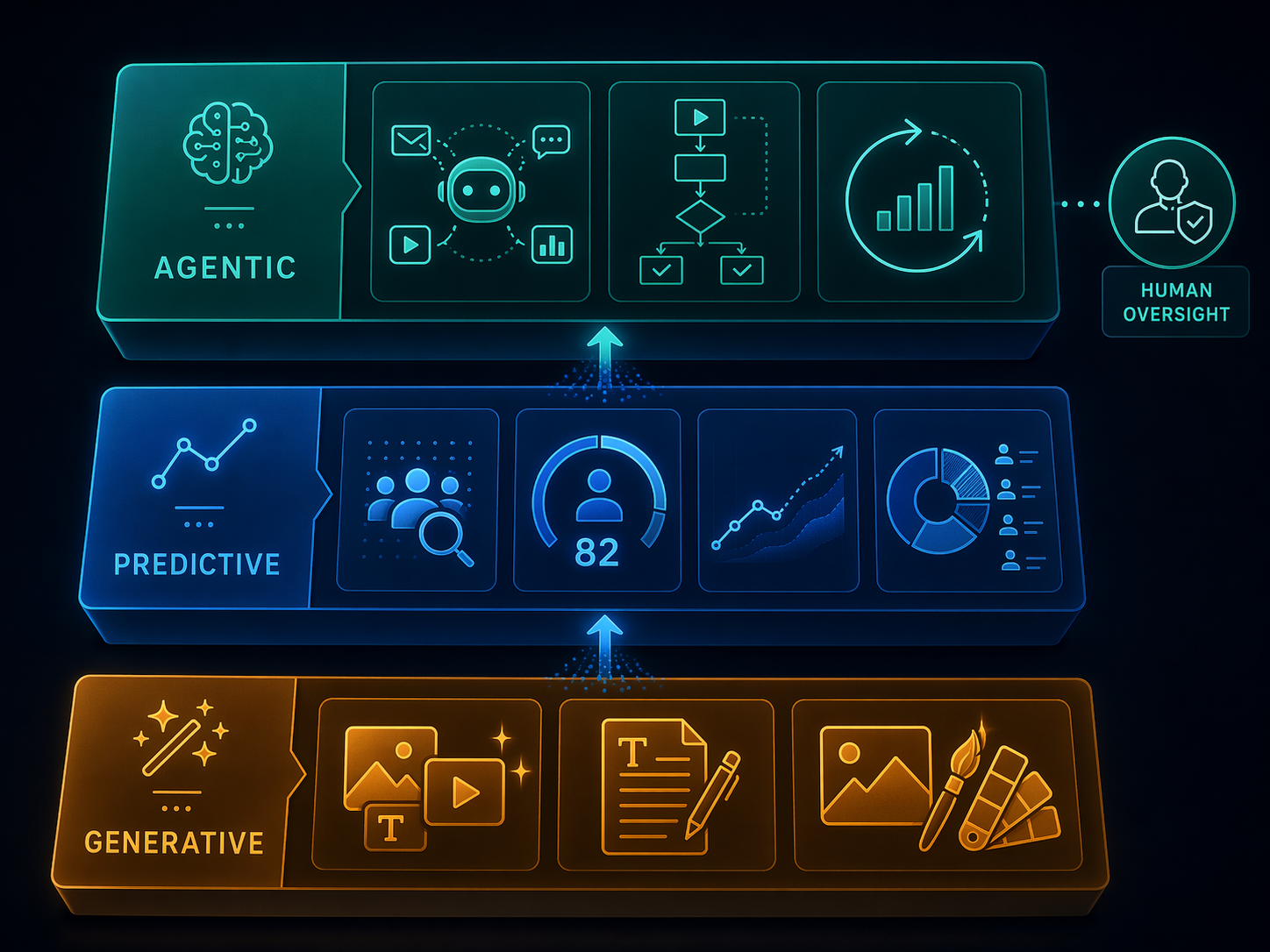
| Layer | Primary job | What it should answer | What breaks when it is misused |
|---|---|---|---|
| Generative | Drafting, rewriting, repurposing, summarizing | What should we create faster? | Teams confuse faster output with a strategy. |
| Predictive | Scoring, forecasting, segmentation, prioritization | What should we do next? | Scores get produced, but nobody owns the decision they are supposed to change. |
| Agentic | Orchestration, routing, triggering, pausing, reconciling | What can run safely without waiting on every human touch? | The system acts before the team has defined the guardrails. |
Generative is still the floor, not the finish line
For many teams, generative AI is still where the daily time savings show up first. It handles first drafts, variant generation, brief summaries, and content adaptation across channels, which is why it remains the baseline capability inside most marketing stacks [1][2]. If the team is still standardizing prompts, review steps, and content QA, the better off-ramp is to tighten the workflow itself rather than buy another writing tool; the content workflow guide is the more useful starting point here.
- Draft the first version of emails, ads, landing page sections, and social variations.
- Repurpose longer assets into channel-specific formats.
- Use human review for accuracy, tone, compliance, and brand consistency.
- Treat the output as production material only after it passes the same checks the team would apply to any other published asset.
Predictive is the bridge between content and action
Predictive AI matters because it changes which work gets priority. It is the layer that turns audience behavior, CRM history, product signals, and campaign response data into a decision about who should see what next. If the team has not tied AI to a business objective yet, the strategy framework belongs before model selection. Otherwise the stack just produces nicer-looking scores without changing revenue, retention, or pipeline.
The strongest predictive examples start with a business question, not a technology demo. Pecan AI’s aggregation of public earnings data and company announcements points to that pattern, though each figure should be verified against the original disclosures before anyone copies it into a business case [4].
| Company | Predictive use | Reported outcome | What it shows |
|---|---|---|---|
| Starbucks | Deep Brew predictive personalization | 30% global ROI uplift [4] | Personalization becomes a decision system, not just a content trick. |
| Progressive | Propensity modeling | $2B in premiums [4] | Prediction only matters when it changes who gets prioritized. |
| Grammarly | Einstein-based lead scoring | 80% increase in upgrades [4] | Scoring pays off when it sharpens follow-up and routing. |
| Netflix | Retention modeling | $1B+ in annual retention savings [4] | Forecasting has value when it protects recurring revenue. |
Agentic is where the stack starts to act
This is the layer getting the most attention because the operational gains are no longer abstract. AI-assisted decisioning has been associated with 25% faster campaign execution, 12% higher task completion, and 40% better output quality [2]. That is the kind of result that moves a marketing operations team from pilot mode into production mode.
The adoption signal is real but not a blank check. 34% of enterprise marketing teams now run at least one production agent, up from 14% in Q4 2025, but 29% of attempted deployments are abandoned within 90 days. The most common failure modes are not mysterious model flaws; they are unclear success criteria (41%), poor data access (33%), and brand-voice drift (19%) [2][3].
That is why the handoff points matter more than the label. An agent can route leads, launch approved variants, pause spend, reconcile reporting, or trigger a review when a threshold is crossed. It should not be allowed to guess at brand strategy, invent its own success metric, or operate without a rollback path. The human checkpoint belongs at the action boundary, not in every microstep.
- A single decision owner can name the business outcome the agent is improving.
- The data the workflow needs is available, current, and not trapped in one system.
- Success is visible in a metric the team already reviews.
- A human can approve, correct, or unwind the action without rebuilding the process from scratch.
Build or buy after the workflow is clear
Once the architecture is clear, tool choice becomes easier. The wrong sequence is to buy a broad platform and hope the workflow appears later. The better sequence is to define the decision, map the data, specify the guardrails, then decide whether the orchestration layer should be assembled internally or purchased. That is also where the agency-vs-platform decision guide becomes relevant.
If the team is still deciding how much budget belongs in experimentation versus infrastructure, the ROI benchmarks article and the budget allocation guide are better prep than another demo. They help separate isolated wins from stack-level investment.
The most durable ai driven digital marketing stack in 2026 is not the one with the most agents. It is the one that knows which workflows are ready to be predicted, delegated, measured, and safely corrected.
References
- AI Marketing Trends — Improvado
- AI Marketing Statistics 2026 — Digital Applied
- The Future of Marketing — Gartner
- 10 Companies Using AI for Marketing 2026 — Pecan AI

Comments
Join the discussion with an anonymous comment.