
How to Build a Summer Product Deal Workflow with AI Tools
Plan and execute summer product deals with a six-stage AI workflow. Learn which tools deliver measurable improvements at each stage — from audience targeting to performance measurement — backed by brand results like 41% conversion rates and 90% conversion uplift.
Summer deals rarely fail because the offer is weak. They fail because the work is split across audience exports, creative variants, channel owners, send-time guesses, and a recap that arrives too late to help the next launch. For Memorial Day, Prime Day, Labor Day, or the back-to-school handoff, AI tools for marketing summer product deals are most useful when they handle one stage at a time and keep the campaign connected from the first segment to the final report.
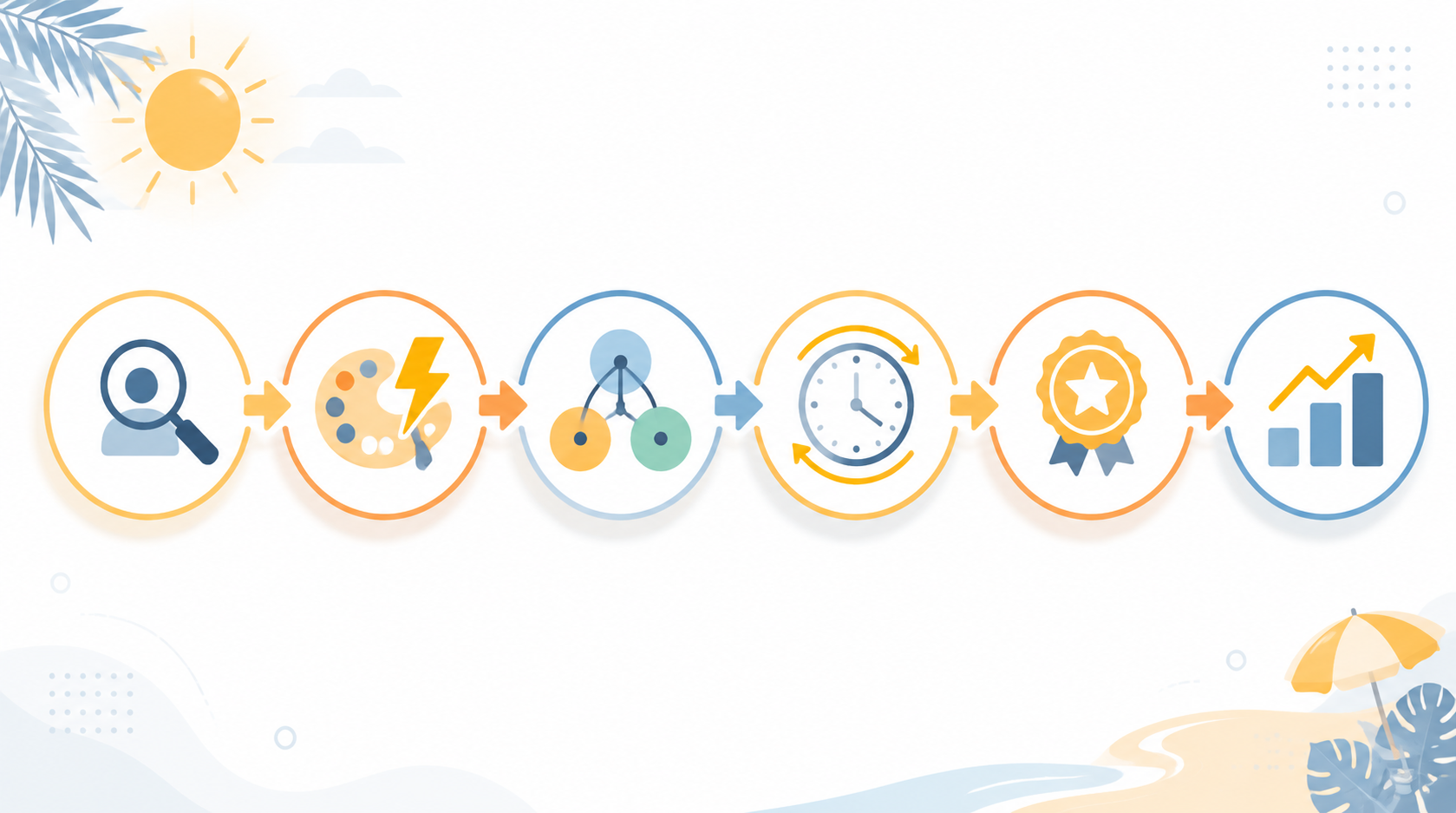
The workflow at a glance
A practical summer promotion workflow has six linked stages. The point is not to turn AI into an autonomous campaign manager. It is to remove the repetitive work that breaks under deadline pressure while leaving the campaign lead in control of offer logic, creative approval, and performance review. The evidence below is heavier on Braze because that is where the most useful summer-relevant case material is published; that makes the examples helpful, but still vendor-reported rather than universal benchmarks.
| Stage | What AI does | What still needs human control |
|---|---|---|
| Audience identification | Clusters buyers, browsers, and lapsed customers into usable segments | Offer rules, exclusions, and which audiences are worth the summer push |
| Creative production | Drafts and varies copy, visuals, and message angles across channels | Brand voice, legal review, and which claims are safe to use |
| Channel orchestration | Keeps email, paid media, social, and lifecycle messaging aligned | Channel order, overlap, suppression, and calendar handoffs |
| Send-time optimization | Chooses when each segment is most likely to act | Frequency caps, blackout periods, and launch windows |
| Personalization | Recommends products, offers, or content variants | Which data inputs are allowed and which exceptions need review |
| Performance measurement | Surfaces patterns in response, conversion, and revenue | What counts as success and how the result is explained upward |
Where the workflow starts to pay off
Creative production is not just a faster draft
The creative layer is where summer campaigns first start to multiply. A Memorial Day promotion may need a headline for email, a tighter version for paid social, a product-led variant for display, and a lifecycle message that does not repeat the same wording three times in a row. AI helps most when it turns one approved offer into multiple channel-ready versions without forcing the team to rebuild every asset by hand.
That is also where paid creative optimization becomes measurable. StackAdapt reports that Dynamic Creative Optimization produced 32% higher CTR and 56% lower CPC than static creative [2]. That is platform data, not a universal benchmark, but it is exactly the kind of number a campaign lead can use when paid media is chewing through summer budget and the team needs faster signal on which creative variant deserves more spend.
Channel orchestration keeps the deal from splintering
Once the creative variants exist, the campaign still has to move through email, paid media, social, and lifecycle messaging without each channel behaving like a separate promotion. AI can help coordinate audiences, suppressions, and message paths, but the campaign lead still has to decide the order of contact, the blackout periods, and which channel gets priority when audiences overlap.
Timing matters when the calendar is crowded
Send-time optimization is easy to describe and hard to do well during a seasonal burst. Audiences do not all open, click, or buy on the same schedule, and the pressure is worse when the deal window is short. Braze reports that foodora used Intelligent Timing to reach a 41% conversion rate and 26% lower unsubscribe rate [1]. That is a useful reminder that timing is not just about getting the send out sooner; it is about avoiding unnecessary fatigue while the offer is still relevant.
Personalization is where channel choice starts to matter
The personalization layer gets more interesting once the promotion has to travel across channels. Braze reports that Pazza Pasta used AI item recommendations to drive 6x higher purchase rates on WhatsApp than email, while a two-person team saved 12 hours per week [1]. That should not be read as a general rule that WhatsApp always outperforms email. It shows something narrower and more useful: recommendation logic can behave very differently depending on where the message lands, and automation can reduce the amount of manual work needed to keep that logic in place.
Braze also reports that Luxury Escapes saw a 10% revenue lift per user when AI-powered cohort assignment replaced rule-based segmentation in welcome flows [1]. That is the kind of result that makes audience work worth the trouble. If the segment is wrong, the offer logic is wasted. If the segment is right, later steps have a chance to compound rather than fight each other.
Dayuse adds a more direct personalization example: Braze reports a 90% conversion uplift after using BrazeAI Agent Console for personalized offer selection [1]. The useful part of that case is not that AI can pick an offer in the abstract. It is that the system was applied to a specific decision point that usually consumes time and introduces inconsistency when teams are trying to launch quickly.
Measurement gets easier when the workflow is connected
The final layer is not a dashboard polish exercise. It is the difference between a recap that says a campaign was busy and a recap that can defend why revenue moved. When audience selection, creative variation, timing, and personalization are all part of the same campaign logic, the measurement story is cleaner because the team can trace what was sent, to whom, when, and with which offer treatment.
That is why the best summer-deal results are usually the ones that span the workflow rather than sitting inside a single channel. Foodora’s timing gain, Pazza Pasta’s channel-specific recommendation result, Luxury Escapes’ cohort assignment lift, Dayuse’s offer selection improvement, and StackAdapt’s paid creative results all point in the same direction [1][2]: AI is most useful when it is assigned to a defined job, measured against the right channel metric, and kept under campaign lead control.
That also keeps expectations honest. These are promising vendor-reported cases, useful for planning and internal advocacy, not guaranteed forecasts. The realistic win is not autonomous seasonal marketing. It is a repeatable workflow where targeting, timing, offer selection, creative variation, and measurement reinforce each other without forcing the marketer to clean up every dependency by hand.
References
- 7 Top AI Marketing Campaigns in Action — Braze
- Dynamic Creative Optimization platform data, 2026 — StackAdapt

Comments
Join the discussion with an anonymous comment.