

Signal-Based Selling: How AI Achieves 5x Reply Rates in B2B Prospecting
Signal-based selling uses AI to identify real-time buying signals—job changes, funding events, technology adoption—to personalize outreach. This article explains how it achieves reply rates roughly 5x higher than cold email averages and what workflow changes sales and marketing teams need to make for consistent results.
Signal-based selling works because it changes who gets contacted and when. Instead of sending the same sequence to a static list, AI watches for real buying signals—job changes, funding events, hiring spikes, and technology adoption—and uses those triggers to personalize outreach. Autobound's 2026 platform data puts signal-personalized reply rates at 15–25%, versus a 3–5% cold email average, a roughly 5x gap that is large enough to change pipeline math. Those figures are directional benchmarks from vendor-reported data, not independent audits. [1]
What the lift actually comes from
The improvement is not just in the copy. Autobound reports that accounts with three or more active buying signals convert at 2.4x the rate of single-signal accounts, which suggests that signal density matters as much as signal type. The same source cites signal-qualified leads as producing 47% better conversion rates and 43% larger deal sizes, but those results still come from platform-linked data, so they are better read as benchmarks than universal outcomes. [1]
| Cold email | Signal-based selling |
|---|---|
| Static contact list, broad fit criteria | Buying trigger, account context, and fresh timing |
| 3–5% reply-rate average [1] | 15–25% reply-rate benchmark [1] |
| Success is often measured by replies | Signal-to-meeting rate matters more than raw replies |
That is why raw reply rate is not the cleanest success metric. A reply from the wrong account can make a sequence look healthier than it is, while a smaller number of replies from urgent triggers can produce more meetings. The metric that deserves more attention is signal-to-meeting rate, because it ties the signal to actual sales motion instead of inbox activity.
What has to change in the workflow
The real operational shift is cross-functional. Marketing has to detect, enrich, and structure the signals so they are usable inside the stack; sales has to work them quickly enough that the trigger is still fresh. That usually means a shared intelligence layer rather than a pile of disconnected lists and alerts. The point is not to automate outreach at scale, but to make the handoff from signal to message happen fast enough to matter.
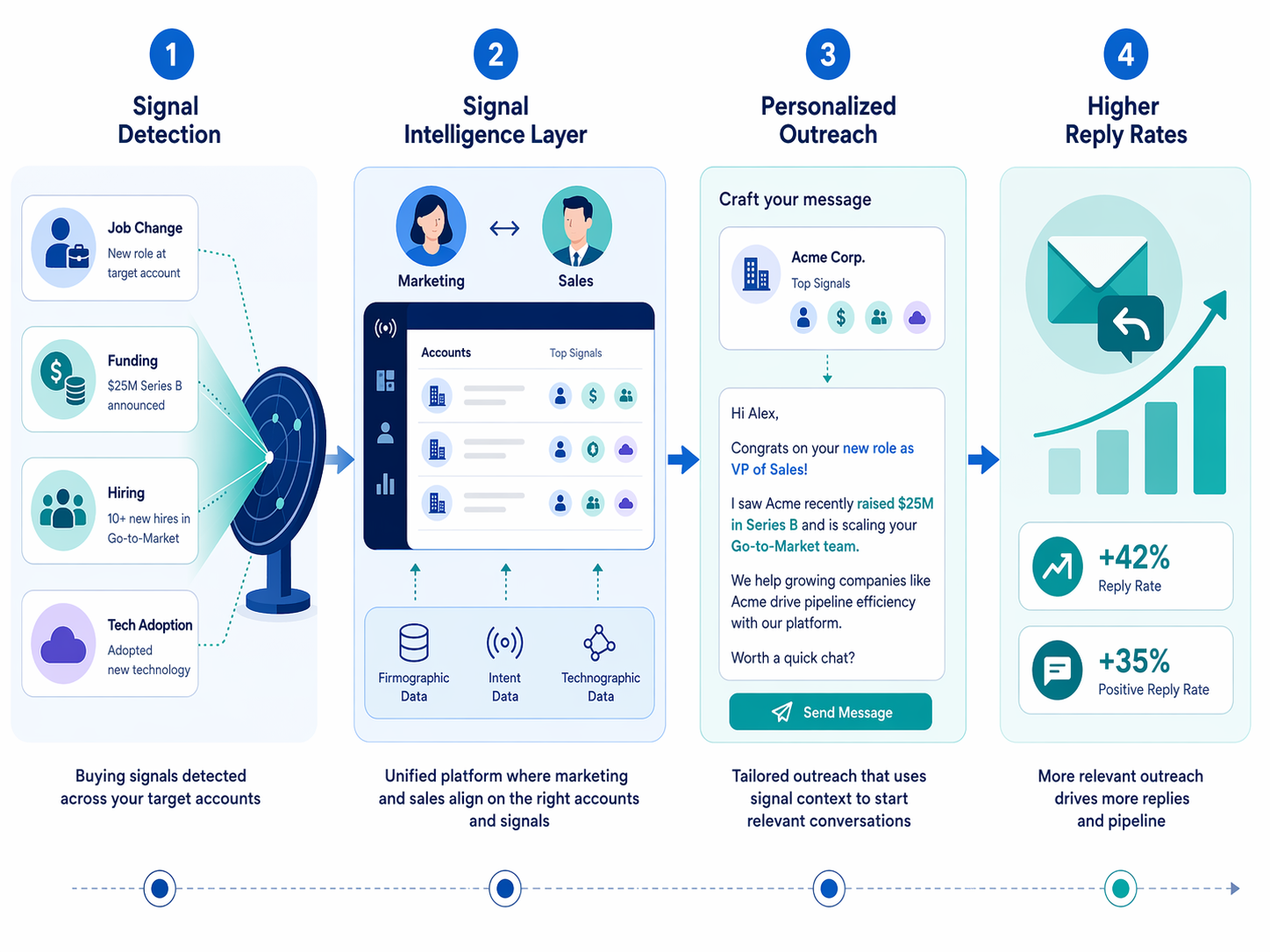
The window is still open, but not wide. Autobound cites data suggesting only 25% of B2B companies currently use intent or signal data tools, while Sopro's 2026 statistics say 94% of teams are already experimenting with AI in sales and marketing. That combination usually means the differentiator is no longer access to AI itself, but the quality of the workflow around it. [1][2]
Signal-based selling is strongest in B2B motions where account events are visible and the ideal customer profile is reasonably tight. It is weaker when signal quality is poor, routing is slow, or the team cannot agree on what counts as a usable trigger. In practice, the 5x reply-rate gap is real enough to matter, but it only holds when the signal reaches sales quickly and the outreach stays tied to the event that created it.

Comments
Join the discussion with an anonymous comment.