

4 Marketing Lessons from Samsung's Galaxy Z Fold 8 Launch
Samsung's Galaxy Z Fold 8 launch offers four repeatable tactics for marketing AI-powered products: lead with a visible physical transformation, earn attention through cryptic campaigns, use AI internally to accelerate launch decisions, and scale content through a global-local creator network. This article walks through each tactic with sourced examples for content marketers.
Samsung’s smartest Galaxy Z Fold 8 marketing move so far is not an AI claim. It is a rectangle.
Ahead of the phone’s official launch, Samsung appears to be making “wider” the first story the market has to decode. Android Central reported that Samsung wiped its Instagram account of about 2 million followers and replaced the feed with cryptic ASMR-style clips: a chocolate bar, a pizza slice, and paint being reshaped into a wider rectangle. When asked what was happening, Samsung said it would not explain until it was ready.[1] Forbes read the tease as confirmation of a wider 4:3 aspect ratio for the Galaxy Z Fold 8, positioning the shape itself as the launch clue.[2]
That matters for anyone planning a campaign around AI features. Buyers do not experience “AI” as a bullet list. They experience it as a changed screen, a shorter task, a better comparison, a faster answer, or a workflow that finally fits. Samsung’s pre-launch signals work because the physical form gives the AI story somewhere to live before the brand asks people to care about model behavior.
| Samsung move | What marketers can borrow | What not to overclaim |
|---|---|---|
| Lead with the wider form factor | Put the visible product change before the AI feature list | Do not treat form-factor interest as proof of product-market fit |
| Run a cryptic social reset | Give audiences and media something concrete to decode | Do not confuse curiosity with conversion |
| Use AI agents inside launch operations | Compress the time between signal and decision | Do not assume automation removes human judgment |
| Scale through modular local content | Separate global campaign architecture from regional execution | Do not present third-party ROI figures as audited Samsung results |
Start With The Thing People Can See
The usual mistake with AI product launches is to start with the AI features, then attach them to the device. Samsung’s better move is to reverse that sequence. The wider shape gets attention first. AI becomes the reason the shape is useful.
Samsung had already laid the groundwork for that logic before this launch cycle. In a Samsung Newsroom interview about One UI 8, the company’s design team described the 4:3 aspect ratio as a way to show AI-generated results in split view or floating view at the same time.[3] That interview was published in the Fold7 and Flip7 cycle, so it should not be treated as a direct Galaxy Z Fold 8 spec confirmation. It is still useful because it explains the design philosophy Samsung is carrying into foldables: the screen shape is not cosmetic packaging around AI. It is part of how AI output becomes usable.
That is the first transferable lesson. If an AI product has a visible change, lead with the changed surface. A wider canvas, a new workspace, a reconfigured dashboard, a different approval queue, a shorter intake form, a split-screen review mode—these are easier for a campaign to dramatize than “smarter assistance.” The marketer’s job is to make the buyer feel the behavioral promise before naming the model.
This does not mean hiding AI. It means refusing to let AI become launch wallpaper. “AI-powered” can explain why the experience improves after the audience understands what changed in their hand, feed, or workflow. In Samsung’s case, the wider rectangle creates the question. The AI story can then answer it.
Make The Tease Specific Enough To Decode
Mystery campaigns fail when they are only atmospheric. Samsung’s Instagram reset had a better asset: repetition with a rule. Chocolate, pizza, and paint are unrelated objects, but each was pushed into the same wider rectangular form. That gave audiences and reporters a pattern to solve instead of a mood to admire.[1]
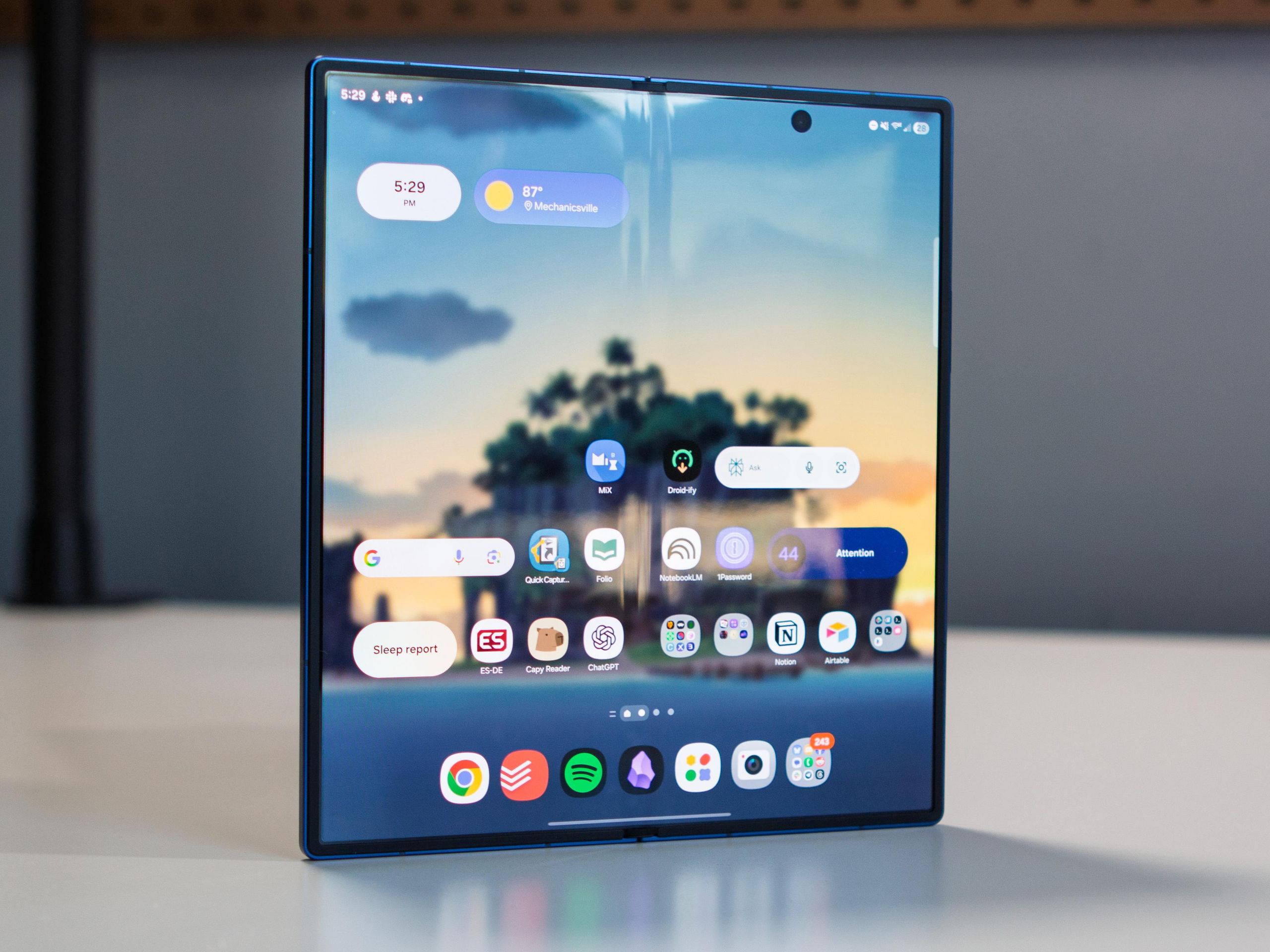
The restraint was also part of the mechanism. Samsung did not immediately publish a thread explaining the symbolism. It let Android Central cover the reset and quote the company’s refusal to explain. Then Forbes connected the campaign to the wider aspect ratio narrative.[1][2] That sequence created earned interpretation before the product had to carry a full launch message.
For social teams, the useful part is not “wipe your Instagram.” Most brands should not casually delete or archive a working channel just because Samsung can absorb the risk. The useful part is the editorial construction:
- Use one repeated visual rule that maps back to the product change.
- Choose objects people recognize instantly, so the transformation carries the meaning.
- Withhold the explanation long enough for interpretation, not so long that the audience loses the thread.
- Make the reveal capable of satisfying the clue, rather than feeling like a bait-and-switch.
The key distinction is between cryptic and vague. Cryptic gives the audience enough structure to participate. Vague asks them to care without evidence. Samsung’s wider-rectangle motif works because it is simple, repeatable, and tied to a visible product idea.
Use AI Where The Launch Team Feels The Delay
The less obvious AI marketing lesson from Samsung is not in the teaser at all. It is in the operating room behind the launch.
At Snowflake Summit 26, Samsung VP Seo Jeong-ah demonstrated consumer-insight AI agents analyzing Galaxy S26 sales data against prior models from Amazon and returning actionable insights “within seconds,” according to SammyFans’ report based on SEDaily coverage. The same report said this kind of work previously consumed hours.[4]
For a launch team, that is a more practical promise than “AI writes more copy.” The bottleneck in a campaign war room is often not the first draft. It is the lag between a signal and a decision: sales patterns, search traffic, demographics, creator performance, retailer movement, sentiment shifts, and regional promotion results arriving faster than people can synthesize them.
If AI agents shorten that loop, the marketing team can ask better operational questions while the launch is still alive:
- Which audience segment is responding to the wider-screen message versus the AI-productivity message?
- Which region needs more creator content, and which needs clearer product education?
- Which search queries are rising after the teaser, and do landing pages answer them?
- Which launch promotion deserves more budget, and what evidence is strong enough to justify the shift?
The last question is where human judgment stays in the room. Faster analysis does not decide what level of evidence is acceptable, whether a spike is durable, or whether a regional result should change global messaging. AI can compress the time between signal and possible action. It cannot carry the accountability for the action.
A Better Launch AI Brief
For content managers, this changes the AI brief. Instead of asking only for more campaign assets, ask where the launch loses time. The answer may be competitive monitoring, query clustering, regional performance readouts, creator brief matching, or promotion analysis. The most important AI feature in a launch may never appear in the product copy. It may be the internal system that helps the team decide what to change by Tuesday morning.
Build A Global Idea That Local Teams Can Actually Use
A wider foldable and a cryptic social reset can create the launch spark. They do not solve distribution. Samsung’s scale requires a content system that can travel without becoming generic.
Blankboard Studio’s 2025 analysis of Samsung’s marketing strategy reports a global network of more than 15,000 local micro-influencers and creators, more than 2,700 experiential stores, and modular campaign templates adapted by region, including cricket-themed work in India and Ramadan-focused work in MENA.[5] The same analysis reports a 3:1 ROI and 68% five-year user retention, but those figures should be read as third-party marketing analysis, not audited Samsung financial disclosure.[5]
The planning lesson is still valuable. Modular does not mean “translate the headline.” It means deciding which parts of the campaign must remain stable and which parts local teams can change without breaking the idea.
| Keep stable globally | Adapt locally |
|---|---|
| The core product behavior: a wider canvas for AI-assisted work and content | The cultural metaphor that makes “wider” feel relevant |
| The visual rule: familiar objects reshaped into the new form | The objects, creators, formats, and moments that fit the market |
| The evidence hierarchy: what counts as a strong launch signal | The channel mix and promotion timing |
| The claims boundary: pre-launch attention is not sales performance | The local proof points once real market data appears |
This is where many AI launches get brittle. The global team writes a grand AI promise. The regional team receives a deck full of abstractions. The creator gets a script that sounds like a product page. The result is technically aligned and socially dead.
Samsung’s better pattern is to give the system a tangible center. If the center is the wider canvas, local teams can find their own ways to show what “more room” means: studying, gaming, shopping, comparing, editing, navigating, watching, planning. The AI feature set can then attach to those behaviors instead of floating above them.
What To Borrow Without Copying Samsung
As of July 19, 2026, the Galaxy Z Fold 8 has not officially launched. That boundary matters. The available evidence supports an analysis of pre-launch signals, earned media, operating models, and content infrastructure. It does not support claims about sales performance, conversion lift, or long-term adoption for the Z Fold 8.
The campaign is still useful because it gives AI product marketers four planning prompts that do not depend on Samsung’s budget:
- Identify the visible change before writing the AI headline. If the product looks, feels, or behaves differently, make that the entry point.
- Design the tease around a decodable rule. Mystery earns attention when the audience can detect a pattern and the reveal pays it off.
- Deploy AI inside the launch process, not only inside the copy. Look for decisions that are slowed by messy signals, not just content tasks that need faster drafts.
- Modularize the campaign for local proof. Keep the product behavior and claims boundary consistent, then let regions adapt metaphors, creators, and formats.
Samsung’s Galaxy Z Fold 8 launch cycle does not prove that a wider foldable will win the market. It does show a cleaner way to market AI features: put a concrete transformation in front of the audience, let social curiosity build around it, use AI to help the team move faster behind the scenes, and give local marketers enough structure to make the story feel native.
References
- Samsung hits restart with a cryptic social campaign ahead of the Galaxy Z Fold 8, Flip 8, Android Central, June 30, 2026
- Samsung Confirms Galaxy Z Fold 8 Wide Smartphone In Juicy Tease, Forbes, July 1, 2026
- [Interview] When Foldables Meet AI: Behind the Scenes of One UI 8’s Development, Samsung Newsroom, August 2025
- Samsung giving AI a bigger role in Galaxy launches, SammyFans, June 3, 2026
- Samsung Marketing Strategy, Blankboard Studio, 2025

Comments
Join the discussion with an anonymous comment.