

What Can Samsung Galaxy Card Learn from Apple Card's Marketing?
A comparison of the marketing launch strategies behind Apple Card (2019) and Samsung Galaxy Card (2026), and the strategic lessons for financial services marketers evaluating co-brand or ecosystem credit card launches.
Apple Card won the visible launch battle before many incumbent issuers seemed to notice there was a battle. Within 24 hours of its August 2019 launch, Apple Card reached the No. 3 impression-share position in Google search advertising, captured roughly 70% of impressions, bid on more than 400 terms, and drew 12% of its impressions from competitor brand terms.[1] For a credit card, that was not a polite brand extension. It was a search land grab.
That is where any serious Samsung Galaxy Card vs. Apple Card marketing comparison has to begin. Not with titanium cards, phone ecosystems, or a generic rewards chart, but with launch-channel control. Apple turned demand formation into a paid-search event. It met curious consumers, Apple loyalists, card shoppers, and even competitor-intent traffic before the category’s usual defensive bidders had adjusted.
But the later Apple Card story makes that launch victory look incomplete. Apple disclosed 12 million Apple Card users by 2024, while a third-party compilation cited by WIRED estimated 18.2 million users by the end of 2025; WIRED also quoted experts describing the product as “fine” and saying it “never became a mainstream challenger.”[2] Meanwhile, Goldman Sachs’ Apple Card partnership became associated with losses and regulatory scrutiny, including a gender-discrimination probe.[2] The launch worked; it just did not make the full credit-card business simple.
Apple’s real first-mover advantage was search ownership
“First mover” is often used lazily in financial marketing. Being first to announce a product is not the same thing as owning the customer’s first serious search. Apple Card did the latter. The Financial Brand’s launch-window analysis showed Apple bidding on more than 400 terms and quickly reaching about 70% impression share in August 2019.[1] The time window matters: those figures describe the launch burst, not a permanent search position. Still, as a launch tactic, it was unusually disciplined.
The competitor-term share is the part card marketers should not skip. If 12% of impressions came from competitor brand terms, Apple was not merely harvesting people already typing “Apple Card.”[1] It was intercepting comparison behavior. That changes the role of search from fulfillment to positioning. A customer looking for another issuer’s card could be made to evaluate Apple Card before reaching that issuer’s funnel.
That kind of move is uncomfortable inside a bank. Competitor bidding raises budget questions, legal review questions, brand-risk questions, and landing-page quality questions. Apple appeared to have the organizational alignment to move quickly anyway. The speed was part of the strategy.
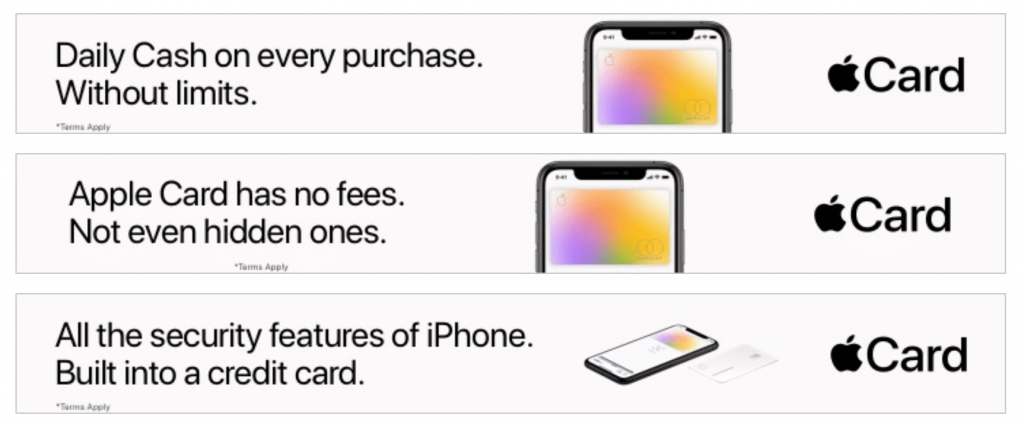
The creative matched the channel discipline. Apple Card’s early marketing leaned on minimalist product presentation, no annual fee messaging, and a product-page-as-landing-page experience rather than the standard card-launch stack of bonus math, dense comparison modules, and rotating promotional claims.[3] There was no sign-up bonus to carry the proposition.[3] That was either brave or very Apple, depending on one’s tolerance for acquisition-cost orthodoxy.
In most card programs, a no-bonus launch would trigger the same internal objection: what gives the undecided applicant a reason to apply now? Apple’s answer was not a bonus. It was momentum, distribution, and simplicity. The product page reduced friction. The search buy filled the top of the funnel. The brand did the work that a $200 or $300 bonus often has to do elsewhere.
That is a useful lesson, but a narrow one. Apple could break card-marketing conventions because it had unusually concentrated consumer attention, a controlled device ecosystem, and the confidence to make the product page itself feel like the application prelude. A regional bank, fintech, or retailer copying the no-bonus aesthetic without Apple’s search pressure and brand demand would mainly be copying the easiest-looking part.
The launch promise eventually met issuer economics
The hard part of a credit-card launch starts after the dashboard says acquisition is working. Then underwriting quality, reward cost, servicing load, disputes, credit losses, partner incentives, and regulatory exposure begin to express themselves. Brand teams may still be celebrating; issuer teams are already looking at cohorts.
Apple Card’s later record is mixed enough that marketers should resist both triumphalism and dismissal. The program reached real scale: Apple said in 2024 that Apple Card had more than 12 million users.[2] CoinLaw’s compiled third-party estimate, cited by WIRED, put the figure at 18.2 million by the end of 2025, but that should not be treated as an official Apple disclosure.[2] WIRED’s expert framing is more useful than the exact estimate: Apple Card became a credible product, yet not a mainstream challenger on the level implied by the launch mythology.[2]
The partnership strain was more than a footnote. WIRED reported that Goldman Sachs’ Apple Card relationship was tied to losses and regulatory scrutiny, including a gender-discrimination probe.[2] That does not erase the marketing achievement. It does put the achievement in its proper container. Paid search can create demand. It cannot repair a partner model if the economics, risk controls, and servicing expectations do not hold.
Apple also had evidence of ecosystem value beyond the card account count. CoinLaw reported that Apple Card’s 0% financing on Apple products drove a 36% increase in hardware purchases and that Apple Card Savings deposits reached $16.5 billion by 2025.[4] Those are meaningful ecosystem signals. They suggest the card was useful as a commerce and financial-services layer around Apple customers, even if it did not become a broad-based credit-card insurgent.
That distinction is easy to lose in launch retrospectives. A card can be strategically valuable to a platform without becoming a category-redefining challenger. It can increase device purchasing, deepen wallet behavior, and create deposit relationships while still disappointing an issuer’s profit expectations. Those outcomes sit in different columns of the operating review.
Samsung cannot replay 2019, so it is making a different argument
Samsung Galaxy Card enters a very different market. It launched in the U.S. in the July 20–22, 2026 window, so there is no responsible adoption curve, campaign-performance readout, or cohort-quality story to analyze yet.[5] Any confident claim about early traction would be theater. What can be evaluated is the launch proposition Samsung has chosen.
The Galaxy Card is not trying to look more elegant than Apple Card. It is trying to look more economically explicit. The announced rewards structure offers 5% back on Samsung direct purchases, 3% through Samsung Wallet, 2% on streaming, and 1% on everything else, plus a $200 sign-up bonus.[5] It is a Barclays-issued Visa co-brand, and Samsung says non-Samsung-device owners can access it through the Barclays.com portal.[5]
| Launch proposition | Apple Card, 2019 | Samsung Galaxy Card, 2026 |
|---|---|---|
| Primary marketing edge | Search dominance and brand-led simplicity | Reward superiority, bonus offer, and issuer/co-brand infrastructure |
| Launch offer posture | Minimalist creative; no sign-up bonus | $200 sign-up bonus |
| Ecosystem reward hook | Apple product and Apple Pay-centered utility | 5% Samsung direct; 3% Samsung Wallet |
| Issuer partner context | Goldman Sachs launch partnership, later strained | Barclays/Visa co-brand at launch |
| Evidence available now | Launch-window search data plus later user and partnership record | Product terms and analyst context only; no adoption data yet |
That table is not a consumer recommendation. It is a positioning map. Apple’s 2019 offer trusted attention and experience design to overcome the absence of a bonus. Samsung’s 2026 offer assumes the second mover needs visible economics. That is a reasonable concession, not a lack of imagination.
Samsung also has a distribution story worth taking seriously. eMarketer reported that Samsung and Barclays are targeting a U.S. Samsung smartphone base of 128.7 million, and it framed Barclays’ co-brand experience as part of the bet.[6] A phone base is not the same as a qualified card prospect, and it certainly is not the same as active card usage. But for marketers, it defines the reachable audience and the natural moments for offer placement: device upgrade, Samsung.com checkout, Samsung Wallet activation, financing consideration, and post-purchase accessory or services engagement.
The broader Samsung device playbook matters here only to the extent that it gives the card useful surfaces. A card can be introduced around a foldable launch, a trade-in moment, or a wallet prompt without asking the customer to enter a separate financial-services universe. For readers tracking how Samsung packages device launches more broadly, the same ecosystem logic shows up in our analysis of Samsung’s Galaxy Z Fold 8 marketing lessons.
Barclays is part of the marketing message, whether Samsung says it loudly or not
In co-brand cards, the issuer is never merely back-office plumbing. The issuer shapes underwriting, compliance, servicing, charge-off tolerance, offer economics, and how quickly the program can adapt after launch. That is why Samsung’s Barclays relationship matters as a marketing fact, not just a legal line in the disclosure.
Samsung’s timing also benefits from Apple’s issuer transition. Apple announced in January 2026 that Chase would become the new issuer of Apple Card, with the transition expected to occur over roughly 24 months.[7] That does not mean Apple Card is weak today, and the final feature impact remains unconfirmed. But transition periods create uncertainty for customers, partners, and competitors. They also give a second mover permission to talk about reliability, continuity, and co-brand operating discipline without sounding purely defensive.
Samsung should not overplay that hand. Attacking an in-process issuer migration can look opportunistic, and Chase is not a fragile counterparty. The more credible move is subtler: make the Barclays/Visa structure feel dependable, make rewards easy to understand, and avoid a launch message that depends on consumers caring about card-industry inside baseball.
The wallet risk should be treated as a question, not a conclusion
Samsung’s wallet-centered reward tier gives the Galaxy Card a clean ecosystem behavior to promote: use Samsung Wallet, earn more. The risk is that wallet behavior may not be strong enough in the U.S. to carry the proposition on its own. The available brief references a declining Samsung Pay adoption trend from Statista, but that source was not directly reviewed here, so it should be treated as a verification item rather than a settled premise.
Even without leaning on that unverified trend, the strategic concern is obvious. A 3% Samsung Wallet tier is only powerful if enough eligible customers are willing to make Samsung Wallet part of their payment routine. A wallet limited to Samsung devices can still be valuable, especially inside a large device base, but it narrows the behavioral path. Samsung’s choice to make the card available to non-Samsung-device owners through Barclays.com helps broaden access, yet the strongest rewards still point back to the Samsung ecosystem.[5]
That is the operating trade-off. Ecosystem cards need privileged behaviors, otherwise they become generic cashback products with a famous logo. But the more tightly the reward value depends on ecosystem behavior, the more the card inherits the ecosystem’s adoption limits.
What financial marketers should actually take from the comparison
The wrong lesson from Apple Card is that a beautiful product page and a premium brand can suspend the rules of credit-card economics. They cannot. The better lesson is that launch-window channel aggression can permanently shape the terms of comparison. Apple made “Apple Card” feel like the object of search demand and then used paid search to intercept adjacent demand before competitors had organized a comparable response.
For a financial-services marketer planning a co-brand or ecosystem card, the Apple playbook breaks into a few usable decisions:
- Decide which search terms must be owned in the first launch window, including competitor and category-intent terms where legally and operationally acceptable.
- Make the landing experience match the promise; do not send high-intent traffic into a generic card page built for every audience.
- Be honest about whether the offer can succeed without a bonus. Most brands do not have Apple’s demand advantage.
- Model the post-acquisition economics with the same seriousness as the launch media plan.
- Treat the issuer relationship as part of the product architecture, not as a procurement detail.
Samsung’s lesson is narrower because the Galaxy Card is too new to judge by outcomes. Its strategic choice is clearer than its likely result. It cannot recreate Apple’s 2019 search shock; consumers, competitors, and analysts now understand that tech-platform credit cards are a category. So Samsung has to compete through visible reward math, device-commerce utility, Barclays’ co-brand infrastructure, Visa acceptance, and the opening created by Apple’s issuer transition.
The danger for Samsung would be mistaking higher reward rates for a complete go-to-market strategy. A 5% Samsung direct tier is useful when it is tied to upgrade cycles, financing moments, and high-consideration purchases. A 3% wallet tier is useful when it changes repeat payment behavior. A $200 bonus is useful when it brings in customers who can be retained after the bonus is earned. Each piece has to move a specific behavior, not simply improve the comparison chart.
Apple proved that launch-channel domination can create brand-term ownership and cultural visibility. Apple’s later experience proved that issuer alignment, economics, compliance, and execution decide whether that visibility compounds. Samsung does not need to chase the shape of Apple’s 2019 launch. In Q3 2026, its better opportunity is to make the Galaxy Card feel economically worth adding and operationally safer to trust, while Apple Card moves through its Chase transition. Whether Samsung can turn that into adoption is still unknown. The durable marketing lesson is not.
References
- Apple Card Takes Over Google Search for Big Marketing Launch — The Financial Brand
- The Galaxy Card Is Samsung's Answer to the Apple Card — WIRED
- Apple Credit Card Marketing Bucks Best Practices — Media Logic
- Apple Pay Statistics 2026: Powerful Market Insights — CoinLaw
- Samsung launches its first credit card in the U.S. — Yahoo Finance
- Barclays, Samsung bet on co-brand flywheel — eMarketer
- Chase to become new issuer of Apple Card — Apple Newsroom, January 2026

Comments
Join the discussion with an anonymous comment.