
Salesforce Einstein Marketing Cloud: Which Features Actually Deliver ROI
A tiered audit of 15 Einstein Marketing Cloud features ranking them by measurable ROI, with honest analysis of deployment prerequisites and which features underdeliver for mid-market organizations.
The budget question around Salesforce Einstein Marketing Cloud is not whether the AI sounds useful. Most of it sounds useful. The better question is which features turn existing campaign behavior into a next action that a normal marketing operations team can measure before the next renewal.
On that standard, the feature set separates quickly. SalesforceBen’s catalog of Marketing Cloud Einstein features is the most useful starting point because it shows both the inventory and the access problem: some capabilities sit behind higher Marketing Cloud editions or add-ons, with Corporate listed from $3,750 per org per month, while other pricing references describe Einstein for Marketing Cloud from $1,500 per month plus usage, likely reflecting different packages or tiers.[1][2] That gap matters. A feature can be technically impressive and still be a poor mid-market purchase if it needs an edition upgrade, clean opportunity-contact data, or send volume the team does not have.
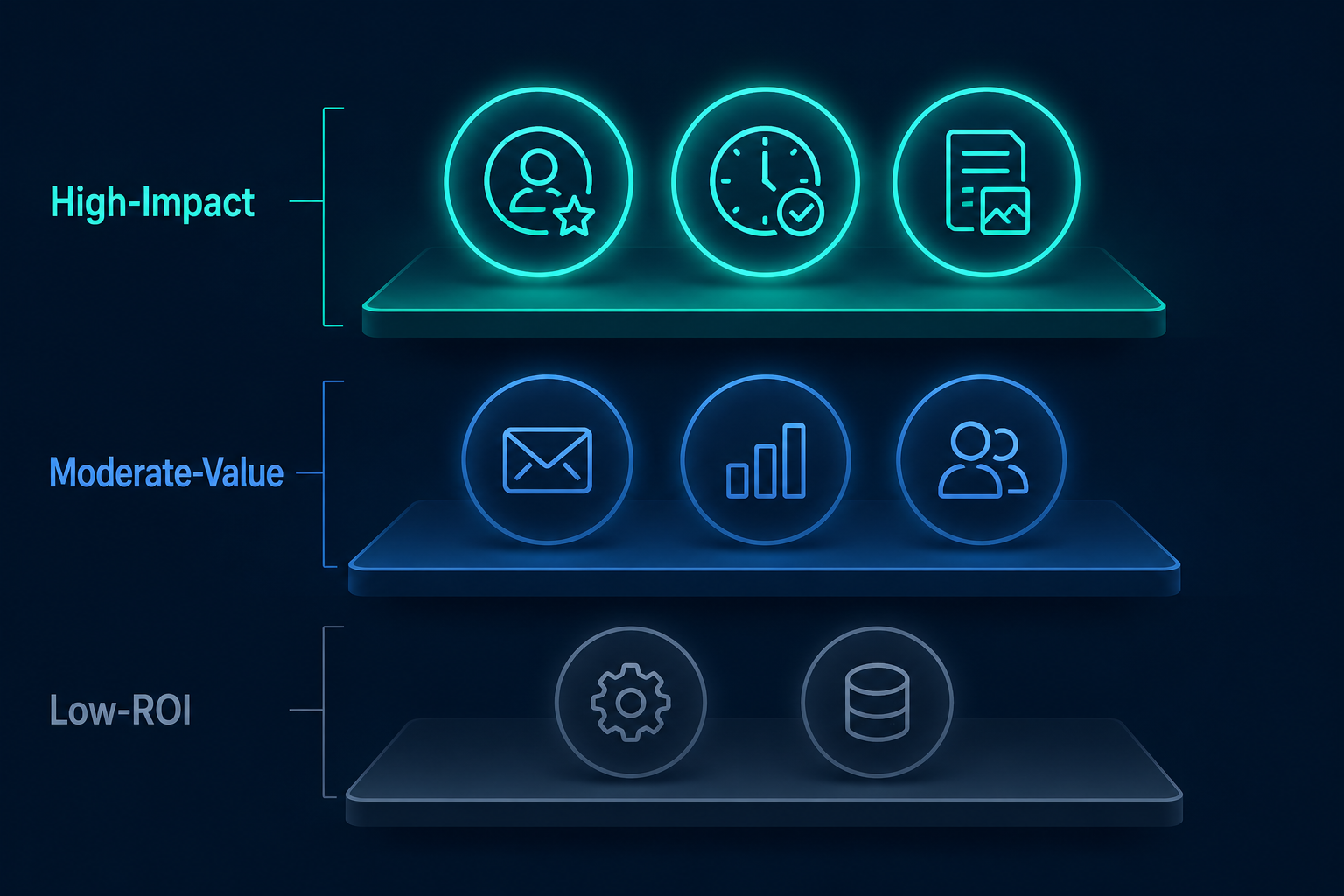
| ROI tier | Features | Practical verdict |
|---|---|---|
| High-impact | Engagement Scoring, Send Time Optimization, Content Selection | Prioritize first when data volume and campaign operations can support measurement. |
| Moderate-value | Copy Insights, Engagement Frequency, Path Optimizer, Engagement Splits, Frequency Split, Scoring Split, Content Tagging, Email Recommendations, Web Recommendations, Campaign Insights | Useful signals, but most require interpretation, setup discipline, or merchandising/content support. |
| Low-ROI or highly conditional | Attribution, Messaging Insights | Often overbought by mid-market teams because the prerequisites are heavier than the sales story implies. |
The three features worth testing first
Engagement Scoring earns the first slot because it changes a recurring operational argument into a usable segmentation rule. Instead of debating whether a subscriber is “warm,” the model sorts contacts into four engagement personas based on predicted open and click behavior: loyalists, window shoppers, selective subscribers, and winback or dormant audiences.[1] That is the kind of output a team can put directly into Journey Builder decisions, suppression rules, reactivation tests, or campaign prioritization.
The catch is not conceptual; it is statistical. Engagement Scoring needs enough historical behavior to separate signal from noise. The working threshold in the available brief is at least 1,000 leads with conversion outcomes before the model becomes reliable. Below that level, a team may still like the dashboard, but the score is less defensible as a basis for budget, suppression, or lifecycle automation.
When the threshold is met, the ROI path is straightforward. High-engagement subscribers can receive more frequent commercial messaging. Low-engagement subscribers can be moved into lighter-touch journeys before they damage deliverability. Mid-engagement groups can get different offers, cadence, or content blocks. None of those actions requires a separate analytics practice; they require a marketer to trust the segmentation enough to act on it and then compare holdout or pre/post campaign behavior.
Send Time Optimization is the second feature to test because it is narrow in the right way. It does not promise a new marketing strategy. It chooses a better send window for each subscriber based on engagement patterns. A practitioner-tested result cited in the available materials found roughly a three-percentage-point open-rate improvement over an 18-month period.[1] That is not a board-deck miracle number, but it is operationally believable: if the team already sends enough email to measure open-rate movement, a small timing gain can compound across recurring campaigns.
Send Time Optimization is also easier to evaluate than many broader AI claims. Pick a recurring campaign type, hold back a comparable audience or compare against recent matched sends, and measure whether opens improve without a decline in clicks, conversions, or unsubscribe behavior. The feature is most defensible where the email program already has cadence, volume, and similar campaign patterns. For a team sending sporadic newsletters to small lists, the model has less behavior to learn from and the result will be harder to prove.
Content Selection is the third high-impact feature, and it is the most dependent on the marketing team’s operating model. It can select content assets for a subscriber based on predicted engagement, which makes it attractive for retailers, publishers, financial services teams, and any organization with multiple offers or content modules competing for the same email real estate.[1] The strongest outcome figures in the brief come from Bluprintx, a Salesforce consulting partner, which reports 25% to 40% better open rates and doubled click-through rates in client work involving Marketing Cloud Einstein.[3]
Those Bluprintx figures should be used, but not inflated. They are consulting-partner documentation, not independently audited benchmarks. Bluprintx also reports Nordstrom achieving a 24% conversion increase and $5.3 million in incremental first-year revenue, U.S. Bank seeing 31% higher open rates, 18% better click-through rates, and $2.1 million in added revenue through Engagement Scoring, and Adidas producing a 36% conversion lift on dynamic content.[3] The lesson is not that every team should expect those numbers. The useful lesson is that Content Selection has a direct path to email performance when there is enough content variety, enough audience behavior, and enough production discipline to keep the asset pool fresh.
The middle tier helps, but it does not run itself
Copy Insights, Engagement Frequency, and Path Optimizer are worth enabling when the team has someone assigned to interpret the output. They are less compelling when leadership expects the feature to make decisions on its own. Copy Insights can surface language patterns associated with better engagement. Engagement Frequency can indicate whether subscribers are being over- or under-messaged. Path Optimizer can compare journey branches and move traffic toward the better-performing path.[1]
| Feature | What it can usefully reduce | Why it stays in the moderate tier |
|---|---|---|
| Copy Insights | Subject-line and message-copy guesswork | Someone still has to convert the signal into brand-safe, campaign-specific copy decisions. |
| Engagement Frequency | Arguments about how often to send | The output is only useful if the team is willing to change cadence, suppression, or journey rules. |
| Path Optimizer | Manual journey branch comparisons | It needs disciplined test design; weak branches and unclear success metrics still produce weak learning. |
| Engagement Splits, Frequency Split, Scoring Split | Manual audience routing | They depend on the quality of the underlying score or frequency model. |
| Content Tagging | Manual asset classification | It supports personalization operations but is not, by itself, a performance engine. |
| Email Recommendations and Web Recommendations | Manual product or content recommendation logic | They need catalog depth, behavioral data, and merchandising oversight. |
| Campaign Insights | Manual monitoring of campaign patterns | It surfaces observations; it does not automatically resolve the campaign decision. |
This is where Einstein can quietly disappoint a team. A feature that produces an observation still creates work: someone has to decide whether to change the segment, the copy, the journey branch, the send cadence, or the content pool. Cotera’s 18-month review of Sales Cloud Einstein is not a direct Marketing Cloud Einstein benchmark, but it is a useful caution. In that Sales Cloud implementation, Opportunity Insights was reported as 52% accurate, and the VP of Sales stopped referencing the predictions after month four because the tool mostly observed rather than acted.[4] Marketing Cloud teams should not treat that as proof that their Einstein features will fail. They should treat it as a reminder that predictive output without a decision owner decays into dashboard furniture.
Attribution is where mid-market teams most often overbuy
Einstein Attribution has an appealing promise: connect marketing activity to pipeline or revenue more intelligently than last-touch reporting. SalesforceBen’s catalog places it in the higher-access part of the Einstein Marketing Cloud conversation, with Corporate and Enterprise edition implications.[1] The practical barrier is not the model name. It is the data underneath it.
Attribution depends on CRM hygiene, campaign member discipline, opportunity-contact relationships, and enough closed-won and closed-lost history to make the model meaningful. The available brief notes claims of up to 10x coverage through virtual Opportunity Contact roles, but that does not remove the underlying requirement: the organization still needs a credible relationship between people, campaigns, opportunities, and revenue. Many mid-market teams do not have that. They have partial contact roles, inconsistent campaign association, sales-created opportunities with missing buying committees, and marketing campaigns that were never designed for attribution analysis.
That does not make Attribution useless. It makes it late-stage. Buy or enable it when the team can already answer basic questions from the CRM without a cleanup sprint: which contacts influenced which opportunities, which campaigns touched which buying groups, and whether sales consistently maintains opportunity-contact data. If those answers are weak, Attribution will not fix the operating model; it will make the gaps look more sophisticated.
Messaging Insights is alerting, not intelligence
Messaging Insights can be helpful in the right environment. It detects unusual engagement or performance patterns and alerts the team when something deserves attention.[1] That is valuable for high-volume senders with enough campaign activity for anomalies to mean something. A sudden drop in engagement, an unusual spike, or a deviation from normal campaign behavior can help a busy operations team investigate faster.
For lower-volume senders, the value is thinner. Alerting does not equal diagnosis. If a weekly campaign to a modest list underperforms, the team still has to determine whether the issue was audience mix, subject line, offer, deliverability, seasonality, creative, or a tracking problem. Without enough sends and enough comparable history, anomaly detection can become another feed to check rather than a decision engine.
The access question changed in 2026, but not enough to ignore prerequisites
Salesforce’s 2026 marketing roadmap makes Einstein feel more accessible because Agentforce, Growth Edition, and Advanced Edition are bringing more AI-assisted workflows into the marketing stack.[6][7] Digital Marketing on Cloud describes the broader shift from Marketing Cloud Engagement toward more agentic marketing operations in 2026, which is directionally important for mid-market teams evaluating whether AI capabilities will remain locked behind enterprise-only packaging.[7]
That packaging shift does not erase the deployment math. A feature can be included, discounted, or easier to activate and still fail if the team lacks the data volume, content supply, or process owner needed to turn output into action. The access question should be asked in two parts: whether the contract allows the feature, and whether the marketing operation can feed and measure it.
| Prerequisite | Why it matters | Feature most affected |
|---|---|---|
| At least 1,000 leads with conversion outcomes | Gives scoring models enough outcome history to become more reliable. | Engagement Scoring |
| Recurring email volume and comparable campaigns | Makes timing tests measurable rather than anecdotal. | Send Time Optimization |
| A maintained library of content or offers | Gives the model real choices instead of stale assets. | Content Selection, Email Recommendations, Web Recommendations |
| Clear journey success metrics | Prevents optimization toward a branch that wins on the wrong measure. | Path Optimizer, Engagement Splits |
| Clean opportunity-contact and campaign data | Determines whether revenue influence can be modeled credibly. | Attribution |
| High enough send volume for anomalies to matter | Separates meaningful alerts from noisy fluctuations. | Messaging Insights |
What the ROI studies can and cannot prove
The biggest Salesforce Einstein Marketing Cloud ROI number in the available material is the Forrester Total Economic Impact study cited by Bounteous: 299% ROI over three years and a 60% increase in email and web conversion rates for Salesforce Marketing Cloud plus Einstein.[5] That figure belongs in the evaluation, but not at the top of it. The study was commissioned by Salesforce, so it is useful for understanding the optimistic business case, not for setting a default expectation for a mid-market implementation.
The same caution applies to partner case studies. Bluprintx’s client-reported results are relevant because they connect Einstein features to open rates, click-through rates, conversion lift, and revenue outcomes.[3] They are also not neutral benchmarks. The right use of those figures is to identify which features have a plausible measurement path, then test them under the organization’s own campaign conditions.
The missing data is independent, feature-level benchmarking for Marketing Cloud Einstein across ordinary mid-market accounts. The available evidence is a mix of feature catalogs, practitioner notes, partner-documented client outcomes, Salesforce-commissioned economic modeling, and directional caution from Sales Cloud Einstein. That is enough to rank the features for enablement order. It is not enough to promise a universal ROI percentage.
A defensible enablement order
Start with Engagement Scoring if the account has enough conversion history. It creates immediately usable audience groups and gives the team a reason to change segmentation, cadence, suppression, and reactivation logic. If the data threshold is not met, do not force the model into production decisions; fix the capture of outcomes first.
Test Send Time Optimization next where email volume supports measurement. The expected gain is not dramatic, but it is clean to test and easy to explain: the same message reaches subscribers closer to the time they are likely to engage. Watch downstream behavior, not just opens, so the team does not optimize into a vanity metric.
Consider Content Selection when content operations can keep up. The feature needs a real asset pool, clear tagging, and enough performance feedback to learn from. If the team struggles to produce one strong email version, dynamic selection will expose that constraint rather than solve it.
Treat Copy Insights, Engagement Frequency, Path Optimizer, and the related split and recommendation features as analyst-assist tools. They can reduce manual review and sharpen campaign decisions, but only when someone owns the follow-through. Avoid Attribution until CRM and opportunity-contact data are already trustworthy. Avoid Messaging Insights unless the send volume is high enough for alerting to change response time. That order keeps the investment tied to measurable action instead of feature activation for its own sake.
References
- Marketing Cloud Einstein, SalesforceBen
- How Much Does Salesforce Einstein Agent Cost? A Complete Pricing Breakdown, Monetizely
- Salesforce Marketing Cloud Einstein: Real Results, Bluprintx
- Salesforce Einstein AI Review, Cotera
- Einstein AI in Marketing Cloud: Empower Marketers, Boost Customer Experiences, Bounteous, 2024-08-22
- Top 10 Spring ’26 Updates for Salesforce Marketers, SalesforceBen
- The State of SFMC in 2026: Navigating the Shift from Engagement to Agentic Marketing, Digital Marketing on Cloud

Comments
Join the discussion with an anonymous comment.