
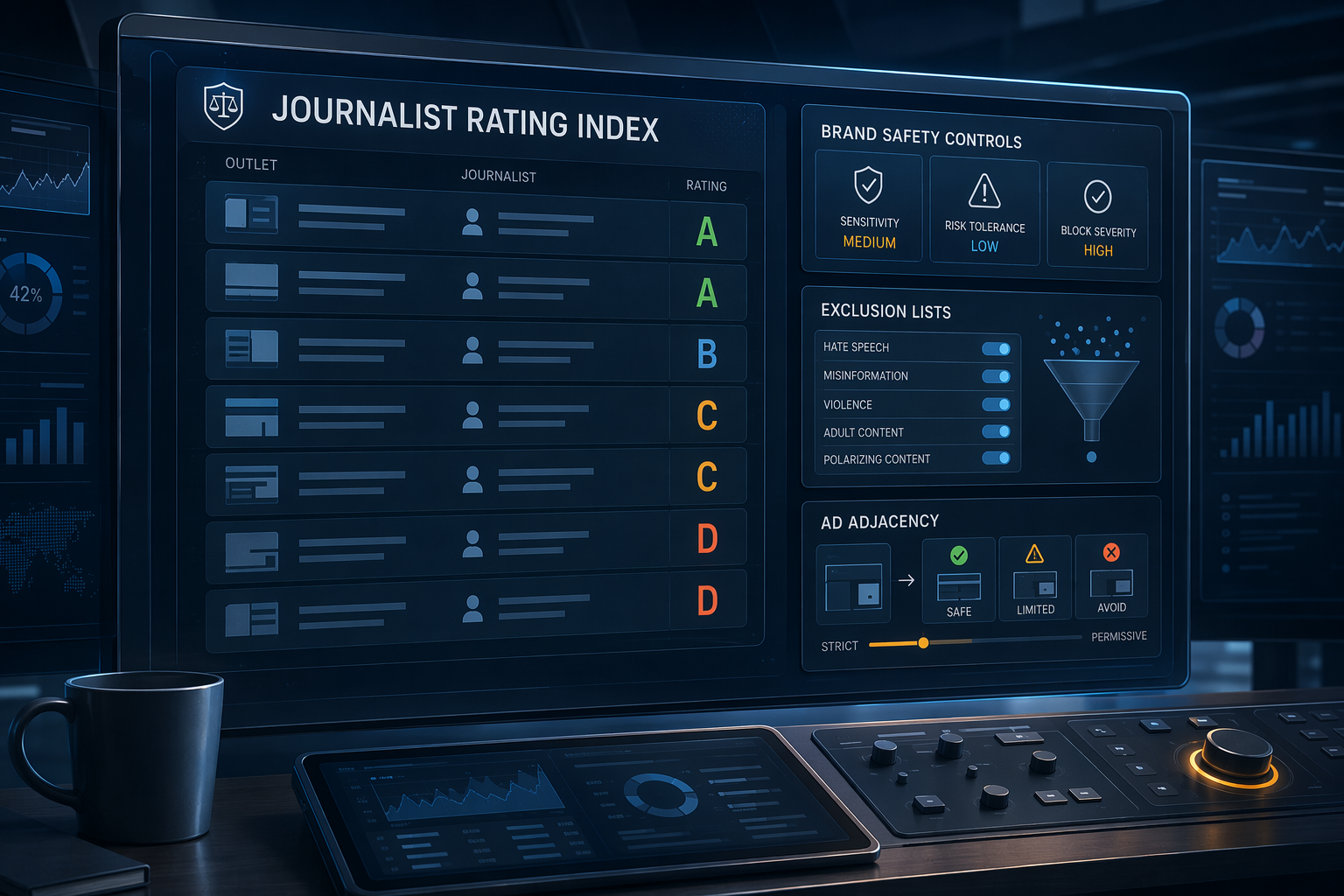
Peter Thiel's AI media scoreboard won't fix brand safety
The Primary's AI-generated journalist ratings promise a new brand safety signal, but the methodology is opaque, unverified, and unsupported by any advertiser or DSP. This article explains why practitioners should watch carefully but not adopt yet.
A journalist-level media scoreboard is interesting to programmatic buyers for one reason: it sounds like it could make inclusion and exclusion decisions less blunt. Most brand safety work still happens at the level of domains, keywords, categories, adjacency rules, blocklists, allowlists, and post-bid verification. Those controls can keep ads away from obvious problems, but they are not very good at distinguishing a deeply reported but contentious article from a low-quality page wearing the same topic label.
That is why the marketing pitch around Peter Thiel's AI media scoreboard gets a hearing. The Primary says its index has analyzed more than 2 million articles, rated more than 20,000 journalists, and used large language models from five major AI providers to generate scores for journalists and outlets.[1] If that data layer were transparent, stable, and available inside buying tools, it could theoretically sit near existing brand safety controls as a more granular signal: not just whether the page is about politics, crime, AI, or litigation, but whether the publication or journalist has a measurable record of reliability.
The problem is that a promising data shape is not the same thing as an operational buying signal. As of July 2026, The Primary has not shown the three things a media team would need before threading its scores into live campaigns: an auditable method, independent verification, and evidence that advertisers, DSPs, or established brand safety vendors are actually using it.
What The Primary is trying to score
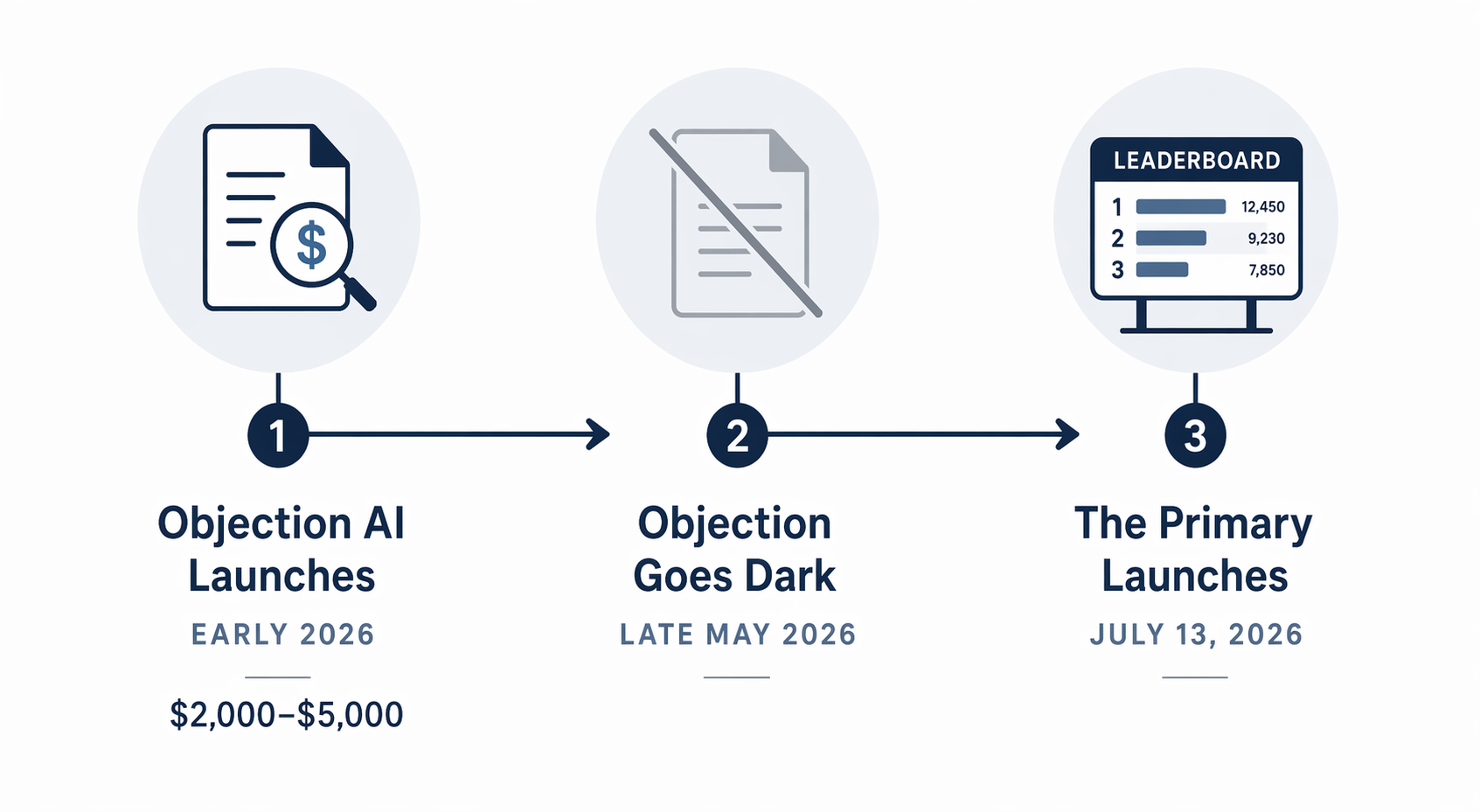
The Primary launched on July 13, 2026, presenting itself as the "world's first AI index of journalism." Its public claim is broad: use AI to evaluate journalism at scale, then assign scores that help readers, institutions, and potentially other market participants judge media quality.[1]
For a marketer, the useful part is not the public scoreboard by itself. A buyer does not need another website to check manually between trafficking deadlines. The useful version would be a signal that can be mapped to decisions already made in the stack: bid, do not bid, bid only with a floor, include on a vetted news list, exclude from a sensitive campaign, or flag for human review.
There is a real market pain underneath the pitch. One estimate puts annual ad waste on unreliable news sites at $2.8 billion, which helps explain why buyers keep looking for better news-quality signals rather than relying only on topic-level avoidance.[2] A luxury advertiser may not want to block all news about war, courts, or regulation; a pharmaceutical advertiser may need to separate misinformation from legitimate public health coverage; a B2B software brand may want to avoid AI slop without cutting off serious technology reporting.
A journalist-level score would be most useful in the gray zone where page content, domain reputation, and campaign sensitivity collide. It could help answer questions that keyword lists do not handle well: Is this reporter known for careful sourcing? Is this outlet producing original reporting or recycling claims? Does this byline tend to publish thin aggregation around high-risk topics? Those are buying-relevant questions. The Primary's current evidence does not yet make its answers usable.
Where a journalist score would enter the buying workflow
In a working programmatic environment, a score like this would need to become machine-readable and decision-ready. It would have to connect to domains, page URLs, article metadata, bylines, content categories, and campaign-level tolerance rules. A buyer would also need to know whether the score updates after corrections, whether it handles syndicated content, and how it treats articles with multiple authors.
| Possible use | What the buyer would need | Why The Primary is not there yet |
|---|---|---|
| Pre-bid exclusion | A stable feed that maps scores to bidstream-level decisions | No announced DSP or brand safety integration as of July 2026 |
| Allowlist construction | Transparent criteria for choosing outlets, journalists, or pages | The scoring method remains proprietary and LLM-based |
| Sensitive-news review | Explainable flags that a legal, comms, or brand team can defend | No independent audit or visible validation procedure |
| Post-campaign analysis | Logs showing where ads served and how the score affected delivery | No public advertiser case studies or measurement evidence |
This is why adoption matters more than the existence of the index. Programmatic teams do not adopt signals because a dashboard is visually persuasive. They adopt them when the signal can be piped into controls, tested against delivery data, reconciled with verification vendors, and explained when someone asks why spend moved away from a publisher.
The Primary may eventually decide to sell or license data in that form. The launch materials show ambition and scale, but they do not show a path from score to bid decision.[1] Until that path exists, the index is a media-quality product looking toward an advertising use case, not a brand safety tool buyers can deploy.
The method is the first hard stop
The Primary says it uses large language models from five major AI providers, but the public materials do not disclose enough about weights, grading criteria, training assumptions, validation sets, appeals, or error rates for a buyer to treat the output as a governed signal.[1] That is not a minor documentation gap. In brand safety, an unexplained score becomes a liability the moment it affects spend.
LLM scoring can be useful for classification, summarization, and pattern detection. It can also reward the wrong things. A model may prefer surface regularity over adversarial reporting, penalize articles that rely on confidential sources, flatten beat-specific norms, or misread technical skepticism as bias. Those are not abstract problems when the object being scored is journalism. A reporter covering AI, defense, pharmaceuticals, finance, or labor may write in a way that looks contentious because the beat itself is contentious.
One reported anomaly around the index makes that concern concrete, though it should be treated with caution because the underlying Hollywood Reporter account was not fully accessible in the available materials: New York Times journalists focused on AI were described as receiving among the lowest scores, with the claim also referenced in later industry discussion. If accurate, that does not prove the model is biased against expertise. It does show the exact kind of failure mode buyers would need investigated before using the score: a system that may confuse deep subject-matter coverage with partiality.
A vendor can say a score measures reliability. A buyer still has to ask what the score actually penalizes. Does it punish anonymous sourcing? Does it discount aggressive but accurate investigative reporting? Does it distinguish a reporter's original work from an outlet's headline packaging? Does it treat corrections as evidence of accountability or evidence of error? Without those answers, the score cannot be defended in a brand suitability policy.
Independent audit is the missing bridge. Existing brand safety and news-quality vendors are not perfect, but professional buyers are used to asking for methodology documents, dispute processes, taxonomy definitions, and evidence of third-party review. The Primary has not cleared that bar in the public record as of July 2026.
The project's history makes the trust question harder
The Primary did not arrive in a vacuum. It followed Objection AI, a Thiel-backed project that launched earlier in 2026 with a more confrontational model. TechCrunch reported that Objection allowed people to challenge a journalist's article for $2,000 to $5,000, triggering review by former FBI and CIA contractors and an LLM "jury" that contributed to an "Honor Index" score.[3]
That predecessor matters to advertisers because provenance affects internal defensibility. A brand safety signal is not just a data feed; it is a policy instrument. If the signal's history suggests it was built to pressure journalists rather than neutrally classify media quality, legal, communications, and procurement teams will ask harder questions before approving it.
Salon described the earlier Objection project as struggling to gain traction and noted criticism from media lawyers who viewed the model as a pressure mechanism against the press.[4] The Intercept later reported that Aron D'Souza, who helped Peter Thiel in the campaign that led to Gawker's collapse, was behind the effort and argued that his framework devalues anonymous sourcing.[5] The Observer also reported that journalists largely declined to participate while the system continued assigning scores.[6]
The anonymous-sourcing point is especially relevant for advertisers, even if they do not want to litigate the politics of the project. Major investigative stories about companies often depend on sources who cannot speak on the record. A scoring system that structurally devalues anonymous sourcing may favor safer-looking coverage over harder reporting. That could make a buy look cleaner while quietly pushing spend away from journalism that is uncomfortable, consequential, and accurate.
None of that means every score is wrong. It does mean the burden of proof is higher. A buyer asked to use this signal would need to know whether the current Primary Index is materially different from Objection's adjudication model, how the rebrand changed the underlying methodology, and whether the system has safeguards against being used as a reputation weapon.
The adoption gap is the operational answer
The most important fact for current media buyers is not the funding lineage or the press criticism. It is the absence of adoption evidence. As of July 2026, there is no public announcement that a major advertiser, DSP, or established brand safety vendor has integrated The Primary's scores into programmatic buying workflows.
That negative finding should be handled carefully. It does not prove no private testing exists, and it does not prove the product cannot become useful. It does mean practitioners have no public case study, no benchmark, no delivery impact, no lift or waste-reduction analysis, and no vendor-side implementation model to evaluate.
For a live campaign, that is enough to stop the conversation. A buyer cannot responsibly add a journalist score to exclusion logic if the team cannot explain how the score is produced, how often it changes, what errors look like, who handles disputes, and whether the signal has been tested against campaign outcomes. The consequences are not theoretical: blocked inventory, publisher disputes, underdelivery, skewed reach, and awkward conversations with legal or communications teams.
This is also where The Primary differs from tools that already occupy the brand safety and news-quality space. Buyers may debate the limits of NewsGuard, Adalytics, GARM-aligned taxonomies, IAS, DoubleVerify, or platform-native controls, but those tools at least exist in recognizable buying and verification conversations. The Primary is not yet in that layer. It is still outside the operational plumbing.
What would make the signal worth testing later
The right posture is not to dismiss journalist-level scoring as useless. The unit of analysis is genuinely interesting. Domain-level judgments are often too coarse, and page-level classification can miss persistent patterns by author, desk, or editorial format. If a future tool could evaluate those patterns transparently, it might help buyers avoid both overblocking legitimate news and funding low-quality sites that mimic journalism.
The watch list is practical:
- A published methodology that explains criteria, weights, model roles, update cadence, and dispute handling.
- Independent audits that test false positives, false negatives, political or topical skew, and treatment of investigative sourcing.
- Documented pilots with advertisers, agencies, DSPs, or verification vendors that show how scores affect delivery and suitability outcomes.
- A machine-readable integration path that maps scores to actual pre-bid, post-bid, allowlist, or review workflows.
- Clear governance for appeals, corrections, journalist non-participation, and changes in scores over time.
Until those pieces exist, The Primary Index is best treated as an external object to monitor, not a control to activate. It may become a useful benchmark against later, more transparent journalism-quality tools. It may also expose how difficult it is to turn editorial judgment into a scalable AI score without flattening the very reporting buyers should not want to punish.
For current media buying, the answer is straightforward: do not put The Primary's scores into the stack yet. The idea is novel enough to watch, but it has not cleared the thresholds that matter in programmatic brand safety: auditable method, demonstrable adoption, and a clean route into existing controls.
References
- Primary Launches the World's First AI Index of Journalism, BusinessWire / Morningstar, July 13, 2026.
- The $2.8 Billion Brand Safety Black Hole, Marketing Economics Substack.
- Can AI judge journalism? A Thiel-backed startup says yes, even if it risks chilling whistleblowers, TechCrunch, April 15, 2026.
- Thiel-backed AI project to block bad press looks like a bust, Salon, April 23, 2026.
- Businessman Who Helped Thiel Kill Gawker Wants to Save Journalism With AI, The Intercept, June 29, 2026.
- Billionaire-backed startup convenes AI juries to take aim at journalists, Observer.

Comments
Join the discussion with an anonymous comment.