

Is the NY Data Center Moratorium a Turning Point for AI?
New York just became the first state to pause hyperscale data centers. This analysis explains why the moratorium signals a broader regulatory shift that will affect AI compute costs and development timelines, and what it means for marketers relying on AI tools.
New York’s data center moratorium matters because it turns AI infrastructure from a background assumption into a planning risk. On July 14, 2026, Gov. Kathy Hochul launched a first-in-the-nation statewide pause on new hyperscale data centers above 50 megawatts, halting discretionary state environmental permits for up to one year while New York develops a Generic Environmental Impact Statement, or GEIS, for the sector.[1]
That does not stop AI development. It does not switch off existing data centers. It does not ban every server room, cloud region, or enterprise technology project in the state. But it does something that may matter more over the next several years: it changes the negotiating position around large AI-era compute buildouts. A project that once looked like a private site-selection decision now has to move through a more visible argument over electricity demand, grid investment, community benefit, and household energy costs.
For marketers, the point is not that a campaign calendar will slip next month because Albany paused a class of facilities. This is early-stage analysis; the executive order is less than two weeks old. The stronger and more useful conclusion is narrower: the compute layer underneath AI tools is entering a more expensive, negotiated, and geographically uneven phase. That can eventually show up in cloud pricing, enterprise AI contract terms, tool margins, feature availability, and model deployment timelines. None of those downstream effects is proven yet. They are now planning risks rather than abstract hypotheticals.
What New York actually paused
The operational detail is important. New York’s order applies to new hyperscale data centers that exceed 50 MW. It pauses discretionary state environmental permits for up to one year while the state prepares a GEIS, a planning document intended to evaluate cumulative environmental and infrastructure effects rather than forcing each project to be considered as if it were isolated.[1]
That threshold matters because it separates ordinary commercial computing from the kind of very large load now associated with cloud, AI training, AI inference, and dense digital infrastructure. A 50 MW facility is not a marketing SaaS vendor renting a few racks. It is an industrial-scale electricity customer entering a grid that was not built around an unlimited queue of new high-intensity loads.
| Policy element | What it changes | What it does not prove yet |
|---|---|---|
| 50 MW threshold | Targets very large hyperscale projects rather than all digital infrastructure | Does not show how many specific AI projects will be delayed |
| One-year permit pause | Creates a time window for statewide environmental review | Does not permanently ban data center construction |
| GEIS process | Moves the state toward cumulative review of sector-wide impacts | Does not by itself determine future siting rules |
| Grid and community mechanisms | Gives New York a way to negotiate infrastructure costs and local benefits | Does not guarantee lower household energy bills |
The executive order also creates the Office of Digital Innovation, Governance, Integrity, and Trust, or DIGIT, as a central AI governance body, beginning with regulation of large frontier AI developers.[1] That pairing is easy to miss. New York is not treating data centers as a side issue separate from AI governance. It is linking the models, the developers, and the physical infrastructure they require.
There is also an unresolved boundary between the executive order and broader legislative proposals. The Responsible Data Center Development Act uses a 20 MW threshold, which would reach a wider set of projects than Hochul’s 50 MW order. That difference has not yet been reconciled in practice, so it is too early to treat New York’s final rulebook as settled.
The grid queue is the part marketers should not skip
The AI industry often talks about compute as if it were a procurement problem: buy chips, lease cloud capacity, optimize workloads, ship faster. New York’s moratorium exposes the missing layer in that story. Before a model can be trained or a platform can serve another wave of AI-generated creative, someone has to secure power, interconnection, cooling, land, permits, and political tolerance.
As of May 2026, more than 12 GW of very large energy-using loads, including data centers, were waiting to connect to New York’s grid. Reuters, citing the state’s independent grid operator report, noted that 1 GW can power about 750,000 homes.[2] That comparison is imperfect for planning purposes, because industrial loads and household usage do not map neatly onto each other hour by hour. But it does translate the AI boom into a number that local officials and voters can understand: these are not marginal additions.
The queue also explains why a moratorium can become politically durable even when economic-development officials want investment. A data center proposal does not arrive alone. It arrives with questions about who pays for new substations, transmission upgrades, backup generation, distribution stress, and reliability risk. If those costs are socialized across ratepayers while the benefits are concentrated in a developer, a landlord, or a local tax base, the politics change quickly.
That is why the household electricity number is not decorative. New York residential electricity prices have risen about 68% since 2019, CNBC reported, citing Empire Center data.[3] A voter does not need to have a position on frontier model governance to care about another large load entering the system. The affordability argument gives the moratorium a base beyond the usual environmental and land-use coalitions.
Polling reflected that opening. A Siena Research Institute poll reported by WXXI News found that 46% of New York voters viewed a statewide data center moratorium as good for the state, while 21% viewed it as bad.[4] That finding should not be overread. It does not prove voters have worked through the trade-off between energy costs, AI investment, jobs, and local redevelopment. It does show that a pause on large data centers is not politically fringe in a state where affordability is already a top concern.
A pause becomes leverage
The most interesting part of New York’s move is not the word “moratorium.” It is the machinery attached to the pause. Hochul is directing the Department of Public Service to create a Grid Acceleration Fund requiring data center developers to invest in aging grid infrastructure, and a Community Investment Framework that would give localities formula-based tools for negotiation.[5]
That is a different posture from simply saying yes or no to a facility. It tries to turn the surge in AI infrastructure demand into a bargaining moment: if a developer wants fast access to scarce grid capacity, the state can ask what the developer will contribute to the system it is stressing. If a locality is asked to host an industrial-scale load, the state can give it a more standardized way to negotiate benefits rather than leaving each town to improvise against better-resourced counterparties.
Whether those mechanisms work is another question. A fund can be too small, too slow, or too politically allocated. A community framework can become a box-checking exercise. A GEIS can produce careful analysis that still leaves hard siting decisions to elected officials. But as a market signal, the direction is clear: large AI infrastructure buyers should expect more states to ask not only “Can you build here?” but “What does the grid and the community get in return?”
That is why the New York data center moratorium is more than a local permitting story. It gives other states a template for slowing the queue without permanently declaring themselves closed for AI business. It also gives economic-development teams a way to say they are not anti-AI; they are pricing the externalities before approving the next wave of load.
New York is first statewide, not alone
If New York were the only jurisdiction moving this way, the strategic read would be simpler: watch one high-cost state manage one contentious infrastructure category. That is not the pattern forming in 2026. Municipal governments have often moved faster than state legislatures, and they are doing so in places that matter for technology, logistics, and regional power planning.
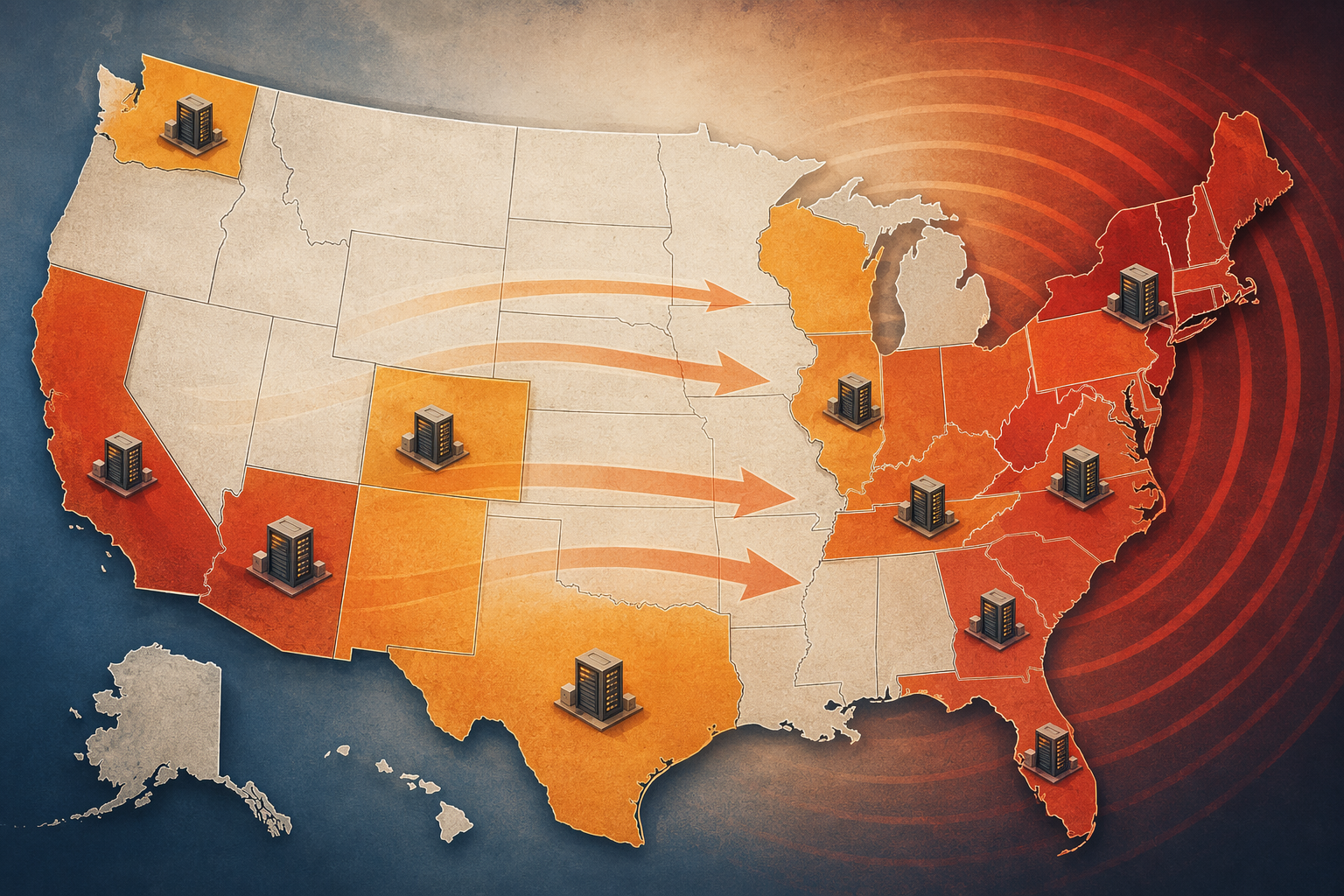
In California, Monterey Park voters approved a data center ban with 90% support. In Washington, Seattle passed a one-year moratorium in June 2026.[6] Those are not identical actions, and they should not be treated as if they came from the same local conditions. But they show that the data center fight is no longer confined to rural siting battles or utility commission filings. It has moved onto ballots, city council agendas, and neighborhood affordability debates.
The Maine case adds a useful complication. In April 2026, Gov. Janet Mills vetoed a similar moratorium bill because it lacked an exemption for a $550 million data center redevelopment of a shuttered paper mill.[7] That veto does not disprove the moratorium trend. It shows why the politics are harder than either side usually admits. A governor can be open to tighter review and still hesitate when a project is tied to replacing lost industrial activity, expanding the tax base, or giving a community a plausible redevelopment path.
This is where the lazy versions of the story fail. Data centers are not just “AI progress” poured into concrete. They are also not just another unwanted land use that can be pushed away without consequence. They are infrastructure nodes in a national competition for compute capacity, tax revenue, jobs, power, water, and political consent. A shuttered paper mill and a stressed residential electric bill can both be real facts in the same policy decision.
The spread is measurable
The national counts are still messy because “ban,” “moratorium,” “large-load tariff,” and “energy-cost legislation” are different instruments. They should not be collapsed into one number. But the direction is not subtle.
- MultiState reported in April 2026 that 27 states were advancing legislation focused on energy costs for large-load customers, and it noted that federal permitting streamlining does not preempt state land-use, zoning, or utility regulation.[8]
- The National Conference of State Legislatures tracked 14 states considering bans on data centers.[9]
- Datacenterbans.com tracked at least 10 states with active bans or moratoriums in some form.[10]
Those sources are measuring different slices of the same fight. Some proposals are about outright restrictions. Others are about making large-load customers pay more directly for the grid capacity they require. Still others are local pauses designed to buy time while officials update zoning, environmental review, or power-cost rules. The common thread is that governments are no longer treating the data center buildout as a frictionless extension of the software economy.
Federal policy can accelerate one part of the process while state policy slows another. President Trump’s July 2025 permitting streamlining executive order does not preempt state land-use, zoning, or utility regulation, according to MultiState’s April 2026 tracker.[8] That leaves room for a split-screen market: federal officials push for faster AI infrastructure deployment, while states and municipalities bargain over the local costs of hosting it.
For AI developers and cloud platforms, that split creates a site-selection problem. For marketers, it creates a supply-chain visibility problem. The marketing team buying an AI content platform may never negotiate with a utility or zoning board. But the vendor’s margin, latency strategy, capacity planning, and feature roadmap may depend on companies that do.
The opposition case is real, even if it is incomplete
The industry and its political allies have a serious argument: if states make data center development slower, costlier, or less predictable, investment will move. Sen. John Fetterman has framed restrictions as a gift to China in the global AI race, while the Data Center Coalition has warned that investment will flow to other states.[2] Digital Realty was more direct, saying the moratorium “will likely push investments outside of New York.”[11]
That warning should not be dismissed as lobbying noise. Compute capacity is mobile in a way that a port, a mineral deposit, or a dense urban consumer market is not. Developers can compare utility rates, tax incentives, interconnection timelines, water access, political risk, and construction pipelines across states. If New York adds uncertainty and another state offers speed, some projects will choose speed.
But the investment-flight argument also has limits. Moving a data center out of New York does not make the power demand disappear. It shifts that demand to another grid, another set of ratepayers, another community, and another permitting regime. If enough states reach the same conclusion at different speeds, the industry does not escape negotiation; it shops for the jurisdictions least ready or least willing to negotiate.
That distinction matters for AI leadership arguments. A country can want faster AI deployment and still face local bottlenecks that are not solved by insisting that every community absorb the cost. The policy problem is not whether compute is important. It is how to build enough of it without quietly transferring infrastructure costs to households and local governments that did not design the AI supply chain but are now asked to host it.
Where this can reach marketing budgets
The direct marketing impact is not immediate enough to justify panic. A brand using an AI writing assistant, ad creative generator, analytics copilot, or media optimization platform should not assume that New York’s order will change its invoice this quarter. The better question is how a more contested compute buildout changes vendor economics over the next planning cycle.
AI tools often reach marketers through several layers: a model developer, a cloud provider, an infrastructure operator, a SaaS vendor, and finally an enterprise contract or self-serve subscription. A constraint at the physical layer can be absorbed at one layer, passed through at another, or hidden in product design. The customer may not see a line item called “grid interconnection delay.” They may see higher minimum commitments, stricter usage caps, slower rollout of compute-intensive features, regional availability differences, or less generous experimentation credits.
The risk is not evenly distributed. Lightweight workflow automation is less exposed than real-time generative video, large-scale personalization, agentic analytics over massive datasets, or always-on creative testing systems. The more a marketing capability depends on high-volume inference or access to the newest frontier models, the more exposed it is to compute economics, even if the marketing team never touches the infrastructure contract.
This is also where procurement language may need to mature. If an enterprise AI vendor promises a roadmap built on newer models, higher context windows, richer multimodal generation, or faster real-time optimization, marketers should ask how capacity is secured and what happens if deployment regions or model access change. That does not require becoming a utility lawyer. It does require treating AI capability as something with a supply chain, not just a feature list.
Questions worth adding to AI vendor reviews
- Which cloud regions and infrastructure partners support the AI features we use most?
- Are premium model features capacity-limited, region-limited, or subject to usage throttling?
- How are compute-cost increases handled in renewals, overage pricing, or minimum commitments?
- If a planned model upgrade is delayed, what functionality changes for our team?
- Are service-level commitments tied to specific AI capabilities or only to general platform uptime?
These questions will not predict every price change. They make visible which vendors are building durable AI capacity and which are reselling access to a constrained resource with little room to maneuver.
A turning point, but not the one the loudest arguments describe
New York’s moratorium is not a switch that turns AI development off. It is not proof that cloud prices will rise next month. It is not evidence that model release schedules have already changed. The order is too new, and the market has too many buffers, alternatives, and contractual layers to support that kind of certainty.
It is a turning point because it makes AI infrastructure publicly negotiable at the state level. The state is saying that large compute projects must be evaluated not only by their private capital expenditure or national AI importance, but by their effect on the grid, electricity affordability, environmental review, and local bargaining power. Other states and cities are already working through similar questions with different tools and different appetites for restriction.
For senior marketers, the strategic adjustment is straightforward: keep building AI capability, but stop treating AI tools as frictionless software floating above the physical economy. The systems behind content automation, media buying, analytics, personalization, and generative creative depend on power-hungry infrastructure that is now politically contested. In 2026, that belongs on the AI roadmap.
References
- First Statewide Moratorium on New Hyperscale Data Centers Launched by Governor Kathy Hochul, NY Governor's Office, July 14, 2026, link
- New York becomes first state to impose data center moratorium, Reuters, July 14, 2026, link
- New York AI data center ban, CNBC, July 14, 2026, link
- New statewide poll shows voters put affordability, data center moratorium at top of priorities, WXXI News / Siena Research Institute, June 25, 2026, link
- New York Governor Kathy Hochul data center moratorium AI infrastructure, Fortune, July 14, 2026, link
- Data center moratoriums gain ground in states and cities, Route Fifty, June 2026, link
- New York data centers moratorium AI, AP News, 2026, link
- Federal AI Data Center Policy Meets Resistance from State Lawmakers, MultiState, April 14, 2026, link
- Which States Are Banning Data Centers?, NCSL, link
- Data Center Bans, datacenterbans.com, link
- New York becomes first state to freeze new AI data centers in move critics warn could drive away jobs, Fox Business, July 2026, link

Comments
Join the discussion with an anonymous comment.