
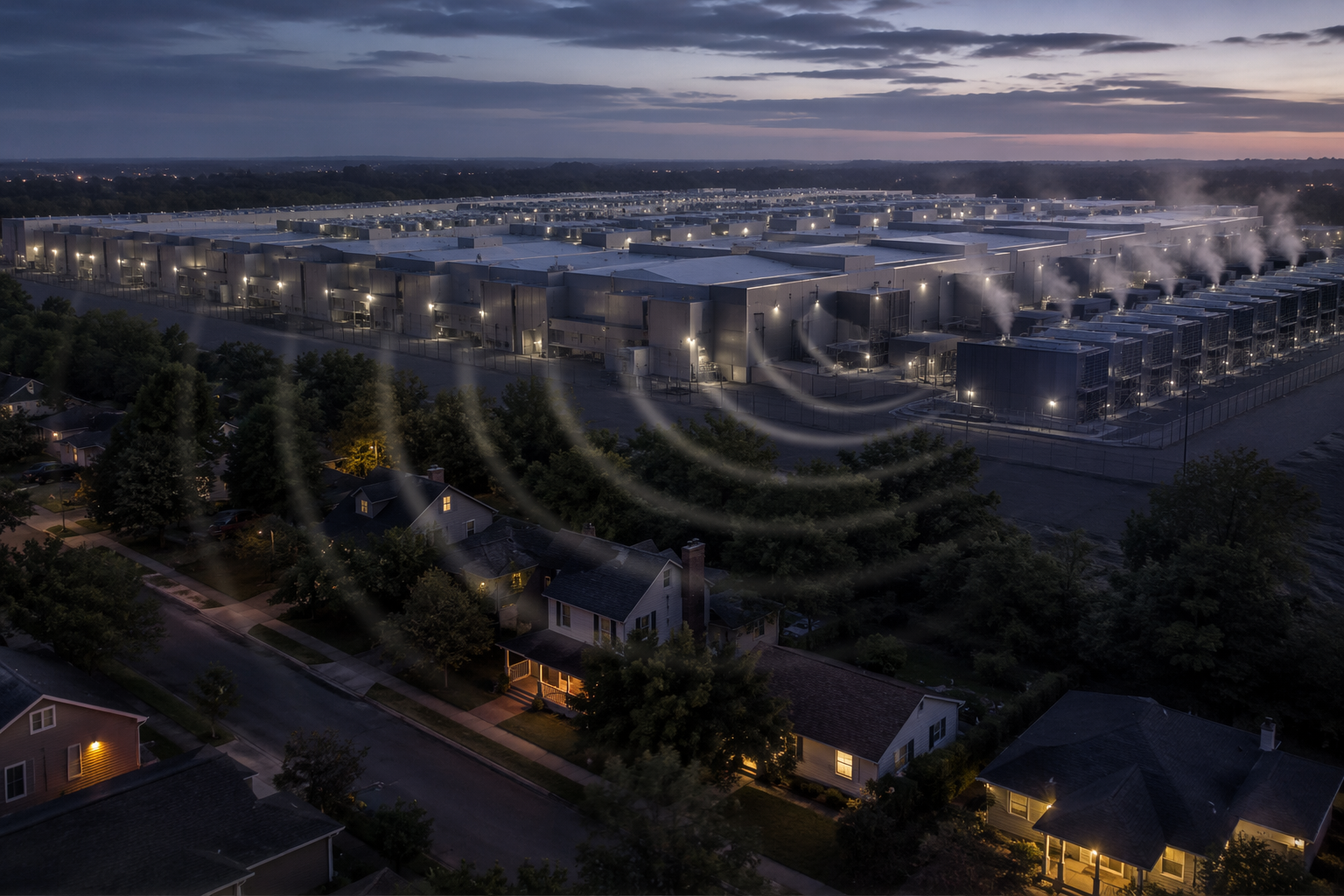
Noise Complaints Now a Major Bottleneck for AI Data Centers
Noise complaints have escalated from local nuisances to a structural constraint, with $130B in AI data center projects delayed in Q1 2026 alone. This analysis examines how community opposition, regulatory fragmentation, and noise measurement gaps are becoming material risks to AI compute availability and cost.
Data center noise complaints no longer describe a neighborhood quality-of-life dispute sitting outside the real buildout plan. In Q1 2026, $130 billion in AI data center projects were blocked or delayed across 75 projects, a quarterly total described as roughly equal to all of 2025 combined; project cancellations also quadrupled year over year.[1] That figure does not mean noise alone stopped $130 billion of construction. It does mean community opposition has become large enough to enter the same planning conversation as chips, power contracts, interconnection queues, water access, and financing.
The important shift is speed. Opposition groups focused on data centers rose from 396 to 833 across 49 states in a three-month period, according to Data Center Watch reporting summarized by DMA.[2] A complaint about a hum, a cooling array, a backup generator, or a proposed substation can now move through a local organizing network that has templates, talking points, legal strategies, and examples from other jurisdictions. That is a different operating environment from the old assumption that permitting objections are slow, isolated, and mostly containable.
For marketing and AI strategy teams, the consequence is not that every model rollout should be redesigned around municipal noise ordinances. The consequence is narrower and more practical: compute availability is partly exposed to local land-use politics, and local land-use politics are becoming easier to mobilize when the infrastructure produces a continuous, hard-to-ignore sound.
Why noise moves faster than many infrastructure objections
Power and water usually dominate the public argument over AI data centers, and the polling supports that hierarchy. In Gallup’s May 2026 polling, 70% of Americans said they would oppose an AI data center being built in their local area, a higher opposition level than Gallup found for a nuclear power plant in the same local-area framing. But among opponents, 50% cited resource consumption such as water and energy, while 16% specifically mentioned noise pollution.[3]
That caveat matters. Noise is not the largest stated concern in the Gallup data, and it should not be treated as a single master explanation for the Q1 delay total. Its strategic importance comes from a different property: noise can convert abstract infrastructure anxiety into daily evidence. A resident does not need to understand load forecasting, utility tariffs, or aquifer stress to notice that the house sounds different at night.
That makes noise unusually potent in public meetings. Energy use can be argued through models. Water use can be argued through projections. Grid strain can be argued through rate cases. A low-frequency hum is experienced as an ongoing condition, and when official measurements fail to match that experience, the dispute quickly becomes about credibility as much as acoustics.
The AI part is not just more servers
Data centers were never silent, but AI density changes the noise profile. Higher-density AI racks require more cooling, and cooling is where much of the community-facing sound problem lives. The facility may market itself as software infrastructure, but the neighborhood experiences fans, chillers, air movement, substations, and sometimes backup or on-site generation.
The measured levels are not trivial. EESI cites internal server noise reaching 92–96 dB(A), while diesel generators can reach 105 dB(A).[4] Those figures do not mean nearby homes hear those exact levels; distance, building design, barriers, enclosure quality, terrain, and operating conditions all matter. But they explain why communities are skeptical when operators describe noise as a minor externality. The source equipment is industrial, and it may operate in patterns that do not resemble the nuisances most local ordinances were written to handle.
The harder issue is the sound that ordinary complaint systems are least prepared to settle. Residents and local officials increasingly point to continuous low-frequency hum and infrasound, including sound that may not register cleanly on standard decibel meters but can still irritate people living nearby.[5] This is where the data center noise fight becomes more than a dispute over one loud fan. It becomes a measurement problem.
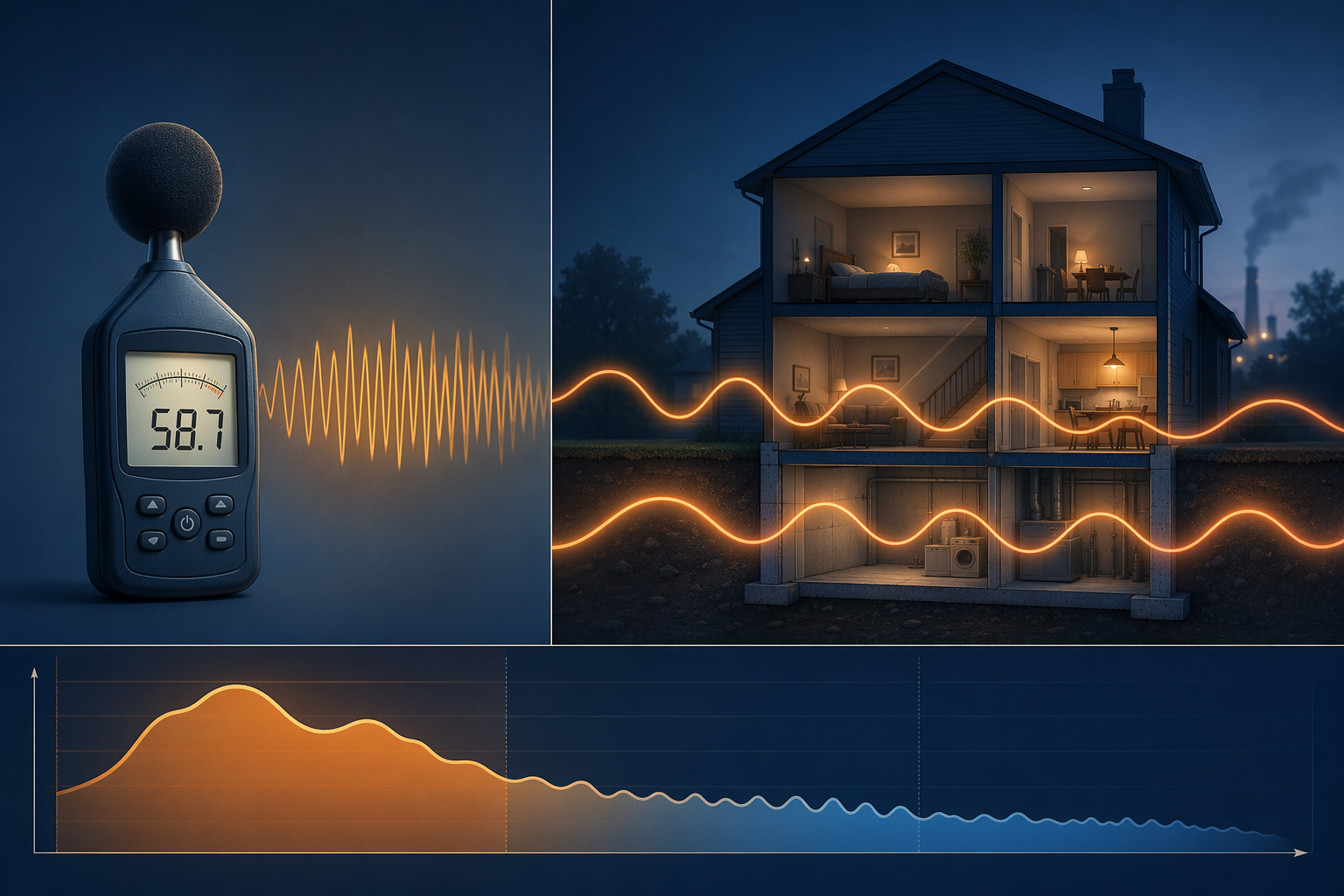
Standard dBA rules are useful for many ordinary noise conflicts because they weight sound in a way that approximates human sensitivity across frequencies. They are less satisfying when the complaint is a 24/7 industrial throb that seems to travel through walls, foundations, and sleep schedules. Legal commentary on data center noise has identified this mismatch directly: nuisance law and conventional ordinances built around intermittent sources such as parties, traffic, or construction do not always capture persistent low-frequency industrial hum.[6]
That mismatch creates an opening for activists and local governments. If residents believe the official meter says “compliant” while their lived experience says “unbearable,” the operator has not closed the issue. It may have simply moved the fight into ordinance design, monitoring requirements, litigation, and local elections.
From complaint to operating constraint
Aurora, Illinois is the clearest example of how the issue hardens. In March 2026, the city adopted a strict data center ordinance with 56 dB daytime and 46 dB nighttime limits, 1,500-foot setbacks from residences for roof chillers, continuous noise monitoring, and annual reporting requirements.[7] Those are not symbolic gestures. They affect site layout, equipment selection, capital planning, documentation, and the margin for future expansion.
The 1,500-foot roof-chiller setback is especially telling. It recognizes that the community-facing problem is not merely whether a parcel can hold a building. It asks where the noisiest mechanical systems sit relative to homes, and it pushes acoustic engineering into the earliest stages of site planning. A developer that treats sound mitigation as a late-stage enclosure decision may discover that the local rule has already changed the geometry of the project.
Other states are moving in different ways. North Carolina has been fast-tracking 500-foot noise impact assessments. Across the country, 27 states have been weighing large-load cost allocation rules, while 14 states have had moratorium bills related to data center construction under consideration.[8] Those measures are not all noise rules, and they should not be collapsed into one policy trend. They show a broader fragmentation problem: AI infrastructure is being negotiated through statehouses, city councils, utility commissions, and local zoning fights at the same time.
| Pressure point | What it changes for AI infrastructure planning |
|---|---|
| Local noise limits | Equipment choice, enclosure design, site layout, monitoring, and operating compliance |
| Setbacks for cooling equipment | Usable parcel geometry and the ability to expand capacity on a chosen site |
| Continuous monitoring and annual reporting | Ongoing compliance burden after launch, not just pre-construction approval |
| Moratorium proposals | Timing certainty and the risk that approvals pause while policy catches up |
| Large-load cost allocation rules | Power economics and who bears the cost of grid upgrades connected to large new loads |
The fragmentation is the business issue. A company can model the cost of a GPU cluster or a long-term power purchase agreement with relative discipline. It is harder to model a county-level backlash that borrows language from Aurora, legal arguments from another state, and organizing tactics from a national network. Data Center Watch has described the opposition movement as evolving from isolated local disputes into a coordinated national force using shared legal strategies.[2]
The buildout is also creating new noise battlefronts
Cooling is the most obvious pathway from AI density to neighborhood sound, but it is not the only one. As some operators explore on-site or off-grid generation to serve AI loads, the infrastructure footprint can expand beyond the data hall itself. The Conversation points to xAI’s 27-turbine gas plant in Mississippi as an example of how data center energy strategies can introduce additional local impacts, including noise concerns, beyond the server building.[9]
This matters because the public does not separate the stack the way industry does. A hyperscale operator may distinguish between compute, cooling, backup generation, interconnection, transmission upgrades, and utility cost recovery. A neighborhood sees one project and asks what it will sound like, what it will use, what it will emit, and who will pay for the supporting infrastructure. When the answer requires six separate proceedings, opposition does not necessarily weaken. It can find six points of leverage.
The same pattern is visible across adjacent AI infrastructure pressures. Power market exposure is already reshaping the economics of training and inference, as discussed in How PJM Power Prices Are Reshaping AI Training and Inference Costs. Vendors are also repositioning around the AI power crunch, as covered in Bloom Energy's Data Center Marketing Playbook for the AI Power Crunch. Noise complaints sit beside those pressures, not above all of them. But they move through a different channel: public tolerance, local legitimacy, and the ability to keep a site on schedule.
What strategy teams should actually take from this
Senior marketers and AI strategy teams do not need to become acoustical engineers. They do need to retire a too-clean mental model of compute supply. AI capacity is not produced by procurement alone. It is produced by parcels, permits, cooling systems, substations, generation choices, utility proceedings, community trust, and rules that can change after a project has been announced.
That has practical implications for planning conversations. If a product roadmap assumes new inference capacity from a specific region, the risk register should not stop at chip delivery and power availability. It should ask whether the project is exposed to organized local opposition, whether the local debate has centered on noise, whether cooling equipment sits close to residences, whether the jurisdiction is considering new setbacks or monitoring rules, and whether the operator has already made commitments that limit future expansion.
The answer will not always be alarming. Some projects will be sited far from homes, engineered conservatively, or backed by local economic support. Some opposition will focus more on water, ratepayer exposure, land use, or grid strain than on sound. The point is not to label every community challenge as a noise crisis. The point is to recognize that noise has become one of the fastest-moving ways for local discomfort to become a permitting, legal, and schedule constraint.
That is why the Q1 2026 delay number deserves attention without being overread. It captures a broader opposition bundle, not a clean noise-only causal chain. But the organizing data, the polling, the measurement gap, and the early regulatory response all point in the same direction: data center noise complaints are now material to AI infrastructure planning because they can turn an invisible backend dependency into a visible local fight.
References
- 130B in AI data centers has been blocked or delayed this year. Here's what you need to know, WSLS, July 10, 2026
- Data Center Community Opposition, DMA
- Americans Oppose Data Centers in Their Area, Gallup News, May 2026
- Communities Are Raising Noise Pollution Concerns About Data Centers, EESI
- Data centers face increasing infrasound complaints from neighboring communities — sounds do not register on decibel meters but irritate local citizens, Tom's Hardware
- When the Hum Never Stops: Noise Pollution, Data Centers, and the Limits of Nuisance Law, Duquesne JOULE
- Aurora adopts strict new regulations on data centers, Chicago Tribune, March 25, 2026
- States race to regulate data centers as AI demands more power, USA Today, June 4, 2026
- 5 ways data centers endanger their local communities and the country as a whole, The Conversation

Comments
Join the discussion with an anonymous comment.