
The New Marketing Org Chart: How AI Is Reshaping Teams and Careers in 2026
Net marketing headcount is flat, but composition is shifting: junior production roles are contracting while AI-native and strategic roles grow. This article examines the 2026 data from Gartner, Jasper, and Deloitte to help leaders make informed hiring and structure decisions.
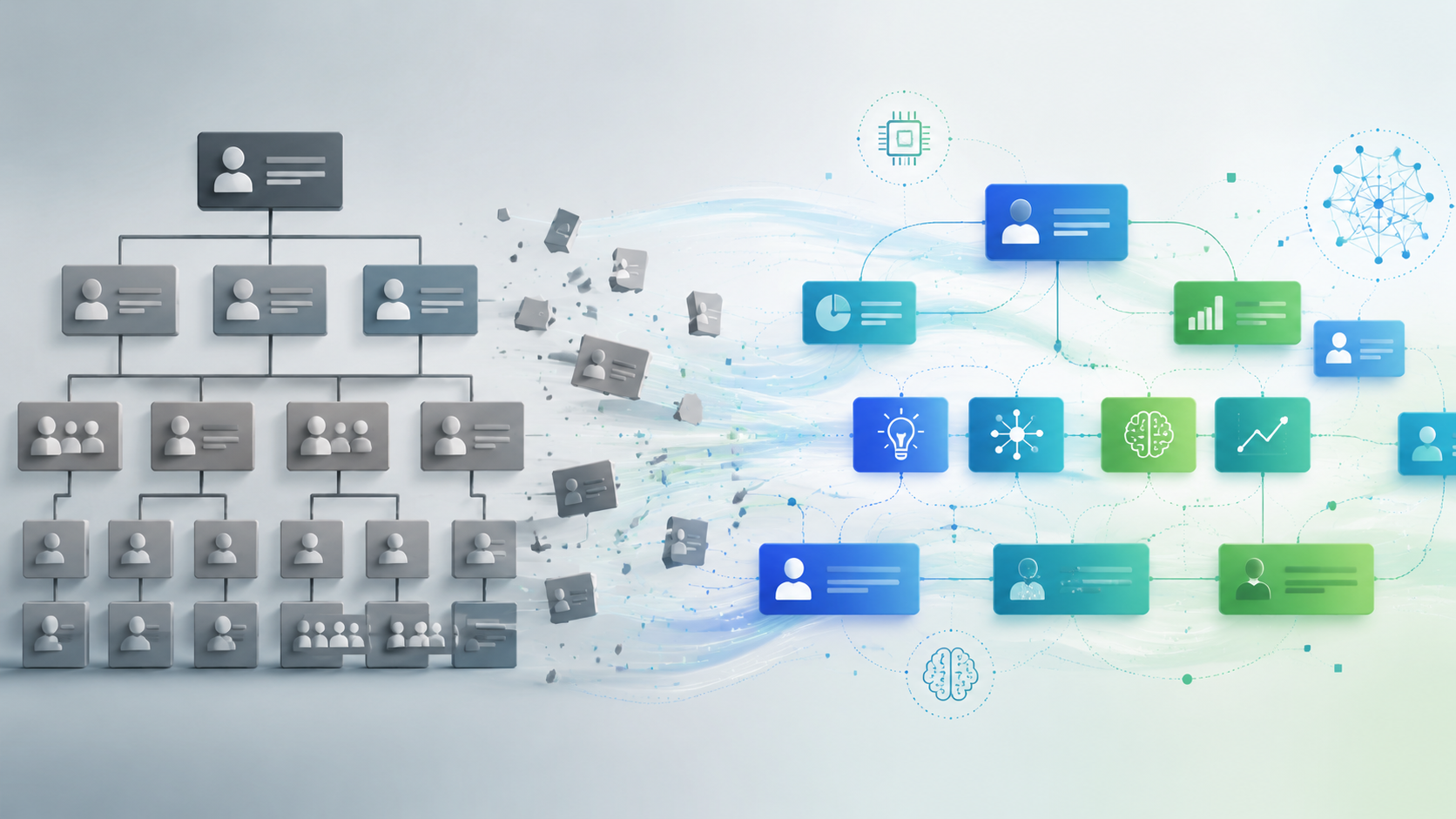
The marketing org chart is not getting smaller in the simple way many people expected. It is getting redrawn.
That distinction matters for anyone budgeting headcount in 2026. The visible pressure is not only on how much marketing work can be automated. It is on where judgment sits, who owns measurement, who reviews AI-assisted output, and how a team develops people when the easiest production work no longer needs as many hands.
Gartner's 2026 marketing data points to the pattern clearly: 23% of US agencies reduced junior copywriter headcount in 2025, and 31% plan further cuts in 2026. At the same time, open roles grew for senior content strategists, marketing data analysts, and AI-native marketing engineers, with year-over-year increases of 18%, 21%, and 24%, respectively.[1]
So the practical question behind AI and marketing is no longer whether the tools can draft, summarize, segment, or personalize. Marketing leaders already know they can. The question is what kind of team remains effective when first-draft capacity becomes cheaper, faster, and easier to distribute across the organization.
The Boxes Are Changing Faster Than the Headcount
Flat headcount can hide a lot of movement. A marketing team may keep the same number of seats while replacing two production-heavy roles with one analytics role and one AI operations role. An agency may hold staffing steady while moving work from junior drafting benches into smaller pods led by senior strategists. On paper, that does not look like a collapse. Inside the team, it changes who gets hired, who gets promoted, and who has leverage.
The contraction in junior copywriting is the most uncomfortable part of the data because those roles have never been only about output. They have also been a training mechanism. Junior writers absorbed positioning by rewriting landing pages, learned review standards by having drafts marked up, and built commercial judgment by seeing which messages survived legal, sales, product, and performance scrutiny.
Some of that work was inefficient. No one needs to romanticize handoffs, bloated content calendars, or the practice of assigning low-context writers to produce assets no one has time to brief properly. AI can remove a real amount of that waste. But when junior production capacity gets cut without a replacement training path, the team does not simply become leaner. It starts borrowing future senior talent from a pipeline it is no longer feeding.
| Role movement in 2026 data | What it suggests for team design |
|---|---|
| Junior copywriter headcount reduced by 23% of US agencies in 2025; 31% plan further cuts in 2026 | Routine drafting and production are losing bargaining power, especially where AI has compressed first-pass work |
| Senior content strategist roles up 18% year over year | Teams still need people who can decide what should be created, for whom, and why |
| Marketing data analyst roles up 21% year over year | Measurement and interpretation are moving closer to the center of marketing execution |
| AI-native marketing engineer roles up 24% year over year | Organizations are beginning to value people who can connect AI systems, workflows, data, and governance |
This is why the phrase “AI replaces juniors” is too blunt. The narrower, better-supported conclusion is that AI is compressing demand for some junior production work, while increasing demand for people who can frame problems, evaluate outputs, build workflows, and connect marketing activity to business outcomes.
Why Junior Production Roles Are Under Pressure
Junior production roles tend to sit closest to the tasks AI now handles most visibly: generating variants, rewriting for format, creating first-pass email copy, adapting a message for different channels, summarizing source material, and filling out campaign asset lists. If a team previously needed extra hands because each asset had to be manually drafted from a blank page, that staffing logic is weaker now.
The work has not disappeared, but the sequence has changed. A strategist or channel owner can now create a rough version of an asset set before a junior producer would have finished gathering examples. That does not mean the rough version is good, compliant, differentiated, or useful. It means the bottleneck has moved. The scarce capacity is less often the ability to produce words and more often the ability to know whether those words are strategically correct.
That shift creates a messy middle. Teams still need editing, QA, brand interpretation, legal sensitivity, audience knowledge, and campaign context. But if leaders do not name those responsibilities clearly, they can mistake AI-assisted speed for completed work. The cleanup then lands on senior people who were supposed to be freed for strategy, or on marketing operations teams that already own the hidden labor of making workflows function.

The risk is not that every junior role should be protected in its old form. The risk is that leaders cut the old entry-level work, celebrate a flatter structure, and then fail to assign the work that juniors used to learn from: reviewing briefs, comparing positioning choices, tracing performance back to messaging decisions, and understanding why a technically acceptable asset still misses the market.
The New Center of Gravity: Strategy, Data, and AI Direction
The roles growing in Gartner's data share a useful pattern. They are not simply “more senior” versions of old production roles. They sit closer to decisions: what audience to prioritize, what message to test, what data to trust, what workflow to automate, and what standard an AI-generated output must meet before it reaches a customer.[1]
A senior content strategist has more value when the content system is flooded with possible drafts. Someone has to decide which ideas deserve resources, which themes are overused, where subject-matter expertise is thin, and how content supports pipeline, retention, adoption, or brand trust. In a high-output environment, editorial judgment becomes a capacity constraint.
A marketing data analyst becomes more central for a related reason. AI makes it easier to create and distribute more variations, but more variation does not automatically improve learning. Teams need people who can separate channel noise from meaningful movement, define what an experiment is actually testing, and stop the organization from treating every dashboard fluctuation as a creative verdict.
The AI-native marketing engineer is the clearest signal that the org chart is changing, not just the tool stack. This role sits between marketing operations, data, automation, governance, and campaign execution. It is not just prompt writing. It is workflow design: connecting systems, managing inputs, building repeatable processes, and making sure AI-assisted work can be reviewed, measured, and improved.
Jasper's 2026 survey adds another layer: 65% of marketing teams report having designated AI roles, often focused on AI operations, workflows, or strategy, and one-third of marketers say AI strategy, policies, and governance have been added to their existing responsibilities.[2]
That finding is useful, but it should be read carefully. Jasper's survey is vendor-sponsored and based on 1,400 marketers, so it may make AI adoption look more formalized than it feels inside many teams.[2] Still, it points in the same direction as Gartner's hiring data: AI work is becoming a named responsibility, whether it appears as a new role or gets added to an existing one.
Flatter Teams Need More Ownership, Not Less
A flatter marketing team can be faster. It can also be a polite way of saying there are fewer people available to absorb ambiguity. The difference comes down to ownership.
If AI removes a layer of production handoff, the team has to know who now owns the brief, the source material, the review standard, the data interpretation, and the final decision to publish. Without that clarity, the organization gets the worst version of AI-enabled work: more assets moving faster through a process no one fully owns.
Gartner predicts a shift toward fully composable, AI-dependent marketing organizations with human-AI hybrid roles and flatter structures.[1] Deloitte describes a similar broader movement away from traditional departments and toward fluid teams oriented around outcomes rather than functions.[3]
Those are credible signals, but they are still better treated as emerging operating logic than as a finished reality. The hiring data supports role recomposition. It does not prove that most marketing organizations have already become composable, outcome-based networks. For many teams, 2026 is less a completed transformation than an awkward budget cycle where old job families and new work patterns are colliding.
A practical org-design conversation should therefore start with ownership rather than titles. Before backfilling a production role, leaders should ask what work has actually changed: Is the role still needed to create assets, or is the greater need now QA, workflow design, campaign analysis, sales enablement alignment, or AI governance? Before hiring an AI specialist, they should ask whether the person will have authority to change workflows or will merely become the help desk for everyone's tool experiments.
Agencies Feel the Staffing Shift Through Pricing
Agencies have a sharper version of the same problem because staffing models and pricing models are tied together. If clients know AI has compressed production time, they are less willing to pay for the same number of junior hours attached to the same deliverables.
Gartner reports that 38% of US digital agencies have moved at least one service line from hourly to outcome-based pricing in 2026, citing AI-driven productivity gains.[1] That does not mean hourly billing disappears. It does mean the old pyramid model becomes harder to defend when the work at the bottom of the pyramid is visibly faster to produce.
For agency leaders, the staffing implication is direct. A team built around drafting volume has weaker economics when clients buy outcomes, not hours. A team that can diagnose growth constraints, build AI-enabled production systems, interpret performance, and connect marketing work to revenue or retention has a clearer reason to exist.
This also changes what “senior oversight” means. It cannot be a thin review layer placed above a large production bench if the bench itself is shrinking. Senior people have to shape the work earlier: defining the problem, setting the measurement plan, deciding where AI can safely accelerate execution, and knowing where human expertise still needs to slow the process down.
What to Protect in the 2026 Marketing Budget
The strongest budget case in 2026 is not “more AI.” It is a clearer allocation of human capacity around the work AI makes more important.
- Protect strategy roles that define audiences, positioning, campaign priorities, and the trade-offs behind what does not get made.
- Protect analytical roles that can design measurement, interpret performance, and keep the team from confusing output volume with business progress.
- Protect AI operations and marketing engineering capacity where it creates repeatable workflows, governance, integration, and review standards.
- Be cautious about backfilling pure production roles until the team has separated necessary craft from tasks now handled acceptably through AI-assisted workflows.
- Rebuild training deliberately if junior roles are reduced, because the old apprenticeship model cannot be assumed to survive the new workflow.
The training point deserves more attention than it usually gets in budget meetings. If juniors no longer learn by producing large volumes of first drafts, they need other ways to build judgment. That may mean structured review rotations, clearer rubric-based editing, analyst shadowing, campaign postmortems, or junior roles designed around research, QA, content operations, and AI-assisted experimentation rather than blank-page drafting.
None of that requires preserving every old ladder. It does require admitting that ladders do not rebuild themselves. A team can reduce low-value production work and still invest in early-career marketers, but only if someone owns the design of that learning path.
Career Resilience Is Moving Upstream
For individual marketers, the role data points to a firm conclusion: being able to produce more assets is a weaker source of security than it used to be. That does not make craft irrelevant. It means craft has to be attached to judgment, systems, or measurable outcomes.
A copywriter who can only draft from a brief is more exposed than one who can improve the brief, identify weak positioning, evaluate AI-generated alternatives, and explain which message is more likely to move a specific audience. A channel marketer who can launch campaigns is more valuable when they can also read the data, adjust the workflow, and distinguish a creative issue from a targeting or offer issue. A marketing operations person who understands AI governance, data flows, and review processes moves closer to strategic infrastructure.
The useful career question is not “Will AI take my job?” It is “Which part of my work depends on manual production, and which part improves the quality of decisions?” The first category is under pressure. The second is where more of the hiring growth is showing up.
The resilient marketer in 2026 is not necessarily the most technical person on the team. It is the person who can direct AI systems with context, evaluate outputs against a real standard, understand what the data can and cannot prove, and connect marketing work to a business result someone outside marketing recognizes.
The Hiring Lens for AI and Marketing
The 2026 marketing team is being recomposed around judgment, measurement, orchestration, and AI supervision. Routine production is not gone, but it has less bargaining power when AI can generate acceptable first passes quickly and cheaply.
For leaders, the better hiring lens is simple: protect the roles that define strategy, interpret data, govern AI use, and connect activity to outcomes. Be careful about replacing production capacity one-for-one before asking whether the work has changed. And if junior roles are cut, do not pretend the talent pipeline will somehow keep producing senior strategists, analysts, and AI-fluent operators without a new way for people to learn.
For marketers planning their next move, the signal is just as clear. The safest ground is no longer pure output. It is the ability to direct systems, judge quality, and make marketing work accountable to results.

Comments
Join the discussion with an anonymous comment.