
National Ice Cream Day Freebie Campaign Ideas That Worked
Learn which National Ice Cream Day freebie campaigns drove results in 2026 and how to replicate their email, social, and in-store tactics for next year's promotion.
The National Ice Cream Day freebie campaigns worth copying from 2026 were not the ones that simply yelled “free ice cream” the loudest. The cleaner plays used the holiday as a handoff: email created intent before July 19, social made the offer visible or participatory, and the app, counter, or redemption window turned attention into a trackable customer action.
That matters because ice cream is not a novelty category looking for an excuse to exist. The U.S. ice cream industry reported an $11.6 billion economic impact, more than 1.23 billion gallons produced in 2025, and average consumption of 18 pounds per person, according to the International Dairy Foods Association.[1] Those numbers do not prove a free cone will pay for itself. They do explain why a one-day seasonal campaign deserves more planning than a last-minute post.
What the 2026 Freebie Mechanics Actually Looked Like
For planning purposes, the useful detail is not just who gave something away. It is the threshold, the channel, the time window, and the customer behavior each offer encouraged.
| Brand | 2026 mechanic | What it was really asking customers to do | What a smaller operator can copy |
|---|---|---|---|
| Dairy Queen | Free Dilly Bar through the DQ app with a $1 minimum purchase and a week-long window | Open or install the app, make a small purchase, redeem within a forgiving period | Use a low purchase threshold and a trackable redemption code, even without a full app |
| Friendly’s | Free cone with no purchase required | Walk in with almost no friction | Use the simplest possible traffic driver when store capacity can handle it |
| Dippin’ Dots | Free mini cup during a two-hour redemption window | Visit during a narrow operational window | Limit freebie liability by controlling the time, not by complicating the offer |
| Cold Stone | $450 gift card giveaway contest | Enter a higher-value promotional moment rather than claim a guaranteed free item | Use one larger prize when broad engagement matters more than every visitor receiving product |
| Carvel | “Dessert Disaster” social contest | Create or share content around a playful ice cream theme | Turn visual participation into the promotion when product giveaway volume is limited |
| Kilwins | Instagram sweepstakes | Follow, engage, or enter through a social platform | Keep the entry mechanic simple enough to complete from a phone in seconds |
Dairy Queen’s structure is the most reusable of the national-chain examples because it joins generosity with measurement. In 2026, the brand offered a free Dilly Bar through the DQ app with a $1 minimum purchase, and the offer ran over a week-long window around National Ice Cream Day.[2] The free item did the emotional work; the app and minimum purchase did the business work.
Friendly’s went the other direction with a no-purchase-required free cone.[3] That is a beautiful offer when the goal is pure foot traffic and goodwill. It is also the version that demands the most confidence in store execution: staff need to know the rules, signage needs to remove hesitation, and the line has to keep moving even when many guests are not buying anything else.
Dippin’ Dots used a tighter operational lever: a free mini cup during a two-hour window.[3] That kind of constraint is not less generous if it is communicated clearly. It simply moves the pressure from “How many free items can we afford all day?” to “Can we staff and stock one sharp rush?”
The contest-driven examples had a different job. Cold Stone’s $450 gift card giveaway and Kilwins’ Instagram sweepstakes were not the same kind of promotion as a guaranteed free cone.[4] Carvel’s “Dessert Disaster” social contest similarly used the holiday as a content prompt rather than only a redemption event.[5] Those ideas belong in the plan when the brand wants reach, tagged engagement, or user participation more than immediate counter traffic.
The Sequence to Copy: Email First, Social Second, Redemption Last
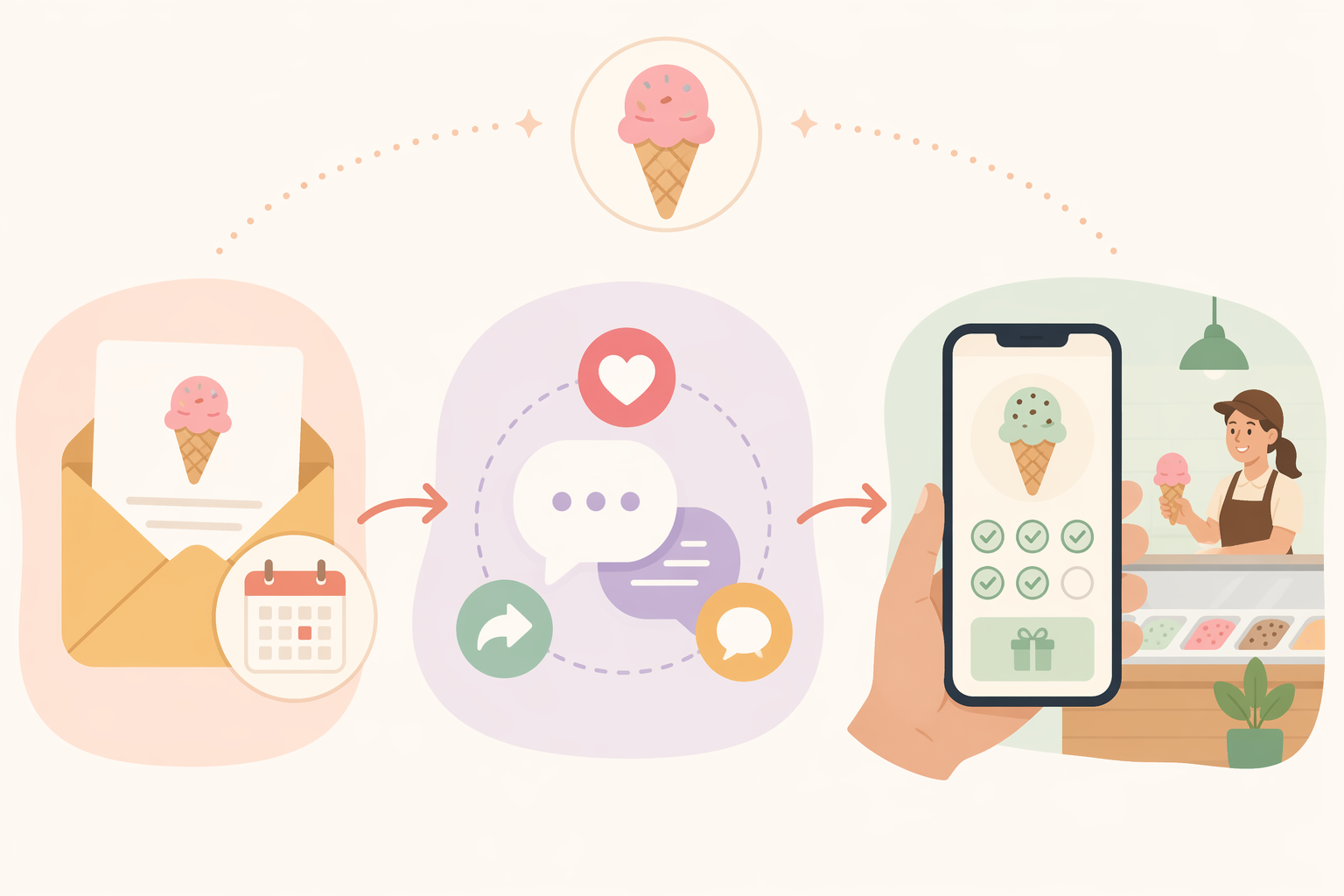
The practical 2027 play is to assign each channel a job instead of making every channel carry the same announcement. Email is where the offer becomes planned behavior. Social is where the offer becomes visible and shareable. The app, POS code, printed coupon, or counter script is where the campaign either becomes measurable or becomes a staff headache.
Use Email to Create Intent Before the Holiday
A seasonal email benchmark cited by Mailmodo says 76% of seasonal campaign revenue comes from sends a week before the holiday.[6] That figure comes from July 4 campaign analysis, not a National Ice Cream Day-specific study, so it should not be treated as proof that ice cream promotions behave exactly the same way. It is still a useful warning against sending the first message on the morning of the event.
For a Sunday holiday like July 19, 2026, the cleaner email rhythm would have been a preview early in the week, a reminder close to the weekend, and a final same-day message only if the store could actually absorb the demand. For 2027, National Ice Cream Day falls on July 18, so the same logic points to warming the list before the weekend rather than depending on a single Sunday send.
MailerLite’s 2025 benchmark puts the average promotional email open rate at 43.46%.[7] That is not an ice cream benchmark either, but it gives planners a rough reality check: a meaningful share of the list may never see one message. A campaign that needs customers to know the rules should not hide those rules in only one email.
The subject line can stay playful as long as the offer remains obvious. Published July newsletter examples include “🍦 Scoop it up or this deal melts fast,” “I Scream, You Scream… Exclusive Deals Inside,” and “A sweet National Ice Cream Day treat.”[8][9][10] Those work because the reader can identify the season and the reward quickly. The cleverness is decoration, not the mechanism.
There is also room for emoji, but not as a strategy by itself. Campaign Monitor data cited by Mailmodo says emoji in subject lines can lift open rates by up to 56%.[6] “Up to” is doing work there. Test the cone emoji if it fits the list, but do not let a higher open rate mask a vague offer, a missing redemption rule, or a store team that finds out about the promotion after the customers do.
Let Social Decide Whether the Campaign Is a Giveaway or a Participation Play
Social content around National Ice Cream Day has an obvious advantage: the product photographs well. The mistake is assuming every post needs to push immediate redemption. Some campaigns should drive claims; others should drive comments, shares, tags, or entries.
A redemption post should answer four things without making the customer tap through three times: what is free, who qualifies, when it is available, and where to claim it. Friendly’s no-purchase cone and Dippin’ Dots’ two-hour mini cup are both examples where the rule clarity matters as much as the creative asset.[3] If the offer is simple, the post should stay simple.
A participation post can ask for more. Cold Stone’s gift card giveaway, Kilwins’ Instagram sweepstakes, and Carvel’s “Dessert Disaster” concept sit in this lane.[4][5] The customer is not just showing up for a free item; they are entering, reacting, posting, or playing along. That gives the brand more social surface area, but it also means the prize or theme has to be strong enough to justify the extra step.
- Use a guaranteed freebie post when the main goal is store visits.
- Use a sweepstakes when the main goal is followers, comments, or reach.
- Use a photo or story prompt when the product or customer experience is visually distinctive.
- Use a narrow redemption window when inventory, staffing, or margin needs protection.
For smaller operators, this is where restraint helps. A local shop does not need to copy a national gift card amount to borrow the structure. A “post your messiest sundae face” contest, a tagged cone photo, or a one-day flavor vote can do the same social job at a more realistic scale, as long as the entry rule is short and the prize is worth the customer’s attention.
Make Redemption Boringly Clear
The redemption layer is where a cute campaign becomes either a good customer experience or a long afternoon for the counter team. Dairy Queen could route customers through its app.[2] Many independent shops cannot. That does not make the tactic unusable; it changes the tool.
| If you do not have... | Use this instead | What to measure |
|---|---|---|
| A mature loyalty app | A single-use email coupon code or POS button | Redemptions, add-on purchases, repeat visits |
| A large paid social budget | A pinned organic post, local partner shares, and staff reposts | Reach, comments, saves, profile visits |
| A national gift card prize | A small bundle, birthday party add-on, pint pack, or monthly cone pass | Entries, follows, email sign-ups |
| All-day staffing flexibility | A two-hour or four-hour redemption window | Redemption volume by hour, wait time, sellouts |
A good freebie rule can be almost plain enough to feel dull: “Free kids cone, no purchase required, 2–5 p.m., while supplies last.” Or: “Free topping with any scoop when you show this email.” Or: “Join the rewards list by July 17 and get a free mini cone on July 18.” The operational question is whether staff can explain it in one sentence while the line is moving.
Low thresholds are often better than elaborate bundles. Dairy Queen’s $1 minimum purchase gave the customer a very small hurdle while still creating a transaction.[2] A local version might be a free topping with any purchase, a free mini cone with a pint purchase, or a free kids scoop for loyalty sign-ups. The point is not to squeeze the highest possible basket out of a holiday built around generosity. It is to connect the free item to the one behavior the business most wants.
How to Resize National-Chain Ideas for a Smaller Shop
The available 2026 examples skew heavily toward large chains with national awareness, app infrastructure, and promotional budgets. That is a limitation, not a reason to ignore them. Their mechanics can still be resized if the planning starts with the business constraint rather than the headline offer.
| Business goal | Best-fit freebie idea | Channel emphasis | Operational guardrail |
|---|---|---|---|
| Store visits | No-purchase mini cone or free topping | Email reminder plus clear social post | Limit by daypart or while supplies last |
| Email or loyalty sign-ups | Free small item for joining before the holiday | Email capture page, QR code, counter signage | Train staff on the sign-up flow before launch |
| Social reach | Photo prompt, flavor vote, or sweepstakes | Instagram, Facebook, TikTok, local partner reposts | Keep entry rules short and prize fulfillment simple |
| Average order lift | Free add-on with purchase | Email segmentation and in-store menu prompts | Choose an add-on that does not slow production |
| Rush control | Timed two-hour freebie | Social countdown and same-day email | Staff for the window and stop promising once inventory is gone |
The no-purchase offer is the cleanest goodwill play, but it is not automatically the best one. If a shop has a small staff, limited freezer capacity, or a counter layout that backs up quickly, the Dippin’ Dots-style timed window may be safer than an all-day giveaway.[3] If the list is small but loyal, an email-only reward may produce a calmer, better-measured day than a broad public freebie.
The app-tied offer is the hardest to copy directly. A national app can push notifications, recognize users, and attribute redemptions. A smaller business can approximate the useful parts with a QR code, a short form, a POS discount key, or a “show this email” redemption. What matters is not having an app icon on the customer’s phone. What matters is knowing whether the holiday produced sign-ups, visits, add-on purchases, or repeatable interest.
Where AI Helps Without Becoming the Campaign
AI tools can speed up the pieces that usually bottleneck a small team: subject line variations, social captions, reminder copy, simple audience segments, and staff-facing FAQ drafts. They should not be treated as evidence that a campaign will perform. None of the documented 2026 National Ice Cream Day examples prove that AI caused the results.
A practical use is to generate three versions of the same message for different customer states: loyal regulars, lapsed customers, and people who have never joined the rewards list. The offer can stay the same while the angle changes. Regulars may care about early access or a favorite flavor; lapsed customers may need the simple reminder; new subscribers may need the clearest explanation of how to redeem.
AI is also useful for stress-testing clarity. Paste the draft rules into a tool and ask what a cashier would need to know, what a customer might misunderstand, and which words create loopholes. Then have a person who actually understands the store fix the answer. The campaign still belongs to the operator, not the generator.
What About Brands That Do Not Sell Ice Cream?
Non-ice-cream brands can participate, but the bar for relevance is higher. The safest route is partnership rather than pretending the brand has suddenly become an ice cream authority. A bookstore can partner with a nearby scoop shop for a receipt swap. A gym can offer a post-class local cone perk. A pet store can run a summer treat bundle with a neighborhood creamery if the customer connection is natural.
The same channel sequence still applies. Email explains why the brand is participating. Social shows the partner, the treat, and the local angle. Redemption happens through a simple proof point: a receipt, code, QR scan, or staff-confirmed offer. If the connection takes a paragraph to justify, it probably belongs to a different holiday.
A Practical 2027 Planning Stance
For July 18, 2027, start with the desired customer action before choosing the freebie. If the goal is reach, build a visual social contest. If the goal is store visits, keep the redemption offer simple and visible. If the goal is sign-ups, make the reward low-friction but trackable. If the goal is order lift, attach the free item to a small purchase threshold that does not make the holiday feel stingy.
Then build the handoff. Send before the holiday so customers can plan. Use social for the part of the campaign that benefits from public sharing. Give staff a redemption rule they can say out loud without checking a manager. The free ice cream gets attention; the sequence decides whether that attention becomes a useful campaign.
References
- July Is National Ice Cream Month, International Dairy Foods Association.
- National Ice Cream Day 2026 deals, freebies, USA TODAY.
- National Ice Cream Day deals 2026: Free Dairy Queen, Cold Stone and more, TODAY.
- National Ice Cream Day 2026: Full list of freebies and deals today, Fast Company.
- Our Scoop of the Coolest Ice Cream Marketing, Contentworks Agency.
- Seasonal Email Campaign Statistics, Mailmodo.
- Compare your email performance metrics: Industry benchmarks, MailerLite, 2025.
- July Newsletter Ideas, Designmodo.
- July Newsletter Ideas, Selzy.
- July Newsletter Ideas, Campaign Refinery.

Comments
Join the discussion with an anonymous comment.