
How the MLB AI iPad Ban Opens New Sponsorship Opportunities
MLB's ban on AI-powered dugout iPads removes a tech sponsorship asset, but sports marketers can follow the T-Mobile ABS playbook to turn rule changes into even more valuable partnership opportunities. This article explains how to identify and activate sponsorship innovations embedded in league policy shifts.
The first answer to the MLB AI iPad ban’s effect on sports marketing is the obvious one: it removes a visible technology asset from the dugout. MLB’s June 11 memo, effective July 19, bars teams from using a custom AI-powered tab on dugout iPads for pitch-calling AI, substitution recommendations, and in-game optimization, while still allowing static data, delayed video, and Statcast access.[1]
That distinction is where the sponsorship conversation should start. This is not a blanket retreat from technology in the dugout. It is a narrower removal of real-time AI decision support from a branded, visible interface. For the roughly one-third of teams that used the custom tab, the immediate loss is concrete enough to matter, but not broad enough to justify treating the category as closed.[1]
A sponsor can lose a tab. A team partnership group can lose renewal language. A broadcast integration can lose a clean visual. Those are real problems. But the more useful question is what the rule now makes scarce. If the dugout can no longer show certain forms of live AI assistance, then the next valuable inventory is likely to gather around permitted decision points, visible confirmations, broadcast explanation, and infrastructure that helps the league manage the new boundary.
The Ban Changes the Surface, Not the Appetite
Sports sponsorship assets rarely disappear neatly. They migrate. A rule removes one screen, and attention moves to the next place where fans, broadcasters, coaches, players, and officials must all look at the same time. That is why a policy memo can matter as much as a new media package.
The iPad ban is frustrating for any partner that treated the dugout device as proof of technical relevance. A custom tab on a team-used device has a seductive simplicity: it is close to performance, close to coaches, and close to the game. But that proximity is also what made it vulnerable. Once a tool is perceived as real-time competitive support, the league can decide that the inventory is no longer merely a marketing surface.
That creates a strategic dividing line. Some sponsors will try to preserve the old asset through narrower language. Others will look for the behavior the rule is forcing: more scrutiny around what data enters the dugout, more interest in what remains visible to fans, and more value in moments where technology is allowed to arbitrate or explain the game.
The Better Model Is T-Mobile’s ABS Bet
The automated ball-strike challenge system is the cleaner comparison because it shows how a rule-driven behavior change can become recurring sponsorship memory. Adam Grossman’s April 2026 analysis of T-Mobile’s ABS activation described a partner that did not wait for the system to become polished inventory in a league sales deck. T-Mobile invested ahead of formal approval and connected its brand to the moment fans would repeatedly notice.[2]
The operational bet was substantial: T-Mobile spent 18 months deploying private 5G infrastructure across all 29 U.S. MLB stadiums before ABS was formally approved.[2] That is the part worth studying. The sponsorship asset was not just a logo near a strike zone graphic. It was a technical position taken before the new behavior was fully normalized.
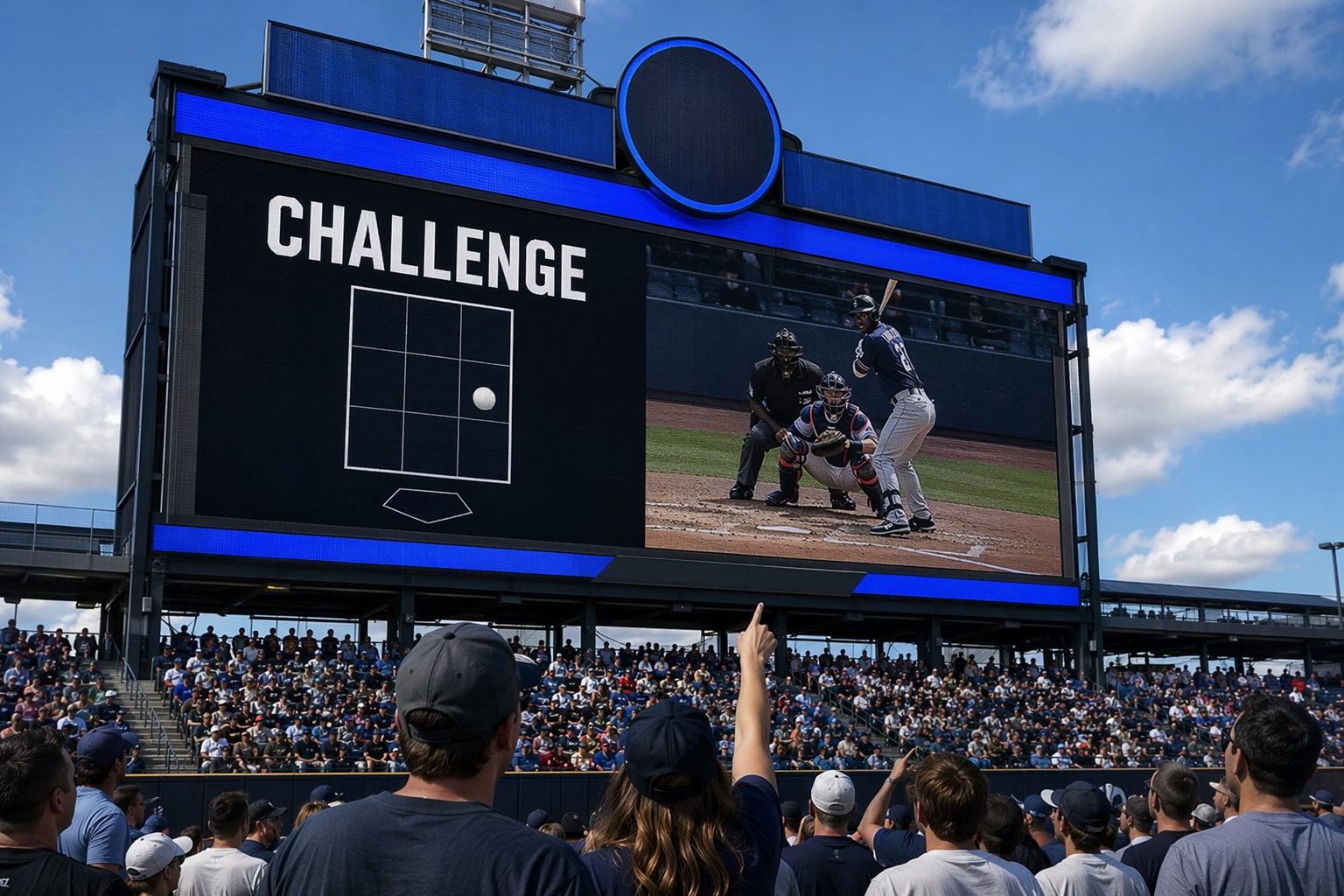
Once ABS entered play, the repetition gave the integration its value. In the first 35 games of 2026, there were 124 challenges, and 54% of challenged calls were overturned.[3] Those figures do not prove that every challenge moment is commercially equal, or that fans process the sponsor every time. They do show that the system creates a recurring interruption with a clear sequence: challenge, wait, display, confirm, react.
That sequence is sponsorship-friendly because it solves a problem most brand integrations struggle with. It gives the audience a reason to look. The scoreboard has a job. The broadcast graphic has a job. The technology has a job. The sponsor has a credible role because the moment needs connectivity, speed, reliability, and explanation rather than decorative presence.
| Rule-driven behavior | Why it creates sponsorship value |
|---|---|
| A player or team challenges a call | The game produces a repeatable, visible pause |
| The system processes and displays the review | Fans and broadcasters need a clear explanation |
| The result confirms or overturns the call | The moment produces reaction, memory, and replay value |
| The process depends on stadium infrastructure | A technical sponsor can support the behavior credibly |
There is a caution here. Grossman’s post is a useful expert analysis, not a universal law.[2] ABS is unusually clean because the rule change creates a discrete, camera-friendly ritual. Not every policy shift will give a sponsor that kind of stage. The lesson is not “find the next challenge system.” The lesson is to look for rule changes that make a new behavior repeat in public.
What the iPad Ban Makes More Valuable
The banned AI tab sat inside the dugout. That made it attractive, but it also limited the number of people who could understand its value in real time. The next sponsorship opportunity may be less intimate with team decision-making and more visible to the audience watching how the game manages technology.
The most promising assets will not necessarily look like replacement iPad inventory. They are more likely to sit around five practical conditions:
- Repeated decision points: moments that happen often enough to become familiar without needing to occur every inning.
- Visible pauses or confirmations: sequences where fans can see that the game is waiting for an answer.
- Infrastructure needs: connectivity, display systems, data handling, authentication, or operational support that a sponsor can credibly provide.
- Broadcast explainability: graphics or commentary that help viewers understand what is allowed, what is being reviewed, or why a decision changed.
- Category fit: partners whose products plausibly support speed, trust, clarity, security, or performance operations.
The important shift is from buying exposure on a tool to underwriting a behavior. A dugout AI tab can be valuable because teams use it. A rule-driven moment can be more valuable because everyone waits for it together.
Why Structural Change Has Been Good Sponsorship Terrain
MLB already has evidence that structural changes can coexist with sponsorship growth. After the league introduced the pitch clock in 2023, team sponsorship revenue rose 23% to $1.5 billion, according to Marketing Dive reporting that cited SponsorUnited.[4] That does not mean the pitch clock alone caused the revenue increase. It does mean a major operational change did not freeze the marketplace.
The broader trajectory also matters. SponsorUnited’s 2025 public report summary put MLB sponsorship revenue at $2.05 billion in 2025, up 9% year over year and 68% since 2022.[5] Those numbers should not be stretched into a claim that every new rule creates automatic sponsor demand. They support a narrower, more useful point: MLB has recently shown an ability to convert changes in how the sport is played, watched, and packaged into commercial growth.
That is why the AI iPad ban deserves more than a defensive response. A restriction can reduce one kind of inventory while increasing the premium on assets that explain, validate, or operationalize the new rule environment. The league still needs technology. Teams still need permitted information. Broadcasts still need to tell viewers what is happening. Fans still respond to visible moments that affect the game.
How Sponsors Should Read the Next Policy Memo
The practical move is to stop reading league policy only as a compliance document. For partnership teams, a rule memo is also an early map of future attention. It tells you which behaviors will be constrained, which actions will need monitoring, and which parts of the game may require new explanation.
The first pass should be blunt: identify what the rule removes. In this case, it removes real-time AI decision support from a custom dugout iPad tab while leaving other data and video functions intact.[1] That prevents lazy overreaction. The sport has not banned dugout technology; it has drawn a line around a particular class of in-game AI assistance.
The second pass is more valuable: identify what the rule makes everyone notice. If coaches can no longer use a tool in one visible way, where do permitted decisions become more deliberate? If the league wants to preserve competitive boundaries, where will it need clearer communication? If fans hear that AI is restricted, which broadcast moments will need to explain what technology remains legal?
The third pass is commercial: ask whether a sponsor can credibly support the new behavior before the inventory is fully packaged. T-Mobile’s ABS position worked as a model because the brand’s infrastructure role matched the operational need and arrived before the moment was fully mature.[2] A sponsor that waits until the league has already named, priced, and sold the asset is no longer shaping the opportunity. It is competing for a finished slot.
The Renewal Conversation Changes
The hardest part may sit inside team and league partnership departments. A seller who promised innovation now has to explain why a visible technology surface has disappeared. There is no public basis yet for projecting Apple’s response, a broader MLB partnership renegotiation, or a specific makegood structure, so the safer commercial work is scenario planning rather than public prediction.
A stronger renewal conversation would not pretend the asset survived unchanged. It would separate the lost exposure from the strategic territory that remains: permitted dugout data, fan-facing technology education, broadcast segments around rules and decision-making, stadium connectivity, and sponsor-backed explainers that make the new boundary legible. The value shifts from “our technology helps the team decide” to “our technology helps the sport operate and explain decisions inside the rules.”
That is not a cosmetic distinction. Performance-adjacent claims invite competitive-integrity scrutiny. Operations-adjacent claims can be built around reliability, transparency, and fan understanding. The sponsor that sees the difference can move faster without overpromising what the league will allow.
What to Build Before the Deck Exists
The T-Mobile ABS example is useful because it rewards patience before visibility. Eighteen months of infrastructure work is not glamorous in a recap deck, but it is exactly the kind of investment that can make a sponsor hard to dislodge once the moment becomes part of the game.[2]
For the next rule-driven opportunity, the early work may be less about creative and more about operational fluency. A sponsor should know which stadium systems are involved, which league approvals are needed, which broadcast graphics would make the moment understandable, and which team personnel would actually touch the process. The best asset may be born in the meeting where operations says, “We need this to work every night,” not in the brainstorm where marketing asks for a logo location.
That does not mean every technology sponsor should rush toward MLB’s AI boundary. Some categories will not have a credible role. Some rule changes will be too rare, too invisible, or too politically sensitive to support a clean activation. The filter should be practical: can the sponsor help the new behavior happen, be trusted, or be understood often enough that fans and broadcasts recognize the association?
The banned iPad tab is a lost asset. It is not the end of the opportunity. The marketers with the better position will be the ones who treat rule changes as early asset-discovery signals, not as dead ends to mourn until the next approved inventory package arrives.
References
- MLB AI iPad ban coverage, The Athletic, Fox News, and New York Post, July 16, 2026
- T-Mobile ABS sponsorship analysis, Adam Grossman on LinkedIn, April 2026
- ABS challenge system early 2026 figures, Front Office Sports
- MLB team sponsorship revenue and pitch clock reporting, Marketing Dive via SponsorUnited
- MLB 2025 Marketing Partnerships Report, SponsorUnited, 2025

Comments
Join the discussion with an anonymous comment.