

How Micron's Memory Chip Shortage Is Driving Up Your AI Tool Costs
Learn how Micron's sold-out HBM4 memory and record DRAM price increases are translating into higher AI marketing tool subscriptions, tighter usage caps, and why locking in annual contracts now may protect your budget.
The first sign usually does not look like a semiconductor story. It looks like an AI writing platform moving your team to a higher tier, an analytics assistant reducing the number of included runs, a creative tool adding overage charges, or a renewal quote that is only valid for a shorter window than last year.
That is where Micron’s memory-chip supply starts to affect AI hardware costs and, eventually, marketing budgets. Most marketing teams do not buy high-bandwidth memory directly. They buy subscriptions from SaaS vendors that run models on cloud infrastructure. Those cloud systems depend on memory-heavy AI hardware. When the cost and availability of that hardware change, vendors eventually have to decide whether to absorb the pressure, redesign product limits, or pass more cost to customers.
No public source proves a straight line from Micron’s HBM4 allocation to a specific AI marketing tool’s invoice. The practical chain is a synthesis: memory scarcity affects AI hardware economics; AI hardware economics affect cloud inference costs; cloud inference costs shape SaaS pricing, usage caps, and contract language. That chain is now strong enough to deserve a place in renewal planning.
The Budget Signal Is Coming From Memory, Not Just Models
Micron’s entire 2026 HBM4 production capacity has been reported as sold out under binding multiyear contracts, and TrendForce data cited by CNBC said average DRAM prices rose 50% to 55% in Q1 2026 from Q4 2025, a move TrendForce called “unprecedented.” The same reporting said memory accounted for about 20% of device bill of materials, up from 10% to 18% in the first half of 2025.[1]
That is not ordinary vendor noise. A one-year SaaS increase can be dismissed as packaging. A broad memory price jump, sold-out next-generation HBM capacity, and a rising share of total hardware cost point to a cost base moving underneath the software layer.
Reuters reported on June 24, 2026 that Micron had $22 billion in strategic customer agreements with take-or-pay provisions and $100 billion in remaining performance obligations.[2] Take-or-pay language matters because it signals customers are not merely expressing interest. They are committing to buy or pay under defined terms. For a marketing operator, the important point is not the legal structure itself; it is that major AI infrastructure buyers are trying to secure memory supply before it reaches spot-market flexibility.
Once capacity is committed that far ahead, waiting for “the market” to casually fix pricing becomes a weaker budget argument. A manager may not care about HBM4 architecture, but she will care that the upstream components behind AI compute are being locked up under multiyear commitments while downstream software vendors are still selling AI access month to month.
How Scarce Memory Shows Up In A Marketing SaaS Renewal
The pass-through rarely arrives with a line item called “Micron shortage fee.” It is more likely to arrive as product packaging.
- Included AI credits shrink while the headline subscription price stays similar.
- A vendor moves advanced models, long-context runs, or bulk generation into a higher tier.
- Monthly plans become noticeably less attractive than annual commitments.
- Quotes expire faster because the vendor does not want to hold pricing while compute costs move.
- Fair-use language becomes narrower, with more explicit caps on seats, prompts, exports, or analysis runs.
This is why a renewal can feel worse even when the vendor says the base subscription is unchanged. If your team used to generate briefs, ad variants, SEO refreshes, and reporting summaries without thinking about marginal runs, a tighter cap changes behavior. Someone starts deciding which campaign gets the expensive model, which recurring report can wait, and which teammate has to stop experimenting near the end of the billing cycle.
Dell’s chief operating officer said the memory shortage would likely affect retail prices, and CNBC reported that Dell was shifting configurations to mitigate the impact.[1] That comment is useful because it moves the issue out of an abstract chip-market chart and into a purchasing decision. If hardware makers are adjusting configurations around memory availability and cost, software vendors running AI infrastructure have similar incentives to redesign what customers can use by default.
There is also limited room for easy competitive relief. Samsung, SK Hynix, and Micron control about 95% of global DRAM production, according to Introl.[3] That concentration does not mean prices can only move one way, but it does mean buyers cannot assume dozens of interchangeable suppliers will quickly erase the shortage.
Annual Contracts Are A Hedge, Not A Moral Principle
If a tool is already proven in your workflow, an annual contract can protect against the most annoying version of AI inflation: discovering mid-quarter that a critical workflow now sits behind a higher tier or lower cap. The value is not only the discount. It is price predictability, usage predictability, and time to adjust before the next renewal.
The wrong move is to lock everything blindly. Annual commitments are weak protection if the vendor is unstable, the workflow is still experimental, or your team cannot show that the tool saves time, improves output, or supports revenue. A cheaper annual invoice can still be waste if no one can defend the use case six months later.
| Contract Situation | Better Posture |
|---|---|
| Tool is used weekly in production workflows and has a known owner | Push for annual pricing, cap protection, and written overage terms |
| Tool is promising but still being tested by one or two people | Stay shorter-term until usage and value are proven |
| Vendor is changing packaging or removing included usage | Ask for a renewal bridge, grandfathered limits, or a longer quote window |
| Team cannot explain what the AI work replaces or improves | Fix measurement before committing more budget |
The renewal conversation should be specific. Ask what happens to included AI credits during the term, whether fair-use policies can change before renewal, whether model access can be downgraded, how overages are calculated, and whether unused credits expire. If procurement asks why this matters now, the answer is not “AI is expensive.” The defensible answer is that memory-intensive AI infrastructure is facing supply and price pressure, and vague usage language transfers that volatility to the marketing budget.
Prompt Caching Is No Longer Just An Engineering Detail
Cloud providers are already treating AI cost control as a design problem. AWS Bedrock, Azure Foundry, and Vertex AI have introduced or emphasized techniques such as prompt caching, model routing, and provisioned throughput, and AWS has reported up to a 90% cost reduction on cached prompts.[4] That figure is a cloud-cost example, not a promise that your marketing SaaS bill will fall by 90%. But it points to the kind of behavior vendors will reward, expose, or eventually price around.
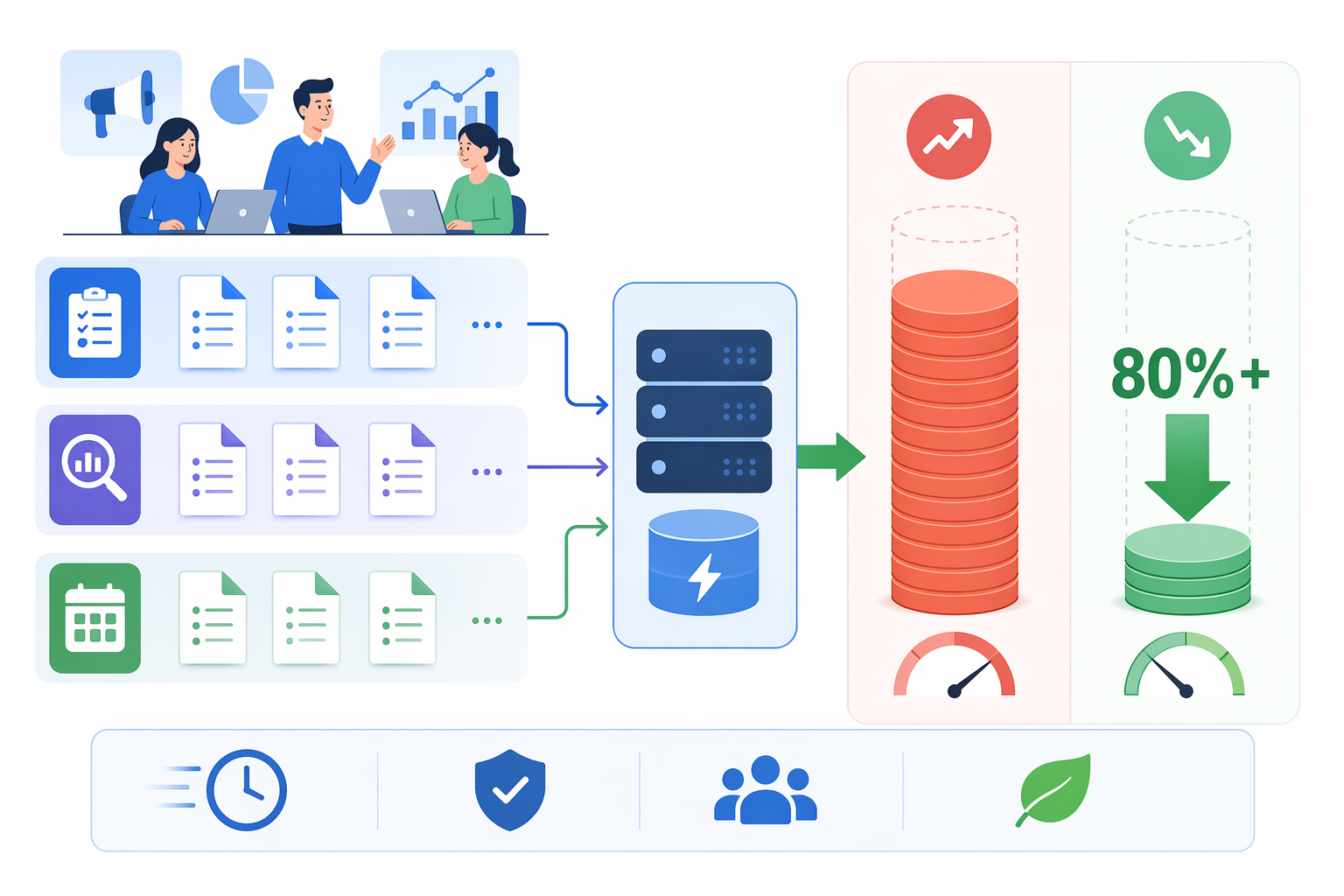
Marketing teams have more repeat prompts than they think. A content team may reuse the same brand brief, audience definition, tone rules, compliance constraints, product descriptions, and article outline format across dozens of articles. A paid media team may run the same analysis pattern against new campaign exports every week. An SEO team may ask the same clustering, cannibalization, or refresh-priority questions against updated data.
If every one of those jobs is submitted as a fresh, full-context prompt, the team is paying for repetition. If the vendor or internal workflow can cache stable instructions, route simple tasks to cheaper models, or reserve expensive models for work that genuinely needs them, the same marketing output can require less compute pressure.
This does not require marketers to become cloud architects. It does require a cleaner inventory of repeat work.
- List the prompts or workflows used at least weekly.
- Separate stable context from variable inputs, such as campaign data or a new URL.
- Ask vendors whether stable instructions are cached or billed repeatedly.
- Check whether simpler tasks can use a lower-cost model without hurting quality.
- Document which workflows must keep access to the highest-capability model.
Where Forecasts Help, And Where They Do Not
Forecasts are useful for timing, but they are not a substitute for contract hygiene. TrendForce’s Q1 2026 DRAM price data and its reported characterization of the increase as unprecedented are strong signals about the market at that point in time.[1] Forecasts from firms such as TrendForce or Mizuho may later be revised as supply, demand, and customer commitments change. Treat them as dated inputs, not permanent laws.
The better planning question is simpler: would your AI-tool budget survive if the vendor reduced included usage, moved a key feature to a higher tier, or changed overage terms before your next planning cycle? If the answer is no, the exact memory-price forecast is less important than the fact that your current contract leaves too much operational risk uncovered.
A Practical Posture Before Renewal Season
Start with the tools already embedded in production work. Pull the last few months of usage if the vendor exposes it. Look for the workflows that would interrupt publishing, reporting, campaign launches, or executive updates if access changed. Those are the tools worth negotiating first.
Then make the renewal ask concrete. Request annual pricing where value is proven. Ask for written protection on included usage, caps, model access, overage rates, and quote validity. If the vendor will not commit, budget as if usage-based pricing is coming rather than treating the current plan as a stable baseline.
At the same time, reduce avoidable compute waste. Standardize reusable briefs. Shorten bloated prompts. Route lightweight tasks to lower-cost options when quality holds. Track which prompts repeat often enough to ask about caching. The point is not to squeeze experimentation out of the team; it is to stop paying premium AI costs for work that is mostly duplicated context.
The final filter is ROI discipline. If a tool is important enough to lock in, it is important enough to measure. Teams that need a stronger business case can use Signal & Convert’s AI analytics ROI gap article to decide which AI investments deserve renewal protection and which ones should stay flexible.
Micron’s memory supply constraints do not mean every AI tool price will jump at the same time or by the same amount. They do mean the old habit of treating AI usage as an unlimited feature inside a fixed SaaS subscription is getting harder to defend. Review usage now, protect proven workflows, and make vendors put the risky terms in writing before your team depends on them.
References
- Micron HBM4 capacity, TrendForce DRAM pricing data, memory bill-of-materials share, and Dell memory-shortage comments, CNBC
- Micron strategic customer agreements and remaining performance obligations, Reuters, June 24, 2026
- Global DRAM production concentration among Samsung, SK Hynix, and Micron, Introl
- Cloud AI cost strategies including prompt caching, model routing, and provisioned throughput, Virtualization Review

Comments
Join the discussion with an anonymous comment.