
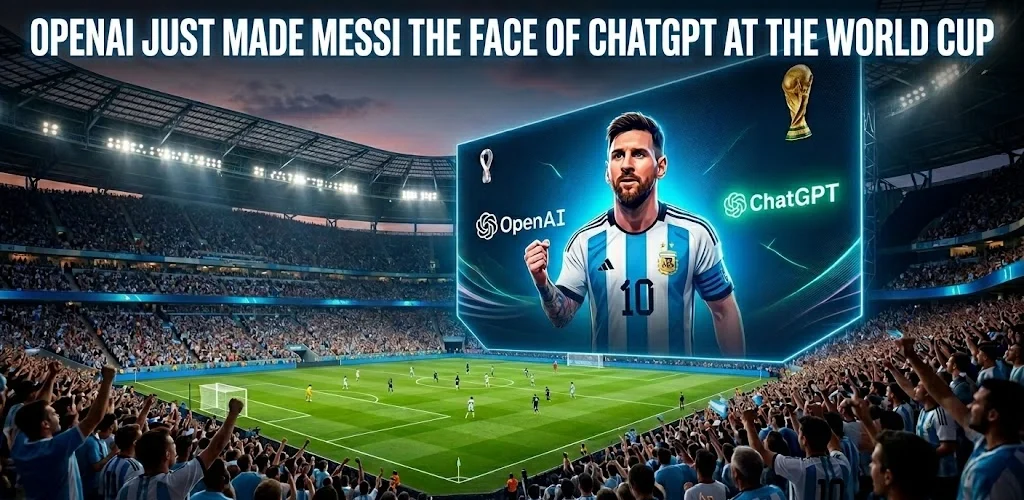
OpenAI-Messi Campaign Lessons for AI Influencer Marketing
The OpenAI-Messi World Cup campaign generated 17M+ prompts and top creative rankings, but its long-term value for marketers remains uncertain. This breakdown examines the campaign's mechanics, metrics with caveats, and lessons for AI influencer strategy.
OpenAI’s Messi AI influencer marketing campaign did not ask fans to watch a celebrity talk about artificial intelligence. It asked them to do something with it. On June 11, 2026, the opening day of the World Cup, OpenAI launched its first global collaboration with a public figure: Lionel Messi fronting a ChatGPT Images activation built around #MessiMode.[1][2]
The mechanic was unusually clear for an AI campaign. A fan could open ChatGPT Images, select a preset-style prompt — “Make my hair the colors of my country flag but keep it natural-looking” — and generate a World Cup-themed image of themselves. The celebrity was not just a face on the media plan. Messi was the cultural shortcut into a product behavior.
That distinction matters. Most celebrity technology campaigns still depend on borrowed attention: the star appears, the brand gets reach, and the audience is expected to infer relevance. OpenAI’s stronger move was turning attention into a low-friction action. A fan did not have to understand generative AI, compare models, or sit through a feature demo. They only had to recognize the World Cup mood, tap a familiar visual idea, and see themselves inside it.
The Campaign Worked Because the Prompt Behaved Like a Preset
The useful lesson is not “hire Messi.” Almost no brand can do that, and even fewer can combine him with a globally newsworthy tournament. The transferable idea is more specific: OpenAI compressed a generative prompt into something closer to a creative preset.
That solves a real adoption problem. Generative AI tools often put too much burden on the user at the moment of trial. The interface may be powerful, but the first blank prompt box is still work. #MessiMode removed the first decision. It gave fans a ready-made behavior that felt socially legible: show your national colors, stay recognizable, share the result.
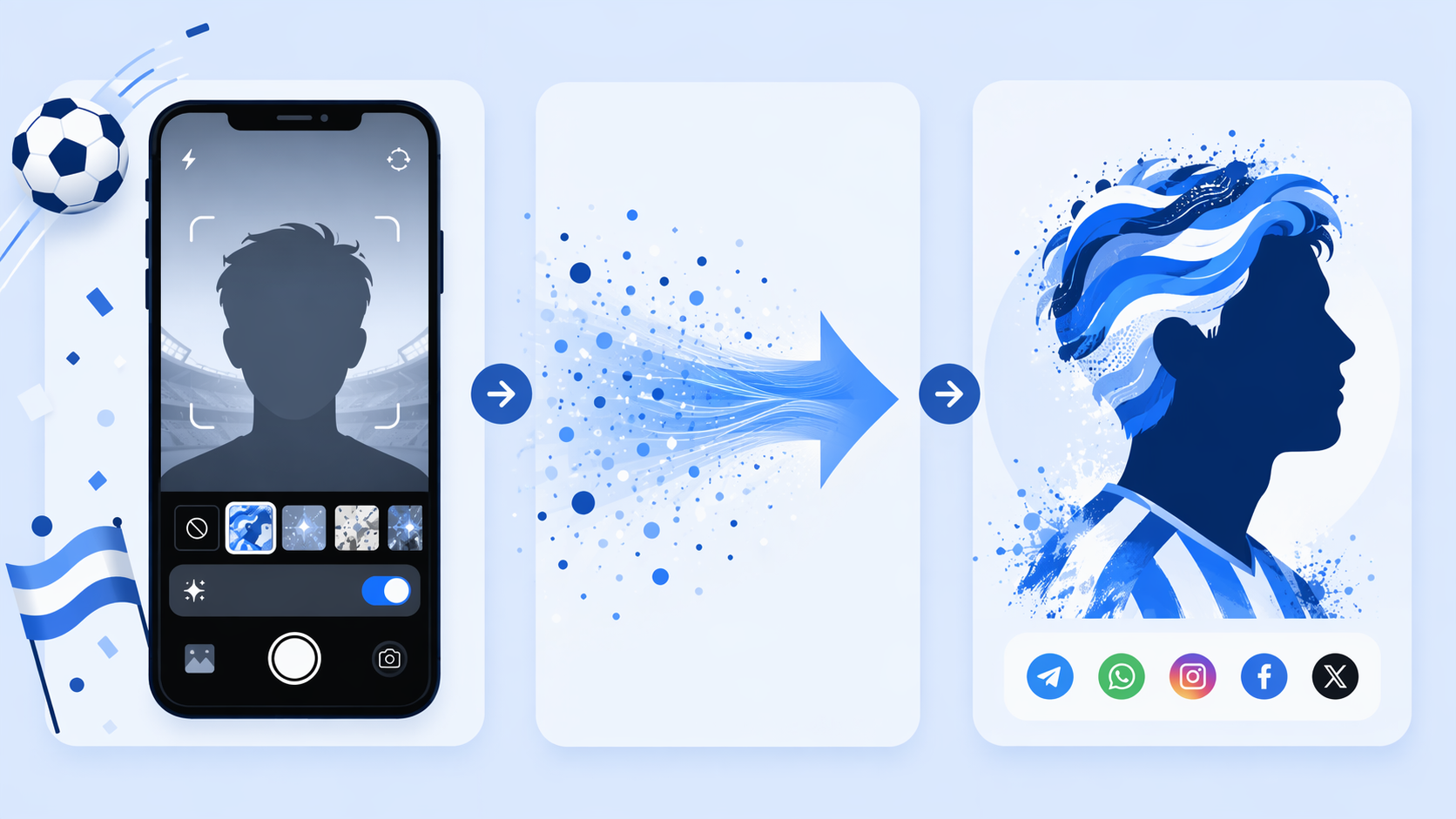
The loop looked simple because each participant had a small, obvious job:
- Messi supplied the cultural signal: football, national pride, and World Cup timing.
- OpenAI supplied the product action: ChatGPT Images generating a personalized visual.
- The preset supplied the creative constraint: flag-colored hair that still looked natural.
- Fans supplied the distribution: images that could be posted, compared, and remixed socially.
That is a cleaner piece of engagement architecture than a standard endorsement. It gives the user a reason to enter the product and a reason to leave with something shareable. The brand message is not carried only by Messi’s credibility; it is carried by a completed action inside ChatGPT.
The Public Numbers Show Activity, Not Yet Adoption
The early numbers are large enough to take seriously. In the week around launch, users generated more than 17 million World Cup-related ChatGPT prompts, based on OpenAI data reported in press coverage. Messi’s launch Instagram post was reported at more than 42 million views, from an account with roughly 506 million followers. Creative-intelligence firm DAIVID also ranked the campaign as the top performer in the pre-tournament window.[1]
Those signals are useful, but they are not interchangeable. A prompt count is not a conversion rate. Instagram views are not independently audited proof of product use. A creative ranking is not post-campaign revenue. The campaign deserves credit for generating visible participation, but the available public metrics stop well before business impact.
| Reported signal | What it supports | What it does not prove |
|---|---|---|
| 17M+ World Cup-related ChatGPT prompts in one week | High activity around World Cup use cases inside ChatGPT | The specific volume of #MessiMode image generations, retention, paid conversion, or repeat use |
| 42M+ views on Messi’s launch Instagram post | Large cultural reach through Messi’s own audience | Audited conversion, product trial rate, or downstream revenue |
| DAIVID top performer in the pre-tournament window | Strong creative performance relative to other tested or tracked campaign assets | Post-campaign business outcomes or long-term brand trust |
The most important caveat sits inside the 17 million figure. The number aggregates World Cup-related ChatGPT usage, including prompts for schedules, stats, travel planning, and other tournament questions. OpenAI has not publicly broken out #MessiMode-specific volume. That means the strongest public activity metric is directionally encouraging, but it cannot isolate the celebrity-preset mechanic that made the campaign strategically interesting.
For a brand-side recommendation, that distinction changes the story. “World Cup ChatGPT usage spiked” is a different claim from “Messi’s preset drove millions of image generations.” The first claim supports relevance and timing. The second would support creative-mechanic effectiveness. Publicly, marketers have evidence for the first and a plausible hypothesis for the second.
This is also where campaign age matters. The launch is only about six weeks old as of Q3 2026. Long-term retention, product habit formation, and ROI data are not available in the public record. Any claim that the campaign has already proved durable AI adoption would be running ahead of the evidence.
Why the Messi Fit Mostly Works Here
Messi is doing a very particular job in this campaign. He is not being asked to explain large language models, vouch for technical accuracy, or persuade a CFO to trust AI-generated analysis. He is being used as a trigger for playful participation during the World Cup.
That is why the authenticity issue is real but not fatal. In January 2026, Messi told the Argentine TV show Luzu TV: “I don't use ChatGPT… I don't use AI; not because I'm against it, I just haven't gotten into it or figured it out.” Five months later, he became the global face of a ChatGPT campaign.[3]
For a hair-recolor image prompt, the gap is survivable. Fans are not being asked to believe Messi is a power user of generative AI. They are being invited to participate in a football-themed visual trend. The product promise is immediate and visible: upload or generate an image, apply the style, decide whether it is worth sharing.
The same gap would be much harder to defend in a fact-dependent or advisory campaign. If a celebrity who had recently said he did not use AI became the face of an AI tool for injury analysis, financial planning, health guidance, or education, the mismatch would carry more weight. In those cases, celebrity trust can make a technical product feel more credible than the evidence supports.
That line is easy to miss when campaign results are presented as one big success story. The Messi campaign looks strongest when judged as a participation driver. It should not be casually generalized into proof that any trusted public figure can transfer trust to any AI use case.
The Reception Was Split for Good Reasons
Some criticism landed on the campaign’s cultural fit. TechRadar called it “marketing written by AI for people who don't watch soccer,” pointing directly at the oddity of Messi promoting ChatGPT after saying he did not use AI.[3]
That critique is useful as a pressure test, even if it underrates the participation mechanic. The campaign was not built for football purists looking for tactical depth. It was built for mass, fast, visual engagement around a tournament moment. Judged against that job, a simple national-color transformation is not an accident; it is the point.
A LinkedIn industry analyst from TEC was less generous, calling the activation “insipid” and comparing it unfavorably with older AR experiences such as the Dallas Cowboys’ 2019 “Pose with the Pros,” which offered fans a more embodied personalization experience. That comparison is fair in one respect: AI image generation is not automatically deeper than AR just because it is newer.
The stronger defense came from coverage that framed the campaign as a “masterclass in participatory marketing.” That praise is closer to the practical value of the case, as long as “participatory” is not inflated into “proven profitable.” OpenAI created a simple bridge from celebrity attention to product action. It has not publicly shown what happened after that action.
The Competitive Context Makes the Story Less Tidy
There is one awkward detail around exclusivity: Argentina’s national football federation separately signed Google Gemini as a sponsor, creating a split where Messi’s national team is associated with a competing AI platform while Messi himself fronts OpenAI’s World Cup campaign.
For most consumers, that probably does not matter much. Sponsorship architecture is rarely clean from the outside. For marketers, it is a reminder that celebrity, team, league, platform, and tournament rights can point in different directions. The cleaner the creative idea, the easier it is to miss those surrounding conflicts until a stakeholder asks why the same cultural property appears to be carrying two AI brands.
What Other Brands Can Actually Copy
Most brands cannot copy the exact OpenAI-Messi setup. OpenAI owns the product surface, the generative engine, and the user flow. It can add a preset to ChatGPT Images and capture activity inside its own platform. A consumer brand using a third-party AI tool has more friction: permissions, data flow, measurement gaps, creative moderation, and platform dependency.
The part worth copying is the structure of the action:
- Start with a use case that is low-risk enough for playful experimentation.
- Turn the AI action into a preset, template, or constrained behavior instead of an open-ended prompt.
- Use the celebrity to make the behavior culturally obvious, not to overclaim technical authority.
- Measure the campaign-specific action separately from general platform usage.
- Decide before launch which metric would justify a second investment after the initial reach spike fades.
That fourth point is where many AI influencer proposals get soft. A brand may be able to report impressions, views, prompt starts, completions, shares, or sign-ups. Those are not the same metric. If the goal is product trial, the campaign needs a clean trial event. If the goal is habit, it needs return behavior. If the goal is trust, it needs a trust measure that is not just engagement with a famous person.
This connects directly to a larger AI marketing measurement problem: campaign-level engagement often looks impressive before anyone proves it changed a business outcome. For a deeper treatment of that distinction, Signal & Convert’s guide to where AI marketing ROI actually pays off separates use cases where AI creates measurable value from places where the evidence is thinner.
A Better Brief for an AI Influencer Campaign
The Messi campaign gives marketers a useful internal planning test. Before approving a celebrity-AI idea, the brief should be able to answer four questions without hiding behind reach:
- What exact behavior do we want the user to perform inside the AI experience?
- Can that behavior be simplified into a preset, template, or guided flow?
- Is the celebrity’s role cultural, instructional, or trust-based?
- Which metric isolates this campaign from ordinary platform activity?
Those questions would have made the OpenAI-Messi case stronger if answered publicly. The campaign can show World Cup-related activity at scale, but marketers still cannot see the #MessiMode funnel: how many people selected it, how many completed an image, how many shared it, how many returned to ChatGPT Images later, and whether any of that changed broader product perception.
The trust question deserves its own line in the brief. If the use case is playful, a celebrity can be a cultural host. If the use case is consequential, the celebrity starts to function as a credibility layer. That is where the brand needs more than fame. It needs evidence, disclosures, and a fit between the person’s known behavior and the product claim. Signal & Convert has covered that broader issue in its analysis of AI-generated marketing and the trust gap.
The Conditional Lesson
The OpenAI-Messi campaign is one of the more interesting AI influencer campaigns because it did not stop at awareness. It gave fans a simple, timely reason to use the product and made the prompt feel like part of the World Cup ritual rather than a software tutorial.
That is a real achievement. It is also not the same as proving retention, conversion, or durable trust. The public numbers support a narrower conclusion: the launch worked as engagement architecture, especially for playful image generation. The long-term value remains unproven.
For marketers, the safest takeaway is conditional. AI influencer campaigns can work when the celebrity drives low-friction participation inside a product experience. They become much harder to defend when the campaign borrows celebrity trust for technical or consequential claims the evidence cannot yet support.
References
- OpenAI Just Made Messi the Face of ChatGPT at the World Cup, Almcorp.com, 2026
- Messi Meets Machine, AL DÍA News, 2026
- Wait, what? Lionel Messi's new ChatGPT World Cup partnership feels like marketing written by AI for people who don't watch soccer, TechRadar, 2026

Comments
Join the discussion with an anonymous comment.