
How McDonald's Biscuit Pricing Teaches Tiered Menu Engineering
McDonald's biscuit family is a deliberate price-anchoring system: the Sausage Biscuit at $2.99 acts as a value signal while premium variants capture higher margins. This case study unpacks the tiered pricing structure and its lessons for marketing professionals managing multi-product pricing.
The interesting part of McDonald’s biscuit pricing is not that one breakfast sandwich costs less than $3. It is that the same small product family can make three different promises on the same menu board: a cheap way in, a more expensive way up, and a bundle that makes the single-item comparison feel incomplete.
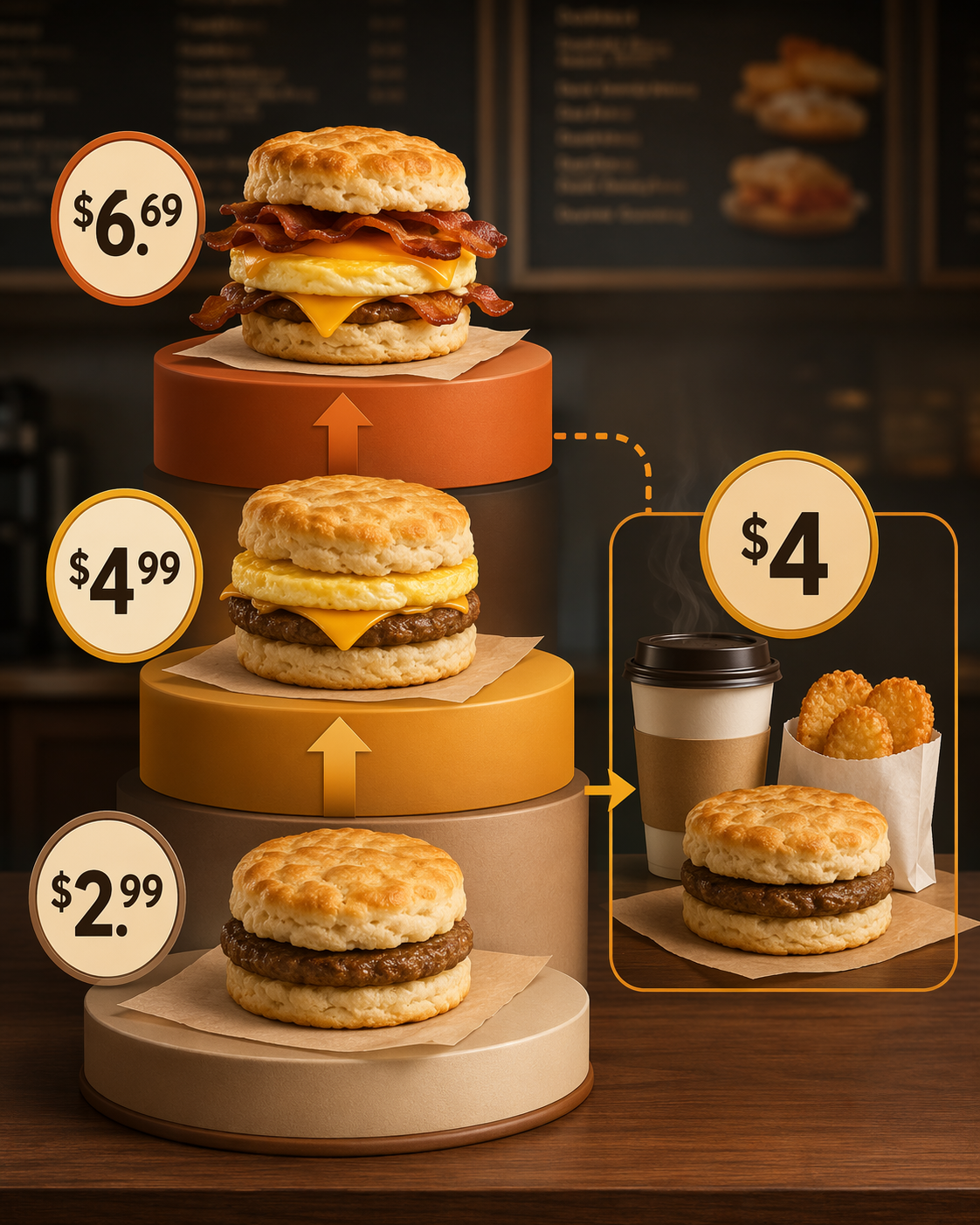
In the 2026 McValue breakfast structure, the ladder is unusually plain. The Egg Biscuit is listed at $2.69. The Sausage Biscuit sits at $2.99 and is featured as part of the Under $3 Menu. The Bacon Egg Cheese Biscuit moves into a much higher range, from $4.99 to $6.69 depending on location and source pricing. McDonald’s also announced a $4 Breakfast Meal Deal built around a Sausage Biscuit, Hash Browns, and coffee, shifting the customer’s comparison from “one biscuit sandwich” to “a breakfast occasion.” [1]
That is the useful pricing lesson. McDonald’s is not asking every biscuit item to communicate the same thing. The Sausage Biscuit carries affordability. The bacon, egg, and cheese version carries premium capture. The bundle carries traffic and attachment logic. Each price point has a different job.
The $2.99 biscuit is the anchor, even when it is not technically the cheapest
The Egg Biscuit at $2.69 complicates the cleanest version of the story. If the lowest price always created the value signal, the Egg Biscuit would be the obvious anchor. But menu boards do not work only by arithmetic. Visibility, familiarity, and feature placement matter.
McDonald’s put the Sausage Biscuit, not just the cheapest possible biscuit, into the Under $3 Menu conversation. At $2.99, it is close enough to the floor to signal affordability, but substantial enough to feel like a complete breakfast sandwich rather than a stripped-down concession. That matters when the customer is scanning quickly and asking a blunt question: can I still get breakfast here without feeling punished by the menu?
For marketers, this is the first transferable point in McDonald’s biscuit pricing strategy: the anchor does not have to be the absolute cheapest SKU. It has to be the item that customers recognize as a real purchase. A low price on a product nobody wants may protect a claim, but it does not stabilize the rest of the architecture.
| Menu item or offer | Cited price | Pricing role |
|---|---|---|
| Egg Biscuit | $2.69 | Technical low-price floor |
| Sausage Biscuit | $2.99 | Visible value anchor on the Under $3 Menu |
| Bacon Egg Cheese Biscuit | $4.99–$6.69 | Premium step-up within the same biscuit family |
| $4 Breakfast Meal Deal | $4 | Bundle reframing the purchase as a full breakfast occasion |
The gap between $2.99 and $4.99 is doing real work. Moving from the Sausage Biscuit to the lower end of the Bacon Egg Cheese Biscuit range is a jump of more than two dollars, or roughly two-thirds above the anchor price. At the high end of the cited range, the premium biscuit is more than double the Sausage Biscuit price. Those spreads are too large to treat as minor ingredient adjustments; they create a tiered decision path.
The premium biscuit tier monetizes the customer who has already accepted the category
Once the Sausage Biscuit has established that breakfast can still start under $3, McDonald’s has room to sell upward. The Bacon Egg Cheese Biscuit does not need to win the most price-sensitive customer. It needs to catch the customer who has already decided that a biscuit sandwich is the format and now wants a more complete, more indulgent, or more filling version.
That distinction keeps the strategy from collapsing into a simple “cheap versus expensive” split. The premium item borrows context from the anchor. A $5 to $6.69 biscuit sandwich would look harsher if it stood alone. Sitting above a $2.99 biscuit, it becomes the upgraded version of a known base. The customer is not comparing it only to all breakfast alternatives; the customer is comparing it to a cheaper biscuit already made salient by the menu.
There is a margin temptation here that deserves restraint. McDonald’s does not publicly disclose item-level profit margins for these biscuit sandwiches, and franchise-level costs vary. It is fair to say the higher-priced variant is positioned to capture more revenue from customers willing to trade up. It is not fair to pretend the public price ladder proves the internal profitability of any specific biscuit.
That caveat does not weaken the menu-engineering reading. The architecture is visible even without the margin sheet. A product family with a sub-$3 anchor and a premium variant that can climb to $6.69 is not one undifferentiated breakfast line. It is a segmentation device.
The $4 Breakfast Meal Deal changes the comparison
The bundle is where the pricing becomes more interesting than the sandwich. Based on PriceListo menu-price tracking, the a la carte pieces would be about $2.99 for the Sausage Biscuit, $2.49 for Hash Browns, and roughly $1.50 for coffee. Purchased separately, that is about $7. The $4 Breakfast Meal Deal therefore presents an approximate 43% discount against the individual-component total. [2]
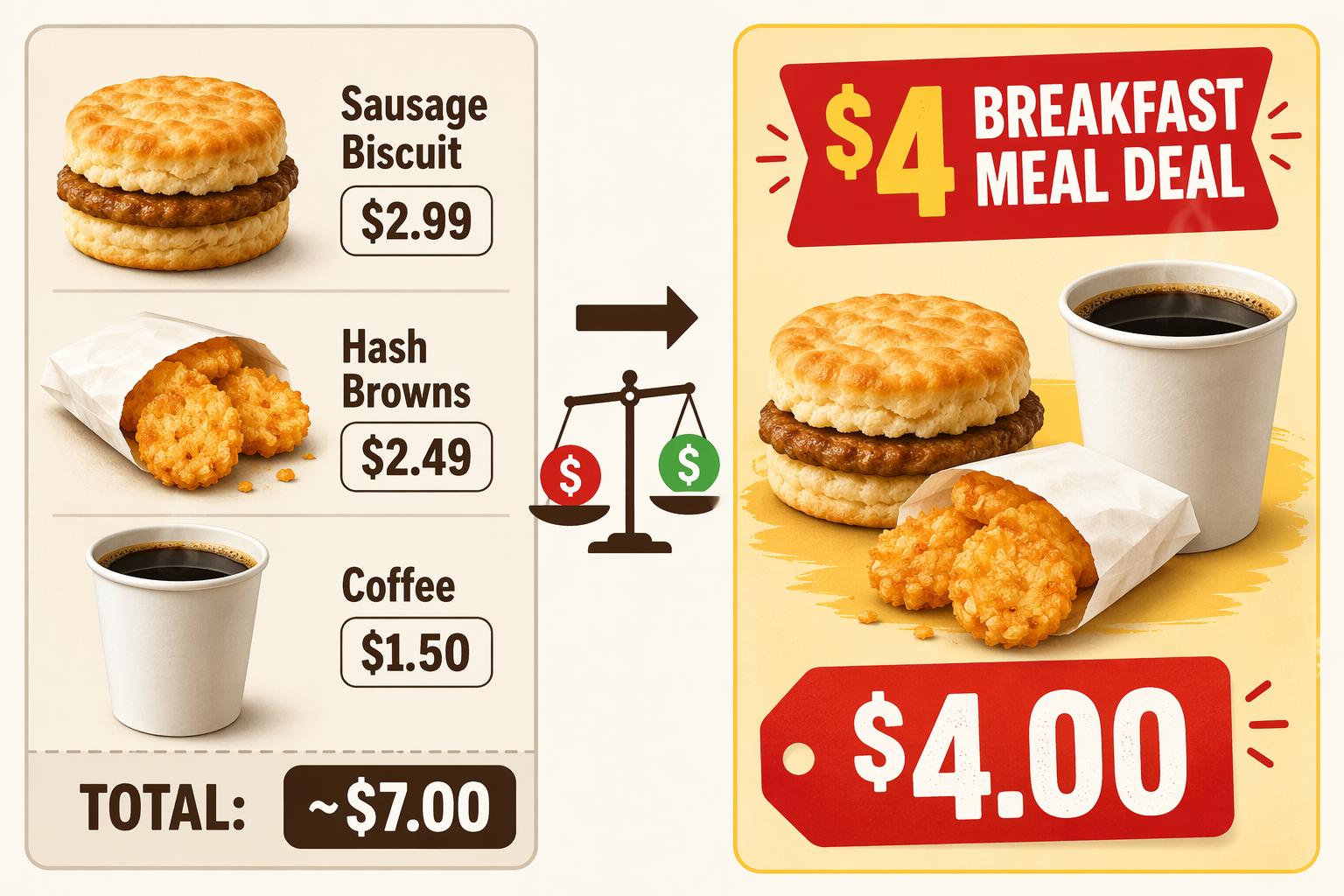
This is where a single-item value signal becomes a breakfast-system value signal. A customer who came in for a $2.99 biscuit can be shown a bundle that adds Hash Browns and coffee for only a dollar more than the sandwich anchor. The operator gives up some a la carte price integrity in exchange for a bigger transaction and a more complete occasion.
Calling that a confirmed loss leader would go too far without McDonald’s internal economics. The safer reading is that it behaves like a loss-leading bundle from a customer-facing price perspective: the stated bundle price is far below the visible sum of the parts, and the offer is designed to make the restaurant feel worth visiting at breakfast. Coffee attachment also matters because beverages are a classic lever in QSR economics, though the exact profit contribution of this deal is not public.
The bundle also protects the premium tier from having to do too much value work. McDonald’s does not need the Bacon Egg Cheese Biscuit to look cheap if the board already contains a credible $4 breakfast. The higher-priced item can remain available for the customer who wants more, while the bundle absorbs the pressure from customers who are there because of price.
Why the value signal had to become more visible
This pricing ladder sits inside a less forgiving consumer environment. FinanceBuzz found that McDonald’s menu prices rose more than 100% since 2014, compared with a 31% increase in general inflation over the same period. The study relied on third-party price archives, so it should be read as a directional view rather than a perfect franchise-level ledger. Still, the scale of the gap explains why a value platform has to work harder now than it did in a lower-price era. [3]
Consumer sentiment gives the same pressure a sharper edge. In a 2024 LendingTree survey, 78% of Americans said they viewed fast food as a luxury. That is an attitude measure, not a direct traffic count, and it predates the current quarter. But it captures the perception problem McDonald’s is trying to manage: the category that trained customers to expect convenience and affordability is now being judged against household budget anxiety. [4]
That is why the Under $3 Menu matters beyond the few items on it. A sub-$3 breakfast sandwich is a rebuttal on the menu board. It gives McDonald’s a concrete price to point to when the broader brand is being pulled into a conversation about fast food becoming too expensive.
The wider industry context points in the same direction. Forbes described McDonald’s McValue rollout as a response to traffic pressure and consumer backlash around pricing, while Fortune, citing AP coverage, framed the 2026 value-menu environment around simpler under-$3 offers. Those are industry interpretations, not proof of a single causal chain, but they match what the biscuit ladder shows at item level: value has to be obvious, fast, and easy to compare. [5][6]
Traffic pressure makes the bundle more than a discount
A value bundle does not only lower the out-of-pocket price. It can change whether a customer makes the trip at all. Restaurant Dive covered data on whether McDonald’s earlier $5 Meal Deal brought customers back, making it a useful precedent for reading the 2026 breakfast bundle as a traffic tool rather than a simple generosity signal. [7]
That distinction matters for marketers. If a brand evaluates the $4 Breakfast Meal Deal only by comparing bundle price to component price, the discount looks almost irrational. If it evaluates the offer by the customer behavior it is meant to create—morning visit, beverage attachment, habit reinforcement, and possible future trade-up—the logic becomes more coherent.
The danger is assuming every bundle automatically produces that behavior. Adoption is not effectiveness. A customer can notice a deal without changing frequency. A deal can lift traffic while training customers to wait for discounts. Public menu data shows the structure of the offer; it does not prove the full economic outcome.
The clean architecture is national; the lived price is local
There is also a franchise reality under the national message. McDonald’s can announce a platform, but local pricing can vary, and third-party menu trackers report averages or ranges rather than every individual store. The $4 bundle and Under $3 framing create a national value story; actual store-level menus still live inside franchise operations, local costs, and payment practices.
Operational changes can make that consistency harder to manage. The New York Post reported on four 2026 McDonald’s changes, including penny rounding and card payment rules, which adds texture to how national pricing messages meet store-level execution. Those details are not the center of the biscuit strategy, but they are a reminder that a clean menu architecture has to survive real checkout conditions. [8]
For a marketer studying the case, this is the reason to separate price architecture from price uniformity. A company can use a common ladder—entry anchor, premium step-up, bundle value—even when the exact price points vary by market. The strategic question is whether the relative roles remain legible to the customer.
What marketers can borrow from the biscuit ladder
The most useful lesson is not “make something cheap.” Many brands already have a low-priced SKU that does very little for them because it is hidden, unattractive, or disconnected from the rest of the line. McDonald’s biscuit structure shows a more disciplined version of value-tier design.
- Give the anchor a real customer job. The Sausage Biscuit is not merely a low price; it is a recognizable breakfast purchase that can make the broader menu feel accessible.
- Let the premium tier sell to a different willingness to pay. The Bacon Egg Cheese Biscuit does not need to be the value hero. Its role is to capture the customer who wants the upgraded version.
- Use bundles to reframe the unit of comparison. The $4 meal deal changes the question from “Is this sandwich cheap?” to “Can I get a complete breakfast for a price that feels defensible?”
- Keep the ladder simple enough to read quickly. A value system fails if the customer has to do too much math before ordering.
- Do not ask one product to serve every margin, traffic, and perception goal. Separate roles make the system easier to manage.
The same logic can apply outside QSR. A software company may need a credible entry plan, a higher-priced plan that captures heavier usage, and a bundle that makes adoption easier for teams. A consumer brand may need a trial-size anchor, a premium formulation, and a multi-pack that changes the value comparison. The categories differ, but the discipline is the same: decide which offer earns trust, which offer monetizes preference, and which offer expands the occasion.
The hard part is resisting the urge to make every tier communicate value in the same way. If the premium product is constantly discounted to defend the anchor, the ladder flattens. If the anchor is too weak, the premium tier looks exposed. If the bundle is too complicated, customers ignore the math. The biscuit family works as a case study because the roles are visible without much explanation.
The strategic judgment
McDonald’s biscuit pricing teaches a practical lesson that is easy to miss when “value” gets treated as a communications problem. The value tier is not just the discounted item. It is the reference point that makes the rest of the system easier to sell.
At $2.99, the Sausage Biscuit tells the price-sensitive customer that breakfast is still within reach. At $4.99 to $6.69, the premium biscuit captures the customer willing to spend more inside the same product family. At $4, the Breakfast Meal Deal turns a sandwich into an occasion and makes the board feel less hostile in a high-price environment. That is tiered menu engineering doing its work in public.
References
- McDonald’s USA Introduces New Under $3 Menu and $4 Breakfast Meal Deal to the McValue Menu, McDonald’s, Jan. 2026
- McDonald’s Breakfast Menu Prices, PriceListo
- Is Fast Food Affordable Anymore? Here's How Menu Prices Have Changed Over the Years, FinanceBuzz
- Nearly 80% of Americans Say Fast Food Is Now a Luxury, LendingTree
- McDonald’s McValue Menu Rollout, Forbes, April 2026
- Simpler Is Better Value-Menu Trend, Fortune/AP, April 2026
- Did McDonald’s $5 Meal Deal Bring Customers Back?, Restaurant Dive
- McDonald’s outlines 4 big changes coming in 2026, New York Post, Dec. 2025

Comments
Join the discussion with an anonymous comment.