

Marketing with AI in 2026: What the Deployment Data Shows
A data-driven look at the real state of AI in marketing, covering deployment gaps, failure rates, ROI timelines, and the finding that most effective AI tools are already in your existing martech stack.
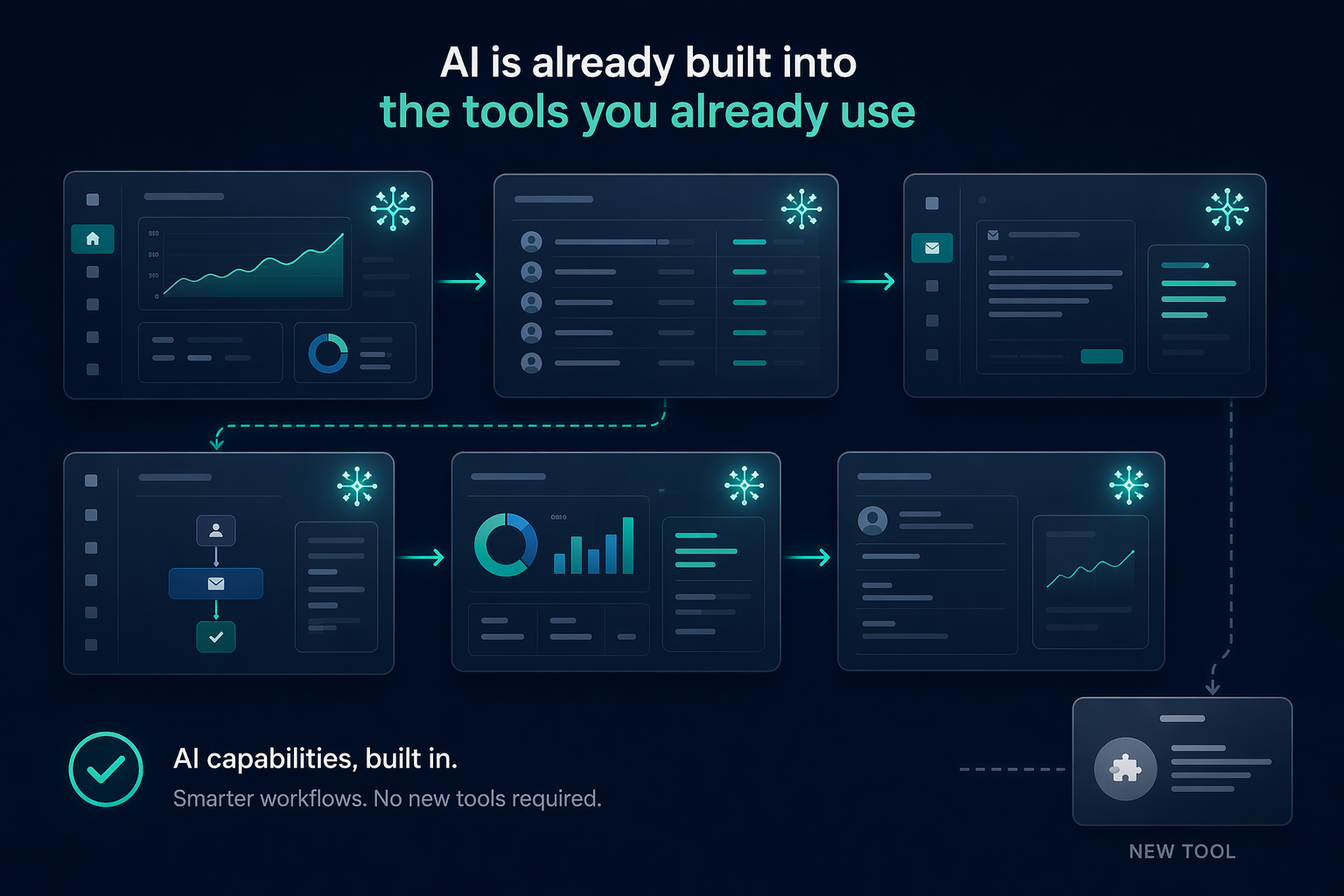
In marketing with AI, the awkward part is not whether teams have adopted it; it's whether the work actually moved into the workflow. Ascend2's data puts AI in production at 56% but fully integrated at only 32%, and that gap matters more than another demo. A separate TechnologyChecker crawl from July 2025 found detectable AI signatures from Mailchimp on 313,840 domains and HubSpot on 107,974, compared with 41,764 for standalone OpenAI, which suggests a lot of the useful capability is already embedded in tools teams pay for. The crawl likely undercounts server-side and API-based usage, so it should be read as directional rather than exhaustive. [1][2]
The gap is deployment, not access
That is why the most useful question in marketing with AI is not “what can the model do?” but “where does the work actually pass through it?” Production means the feature exists somewhere in the stack. Integration means the team can use it without creating manual cleanup, approval drag, or a second reporting layer that nobody trusts.
Why pilots look successful and still contribute nothing
The hard part is that pilots can look busy and still land nowhere. MIT's 2025 NANDA study, as summarized in an intermediary report, said 95% of GenAI pilots produced zero measurable P&L impact across 300 deployments. RAND puts AI projects at an 80% failure rate, roughly double non-AI IT projects, and Gartner says 85% of AI projects miss their stated objectives. Those are different studies measuring different things, but they all point in the same direction: the failure is usually in deployment discipline, not access to model capability. [3][4][5]
The ROI window is longer than most review cycles
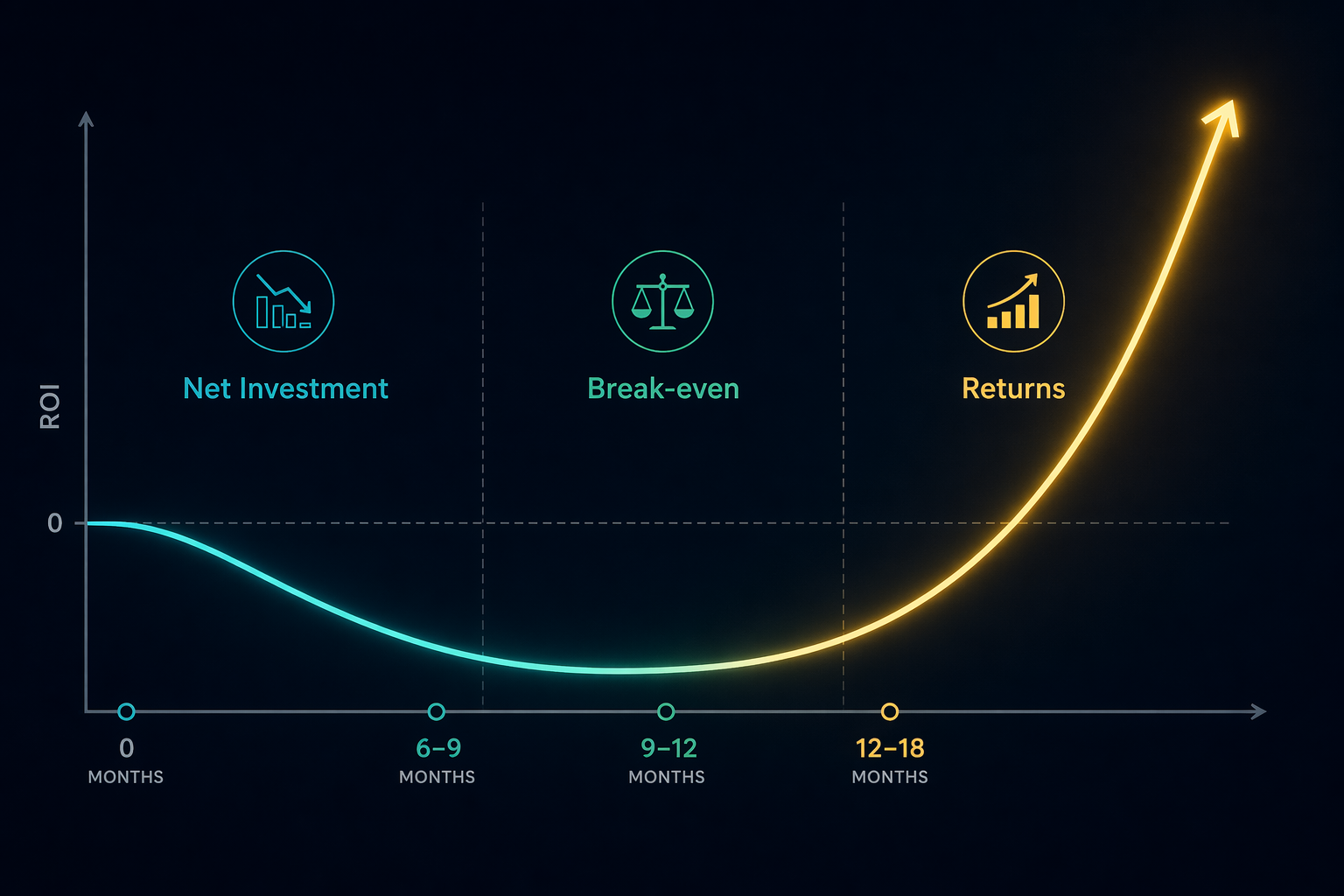
The evaluation window is where a lot of management confusion starts. The reported ROI curve behaves like a J: 6–9 months of net investment, 9–12 months to break even, and 12–18 months before returns become meaningful. If a pilot is reviewed at 90 days or less, as 73% apparently are, the review is happening before the curve has a chance to bend. [6]
What actually works inside the stack
What does work is narrower than the keynote version of the story. Content generation sits in the strongest band, at roughly 60–70% success; customer analytics follows at 45–55%; ad optimization lands around 35–45%; strategic planning trails badly at 10–20%. That pattern fits the kind of work where inputs, outputs, and quality checks are all visible enough to measure. [7]
The buy-vs-build question is less romantic than it sounds. MIT 2025 numbers put vendor tools at 67% success versus 22% for internal builds, with internal total cost of ownership running 3–5x higher over 18 months. That does not prove every vendor feature is better; it does show that most teams should prove the workflow first and only then decide whether they need custom infrastructure. [8]
The faster path is boring on purpose
The practical move is to audit the AI already sitting inside the martech stack, set a pre-AI baseline, use a control group where the workflow allows it, and align the measurement window with the actual payback cycle. If a feature only creates activity, it is not yet a business case. If it changes throughput, quality, or revenue without adding cleanup work, it deserves to stay.
References
- Ascend2 survey on AI in production vs fully integrated (56% vs 32%) — Ascend2.
- TechnologyChecker crawl of detectable AI signatures across domains, July 2025 — TechnologyChecker.
- MIT NANDA study on GenAI pilot outcomes (300 deployments, 2025), as cited by Deep Marketing — MIT / Deep Marketing.
- RAND analysis of AI project failure rates — RAND.
- Gartner analysis of AI projects missing stated objectives — Gartner.
- AI ROI J-curve evaluation timing data (6–9 months net investment, 9–12 months break-even, 12–18 months returns; 73% evaluated at 90 days or less).
- Marketing AI use-case success rates by function (content generation, customer analytics, ad optimization, strategic planning).
- MIT 2025 comparison of vendor tools vs internal builds and total cost of ownership.

Comments
Join the discussion with an anonymous comment.