
What Live Nation's 8% Conversion Lift Means for Pricing Strategy
Live Nation's shift to all-in pricing, driven by regulatory pressure, unexpectedly increased completed ticket sales by 8%. This article examines why price transparency can improve conversion rates, even in a low-trust market, and what marketers can learn from the evidence.
Live Nation’s most useful pricing lesson did not arrive as a clean brand case study. It came after the company moved to all-in pricing under legal, regulatory, and public-pressure conditions that no marketer would choose for a launch plan. The company began showing ticket buyers the full price, including fees, earlier in the purchase journey. Then it reported that completed ticket transactions increased by 8% across roughly 9,000 U.S. shows in 33 states and Washington, D.C. during the first six months of the policy.[1]
That number should not be treated like a universal law. It comes from Live Nation’s own data, not an independent audit, and the company had every incentive to frame the shift favorably. It also describes an early window, not a settled long-term pattern. Still, it is hard to ignore because it lands directly on a familiar growth argument: if the first price looks smaller, more people will start checkout.
The interesting part is not that customers say they dislike hidden fees. They have said that for years. The interesting part is that, in this case, showing the fuller price earlier was associated with more completed purchases, not fewer. For marketers working on pricing pages, cart flows, subscriptions, or ticketing-like experiences, that is the part worth sitting with.
The Smaller First Number Was Never the Whole Funnel
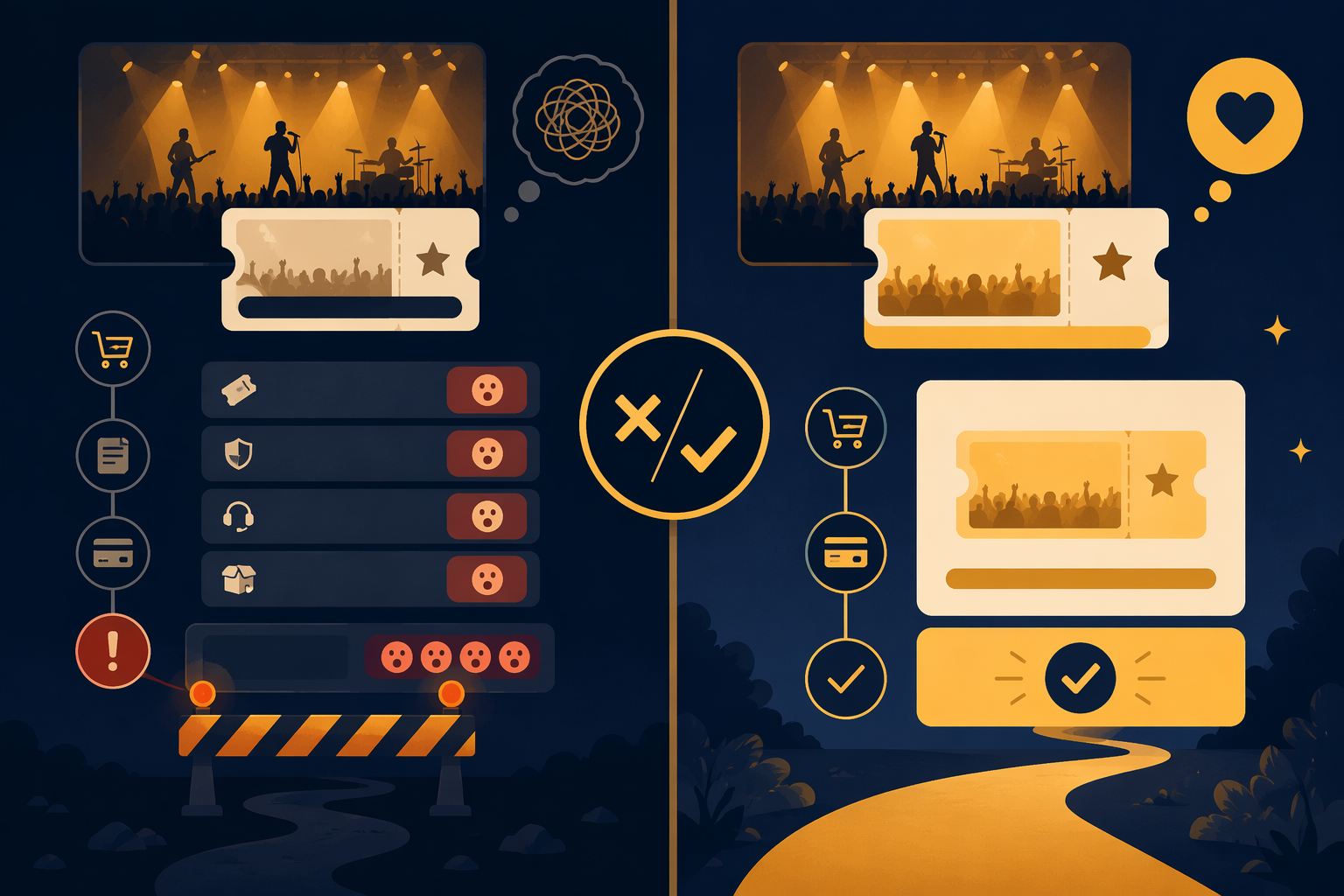
A hidden-fee checkout can look efficient if the dashboard stops too early. The top of the funnel sees a lower displayed price. More users may click. More users may compare that offer favorably against competitors. On paper, the first decision looks easier.
Then the user reaches the moment when the price they had been mentally accepting turns out not to be the real price. That is not just a math update. It changes the meaning of everything that came before it. The buyer is no longer deciding whether the event, product, or subscription is worth the total amount. They are also deciding whether the seller has been managing their attention.
That late-stage trust penalty is easy to undercount. A marketer can defend the low entry price by pointing to click-through rate, product-page engagement, or checkout starts. But if completed transactions fall later, the earlier lift may be borrowing intent from a future abandonment moment. The Live Nation result matters because it suggests that, at least in this market and during this window, removing the price surprise may have recovered more transactions than the higher upfront number lost.
That is a different claim from “transparency always wins.” It is narrower and more useful: when customers already expect pricing manipulation, the penalty for confirming that suspicion can be larger than the penalty for showing a higher number upfront.
This Happened in a Market That Already Distrusted the Price
The 8% lift becomes more interesting when placed against the ticketing market’s starting point. In a March 2023 YouGov survey, 75% of Americans said dynamic pricing makes it hard for them to see their favorite artists.[2] CivicScience reported in August 2023 that 62% of consumers viewed dynamic pricing as “price gouging,” and 56% said they abandon a purchase entirely when they detect dynamic pricing.[3]
Those numbers measure attitudes and self-reported behavior, not audited purchase logs. They do not prove that every fee surprise causes abandonment. But they describe a market in which buyers arrive with a defensive posture. The checkout is not beginning from neutral trust. It is beginning from the suspicion that the visible price may be temporary, incomplete, or engineered.
That context changes how a price reveal works. In a high-trust category, a late fee might be treated as an annoyance. In a low-trust category, it can become confirmation. The buyer’s reaction is not simply, “This costs more than I thought.” It is closer to, “This is what I expected them to do.” That is the kind of reaction that can make abandonment feel principled rather than merely price-sensitive.
For growth teams, this is where stated preference and behavior need to be kept separate. Customers may say they want transparent pricing because it sounds fair. The stronger signal is whether more of them finish buying when transparency is introduced. Live Nation’s self-reported transaction lift does not answer every question, but it does put behavioral weight behind a claim that is often left at the sentiment level.
Pressure Forced the Test Before the Company Could Polish the Story
Live Nation did not adopt all-in pricing in a vacuum. The move sat inside a broader push against hidden fees and ticketing market power: FTC junk-fee pressure, federal ticketing legislation efforts, state attorney general actions, and antitrust scrutiny around Live Nation and Ticketmaster.[4]
The antitrust backdrop became sharper in 2026. On April 15, 2026, a federal jury found Live Nation and Ticketmaster liable on all antitrust counts, and reporting on the remedy framework included a $280 million fund, a 15% service-fee cap, and an eight-year consent decree, with the remedy phase extending into at least early 2027.[5][6]
That legal context matters for the marketing read, but not because every pricing discussion needs to become a legal explainer. It matters because forced changes are often treated internally as pure downside. Compliance becomes the thing that interrupts optimization. The old flow is defended because it has history, dashboards, and a plausible story: disclose fees late, preserve intent early.
But pressure can accidentally create a cleaner test of an assumption that would otherwise survive by inertia. If the business has long believed that fee concealment protects conversion, then a required shift to all-in pricing asks a useful question: protected which conversion event? The first click, or the completed sale?
The Internal Language Makes the Business Assumption Look Worse
The Senate Permanent Subcommittee on Investigations report added a harder edge to the story. It cited internal Ticketmaster communications saying the goal was to “ensure fans will not be aware any dynamic pricing of standard inventory is being done.” The same report cited an executive calling customers “so stupid” and saying the company was “robbing them blind, baby.”[7]
That language is ugly on its own. For marketers, though, the strategic problem is just as important as the contempt. It assumes that not noticing is a business asset. It treats customer confusion as a usable margin source, as if the only relevant question is whether the buyer can be carried far enough through the funnel before the full cost becomes visible.
The all-in pricing result makes that assumption less comfortable. If completed transactions increased after the full price was shown earlier, then at least some portion of the old model may not have been protecting demand. It may have been spending trust to create misleading early-funnel signals.
That distinction matters because many teams optimize around the part of the funnel they can most easily influence. A lower displayed price can improve comparison behavior. A checkout start can make a campaign look healthier. But when the later experience makes the customer re-evaluate the seller, the team has not created durable intent. It has delayed the objection.
What the 8% Lift Can and Cannot Tell Marketers
The cleanest interpretation is tempting: show the full price upfront and conversion improves. The evidence does not support making it that broad. Live Nation’s result is company-reported, category-specific, and drawn from the first six months of one policy across a large but still bounded set of shows.[1]
A ticket purchase also has characteristics that do not map neatly onto every checkout. Inventory is time-sensitive. The buyer may have a specific artist, city, date, or seat section in mind. Alternatives are imperfect. Fees are culturally salient. The emotional stakes are different from renewing a B2B software contract or buying household goods online.
Still, marketers can take a sharper question from the result. The question is not whether customers prefer lower numbers. Of course they do. The question is whether the lower number is creating real intent or fragile intent. Real intent survives the full price because the buyer understands the tradeoff. Fragile intent collapses when the buyer realizes the first number was incomplete.
| Metric signal | What it may hide |
|---|---|
| Higher product-page clicks after showing a lower base price | Users may be reacting to an incomplete comparison |
| More checkout starts | The price objection may simply be delayed |
| High abandonment after fee reveal | The issue may be trust damage, not only affordability |
| More completed purchases after all-in pricing | Some buyers may value price certainty enough to offset sticker shock |
This is also why the denominator matters. An 8% increase in completed transactions is more strategically useful than an 8% increase in clicks would be. It sits closer to revenue behavior. It does not tell us margin impact, artist-level differences, seat-level effects, repeat purchase behavior, or whether the lift persisted after the first six months. But it points at the part of the journey where hidden fees are supposed to prove their value and suggests the value may have been overstated.
All-In Pricing Became a Promotional Frame, Not Just a Compliance Line
Live Nation’s later use of all-in pricing makes the story more interesting. In 2026, the company rolled out a $30 all-in summer ticket promotion covering more than 4,000 shows, with T-Mobile involved for early access.[8] That is not merely a footnote to a regulatory adjustment. It shows the pricing frame being used at campaign scale.
A flat all-in offer does two jobs at once. It reduces calculation effort, and it limits the buyer’s expectation of a late surprise. The promotion still has commercial goals, eligibility rules, and inventory constraints; it should not be mistaken for a public-service announcement. But as a marketing device, “$30 all-in” is cleaner than “$30 plus whatever appears later.”
That matters because compliance language rarely sells. A company can tell customers it is following fee-disclosure rules, and most will not care. A clear all-in price, by contrast, gives the buyer something usable at the decision point. The regulatory origin fades into the background. The price frame becomes part of the offer.
The Pricing Lesson Is About Trust at the Moment of Commitment
The mistake is to treat transparency as a moral preference and opacity as a conversion tactic. In practice, both have to be measured against behavior. A transparent price can reduce early clicks if it looks higher than a competitor’s partial price. A hidden fee can increase early clicks while poisoning the moment that actually matters. Neither side gets to win by intuition.
Live Nation’s data is imperfect, self-reported, and early. It also comes from a company facing intense scrutiny, which makes the source incentive impossible to ignore. But the result is still a useful challenge to a lazy assumption: that opacity protects revenue because it protects the first impression.
In markets where customers expect manipulation, surprise costs can behave like a tax on trust. Removing the surprise may improve completed transactions even when the first displayed price is higher. That does not mean every subscription page, SaaS checkout, or ecommerce cart will see the same lift. It does mean the old defense of late fee disclosure deserves a harder test.
If your checkout depends on customers not noticing the real price until late, you may not have a pricing advantage. You may have an abandonment problem waiting to be measured.
References
- Live Nation's All-In Pricing Policy Delivers Increased Ticketing Transparency for Fans and More Sales for Artists in Its First Six Months, Live Nation Newsroom, May 2024
- Consumer view: Dynamic pricing more acceptable if money goes to artist and cuts out re-sellers, YouGov, March 2023
- How Will Consumers Respond to Dynamic Pricing?, CivicScience, August 2023
- After the Verdict: Navigating the Live Nation/Ticketmaster Antitrust Fallout, Crowell & Moring
- Live Nation-Ticketmaster antitrust trial, NPR, March 9, 2026
- Live Nation-Ticketmaster antitrust verdict monopoly, NPR, April 15, 2026
- So Casually Cruel: How Ticketmaster's Monopoly Supercharges Prices and Fees, Senate Permanent Subcommittee on Investigations, March 16, 2026
- Live Nation $30 All-In Tickets for 4,000+ Summer Shows: Full List, Billboard, 2026

Comments
Join the discussion with an anonymous comment.