

Why the Kimi K3 Selloff Changes AI Tool Pricing for Marketers
The Kimi K3 release triggered a global AI stock selloff on July 17, 2026. This article translates that financial event into a practical procurement framework for marketing leaders, showing why open-weight models are compressing API pricing and how to adjust tool contracts accordingly.
The most useful part of the Kimi K3 story for marketers was not the model card. It was the selloff the next day.
Moonshot AI released Kimi K3 on July 16, 2026. On July 17, AI-linked stocks were hit across several markets: Z.ai fell 28.4% and MiniMax fell 15.6% in Hong Kong, while the Nasdaq dropped about 1.5%, Taiwan’s index fell more than 6%, and Japan’s Nikkei lost 4%.[1][2][3][4][5]
A one-day stock move does not prove that one model is better than another. Traders can overreact, and July’s move may have been amplified by geopolitical noise and the market’s still-fresh memory of the DeepSeek shock. But the direction of the panic is worth taking seriously because it points to a procurement issue: investors suddenly treated open-weight model progress as a pricing threat to the companies selling proprietary AI access.
That is where this becomes a marketing budget story. Most marketing AI products do not train frontier models. They package model access into copy tools, workflow builders, creative systems, research assistants, personalization layers, analytics copilots, and campaign automation. If the underlying API cost curve moves down, the money shows up somewhere: in lower subscription prices, in more generous usage limits, in better vendor margins, or in a quiet refusal to pass savings through.
The price spread is the signal finance will understand
The pricing contrast around Kimi K3 is large enough to change renewal conversations. Artificial Analysis listed Anthropic Fable 5 at $50 per million output tokens and Kimi K3 at $15 per million output tokens, while Tom’s Hardware reported DeepSeek V4 Flash at $0.28 per million output tokens.[6][7]
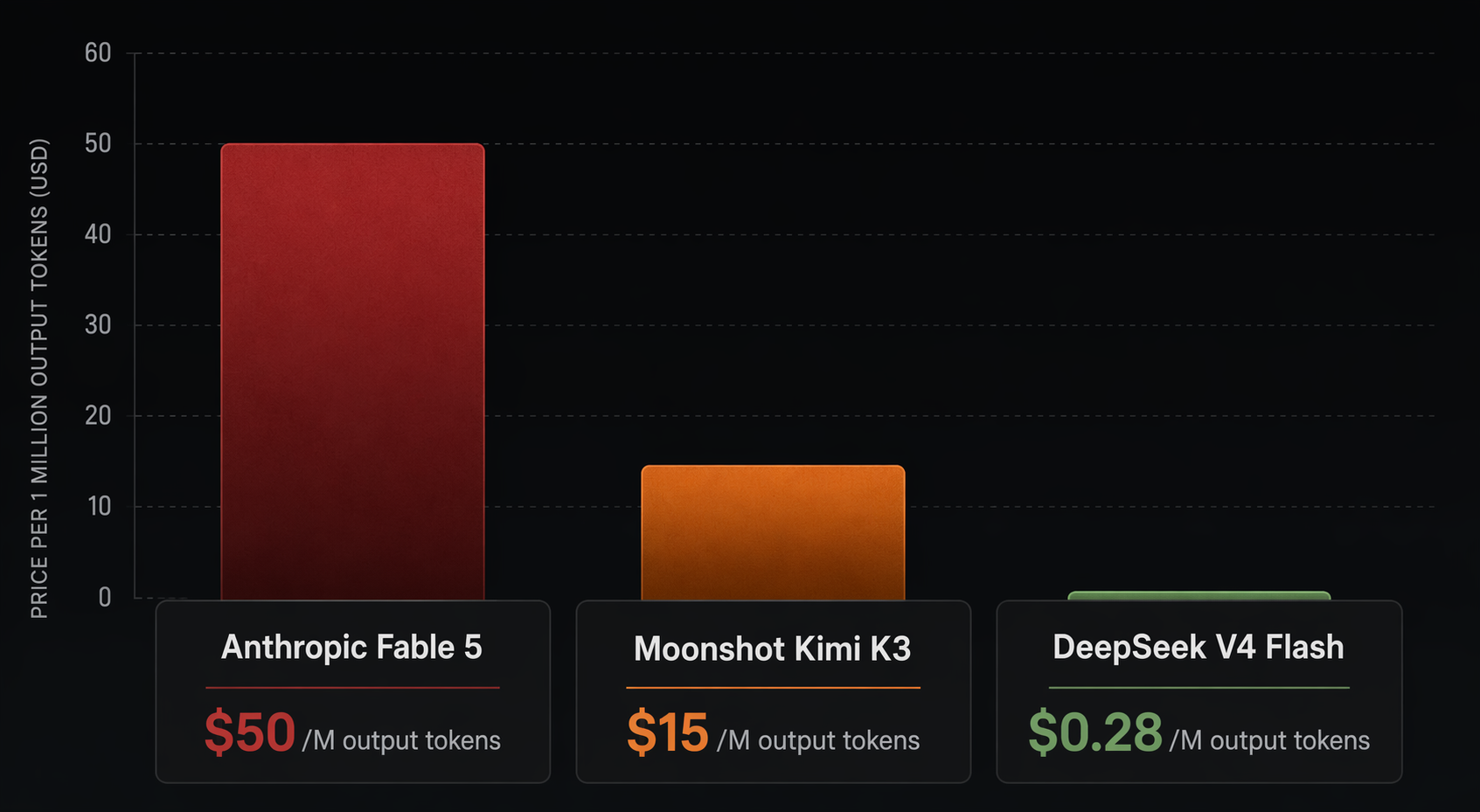
Those numbers should not be translated mechanically into “your AI tool should now be 50 times cheaper.” That would be too convenient. The retail price of a marketing platform includes product development, workflow design, data handling, support, compliance, billing, sales costs, and the vendor’s margin. Model tokens are only one line in the vendor’s cost structure.
Still, token pricing matters because many AI features are usage-sensitive. A vendor that summarizes calls, generates landing-page variants, runs SEO briefs, rewrites ad copy, scores audience segments, or evaluates brand compliance is consuming inference somewhere. When the price of comparable inference falls, a vendor that locks customers into old pricing has to defend why usage caps remain tight or why overage fees still look like frontier-model scarcity.
| Model pricing reference | Reported output token price | What a marketing buyer should infer |
|---|---|---|
| Anthropic Fable 5 | $50 per million output tokens | A premium proprietary reference point for high-end hosted model access |
| Moonshot Kimi K3 | $15 per million output tokens | A much lower hosted price attached to an open-weight frontier-style release |
| DeepSeek V4 Flash | $0.28 per million output tokens | A reminder that the low-cost end of the market can keep pulling expectations down |
Why the market read Kimi K3 as a margin problem
Nathan Lambert’s “decelerationist” framing is useful here because it separates technical excitement from economic pressure. The argument is that open-weight models reduce the margin potential of proprietary AI labs by making strong model capability harder to keep scarce.[8]
That mechanism matters more than any single benchmark chart. If a proprietary lab can charge a premium because only a few vendors can deliver acceptable quality, its pricing power depends on that scarcity holding. Open-weight releases weaken the scarcity story. They give infrastructure providers, application vendors, and larger buyers more credible alternatives. Even when the open model is not the absolute best model for every task, it can be good enough to force price concessions on work that does not require the highest-end reasoning.
For a marketing team, that distinction is practical. A campaign brief, social variation, product description, email rewrite, internal research summary, or first-pass keyword cluster may not need the most expensive model every time. The best tool is often the one that can reserve expensive models for tasks that justify them and route ordinary work to cheaper models without making the user manage the plumbing.
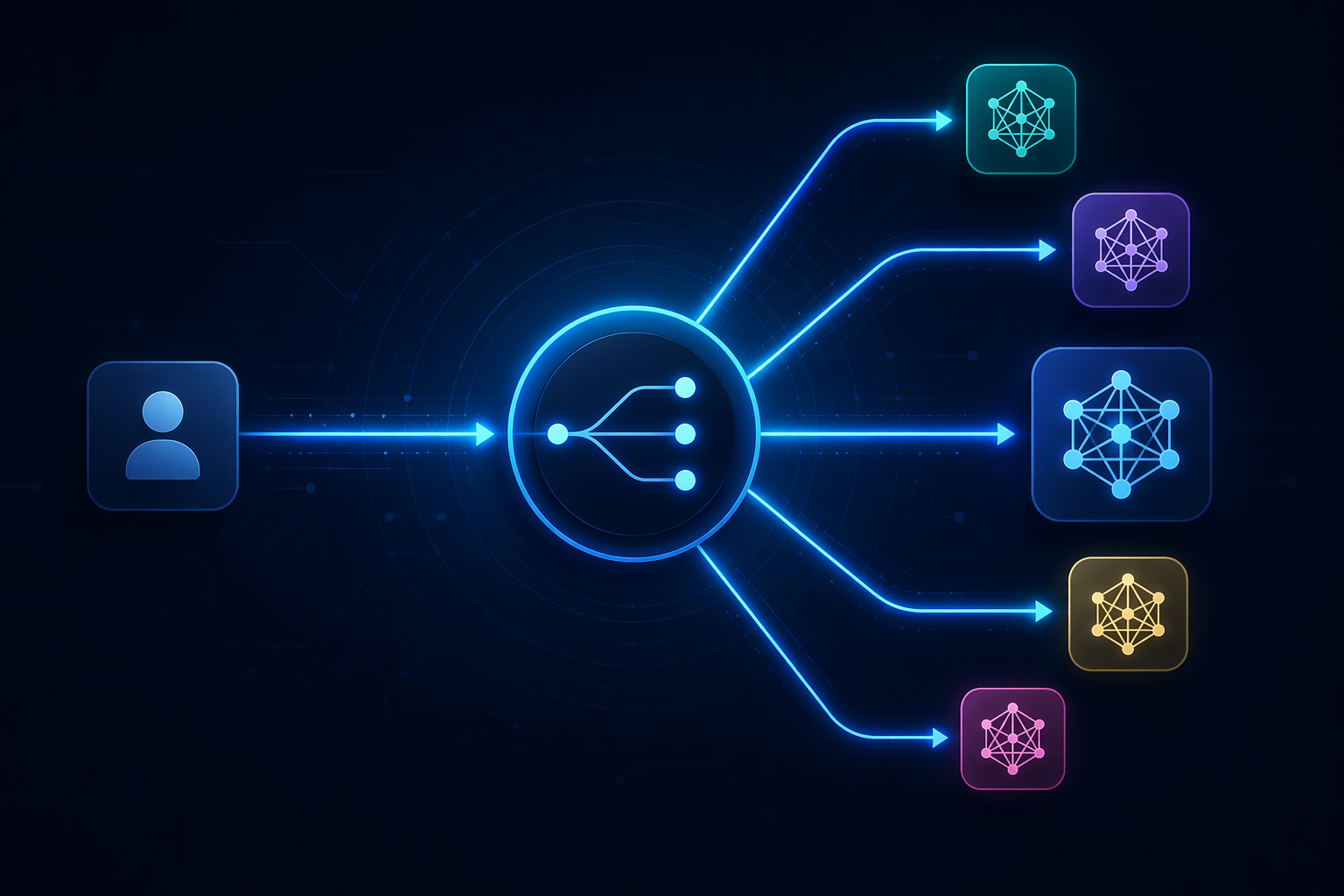
This is why single-model dependency weakens the buyer’s hand. If a vendor is built around one proprietary model and sells annual seats as if that model’s cost curve is fixed, the customer absorbs the lock-in while the market absorbs the price shock. If the vendor can route across models, it has more ways to maintain quality while negotiating cost.
The caveats belong in the renewal file, not in the footnotes
There are good reasons not to turn the Kimi K3 selloff into a sweeping prediction. The weights are not publicly available until July 27, 2026, so benchmark claims through July 20 are either Moonshot-reported or based on limited API access rather than broad independent testing.[7]
The performance story also appears narrower than the stock reaction. The available materials support the view that Kimi K3 is genuinely impressive and roughly competitive with Claude Fable 5 on coding benchmarks, not that it has made every proprietary model obsolete. A serious buyer should not rewrite a workflow architecture around an unverified benchmark window.
Self-hosting is another limiter. The most dramatic “10–50x cheaper” comparisons usually assume hosted third-party inference providers. If a marketing organization tries to run open-weight models itself, infrastructure, engineering, security, monitoring, latency management, and utilization all start to matter. Smaller teams can easily give back part of the apparent savings by taking on operational work they are not staffed to do.
That does not erase the pricing pressure. It just changes the buyer’s question. The point is less “Should our marketing department self-host Kimi K3?” and more “Why should we sign a contract that assumes expensive, single-provider inference is the only viable way to deliver this feature?”
Where the savings can go
When foundation-model access gets cheaper, marketing software vendors have several choices. They can lower prices. They can increase usage allowances. They can improve margins. They can spend the savings on better workflow features, faster processing, richer evaluation, or more human support. They can also do nothing visible and hope customers do not ask.
The vendor’s choice depends partly on competition. In a crowded category such as AI writing, SEO drafting, social content generation, or sales enablement copy, falling model costs are more likely to become customer-facing pressure. If one tool offers materially higher usage limits at the same seat price, rivals have to explain why they cannot. In a more embedded platform, the vendor may keep more of the benefit because switching costs are higher.
This is where procurement language should become more specific. “AI is getting cheaper” is too vague to move a renewal. “Your cost to serve high-volume generation and summarization workloads may have changed, so we need revised usage economics or routing transparency” is harder to wave away.
What to ask before signing an annual AI tool contract
- Which model providers does the platform use today, and which features depend on each one?
- Can the vendor route tasks across multiple models, or is the product architecturally tied to one provider?
- Are usage limits, overage fees, or credit burn rates fixed for the contract term?
- If model costs fall during the term, does the customer receive lower pricing, higher usage, or neither?
- Can the buyer review model-routing logs, at least at an aggregate level, for cost and quality governance?
- Does the contract require approval before the vendor switches models for core workflows?
- Are premium models reserved for premium tasks, or is every workflow priced as if it needs the most expensive inference?
The goal is not to force every vendor into full cost disclosure. Many will refuse, and some have legitimate reasons to avoid exposing implementation detail. The goal is to avoid paying for a static architecture in a market where the underlying cost base is moving.
The marketing adoption data makes this more urgent, but not simpler
A July 2026 study from Profound and Listen Labs reported that 90% of CMOs use LLMs daily and 47% run structured AI workflows.[9]
That finding is useful color, not a neutral market census. Profound sells AI-search-visibility tools, so the study should be read with the usual caution applied to vendor-sponsored research. It still reflects a reality most marketing teams already recognize: AI is no longer a small experimental line item tucked inside innovation budget. It is becoming part of everyday production.
That changes the consequence of bad contracting. A weak renewal decision in 2023 might have meant overpaying for a small pilot. A weak renewal decision in 2026 can set the cost structure for content operations, paid media testing, lifecycle messaging, competitive research, and reporting workflows for a full fiscal year.
Moonshot’s business context is secondary, but it explains the pressure
Bloomberg reported, citing anonymous sources, that Moonshot AI was finalizing a funding round of more than $30 billion and planning a Hong Kong IPO within six months.[10][5]
That context should not distract from the buyer’s problem. Whether Moonshot’s own financing path succeeds is less important to a marketing team than the competitive behavior its release encourages. A company preparing for public-market scrutiny may still price aggressively if the strategic prize is developer adoption, ecosystem gravity, or pressure on rivals. Competitors then have to decide whether to defend premium pricing, match selectively, or shift value up into tooling and workflow.
Application vendors are caught in the middle. If they built their product story around one expensive model, they may talk about quality, reliability, and brand safety. Those are legitimate concerns. But if comparable tasks can be handled by cheaper models, the vendor needs to show why the customer should keep underwriting the old model mix.
How to treat Kimi K3 in the next renewal
Kimi K3 should not become a demand that every vendor immediately cut pricing. It should become a reason to reject vague answers about AI costs.
For tools used lightly or experimentally, monthly terms may be worth the premium. For tools embedded in production workflows, an annual contract can still make sense, but only if the buyer understands what is being locked: seat price, usage limits, model access, routing flexibility, data terms, and downgrade rights.
A practical contract position would look something like this:
- Prefer platforms that can route across multiple model providers instead of tools hardwired to one proprietary model.
- Avoid annual commitments where usage caps and overage fees cannot be revisited if model economics shift materially.
- Separate high-value reasoning workflows from high-volume generation workflows during evaluation.
- Ask vendors to explain which features truly require premium inference and which can run on lower-cost models.
- Negotiate expansion rights carefully; a low entry price can become expensive if every additional workflow consumes premium credits.
The July 17 selloff does not prove that Moonshot wins, that proprietary labs lose, or that every marketing AI vendor must lower prices this quarter. It does show that the market now sees open-weight frontier progress as a direct threat to proprietary pricing power. For marketing leaders, that is enough to change the default posture: avoid single-model annual lock-in, and favor vendors that can move work across models as price and capability change.
References
- Forbes coverage of July 17, 2026 AI stock selloff — Forbes, July 17, 2026.
- CNBC coverage of July 17, 2026 global AI stock selloff — CNBC, July 17, 2026.
- BBC coverage of July 17, 2026 AI market selloff — BBC, July 17, 2026.
- TechCrunch coverage of July 17, 2026 AI stock selloff — TechCrunch, July 17, 2026.
- Yahoo Finance coverage of July 17–18, 2026 AI stock selloff and Moonshot AI IPO plans — Yahoo Finance, July 17–18, 2026.
- Artificial Analysis model pricing data — Artificial Analysis.
- Tom’s Hardware coverage of Kimi K3 and DeepSeek V4 Flash pricing — Tom’s Hardware, July 2026.
- Interconnects AI decelerationist framework — Interconnects AI.
- Profound and Listen Labs 100-CMO study — Profound and Listen Labs, July 2026.
- Bloomberg reporting on Moonshot AI funding and Hong Kong IPO plans — Bloomberg, July 2026.

Comments
Join the discussion with an anonymous comment.