
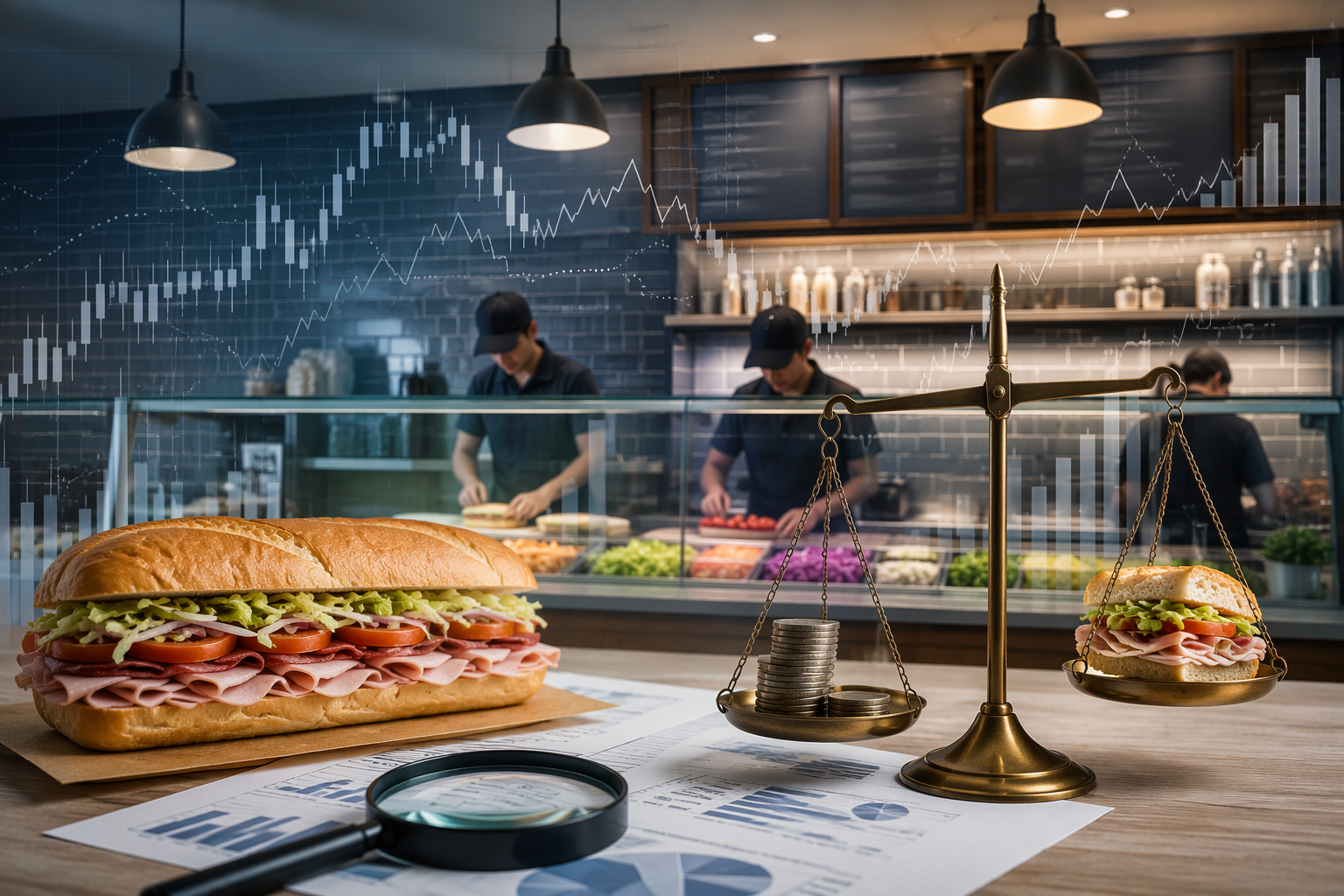
Decoding Jersey Mike's $21–$25 IPO Price Range
An analysis of Jersey Mike's $21–$25 IPO price range, comparing its 39–41x EBITDA multiple to restaurant peers and examining same-store sales trends to help investors assess whether the range is justified.
Jersey Mike's new $21-$25 IPO price range turns a popular sandwich chain into a much harder question: how much growth should public investors pay for before the recent same-store sales trend proves it has reaccelerated? The company filed the range on July 20, 2026, with 43.48 million shares in the offering, putting the deal at roughly $1 billion in gross proceeds at the midpoint.[1]
At $23 per share, the midpoint does not simply mean "Jersey Mike's is worth $1 billion." That is the offering size. The public market capitalization is closer to $7.3 billion, while the broader enterprise equity story sits around $12 billion because of the Up-C structure: public Class A shareholders own only part of the enterprise, while Blackstone and insiders continue to hold operating company units directly.[1][2]
That distinction matters because IPO buyers are not just deciding whether Jersey Mike's is a strong consumer brand. They are deciding whether the public entry price leaves enough room after a private-equity recapitalization, a debt paydown, and a valuation that already assumes a long runway.
What the $21-$25 Range Actually Changes
The difference between $21 and $25 is not cosmetic. Across the proposed range, the implied equity value moves by roughly $1.5 billion, and the trailing adjusted EBITDA multiple shifts from about 35x at the low end to above 41x at the high end.[3][2]
| IPO price point | What it implies | Investor burden |
|---|---|---|
| $21 | Approximately 35x trailing adjusted EBITDA | Still premium-priced, but less dependent on immediate same-store sales recovery |
| $23 | Around $7.3B public market cap and roughly $12B headline enterprise equity | Requires investors to separate public float value from total enterprise value |
| $25 | More than 41x trailing adjusted EBITDA | Needs both unit growth and visible sales reacceleration to look reasonable |
The midpoint looks clean in a headline. It is also where the valuation argument starts to become unforgiving. A restaurant concept can deserve a premium when unit growth is durable, franchisee economics are attractive, and same-store sales keep expanding. But at this range, public investors are not being asked to pay a modest premium for a familiar brand. They are being asked to pay a growth multiple that needs operating evidence behind it.
The IPO Is Not Mostly a Fresh Growth War Chest
The proceeds split is one of the more important pieces of the filing because it changes what the offering funds. Of the roughly $1 billion in gross proceeds, about $301 million goes to the company through primary shares, while the rest goes to selling shareholders. Of the company proceeds, $295 million is earmarked for debt repayment.[1]
The share mix tells the same story. The deal includes 13.78 million primary shares and 29.7 million secondary shares, meaning existing holders are selling substantially more stock than the company is issuing for its own balance sheet.[1]
That does not automatically make the IPO unattractive. Debt repayment can improve the capital structure, and secondary sales are common in sponsor-backed listings. But it does mean buyers should be precise about what their capital is doing. This is not a clean "new money funds store expansion" story. Much of the transaction supports an ownership transition and balance-sheet cleanup.
Blackstone's position sharpens that context. The firm acquired Jersey Mike's at roughly $8 billion in November 2024, is now targeting a roughly $12 billion exit within about 20 months, and previously extracted around $500 million in dividends through securitization, according to Forbes and S-1-cited analysis.[4]
The useful takeaway is not that Blackstone is selling, therefore public investors should avoid the deal. The useful takeaway is that the IPO price has to stand on the operating numbers. A beloved brand and an experienced sponsor are not substitutes for same-store sales momentum when the multiple is already elevated.
The Multiple Is the Center of the Deal
On the current range, Jersey Mike's is being valued at roughly 39-41x trailing adjusted EBITDA. That compares with Domino's at about 18x and Wingstop at roughly 23-25x. The enterprise value bridge used in those analyses puts Jersey Mike's at about $13.9 billion, based on roughly $12 billion of equity value plus $2.12 billion of debt less $232 million of cash.[3][2]
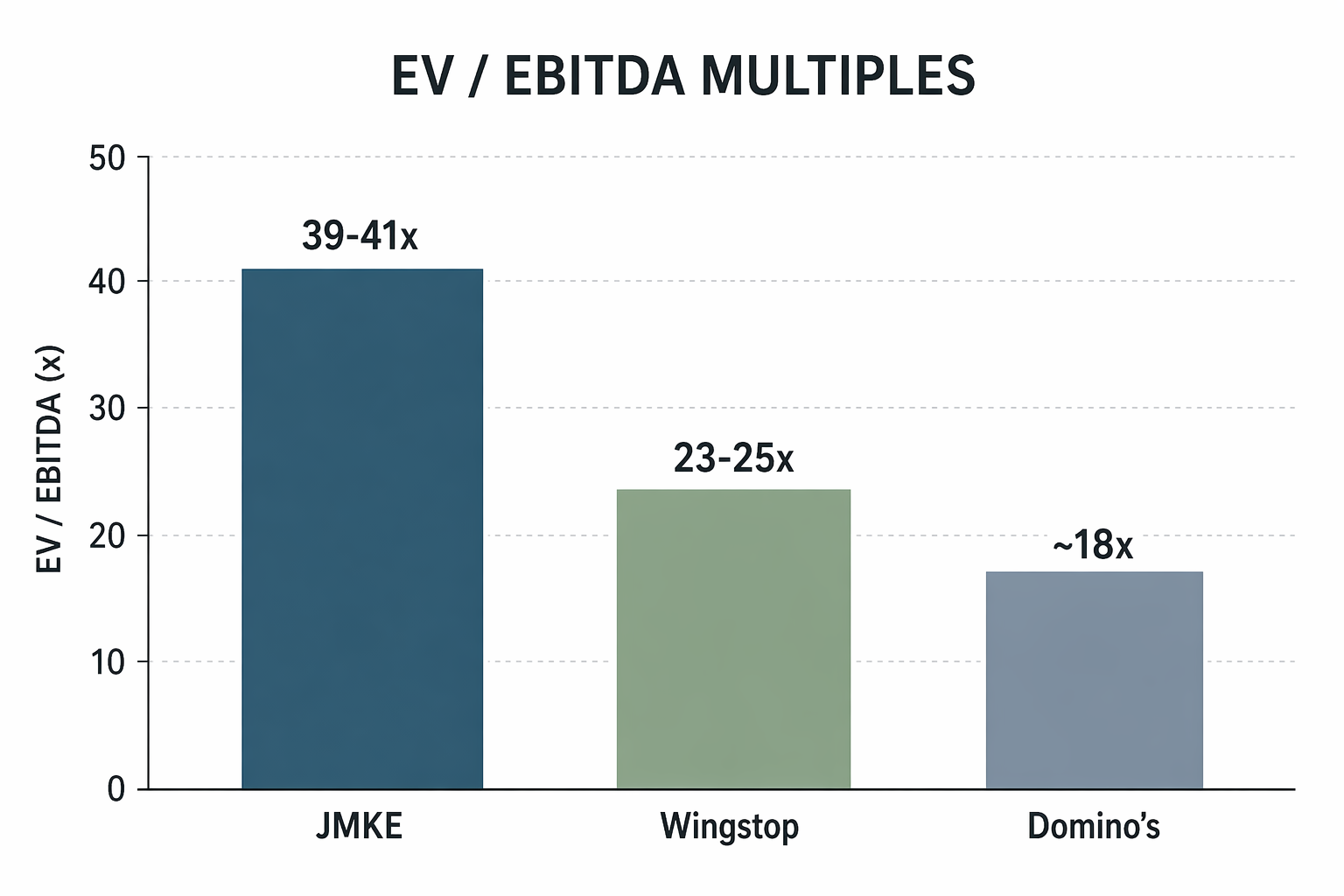
This is where the valuation analysis has to become more disciplined than a brand conversation. Domino's is not an identical business, and Wingstop is not a perfect template. Franchise mix, category exposure, unit economics, store maturity, and growth runway all differ. But the comparison still does useful work: it shows how much future performance the market is being asked to capitalize today.
A 39-41x trailing adjusted EBITDA multiple is not impossible to justify for a restaurant franchisor, but it narrows the path. The company needs sustained unit growth, franchisee demand, margin durability, and enough same-store sales growth to show that new units are not carrying the whole narrative. If same-store sales are soft, the multiple has to lean harder on unit openings. If unit growth eventually normalizes, the multiple has to lean harder on sales productivity. At this price, neither leg can be vague.
The unit story is genuinely strong enough to deserve attention. Jersey Mike's has reported 8.5% net store growth and a development pipeline of more than 1,600 locations.[2][3] That is the part of the IPO that growth investors will immediately understand. A franchised concept with a large committed pipeline can compound units without the same capital intensity as a company-owned restaurant rollout.
But the market is not pricing just store count. It is pricing quality of growth. A franchise pipeline tells investors how many restaurants may open. Same-store sales tell them whether existing restaurants are becoming more productive, holding customer frequency, and supporting franchisee returns as the system expands. That second signal is where the filing becomes less comfortable.
Same-Store Sales Are the Test
Jersey Mike's same-store sales growth has moved from +8.4% in fiscal 2023 to +2.0% in fiscal 2024, then +3.2% in fiscal 2025, before slowing to +1.7% in Q1 2026. Within that sequence, Q4 2025 was only +0.5%.[3]
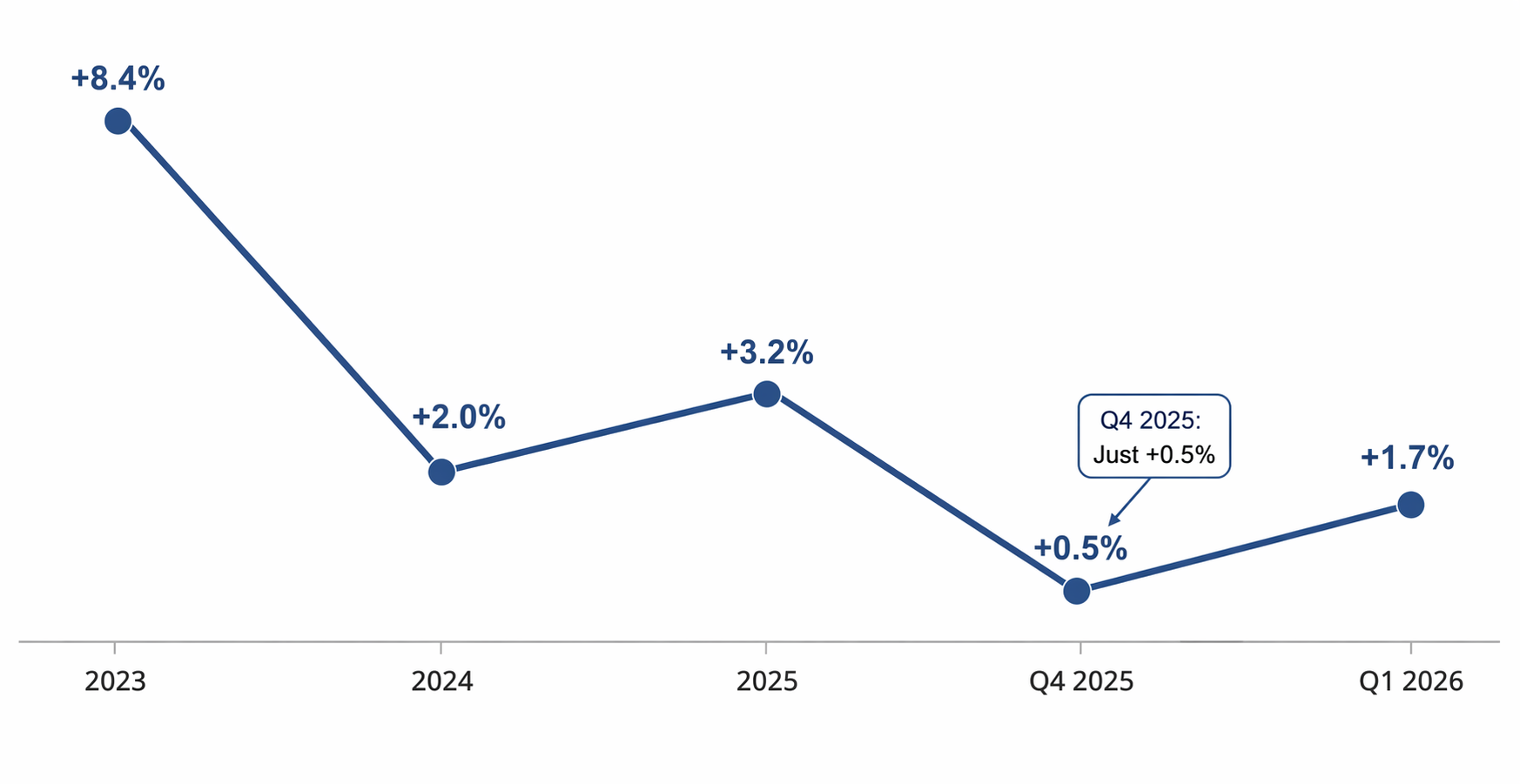
That sequence is not a collapse. It is also not the pattern investors usually want to see when asked to pay above Wingstop's multiple and roughly double Domino's. The 2025 rebound to +3.2% helps, but the late-2025 and early-2026 data points make it hard to call the recovery confirmed.[3]
The distinction matters because same-store sales growth does several jobs in the IPO model. It supports restaurant-level economics for franchisees. It helps royalty revenue grow without relying only on new openings. It gives investors a reason to believe the brand has pricing power or traffic resilience. And it lowers the risk that headline unit growth masks pressure inside the existing base.
At the low end of the range, investors can argue they are paying for a high-quality franchisor before the same-store sales recovery fully appears. That is still not cheap, but the valuation gives the thesis more room to breathe. At the high end, the argument becomes more demanding: the buyer has to believe the company can keep opening units at a healthy pace while same-store sales move back toward a sturdier growth rate than the +1.7% shown in Q1 2026.[3]
What Investors Should Watch After Listing
The first post-IPO quarters should be judged less by brand enthusiasm and more by whether the two parts of the premium valuation move together. Unit growth without better same-store sales would keep the story alive, but it would not fully validate a 39-41x trailing adjusted EBITDA multiple. Same-store sales improvement without continued unit momentum would also weaken the case, because the pipeline is a major reason the company can ask for a premium at all.
- Same-store sales: evidence that growth is moving back above the recent sub-2% level, rather than relying on one favorable quarter.
- Net unit growth: whether the 8.5% growth profile remains intact after the IPO and whether openings match the development narrative.
- Franchisee economics: signs that new and existing operators still have enough return potential to support the 1,600-plus location pipeline.
- Debt reduction: whether the planned repayment meaningfully improves financial flexibility rather than merely tidying the IPO balance sheet.
- Sponsor selling: not as a standalone red flag, but as context for how much future upside is being transferred to new public holders.
One limitation is worth keeping visible. The SEC's full S-1 filing was not directly verified here because the available research set relies on secondary S-1 analyses from IPOScoop, Daloopa, Mostly Metrics, Forbes, and other market coverage. The most questionable revenue and net income discrepancy in the available material, including a Financhill figure that does not align with S-1-sourced analyses, is intentionally excluded rather than forced into the valuation work.
That is also why the final IPO price matters. If the deal prices near $21, the market is still paying for a premium restaurant growth asset, but the same-store sales burden is less severe. If it prices near $25, public buyers are underwriting a cleaner version of the story than the recent sales trend has confirmed: sustained unit expansion, healthy franchisee demand, and a visible recovery from the +1.7% same-store sales growth reported in Q1 2026.[3]
The cleanest read may come after trading begins. A strong debut can show demand for the scarcity and brand story, but the valuation will still need operating proof. For a range this rich, the question is not whether people like Jersey Mike's. The question is whether the next few quarters make the $25 case look earned, or whether the $21 case was already generous.

Comments
Join the discussion with an anonymous comment.