
How Jersey Mike's IPO marketing strategy built a $12B valuation
Jersey Mike's $12B IPO valuation didn't come from sandwiches alone — it was powered by a centralized marketing data stack that turned 12.5 million loyalty members and 42% digital sales into a structural competitive advantage. This article breaks down the infrastructure and shows why the S-1's data story mattered as much as its store growth story.
A 41x trailing EBITDA valuation is an odd place to start a sandwich-chain story, which is why it is the right place to start Jersey Mike’s IPO marketing strategy. The company’s proposed valuation sits well above Domino’s at roughly 18x and Wingstop at about 23–25x, putting a franchise restaurant brand in territory that asks investors to believe in something more durable than unit growth and celebrity media spend.[1]
That “something” is not simply that Jersey Mike’s sells a lot of subs. It is that the company can now point to a scaled first-party data asset: 12.5 million loyalty members and a digital sales mix of 42%.[2] Those numbers change the marketing discussion. They move it from campaign performance into operating infrastructure: who owns the customer relationship, who sees demand signals first, and who can turn repeat behavior into more efficient digital revenue without handing the whole interaction to a third-party marketplace.
The premium multiple needs an operating explanation
Restaurant IPO stories usually lean on store count, same-store sales, brand awareness, and white-space expansion. Jersey Mike’s has those ingredients, but a 41x trailing EBITDA target forces a harder question: what convinces the market that this chain deserves software-like expectations when its core product is still made behind a counter?
The answer cannot be “MarTech did it.” Marketing technology alone did not create a $12 billion valuation. The better answer is narrower and more useful: Jersey Mike’s built enough owned digital infrastructure to make its growth story more finance-legible. A loyalty file with 12.5 million members is not just a retention channel. A 42% digital mix is not just an ecommerce KPI. Together, they suggest that a meaningful share of demand is observable, attributable, and reachable inside systems Jersey Mike’s controls.[2]
That distinction matters in quick-service and fast-casual restaurants, where the most convenient growth channels can also weaken customer ownership. Third-party delivery platforms may add demand, but they can also sit between the brand and the guest. A company with its own app behavior, POS history, loyalty identity, and messaging pathways has more room to optimize frequency, offers, menu discovery, and digital ordering economics on its own terms.
The stack that made the customer file usable
The most important part of the Jersey Mike’s case is not the presence of a customer data platform. It is what the CDP connected. Twilio’s customer case study describes Segment as the central hub tying together data from point of sale, the mobile app, ad networks, and email.[3] In restaurant terms, that is the difference between knowing that sandwiches were sold and knowing which known customer ordered, through which channel, after which behavior, and with which follow-up opportunity.
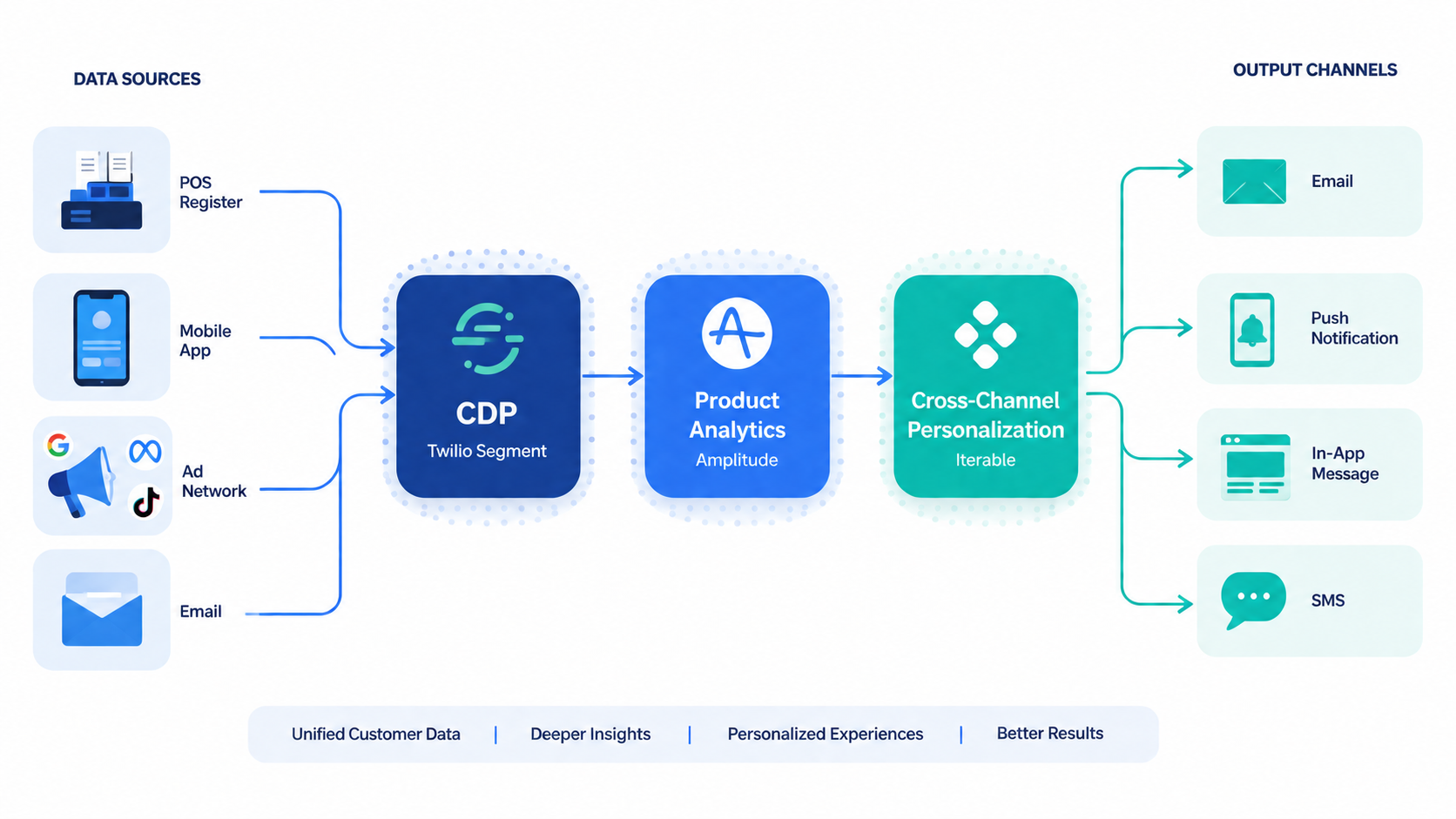
Segment handled the customer data hub role. Amplitude provided the product analytics layer, helping the team interpret behavior in digital experiences. Iterable handled cross-channel personalization and activation.[3] That division of labor is the quiet work most campaign recaps skip: identity resolution, behavioral analysis, and message orchestration are separate jobs, and the value only appears when the handoffs are clean.
| Layer | Role in the system | Why it matters commercially |
|---|---|---|
| POS, mobile app, ad networks, email | Source systems feeding customer and transaction signals | Turns disconnected interactions into observable demand patterns |
| Twilio Segment | Central CDP hub connecting those sources | Creates a usable first-party customer profile across channels |
| Amplitude | Product analytics layer | Shows how customers behave in the app and digital ordering flow |
| Iterable | Cross-channel personalization layer | Activates segments and triggers through email, push, in-app, SMS, or other lifecycle channels |
The vendor-published results are strong, though they should be read with the usual caution applied to case studies written by a platform provider. Twilio reports an 83% lift in monthly active app users and 2x mobile app orders after Jersey Mike’s accelerated its digital transformation with Segment.[3] The case study also says email open rates and offer redemption rates improved, but it does not disclose specific percentages for those two metrics.[3]
Those caveats do not make the operational story irrelevant. They simply keep the claim in its proper lane. The available evidence supports that Jersey Mike’s connected fragmented systems, used that connected data for better app and lifecycle marketing, and saw favorable digital engagement outcomes in the period covered by the vendor case study. It does not prove, by itself, that the stack caused the IPO multiple.
Why the Classic Italian trigger matters more than broad personalization language
The clearest example in the source material is small enough to be believable: if a customer orders a Classic Italian for the fourth time in a month, Jersey Mike’s can trigger an automated cross-sell suggesting cheesesteaks for dinner.[3] That is not a vague “AI-powered experience.” It is a concrete behavioral rule built on recognizable purchase frequency, product preference, and timing.
For marketing operations teams, the importance is in the sequence. The POS and app need to record the behavior. Segment needs to unify it to the right profile. Amplitude can help identify the behavioral pattern or opportunity. Iterable can send the message through the appropriate channel. The customer receives a relevant prompt because the system can see a pattern that a batch-and-blast email program would flatten.
That kind of trigger also makes the finance conversation less abstract. The value of the stack is not “we bought a CDP.” The value is that the company can detect repeat category behavior, change the next offer, and potentially shift a known customer into another daypart or menu item without renting attention from an external platform every time.
Loyalty scale turns plumbing into an asset
A CDP connected to a thin customer file is still mostly plumbing. Jersey Mike’s more interesting IPO argument comes from the scale sitting on top of that plumbing. With 12.5 million loyalty members and 42% of sales coming through digital channels, the company can present its marketing infrastructure as a business capability rather than a back-office cleanup project.[2]
The first-party nature of that data is central. Privacy changes and platform dependency have made rented audience access less predictable. A restaurant brand that can recognize known customers across app, loyalty, transaction, and messaging contexts has more control over segmentation, suppression, testing, and lifecycle economics. It can decide who should receive an offer, who should not be discounted, who is drifting, and which behaviors are worth nudging.
The S-1 breakdown highlights the company’s own-tech-stack advantage as part of the investment story, particularly its reduced dependency on third-party platforms and added flexibility compared with franchise peers that rely more heavily on outside platforms.[2] That is a structural claim, not just a marketing claim. It implies management has better visibility into demand and more direct tools for shaping it.
The careful wording matters. A 42% digital mix does not automatically mean higher margins on every order. A loyalty base does not automatically mean more frequency. But together they give the company a stronger base for testing, personalization, attribution, and direct ordering growth than a brand whose customer relationship is more fragmented or mediated.
How the marketing system supports the IPO narrative
Jersey Mike’s IPO narrative still depends on restaurant fundamentals. The company’s corporate EBITDA margin was reported at 47%, and its marketing fund was $203 million in 2025.[2] QSR Magazine also reported that the company carried $2.1 billion in debt, a reminder that the valuation story comes with balance-sheet pressure as well as growth ambition.[4]
Those figures are important because they frame why digital infrastructure matters to investors. A large marketing fund gives the brand resources to create demand. A high corporate EBITDA margin makes the efficiency of that demand more valuable. Debt increases the need for predictable growth and disciplined capital allocation. In that context, a first-party data system is not decorative; it is one of the mechanisms management can point to when explaining how marketing dollars, app adoption, loyalty, and store-level demand can become more measurable.
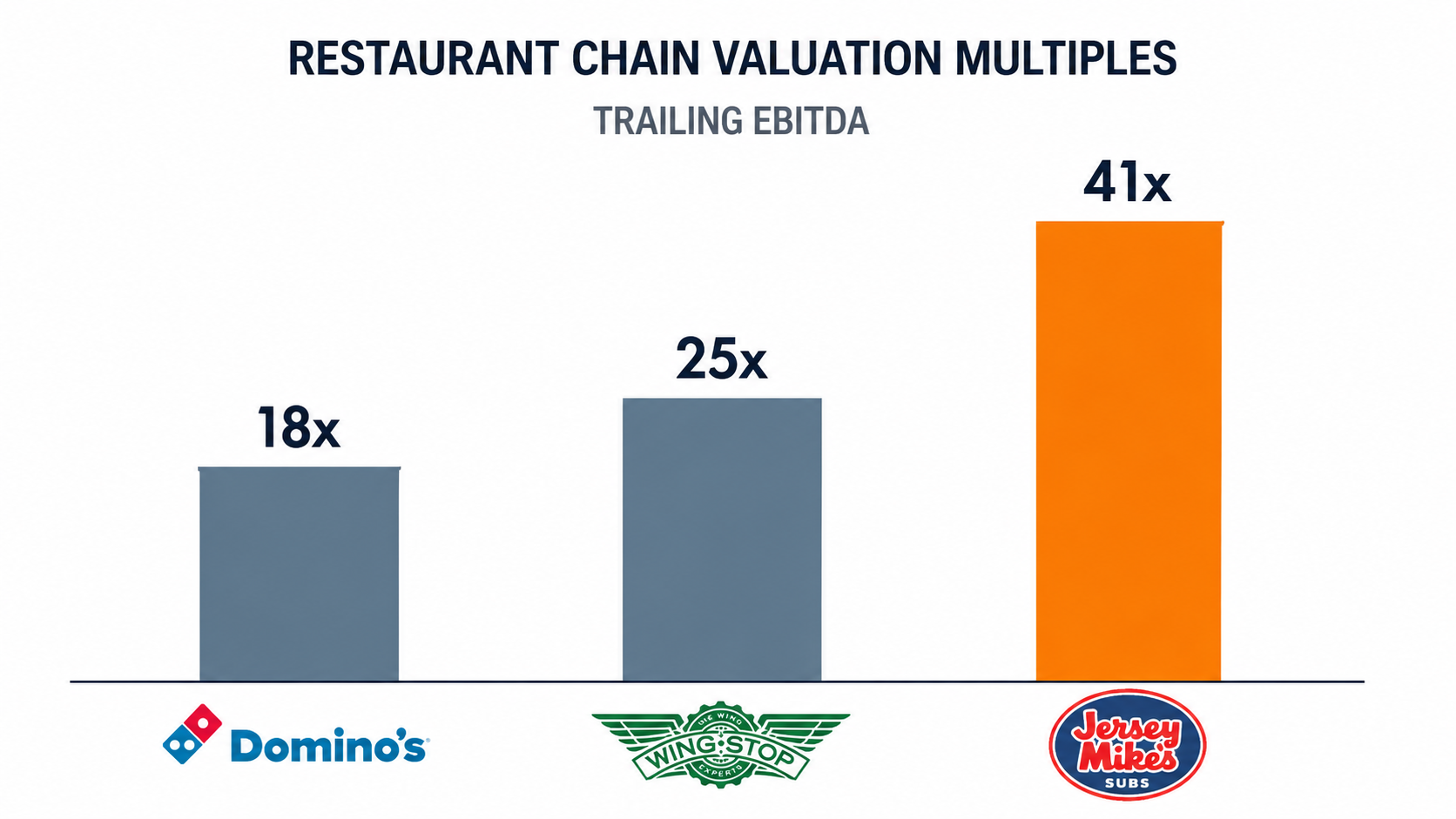
This is where the comparison with Domino’s and Wingstop becomes useful, but only if it is not overstated. Kavout describes Jersey Mike’s IPO as a premium bet, with the company targeting 41x trailing EBITDA versus Domino’s at approximately 18x and Wingstop at 23–25x.[1] The market is not paying that spread because Jersey Mike’s uses Segment, Amplitude, and Iterable. It is paying for a package of expectations: domestic unit growth, international expansion, franchise economics, brand momentum, digital mix, data ownership, and management execution.
The MarTech contribution is that it makes part of that package more credible. If investors are asked to believe that future stores, new markets, and higher digital penetration will compound profitably, the company’s ability to recognize and activate known customers is relevant. It gives the growth model a feedback loop.
The Danny DeVito campaign is context, not the center
Jersey Mike’s has not ignored brand advertising. Its marketing strategy evolved to include Danny DeVito, giving the company a more recognizable national media presence.[5] That matters for awareness, especially as a regional favorite becomes a broader national and international brand.
But celebrity creative is not the most interesting marketing asset in the IPO story. A commercial can create attention. The data stack determines how much of that attention becomes known behavior, repeat ordering, measurable retention, and addressable demand. For a valuation-facing strategy analysis, the back-end system deserves more weight than the front-end spot.
This is also why Jersey Mike’s is a better MarTech example than many software case studies. Restaurants expose weak infrastructure quickly. If identity, POS, app behavior, and lifecycle messaging do not connect, the guest experience becomes messy and the reporting becomes political. When the system does connect, the value is visible in ordinary actions: app orders, loyalty behavior, offer redemption, menu cross-sell, and channel mix.
The AI language should not distract from the working system
The S-1’s AI language deserves a cooler reading than IPO commentary usually gives it. The S-1 breakdown notes that AI appears 22 times, while CEO Charlie Morrison’s stated goal is to raise digital mix from 40% to 60%.[2] The second detail is more operationally meaningful than the first. A higher digital mix would create more owned behavioral data, more direct ordering opportunities, and more surfaces for personalization.
AI may eventually improve forecasting, segmentation, offer decisioning, or labor allocation. The available materials do not support making it the core of Jersey Mike’s marketing strategy. The demonstrated system is more concrete: CDP connection, product analytics, cross-channel activation, loyalty scale, and digital sales mix. Those are the parts that can be inspected.
Where the premium still depends on execution
The first-party data asset improves the IPO story, but it does not remove the risks. The premium valuation prices in continued growth before all of the returns are proven. The research materials point to international expansion ambitions, including 400 stores in the UK and Ireland, as part of the future-growth expectation.[1] That kind of expansion introduces operational complexity that no lifecycle trigger can solve on its own.
Debt also matters. A company carrying $2.1 billion in debt has less room for a sloppy transition from growth story to public-market execution.[4] Marketing infrastructure can help management measure demand and improve digital efficiency, but it cannot guarantee franchisee performance, international adoption, real estate quality, labor discipline, or consumer resilience.
That is why the digital metrics should stay in their lane. The 83% lift in monthly active app users and 2x mobile app orders are useful evidence of operational progress, not enough to assign a precise share of enterprise value to Twilio Segment, Amplitude, Iterable, or any other tool in the stack.[3]
What Jersey Mike’s makes easier to argue
The strongest lesson in Jersey Mike’s IPO marketing strategy is not that every restaurant brand needs the same stack. It is that marketing infrastructure becomes more valuable when it can be described in finance language without losing its operational truth.
A disconnected app, POS file, loyalty program, ad account, and email platform are costs. A connected system that can identify known customers, interpret product behavior, and activate relevant messages across channels can become an asset. Jersey Mike’s had enough scale behind that system — 12.5 million loyalty members and 42% digital sales — for the argument to matter in an IPO context.[2]
That does not mean marketing software built the $12 billion valuation by itself. It means the centralized first-party data infrastructure gave investors a credible reason to treat Jersey Mike’s as more than another expanding franchise chain. The premium multiple is still a bet on execution. The data stack makes the bet easier to underwrite.
References
- Jersey Mike's IPO: A Premium Bet on the Sandwich King's Reign — Kavout
- Jersey Mike's IPO: S1 Breakdown — Mostly Metrics
- How Jersey Mike's accelerated digital transformation with Twilio Segment — Twilio
- Inside Jersey Mike's Unmatched Sandwich Growth Story — QSR Magazine
- How Jersey Mike's marketing strategy evolved to include Danny DeVito — NRN

Comments
Join the discussion with an anonymous comment.