
Is IREN Stock a Smart AI Cloud Investment Right Now?
IREN's pivot to AI cloud is backed by over $13 billion in contracts from Microsoft and NVIDIA, but only 4% of its contracted power is live. This analysis weighs the opportunity against the execution risk that defines the current investment case.
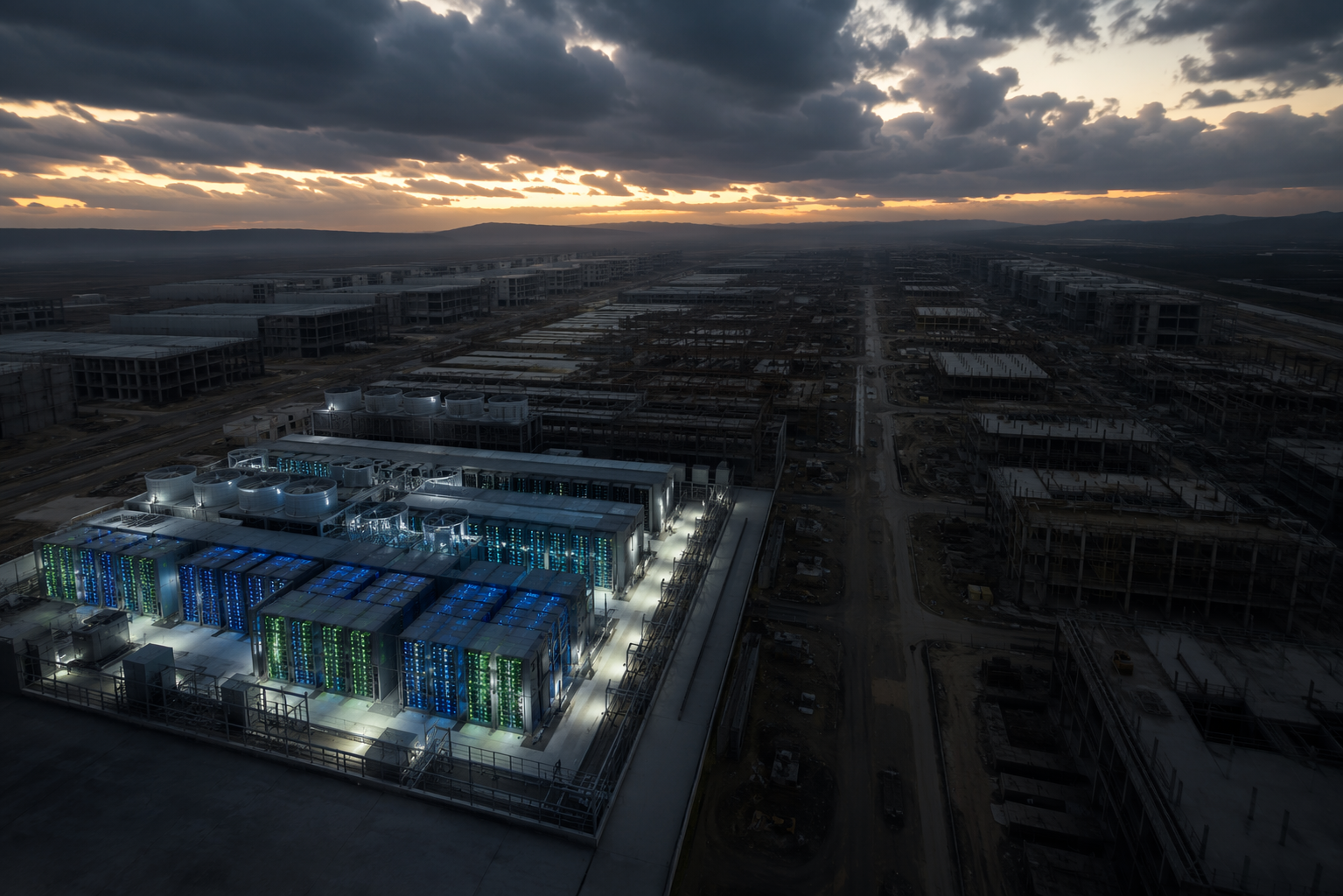
IREN stock has become one of the clearest tests of whether the AI cloud buildout is turning into an investable infrastructure theme or another market willing to capitalize construction promises before the racks are live. The bull case starts with more than $13 billion in major AI cloud-related contracts, including a reported five-year Microsoft contract valued at $9.7 billion and an NVIDIA arrangement valued at $3.4 billion.[1][2] The hard stop is that IREN has roughly 5 GW of contracted power capacity, but only about 200 MW is currently live — approximately 4%.[3][4]
That gap is the investment case. Not the Bitcoin-miner-to-AI pivot by itself, not the headline customer names by themselves, and not the macro story by itself. IREN may be building something genuinely valuable in a constrained AI infrastructure market. It is also a stock already asking investors to underwrite financing, construction, GPU procurement, customer delivery, and power activation before most of the capacity is producing revenue.
The demand signal is real, even if the Microsoft number deserves careful attribution
The reason IREN is being reassessed is not vague AI branding. The reported Microsoft contract is large enough to change how the market categorizes the company, though the $9.7 billion figure in the available research is based on company disclosures and reporting rather than independently verified Microsoft press materials.[1] That distinction matters. A contract can validate demand without removing the need to check delivery risk.
NVIDIA’s role is easier to frame as strategic validation because the research includes an official NVIDIA source. The NVIDIA-IREN arrangement is described as a $3.4 billion deal, alongside a $2.1 billion equity option at $70 per share.[2] That structure gives IREN more than a customer logo; it suggests a financing and ecosystem relationship with one of the central suppliers in the AI infrastructure stack. It also means investors should not treat the upside as frictionless, because an equity option can affect how future value is shared.
IREN has also raised its 2026 annual recurring revenue target to more than $4 billion, with about 85% already under contract across more than 10 AI developers.[1] For a company that was recently understood primarily as a Bitcoin miner, that is not cosmetic progress. It is a real attempt to move from energy-intensive commodity exposure into contracted AI cloud infrastructure.
The better question is not whether AI cloud demand exists. It does. The question is how much of that demand IREN can turn into energized, customer-serving capacity on a timeline that supports the valuation.
Power is the asset, but activation is the bottleneck
IREN’s appeal comes from something more tangible than software multiples: grid-connected power, development sites, and the ability to place GPUs where customers can actually use them. In an AI market where compute demand keeps colliding with electrical constraints, contracted power can become a strategic asset.
Goldman Sachs projects U.S. data center power demand will double to 66 GW by 2027 and estimates a 45 GW shortfall by 2028.[5] That is the right macro backdrop for a company trying to monetize large power positions. But macro scarcity does not automatically make every contracted megawatt equally valuable. A megawatt on paper still has to become energized infrastructure with substations, buildings, cooling, networking, GPUs, customer acceptance, and operating reliability.
This is where IREN’s current profile becomes uncomfortable. The company is associated with roughly 5 GW of contracted power, but only about 200 MW is live.[3][4] Management’s target is to reach 1.2 GW by 2027, which would be a major step up from the current live base, but still far short of the total contracted footprint.[4]
| Capacity marker | What it means for the investment case |
|---|---|
| About 5 GW contracted power | Defines the long-term scale story and explains why the market is willing to re-rate the company. |
| About 200 MW live | Shows how little of the contracted footprint is currently operational and revenue-producing. |
| Roughly 4% operational | Turns the story from a demand question into an execution question. |
| 1.2 GW management target by 2027 | Creates a near-term yardstick for whether IREN can close the activation gap quickly enough. |
The industry’s own delivery record argues for caution. Goldman Sachs notes that only 50% to 60% of scheduled data center capacity comes online on time industry-wide.[5] That does not mean IREN will miss its schedule. It does mean investors should not model every announced megawatt as if it will arrive on the planned date with no cost pressure or customer-delivery friction.
The operational burden is also asymmetric. If AI demand remains strong, customers still need compute. If IREN is late, the stock absorbs the disappointment because the market has already started paying for capacity that is not yet live. The company’s teams have to solve physical infrastructure sequencing; shareholders experience that sequencing as valuation risk.
Financing looks unusually credible for a former Bitcoin miner
The financing side is one of the stronger parts of the IREN story. The company’s $3.65 billion GPU financing facility carries A ratings from Fitch and DBRS, an unusual level of institutional-grade support for a business that, not long ago, was viewed mainly through the lens of Bitcoin mining volatility.[4] Customer prepayments now cover about 45% of GPU capex, which shifts a meaningful part of the capital burden toward clients rather than leaving IREN to fund every deployment from its own balance sheet.[2][4]
That matters because the AI cloud buildout is not just a land-and-power story. The company has to secure GPUs, finance them, install them, connect them to customers, and keep utilization high enough to justify the capital stack. Prepayments and rated facilities do not eliminate execution risk, but they make the opportunity more credible than a simple “miner adds AI” narrative.
There is still evidence that IREN has room to improve the economics of its live infrastructure. Its revenue per operational MW is reported at $10.4 million, compared with CoreWeave at $20.8 million.[4] That comparison should not be stretched too far because customer mix, contract structure, utilization, and service scope can differ. Still, it shows why bulls can argue that IREN may have pricing or mix upside if it successfully converts more capacity into AI cloud revenue.
The premium valuation makes timing the pressure point
At this stage, IREN is not being priced like a slow infrastructure compounder. As of July 21, 2026, research cited a stock price of $41.75, a market capitalization of about $14.9 billion, and a beta of 4.28.[3] Its price-to-cash-flow multiple stood at 63.42X versus an industry figure of 19.22X.[3] Those are not neutral numbers. They mean the stock is already carrying a large amount of expected growth and a large amount of volatility.
The company is also still reporting net losses and negative free cash flow.[1] That does not disqualify an infrastructure buildout, especially one with major contracted demand. It does change the burden of proof. A profitable, cash-generating infrastructure company can absorb some delay with less damage to investor confidence. A high-beta stock with negative free cash flow and a premium multiple has less room to ask for patience.
This helps explain the split in market opinion. Zacks ranks IREN as Strong Sell, while consensus analyst price targets average around $80.93 with a Buy rating.[6] That is not just a disagreement over a spreadsheet assumption. It reflects two different ways of weighing the same facts: one side emphasizes current valuation, losses, and risk; the other gives more credit to contracted demand, power scarcity, and the possibility that IREN becomes a scaled AI cloud platform.
The stock can be both credible and dangerous. A premium multiple tied to a small live capacity base means that deployment timing becomes the main variable. If IREN keeps converting contracted power into operational AI cloud capacity, the market has a reason to look past current losses. If activation slips, the same valuation can reset quickly because investors are not paying mainly for what is live today.
What would make the AI cloud opportunity more investable?
The cleanest confirmation would be visible progress from the current live base toward the 1.2 GW target by 2027.[4] Contract announcements matter, but at this point they are no longer enough. The next stage of the thesis needs evidence that IREN can repeatedly take power, facilities, GPUs, financing, and customer commitments through to live production.
For investors evaluating IREN stock as an AI cloud investment opportunity, the practical watch points are straightforward:
- Live MW additions: whether operational capacity expands on schedule, not just whether contracted power grows.
- Customer delivery milestones: whether large AI cloud contracts translate into accepted, revenue-producing deployments.
- GPU financing and prepayment coverage: whether IREN can keep scaling without overburdening its balance sheet.
- Revenue per operational MW: whether economics improve as the AI cloud mix matures.
- Free cash flow trajectory: whether growth begins reducing, rather than increasing, external capital dependence.
- Delay disclosure: whether management gives enough detail for investors to separate normal construction sequencing from meaningful slippage.
The Microsoft and NVIDIA relationships are important because they reduce the risk that IREN is building into imaginary demand. The 5 GW contracted power position is important because it gives the company a scarce input in a market where power availability may tighten. The financing structure is important because it makes aggressive deployment more plausible. None of those facts changes the core issue: only a small portion of the contracted base is currently operational.
So, is IREN stock smart right now?
IREN is a credible AI cloud investment opportunity, but not a forgiving one. The stock is not merely a bet that AI demand will grow. It is a bet that IREN can turn a large contracted power position into live AI cloud capacity fast enough to support a valuation already reflecting aggressive execution.
For an investor willing to tolerate infrastructure risk, financing complexity, and high volatility, IREN has the ingredients that can justify serious attention: anchor customers, strategic GPU relationships, power capacity, and a macro backdrop that favors scarce data center infrastructure. For an investor who needs current cash generation, predictable deployment, or a margin of safety in the valuation, the 4% operational figure is difficult to ignore.
At the current stage, the smartness of the investment depends less on believing in AI demand and more on accepting the consequences of the activation gap. Every delay in converting contracted power into live capacity can punish a stock already priced for a lot to go right.
References
- IREN press release, GlobeNewswire, July 20, 2026.
- NVIDIA-IREN partnership release, NVIDIA Newsroom.
- IREN stock overview, StockAnalysis.com.
- IREN comparison article citing Bernstein analyst data, INDmoney.
- Goldman Sachs Insights article on data center power demand, Goldman Sachs, May 20, 2026.
- TradingView/Zacks article on IREN ranking and analyst targets, TradingView.

Comments
Join the discussion with an anonymous comment.