
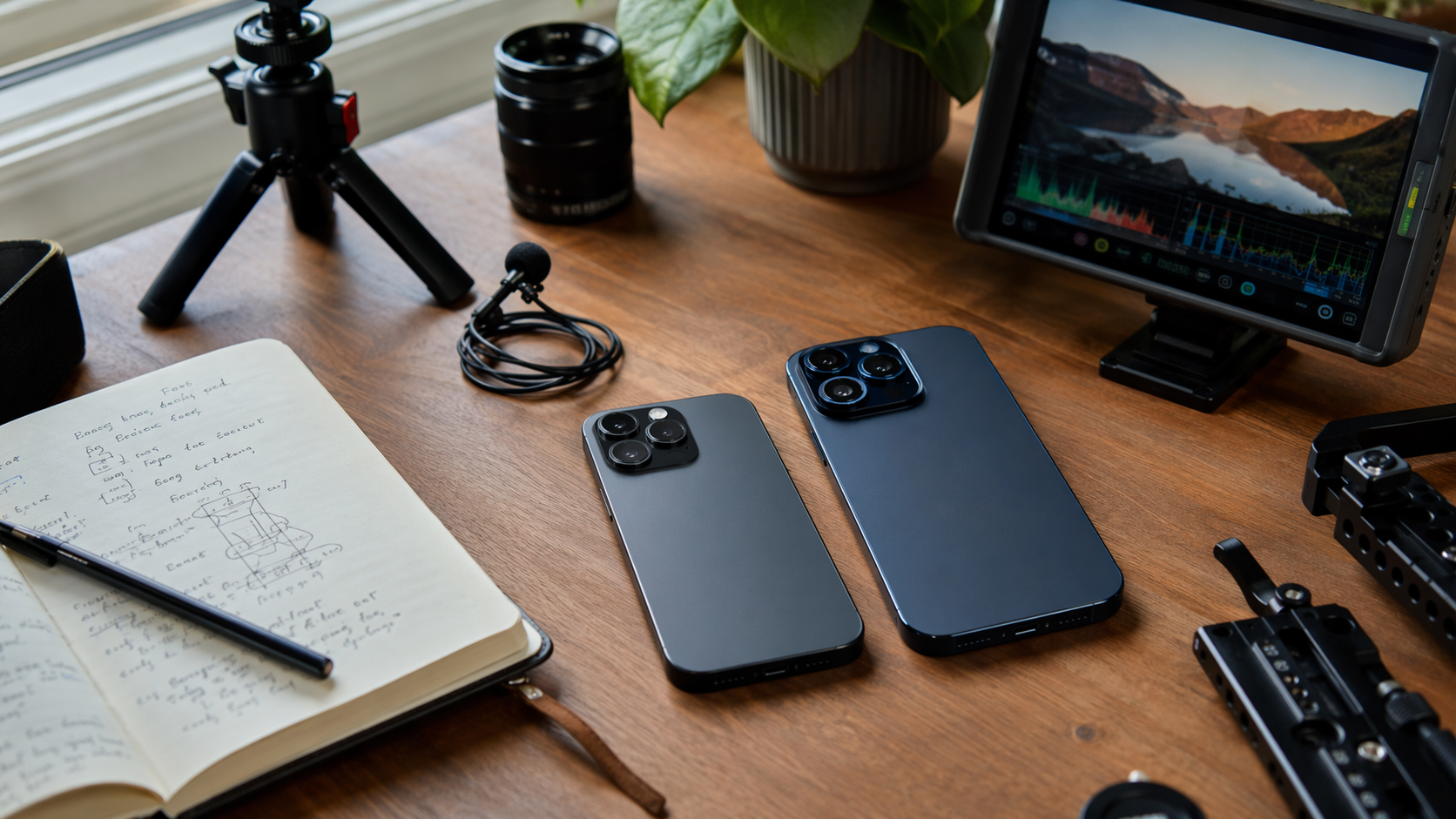
Is the iPhone 18 Pro worth upgrading to for content marketing?
This comparison helps content marketing professionals decide whether the iPhone 18 Pro's variable aperture and A20 chip justify the upgrade cost over the iPhone 17 Pro, and which production scenarios benefit most from the new hardware.
For most content marketing teams, the iPhone 17 Pro is still the value pick. It already covers the work that fills a content calendar: short-form social clips, talking-head explainers, run-and-gun office B-roll, event snippets, and standard product photos. The iPhone 18 Pro only starts to look like the smarter buy if the team repeatedly loses time to bright-light video exposure, heat during long recording sessions, controlled product setups, or multicam interview workflows.
There is one important catch before any comparison gets too confident: as of July 2026, the iPhone 18 Pro has not been announced by Apple. The useful upgrade story is based on supply-chain and analyst reporting, not final Apple specifications. That makes this an upgrade-planning comparison, not a verdict on a shipping phone.
| Production question | iPhone 17 Pro | Rumored iPhone 18 Pro | Practical read |
|---|---|---|---|
| Everyday social video | Already strong for 4K capture, Log workflows, and quick delivery | Likely better, but not necessarily workflow-changing | Keep or buy 17 Pro unless quality failures are already visible |
| Bright outdoor video | May still need ND filters or exposure compromises | Variable aperture could reduce setup friction | 18 Pro becomes interesting if shutter discipline matters |
| Controlled product video | Capable, especially with existing Pro video tools | Variable aperture and thermal gains may help repeatable setups | 18 Pro may save time on reshoots and lighting adjustments |
| Long recording sessions | Professional capture stack is already mature | A20 Pro is reported to improve sustained encoding and reduce throttling | Wait for real thermal tests if this is the upgrade reason |
| Per-unit budget | $1,099 starting point | Reported $1,299–$1,399 starting point | The premium matters fast when buying multiple devices |
The 17 Pro Is Not a Compromise Phone for Content Teams
The easiest mistake in an iPhone 18 Pro vs 17 Pro comparison for content marketing is to treat the older model as the “basic” option. It is not. The iPhone 17 Pro already supports 4K Dolby Vision at 120fps, ProRes RAW, Apple Log 2, Genlock, and Dual Capture, which means it is already built for workflows that go well beyond casual phone video.[1] PetaPixel’s review also framed the 17 Pro as a hardware-focused release for photographers and video creators, not just a routine annual camera bump.[2]
For an in-house team, those features matter in very practical ways. Apple Log 2 helps when clips need to match other cameras or carry a consistent brand grade. ProRes RAW gives post-production more room when a campaign asset has a longer shelf life than a same-day Reel. Genlock matters when multiple cameras need to stay synchronized. Dual Capture is useful when a creator or product lead needs to appear on camera while still showing the scene in front of them.
That is why the 17 Pro remains hard to beat for teams that mainly need a reliable production phone. If the bottleneck is scripting, approvals, lighting discipline, sound, editing bandwidth, or the fact that someone remembered the product shot an hour before publishing, the 18 Pro’s rumored hardware will not fix the real constraint.
Where the 18 Pro Rumors Actually Matter
The most production-relevant iPhone 18 Pro rumor is variable aperture. MacRumors reported in April 2026 that the feature had entered production through the supply chain for the iPhone 18 Pro camera system.[3] Separate reporting said the component would cost Apple 50% more to make, which helps explain why this is being discussed as a premium-model feature rather than a broad camera update.[4]
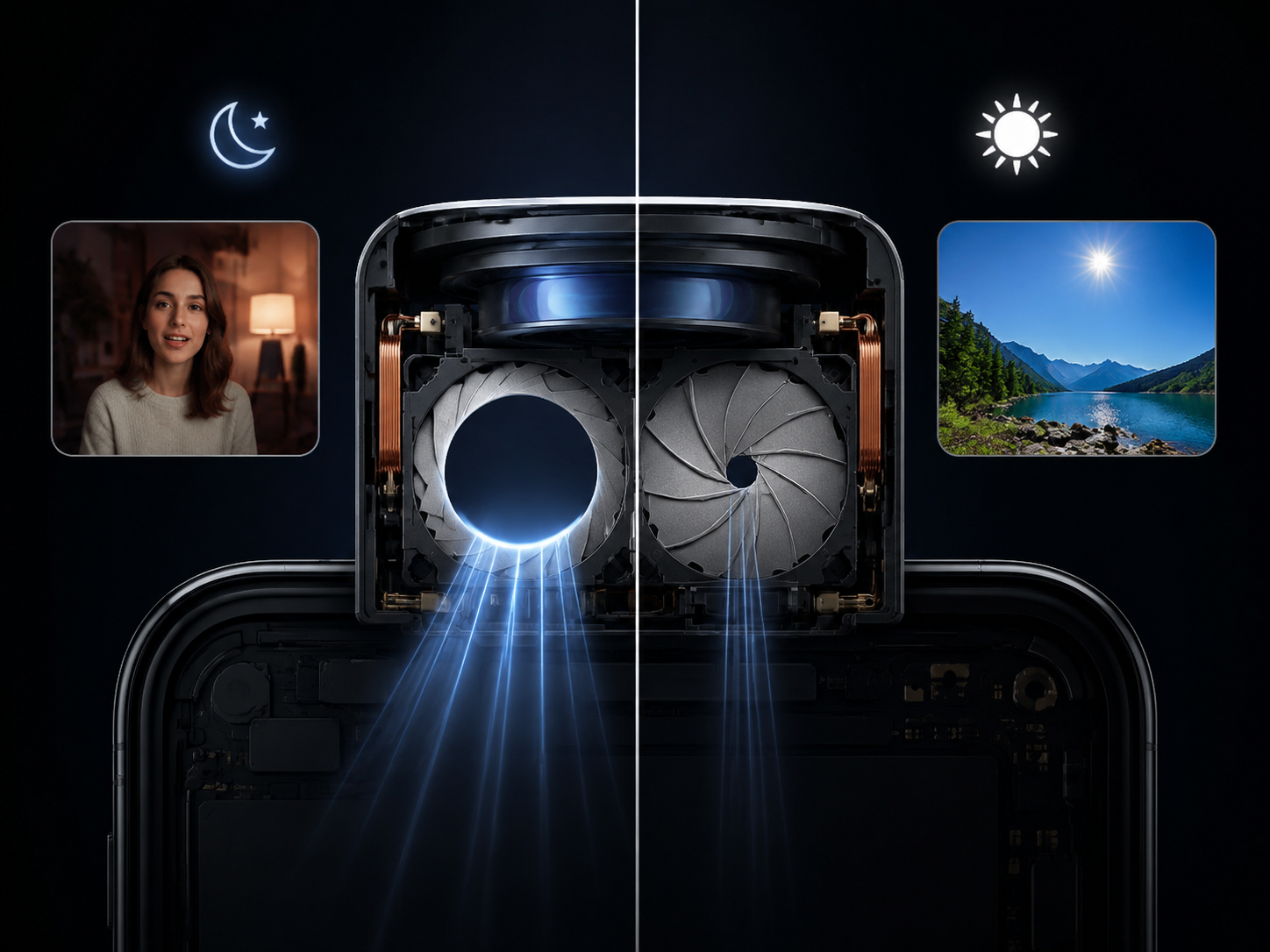
The useful part is not the dreamy shallow-depth-of-field pitch. Smartphone sensors are still small enough that background separation will not suddenly behave like a full-frame camera with a fast lens. The more practical win is exposure control, especially in video. If the aperture can close down in bright conditions, the shooter has another way to manage exposure without immediately reaching for an ND filter, raising shutter speed, or changing the look of motion.
That matters most when the content has to look intentional rather than merely sharp. A product demo on a rooftop, a founder interview near a bright window, a trade-show clip under harsh venue lighting, or a paid social asset shot outdoors all create the same annoying choice: preserve motion cadence and fight exposure, or let the phone solve exposure in a way that makes the footage feel less polished. Variable aperture could reduce that friction if Apple implements it well.
This is also where a small team feels the difference more than a spec sheet suggests. If one person is directing, filming, watching continuity, and keeping the marketing manager calm, every extra filter, retake, or exposure workaround costs attention. A hardware control that makes the shot usable sooner can be worth more than a dramatic-sounding camera feature that only shows up in edge-case photo comparisons.
The Price Gap Gets Expensive Across a Team
The upgrade question changes once the purchase is multiplied. The iPhone 17 Pro starts at $1,099, while one report said the iPhone 18 Pro could start at $1,299 to $1,399, a 15% to 27% increase.[5] That is a $200 to $300 difference per device before accessories, storage decisions, AppleCare, cages, microphones, mounts, batteries, or software subscriptions enter the conversation.
For a solo creator inside a company, the premium may be easy to justify if the phone is the main camera. For a three-person content team, the same premium starts looking like a lighting kit, a better wireless mic setup, a mobile teleprompter, or paid editing support. Those purchases may improve more finished assets than the camera upgrade if the team’s current footage is already technically acceptable.
That does not make the 18 Pro overpriced. It means the buyer has to identify the production failure it solves. “Better camera” is too vague. “We lose too many outdoor takes because we cannot keep exposure and motion looking right” is a real reason. “Our phones heat up during long product shoots and the footage becomes unreliable” is another. “The CEO wants the newest iPhone” is not a production case, even if it is sometimes the actual procurement case.
Thermals Matter More Than Benchmark Speed
The rumored A20 Pro is worth watching, but not because a content team needs another abstract speed claim. The relevant report is about WMCM packaging with LPDDR6 on a 96-bit bus, described as improving sustained video-encoding performance and reducing thermal throttling.[6] If that holds up in shipping hardware, it points directly at the boring problems that ruin production days: dropped reliability, forced cooldown breaks, shorter recording windows, and inconsistent performance during long shoots.
This matters more for teams that record long interviews, capture events, or shoot batches of product clips under lights. A phone that performs beautifully for a two-minute test can still be the wrong tool if it becomes unpredictable after repeated takes. The A20 Pro’s value should be judged by sustained capture and encoding behavior, not by whether an app opens slightly faster.
The catch is that thermal claims need real-world testing. A launch slide or supply-chain report cannot tell a marketing team how the phone behaves after an hour of 4K capture in a warm room with a case attached. If heat is the main reason to upgrade, waiting for hands-on production tests is the safer move.
Camera Upgrades That Are Useful, but Secondary
Reports have also pointed to three iPhone 18 Pro camera upgrades: variable aperture, an improved telephoto camera with a wider aperture, and a pro software mode.[7] Those are credible areas to watch, but only variable aperture clearly changes the production conversation before Apple announces the phone.
The telephoto improvement could help with product detail, compressed-looking lifestyle shots, and cleaner subject isolation in certain setups. Still, the 17 Pro is already strong here. Austin Mann noted that the iPhone 17 Pro’s 48MP telephoto uses a sensor 56% larger than the one in the iPhone 16 Pro, and Lux Camera’s review also treated the 17 Pro camera system as a major step for practical shooting.[8][9]
For many content marketing use cases, the telephoto question is not “which phone has the newest lens?” It is whether the team actually shoots in a way that benefits from it. Product close-ups, texture shots, founder portraits, and detail cutaways can use a better telephoto. Desk-based talking heads, quick vertical clips, and behind-the-scenes posts usually will not expose the difference often enough to justify a fleet upgrade.
The rumored pro software mode is also worth treating carefully. Software features can be valuable, but iOS 26 camera UI changes, Final Cut Camera improvements, and Live Multicam support are expected to be available on both phones through updates. That narrows the 18 Pro’s advantage if the workflow benefit comes from interface and app behavior rather than exclusive hardware.
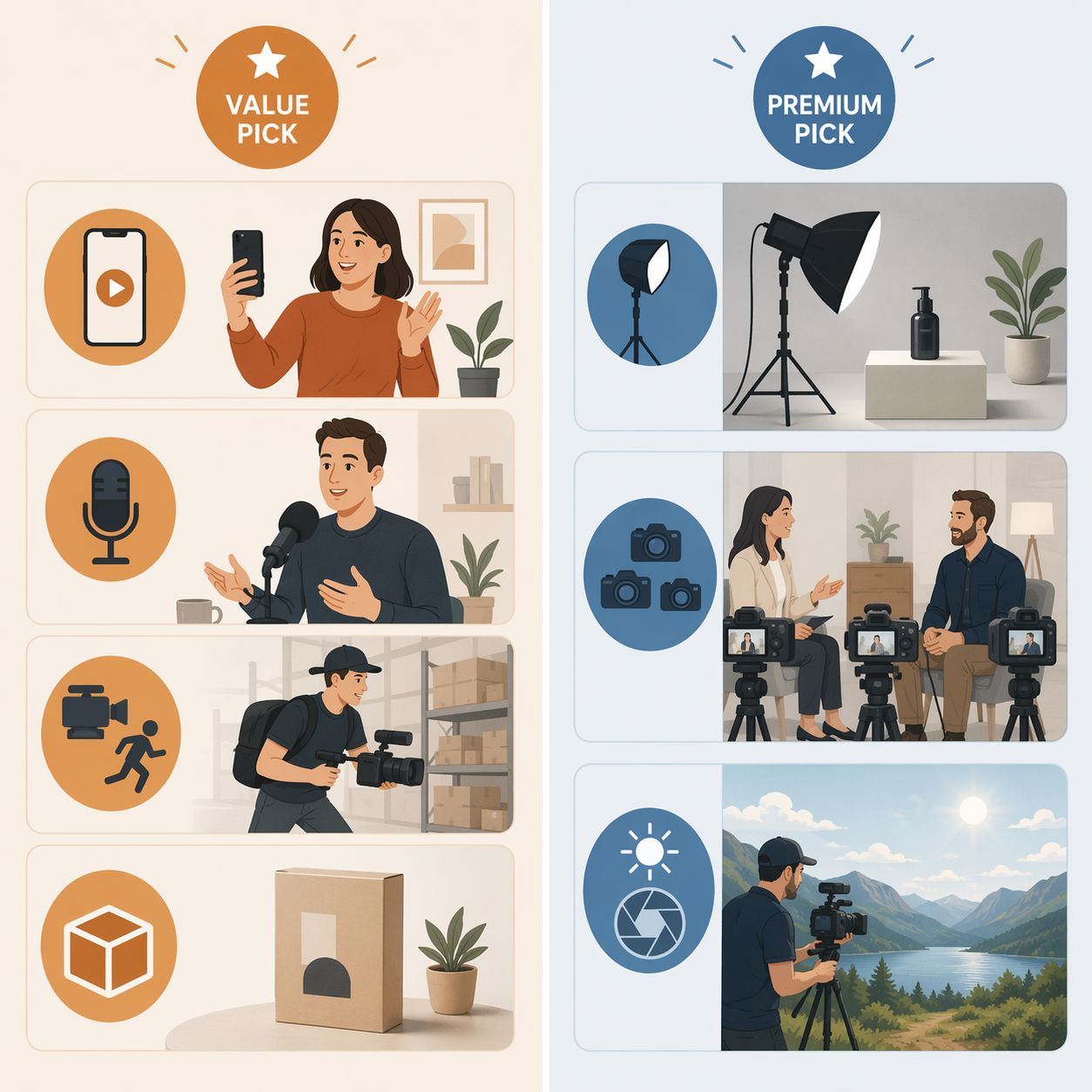
Scenario-Based Upgrade Decision
The cleanest buying decision is to map the phone to the job it will do most often. A content team does not need the technically best iPhone in isolation. It needs the phone that reduces production friction enough to justify its cost.
| Primary workflow | Recommended choice | Why |
|---|---|---|
| Short-form social content, office B-roll, quick creator clips | Buy or keep iPhone 17 Pro | The existing video stack is already more than enough for the usual production constraints |
| Talking-head videos and internal expert interviews | Usually iPhone 17 Pro | Audio, lighting, framing, and review workflow will matter more than the rumored camera changes |
| Standard product photography for web, social, and email | Usually iPhone 17 Pro | The 17 Pro telephoto and main camera are already highly capable for detail and catalog-style work |
| Controlled product video with repeated setups | Consider iPhone 18 Pro | Variable aperture could make exposure control faster and more repeatable |
| Bright outdoor video where motion cadence matters | Consider iPhone 18 Pro | The rumored aperture control may reduce reliance on ND filters or shutter-speed compromises |
| Long takes, event coverage, or heavy 4K capture days | Wait for iPhone 18 Pro tests | The A20 Pro thermal story is promising, but sustained recording needs real validation |
| Multicam interviews or higher-end branded video | Consider iPhone 18 Pro, but do not ignore 17 Pro | Genlock already gives the 17 Pro serious production value; the 18 Pro may add margin rather than create the workflow |
| Buying several phones at once | Default to iPhone 17 Pro unless a specific bottleneck points to 18 Pro | The reported $200–$300 premium per unit can be better spent elsewhere |
A practical test is to review the last month of published work and failed shoots. If the weak assets failed because of rushed planning, poor audio, bad lighting, unclear scripts, or slow approvals, the 17 Pro is the sensible buy. If the failures cluster around bright-location video, repeatable product setups, phone heat, or multicam control, the 18 Pro deserves a closer look once Apple confirms the hardware.
What to Do Before September
If a team needs devices now, the iPhone 17 Pro is the safer production purchase. It is real, priced, tested, and already supports the professional video features that matter for most marketing departments. Waiting only makes sense if the team’s current phone plan can stretch to Apple’s expected September launch window and the rumored 18 Pro features map directly to known production pain.
- Buy or keep the iPhone 17 Pro if the team mainly produces social clips, talking heads, B-roll, product photos, and quick campaign assets.
- Consider the iPhone 18 Pro if exposure control in bright video, sustained 4K capture, controlled product video, or multicam workflows are recurring bottlenecks.
- Wait for Apple’s launch and independent tests if the upgrade case depends on variable aperture behavior, thermal performance, or final pricing.
- Do not upgrade a team fleet for camera language alone; upgrade when the new hardware removes a repeated production cost.
The iPhone 18 Pro may become the better production phone. The iPhone 17 Pro is already the better value for most content marketing teams.
References
- iPhone 17 Pro - Technical Specifications, Apple, https://www.apple.com/iphone-17-pro/specs/
- iPhone 17 Pro / Pro Max Review for Photographers: A Welcome Focus on Hardware, PetaPixel, September 17, 2025, https://petapixel.com/2025/09/17/iphone-17-pro-pro-max-review-for-photographers-a-welcome-focus-on-hardware/
- iPhone 18 Pro Variable Aperture Camera Enters Production, MacRumors, April 16, 2026, https://www.macrumors.com/2026/04/16/iphone-18-pro-variable-aperture-camera-production/
- iPhone 18 Pro's Camera Upgrade Will Cost More, MacRumors, May 29, 2026, https://www.macrumors.com/2026/05/29/iphone-18-pros-camera-upgrade-will-cost-more/
- iPhone 18 Pro could start at $1,399 or more, per report, 9to5Mac, June 18, 2026, https://9to5mac.com/2026/06/18/iphone-18-pro-could-start-at-1399-or-more-per-report/
- iPhone 18 Pro: Three Ways A20 Boosts Performance, MacRumors, July 14, 2026, https://www.macrumors.com/2026/07/14/iphone-18-pro-three-ways-a20-boosts-performance/
- iPhone 18 Pro: Three new camera upgrades are coming, 9to5Mac, June 15, 2026, https://9to5mac.com/2026/06/15/iphone-18-pro-three-new-camera-upgrades-are-coming/
- iPhone 17 Pro Camera Review: Dolomites, Austin Mann, https://austinmann.com/trek/iphone-17-pro-camera-review-dolomites
- iPhone 17 Pro Camera Review: Rule of Three, Lux Camera, https://lux.camera/iphone-17-pro-camera-review-rule-of-three/

Comments
Join the discussion with an anonymous comment.