

How to Use the iPhone 18 Pro Camera for Authentic Social Content
The iPhone 18 Pro's variable aperture camera lets marketing teams shoot optical-depth-of-field content that audiences trust — without the computational artifacts that make polished content underperform. This guide explains why the camera matters for content marketing and how to set it up for product closeups and BTS video.
The useful way to think about iPhone 18 Pro camera features for marketing content is not as a checklist of lenses. It is as a production answer to a 2026 trust problem: audiences have become faster at spotting material that looks processed, over-smoothed, or generically “premium,” while the social manager still has to ship more video by Friday.
That pressure is no longer just a mood. Averi’s 2026 content marketing trends report, citing Content Marketing Institute benchmarks, says human-generated content receives 5.44x more traffic than AI-generated content, with human content showing steady traffic increases over five months while AI content fluctuates.[1] That does not prove every phone-shot clip will beat every studio asset. It does suggest the market is rewarding content that feels physically made by a person, not polished into the same synthetic finish as everything else.
That is where the rumored iPhone 18 Pro variable aperture becomes interesting. Apple has not announced the iPhone 18 Pro yet, and current reporting points to a September 2026 launch window rather than a shipping product anyone can review.[2] But if Apple ships the camera as reported, the feature matters because it could give in-house teams real optical depth of field from a phone, instead of asking software to guess which pixels belong to the subject and which pixels should be blurred.
Why variable aperture is different from Portrait Mode blur
Computational blur has improved a lot, but its weakness is built into the method. Portrait-style processing has to identify the subject, separate it from the background, and then simulate blur after the fact. When it gets hair, glass, hands, product edges, logos, packaging seams, or moving objects slightly wrong, the viewer may not know the term “segmentation artifact,” but they still feel that something is off.
A physical aperture works from the opposite direction. Gadget Hacks’ explanation of the rumored iPhone 18 Pro camera describes variable aperture as a mechanical opening that changes how much light enters the lens and affects depth of field before the image becomes software.[3] Cambridge Mechatronics explains the same principle at the component level: an aperture mechanism changes the optical path by opening or closing the iris, rather than relying on scene analysis to invent blur later.[4]
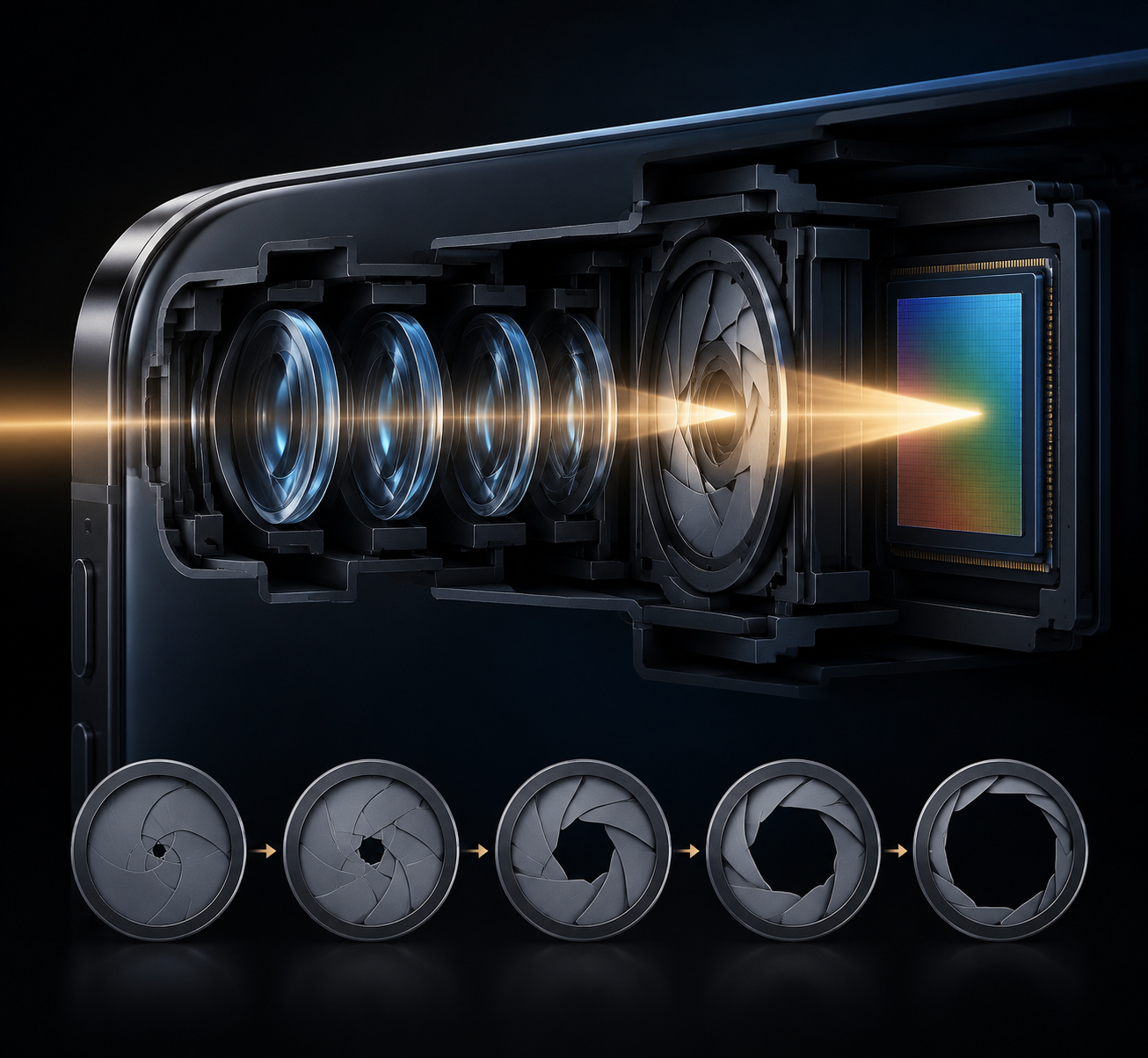
For marketing content, that distinction is not academic. A candle jar on a desk, a founder demoing a prototype, a booth conversation, a plated food shot, a skincare texture closeup, a warehouse walk-through: these are all scenes where the subject has to stay legible while the background stops fighting for attention. If the blur comes from optics, the phone is not pretending to know where the object ends. The lens is simply rendering the scene with a shallower depth of field.
The caution is that “variable” may not mean a smooth dial from wide open to stopped down. Current reporting has not confirmed whether Apple will use a two-position aperture or a continuously variable mechanism.[2][3] That difference matters. A two-position system would still be useful, but it would behave more like choosing between two visual modes. A continuously variable aperture would give teams finer control over how much context remains visible behind the subject.
The marketing use case is trust, not cinematic cosplay
The wrong conclusion is that every brand should make phone content look like a movie. That is usually how teams end up with footage that has the budget cues of production but none of the human cues of social. The more useful goal is narrower: make the subject easier to read without stripping away the environment that made the shot believable.
There is already practitioner momentum behind that choice. Olivia Ridlington of Stay Social wrote on LinkedIn that the agency shoots most of its social content on iPhones because, in its work, iPhone-shot content consistently outperforms polished cinematic video in reach and engagement.[5] That is a single agency post, not a controlled study, so it should not be treated as universal proof. It is still useful because it names what many working teams see in the feed: content can perform better when it looks close to the way people actually use the platform.
Variable aperture could make that phone-native look less compromised. The old tradeoff was blunt. Shoot naturally and accept clutter, or use computational Portrait Mode and risk the synthetic edge blur that makes a real scene feel oddly fake. A physical aperture gives teams a cleaner middle option: retain the speed and intimacy of a phone shoot, while using optics to separate the subject from the background.
A practical flow for two common shoots
If the reported feature ships, the first tests should not be complicated. Use it on the two shoot types where small teams already reach for a phone and already lose time trying to make the result feel intentional: product closeups and behind-the-scenes or lifestyle video.
| Shoot type | Use the wider aperture when | Stop down when | What to watch |
|---|---|---|---|
| Product closeups | The product is the story and the background is only there for texture | Packaging details, instructions, ingredients, labels, or comparison objects must remain readable | Do not let bokeh hide information the buyer needs |
| BTS and lifestyle video | A person, tool, sample, plate, display, or demo moment needs quick visual priority | The setting proves the moment is real: event floor, studio table, kitchen, store, office, warehouse | Do not blur away the evidence that makes the clip believable |
The table is intentionally plain because the decision is usually plain on set. If the background helps the viewer understand the claim, keep more of it. If the background only competes with the claim, let it fall away.
Product closeups: use blur to remove friction, not context
For product content, a wider aperture is most useful when the audience already knows what kind of object they are seeing and the shot needs to make them notice surface, shape, texture, scale, or finish. Think of a supplement bottle on a counter, a notebook next to a laptop, a tool in someone’s hand, or a new apparel detail near a window. The background should become quieter, not disappear into a creamy abstraction that could have been generated anywhere.
Start with the product at a slight angle rather than dead flat to the camera. Put it far enough from the background that the optical separation has room to show. Use natural or practical light if it supports the setting. Then check the boring details: label edges, logo sharpness, ingredient panels, product color, and the exact part of the object that the caption will mention. A beautiful blur is not a win if the viewer cannot read the reason to care.
Stop down when the environment is part of the selling point. A coffee brand may need the mug, bag, grinder, and kitchen counter all recognizable. A B2B hardware company may need the product, technician, and workstation visible in the same frame. A skincare brand may need both the texture and the hand applying it. In those cases, shallow depth of field can become a kind of visual evasiveness. It looks premium, but it removes proof.
BTS and lifestyle video: preserve the mess that makes the moment credible
Behind-the-scenes content fails when it looks like a campaign pretending to be behind the scenes. The phone helps because it lowers the room’s defenses. People behave differently around it, and the viewer reads the result differently. Variable aperture should support that dynamic, not overwrite it.
Use a wider aperture for short moments where the viewer needs a clear lead: hands packing orders, a chef plating one dish, an engineer adjusting a prototype, a speaker clipping on a mic, a customer handling a sample. These shots benefit from real subject separation because the action is brief and the feed is crowded. The viewer should understand what to look at before they scroll.
Stop down when the room is the receipt. Trade show aisles, office whiteboards, warehouse shelves, studio cables, kitchen counters, half-built displays, and team members moving through the background all carry context. Blur too much of that away and the clip starts to look staged. The point is not to show every messy detail; it is to keep enough of the setting that the audience believes the moment happened.
The same rule applies to movement. If the subject crosses through the frame, reaches toward the camera, or turns away, optical blur is more forgiving than fake blur because the lens is not recalculating a mask around each edge. Still, shallow depth of field makes focus more demanding. Marketing teams should rehearse the action once, lock the distance when possible, and avoid turning every casual clip into a focus-pull exercise.
Where the A20 workflow fits
The camera is the main story, but workflow matters because small teams do not just need better footage. They need fewer handoffs. The reported A20 generation is expected to support more on-device AI-assisted editing, and AI-assisted workflow benchmarks point to a three-hour saving per piece of content. Treat that as a workflow benchmark, not a guarantee attached to the iPhone 18 Pro itself.
The practical advantage is compression. Shoot the clip, trim it in the field, clean up the caption, add the safer crop, and publish while the event, launch, demo, or store moment still has heat. Optical capture and faster editing solve different parts of the same problem: one makes the image feel less fake, the other reduces the time it spends being passed around until it loses relevance.
What not to overread before Apple announces the phone
There are a few things this feature does not prove yet. It does not prove the iPhone 18 Pro will replace dedicated cameras for every brand shoot. It does not prove audiences prefer low-quality content. It does not prove a variable aperture automatically improves engagement. And because the phone is still unannounced as of July 19, 2026, it does not prove Apple’s final implementation will match current supply-chain and analyst reporting.[2]
Forbes reported analyst Ming-Chi Kuo’s claim that the iPhone 18 Pro variable aperture lens costs Apple 50% more to manufacture than the prior fixed-aperture lens.[6] That is useful context because it suggests Apple is investing materially in the camera system. It is not evidence that a marketing team will get better results. The result still depends on subject choice, lighting, distance, timing, editing, and whether the shot gives the audience something real to inspect.
The strongest case for watching the iPhone 18 Pro is therefore conditional but practical. If Apple ships variable aperture as reported, the feature is worth testing not because it makes phone content look more cinematic, but because it may let marketing teams make sharper, more intentional content without triggering the fake-polish cues audiences have learned to distrust.
References
- 10 Content Marketing Trends That Will Define 2026 — Averi
- iPhone 18 Pro: Three new camera upgrades are coming — 9to5Mac, June 15, 2026
- iPhone 18 Pro Variable Aperture Camera Explained: Real Photo Impact — Gadget Hacks
- Introducing Variable Aperture in smartphone cameras — Cambridge Mechatronics
- Why we shoot on iPhones at Stay Social — LinkedIn / Olivia Ridlington
- Apple iPhone 18 Pro To Debut Camera Upgrade That Costs 50% More To Make, Analyst Claims — Forbes, June 2026

Comments
Join the discussion with an anonymous comment.