
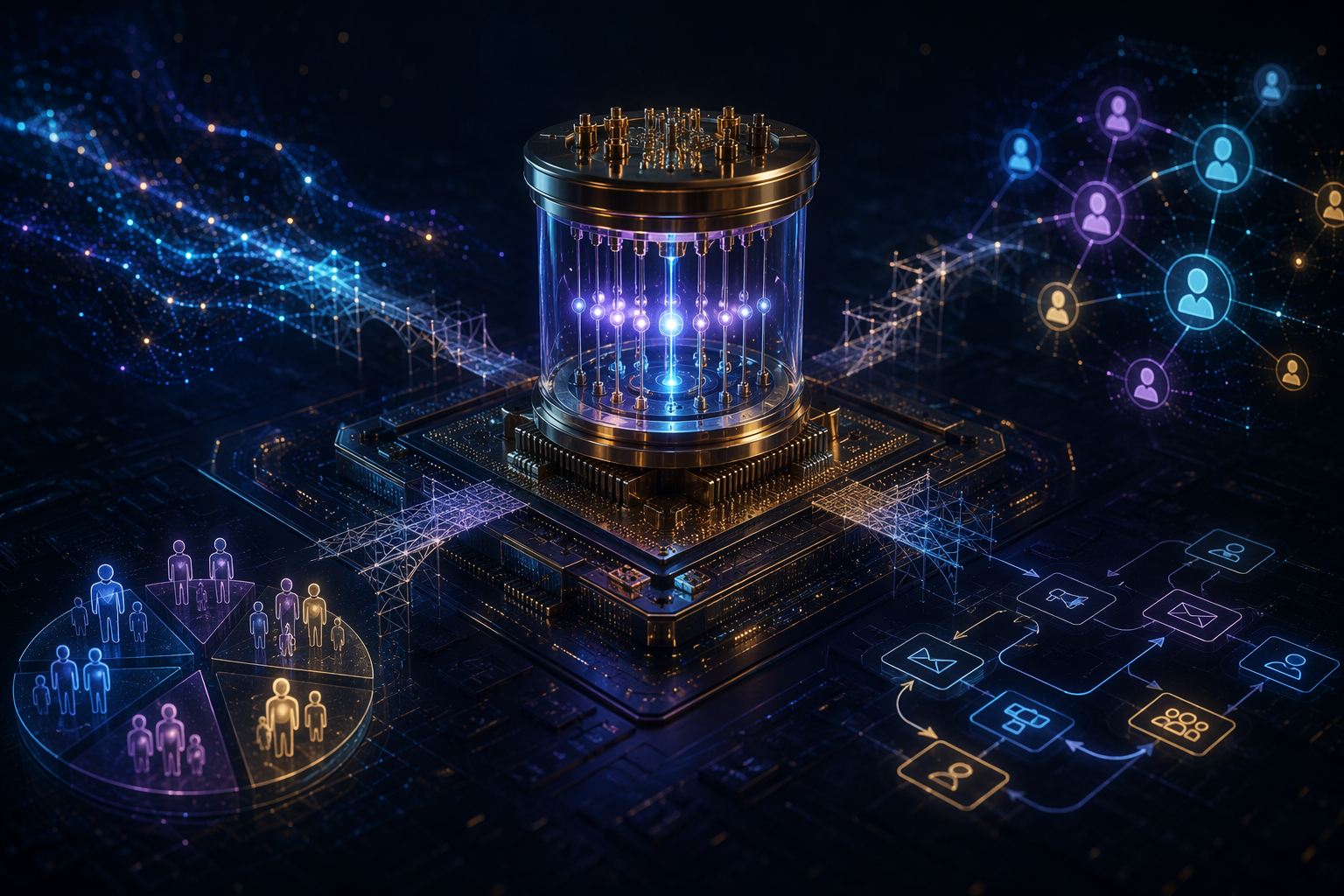
What IonQ’s Quantum AI Can and Cannot Do for Marketing
IonQ has published verifiable quantum AI results with benchmarked accuracy improvements and energy efficiency gains, but marketing-specific applications remain years from production. This article separates the demonstrated capabilities from the speculation so marketers can evaluate future claims and monitor the right metrics.
The practical question for marketers is not whether quantum computing could someday reshape marketing analytics. It is whether IonQ has shown anything in 2026 that a marketing leader should treat as operationally relevant. The answer is yes, but only in a narrow and easily overstated way: IonQ has published benchmarked quantum-enhanced AI results that are worth watching, while marketing-specific use cases remain outside production reality.
That distinction matters because enterprise buying conversations tend to compress the middle. A demonstrated improvement on a sentiment benchmark becomes “better customer segmentation.” A simulated quantum circuit becomes “quantum-powered personalization.” An energy-efficiency extrapolation becomes “lower AI costs next year.” Those may become connected one day, but they are not the same claim.
What IonQ Has Actually Demonstrated
The strongest evidence is more concrete than the usual “quantum will transform marketing” material. IonQ has reported three AI-relevant results: a quantum-enhanced LLM fine-tuning workflow that reduced classification error, an energy-to-solution break-even argument based on quantum processing unit behavior, and quantum generative adversarial network tests that produced higher quality scores in many tested cases.[1][2]
| IonQ result | Metric that moved | What marketers can infer | What marketers should not infer |
|---|---|---|---|
| Quantum-enhanced LLM fine-tuning on SST-2 sentiment analysis | 92.7% test accuracy versus an 89.56% classical baseline; about a 24% reduction in classification error | Hybrid quantum-classical methods may improve some classification tasks | Customer segmentation, audience scoring, or campaign targeting is ready for production |
| Energy-to-solution analysis | Break-even estimated at about 34 qubits, with QPU energy consumption described as scaling linearly while classical scaling rises exponentially | Quantum AI may first become a compute-cost and infrastructure question | Marketing teams can already lower AI campaign costs with IonQ hardware |
| QGAN quality tests | Quantum GANs produced higher quality scores in up to 70% of tested cases | Synthetic data generation is a plausible workload category to monitor | Synthetic customer data for live marketing activation is validated |
The accuracy result is the easiest to translate into familiar marketing language because sentiment classification already appears in customer intelligence, social listening, review analysis, and support-ticket triage. IonQ reported 92.7% test accuracy on SST-2 sentiment analysis compared with an 89.56% classical baseline, which it characterized as roughly a 24% reduction in classification error.[2] That is a meaningful benchmark movement.
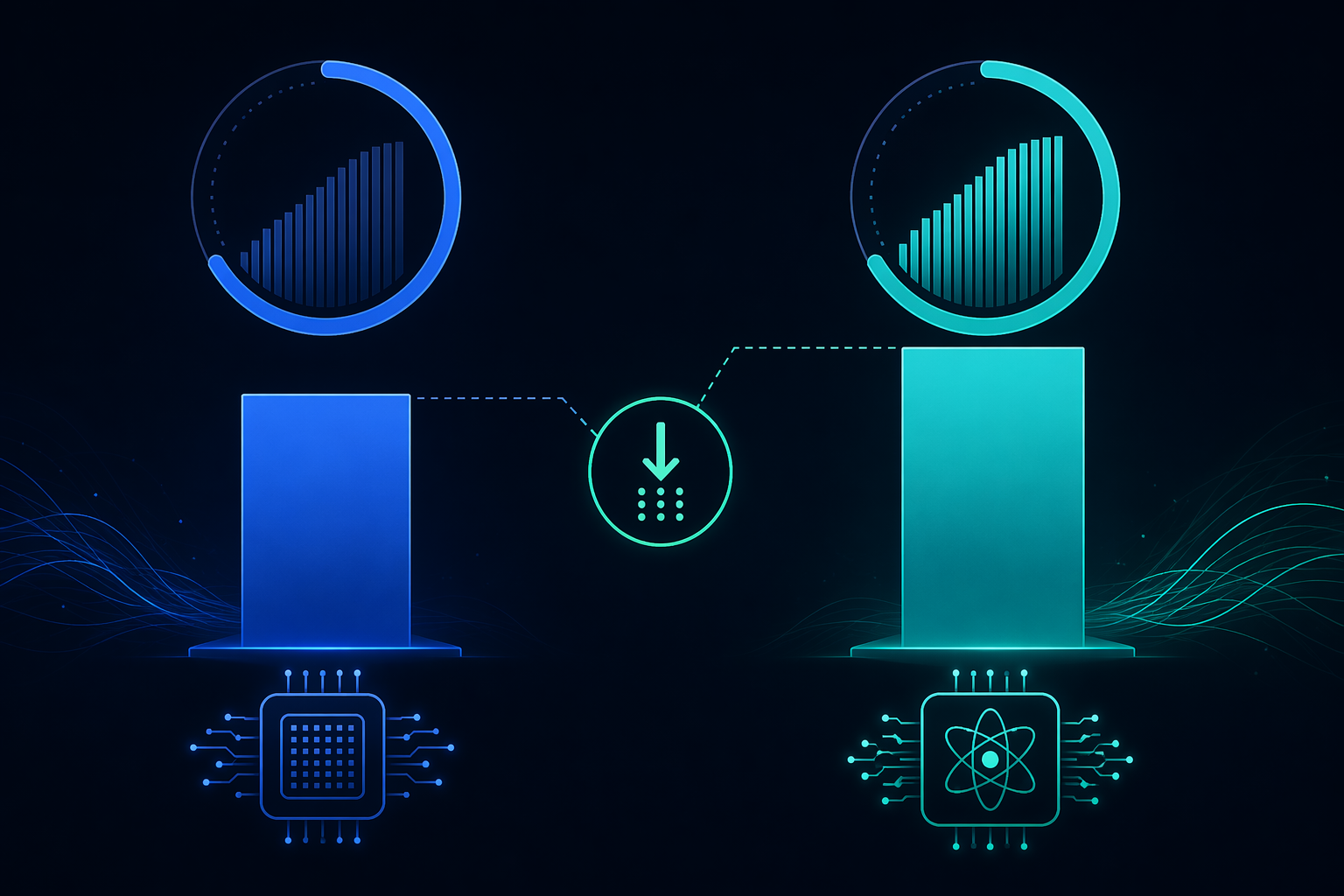
But the useful phrase is still “benchmark movement,” not “marketing application.” SST-2 is a sentiment analysis benchmark. A marketing segmentation system is usually messier: it combines behavioral data, identity resolution, offer history, consent rules, channel constraints, margin targets, and human review. Better classification on a controlled benchmark may become relevant to that stack, but it does not replace the integration, governance, and validation work that determines whether a model can safely influence campaigns.
There is also a technical caveat that should stay attached to every business interpretation of the LLM result: the full training pipeline used simulated quantum circuits, not production IonQ hardware end to end.[1][2] That does not make the result fake. Simulation is a normal part of research and development. It does mean that a buyer should not hear “IonQ improved LLM fine-tuning” and assume a current enterprise marketing workflow can be sent to a quantum computer next quarter.
Why the Energy Result May Reach Marketing Before the Campaign Result
The less glamorous IonQ finding may be the one marketing leaders hear about first. IonQ’s energy-to-solution work estimated a break-even point at roughly 34 qubits, based on measured 12–18 qubit behavior and an extrapolation in which QPU energy consumption scales linearly while comparable classical energy requirements scale exponentially.[1] Futurum Group’s analysis framed energy-to-solution as the metric that could move quantum AI from technical curiosity into procurement and budget conversations.[3]
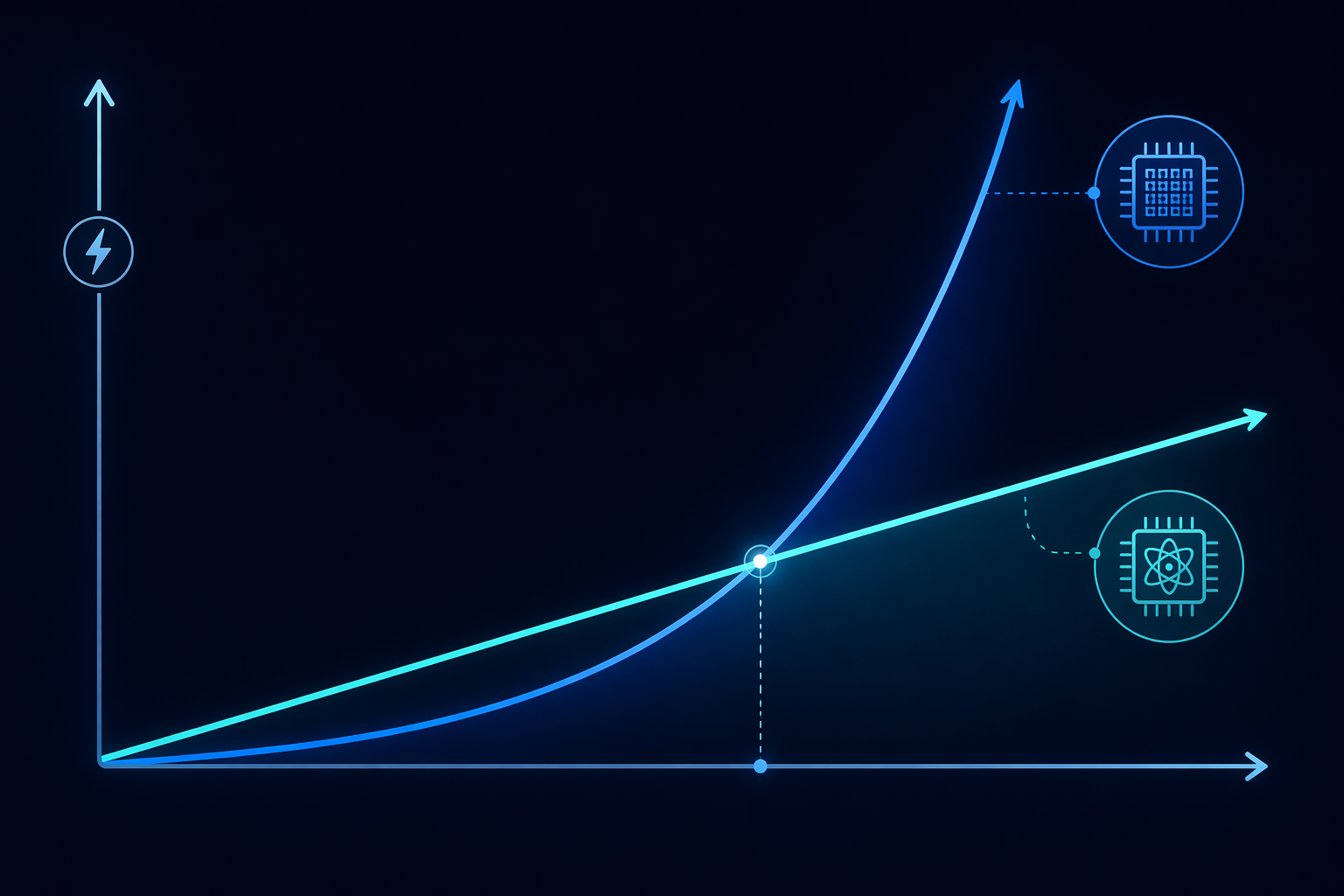
For marketing, that matters because AI costs rarely stay inside the data science department. Model experimentation, content generation, audience scoring, media optimization, and measurement all create compute demand. If a future hybrid quantum-classical workflow can produce the same or better model output with materially lower energy or infrastructure cost, the first internal sponsor may be the CTO, CFO, sustainability office, or platform engineering team—not the campaign team.
This is where marketers should widen their definition of relevance. A technology can affect marketing before a marketer logs into it. Cloud computing changed marketing operations through procurement, data availability, experimentation speed, and vendor economics before every brand had a sophisticated cloud-native growth stack. Quantum AI, if it matters, may follow a similar path: first as a question about where certain AI workloads should run, then as a question about which model architectures become affordable, and only later as something visible in campaign tooling.
The caveat is as important as the opportunity. The 34-qubit figure is not a measured production break-even point for a marketing workload. It is an extrapolation from 12–18 qubit measurements.[1] That makes it a legitimate metric to monitor, not a basis for a 2026 marketing performance forecast.
The Segmentation Leap Is Where Claims Get Too Fast
The most tempting marketing interpretation is also the one that needs the most restraint: if quantum-enhanced AI improves classification, then surely it will improve customer segmentation. It might. But “classification improved on SST-2” and “segmentation improved in a revenue-generating campaign” sit on different evidentiary levels.
Sentiment classification asks a model to sort text into a known evaluation structure. Marketing segmentation asks an organization to decide which differences among customers are meaningful, stable, actionable, legally usable, and worth changing budget or messaging around. The model may be only one part of the system. A technically cleaner cluster can still be useless if media platforms cannot activate it, sales teams cannot interpret it, or consent rules prevent the data from moving where the campaign needs it.
That does not make IonQ’s result irrelevant. It means the right monitoring question is narrower: do hybrid quantum-classical methods keep producing measurable accuracy deltas on classification, ranking, generation, or optimization tasks that resemble pieces of marketing systems? If those deltas persist outside simulations, on larger systems, and against strong classical baselines, the conversation changes. Until then, segmentation should be treated as a plausible downstream workload, not a demonstrated IonQ marketing application.
Where Marketing Workloads Could Eventually Fit
The credible marketing possibilities are not mysterious. They are the same workload categories where marketers already struggle with scale, uncertainty, and trade-offs. The mistake is pretending they have all reached the same stage of readiness.
- Sentiment and intent classification: the closest conceptual bridge to IonQ’s LLM fine-tuning benchmark, but still not validated on live marketing data.
- Synthetic data generation: worth watching because IonQ reported QGANs with higher quality scores in up to 70% of tested cases, but not yet a license to generate customer-like data for activation.[1]
- Audience segmentation and propensity modeling: plausible if hybrid methods improve classification or clustering under realistic constraints, but no IonQ marketing campaign evidence exists.
- Next-best-action and offer optimization: plausible because these are complex decision problems, but any claim needs to show business constraints, not just mathematical elegance.
- Dynamic pricing and budget allocation: potential candidates for optimization research, especially where classical computation becomes expensive, but highly sensitive to governance and commercial risk.
- Attribution and media mix modeling: possible long-term areas if quantum-enhanced methods help evaluate large combinations of variables, though present evidence does not show this in production.
A useful planning window for these applications is measured in years, not quarters. Based on the current gap between benchmark evidence and production marketing execution, marketing-specific applications remain better described as 3–7 years from production readiness. That estimate should not be read as a countdown. It is a guardrail against turning early technical evidence into next-year campaign planning.
Interest Is Real, but Expectations Are Running Ahead
Marketers are not ignoring quantum. A SAS and Coleman Parkes study found that 31% of marketers using agentic AI expected quantum computing to affect marketing within two years, and 50% already had quantum on their innovation roadmap.[4] Those numbers are useful because they show interest is no longer confined to research labs or vendor futurism.
They also show why expectation management is now part of the job. The survey measures expectations and roadmap presence, not realized effectiveness. A roadmap can mean active investment, executive curiosity, competitive scanning, or a placeholder in an innovation deck. None of those should be confused with a validated campaign workflow.
The Pedowitz Group’s personalization maturity framing is more useful when treated as readiness language rather than prediction. Its six-capability model points marketers toward the organizational capabilities that would need to exist before quantum-enabled personalization could matter: data foundations, identity, decisioning, content operations, measurement, and governance.[5] Quantum does not remove those requirements. If anything, it raises the cost of being vague about them.
Broader industry coverage has already connected AI, quantum, and marketing transformation in 2026-and-beyond terms.[6][7] That context is fair as long as it remains context. The evidence base still points to early technical progress, not deployed marketing advantage.
How to Evaluate the Next IonQ or Vendor Claim
The next wave of claims will probably sound more specific than the last one. They may mention hybrid architectures, quantum-enhanced LLMs, synthetic data, optimization, or enterprise-grade systems such as IonQ Forte Enterprise.[8] The words themselves are not enough. A marketing leader needs to know which layer of the stack the claim actually touches.
- Ask whether the result ran on real quantum hardware, simulated quantum circuits, or a hybrid workflow that used both.
- Compare against a strong classical baseline, not against an unspecified or outdated benchmark.
- Separate model accuracy from campaign performance; an improved classifier still has to survive activation, compliance, and measurement.
- Track energy-to-solution alongside accuracy, especially if AI compute cost is becoming visible in planning or procurement.
- Look for qubit counts and system context, including whether claims involve enterprise-grade hardware or extrapolation from smaller measurements.
- Require workload specificity: sentiment classification, synthetic data, optimization, attribution, and personalization are not interchangeable.
This is also the right way to answer a CFO or CTO without sounding dismissive. The defensible position is not “quantum marketing is hype.” It is “IonQ has credible quantum-enhanced AI results, but the evidence is currently at the benchmark and infrastructure-metric level rather than the marketing-application level.” That answer leaves room for progress without importing unearned certainty.
What Not to Put in a 2026 Marketing Plan
Do not plan for IonQ quantum AI to improve campaign performance in 2026. There is no cited evidence of a real marketing campaign executed on IonQ hardware, no validated audience segmentation deployment, and no production case showing quantum-enhanced personalization lifting revenue, conversion, retention, or media efficiency.
What belongs in the plan is a monitoring posture. If your organization already has AI governance, experimentation reviews, or martech architecture planning, add a small set of quantum-AI evaluation criteria to those existing conversations. Do not create a quantum marketing initiative just to have one.
- Monitor hybrid-classical accuracy deltas on tasks adjacent to marketing, especially classification and generation.
- Monitor energy-to-solution, because cost and infrastructure pressure may make quantum relevant before campaign teams see a feature.
- Monitor whether new results use real hardware, simulations, or extrapolated scaling arguments.
- Monitor qubit counts and enterprise system maturity, not just abstract claims about quantum advantage.
- Monitor whether any vendor can connect quantum-enhanced AI to a real marketing workflow with controls, baselines, and business outcomes.
IonQ’s current quantum AI work is relevant enough for marketing leaders to understand now. It is not ready enough to build campaign roadmaps around. The best use of the evidence in 2026 is to improve the quality of internal questions before the next confident slide deck arrives.
References
- IonQ Demonstrates Quantum-Enhanced Applications Advancing AI, IonQ
- Supercharging AI with Quantum Computing: Quantum-Enhanced Large Language, IonQ
- Quantum Fine-Tuning and the Energy Case for Quantum in AI, The Futurum Group
- 'Quantum is coming': Nearly 1 in 3 marketers using agentic AI say, SAS, September 2025
- How Will Quantum Enable New Personalization, The Pedowitz Group
- The Quantum Leap: How Marketing May Soon Compute, CMSWire
- How AI and Quantum Will Redefine Marketing in 2026 and Beyond, CMSWire
- Forte Enterprise, IonQ

Comments
Join the discussion with an anonymous comment.