
Why Independent Artist Partnerships Outperform Celebrity Endorsements
The data is clear: independent music artists now deliver higher trust, engagement, and ROI than celebrity endorsements across most brand objectives. This article presents the evidence, explains when a hybrid strategy still makes sense, and offers a practical framework for selecting and structuring indie artist partnerships.
The useful question in a celebrity-versus-independent-artist partnership decision is not whether fame still works. It does. The budget question for Q3 2026 is narrower: if a brand has a meaningful endorsement budget, should it concentrate that money on one famous name, spread it across independent artists with specific communities, or split the roles between both?
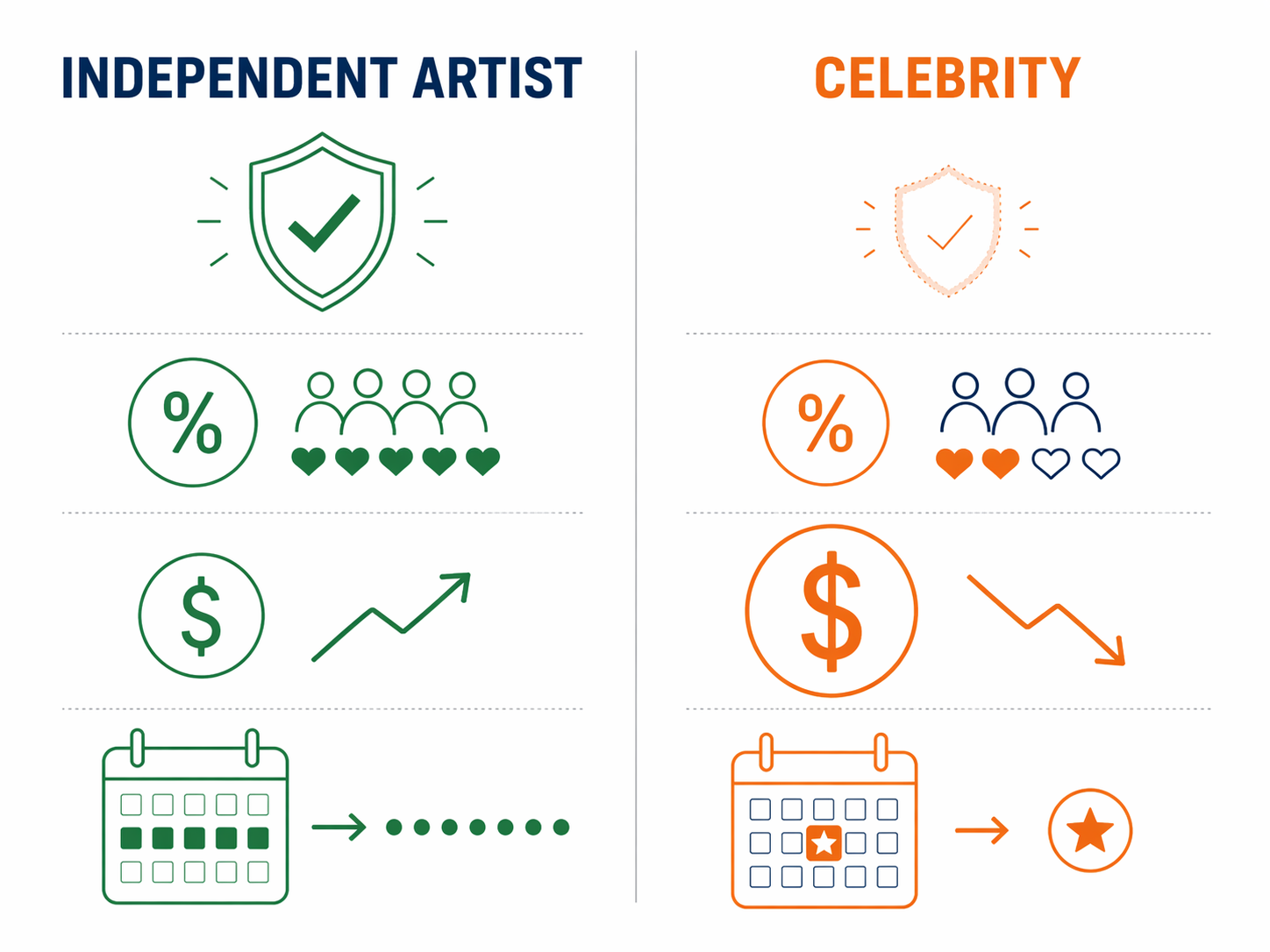
For most brands trying to create trust, engagement, and measurable demand, the default answer has shifted toward independent artists. The evidence is not subtle. Amra & Elma’s 2026 celebrity influencer statistics roundup cites Edelman data showing that 76% of consumers trust influencer recommendations, while celebrity ads influence only 1.8% of purchase decisions; it also reports that 62% of consumers ages 18 to 34 made a purchase from an influencer recommendation in the previous 90 days.[1] That does not mean every independent musician can sell a product. It does mean borrowed celebrity recognition is a weak substitute for audience permission.
The engagement gap points in the same direction. The same roundup cites IMH 2026 analysis of 4.2 million creator accounts, finding that micro-influencers with 10,000 to 100,000 followers average 6.23% engagement, compared with 1.97% for mega-accounts.[1] Many independent musicians sit in that smaller-audience band. Their advantage is not that they are magically authentic; it is that their followers are more likely to have chosen a relationship, not just recognized a face.
Cost efficiency completes the case, with one important caveat. SARAL cites Digital Marketing Institute figures that influencer marketing averages $5.78 in ROI for every $1 spent, with optimized campaigns reaching $11 to $18 per dollar.[2] That number applies broadly across influencer marketing, not specifically to celebrity endorsement deals. In fact, celebrity-tier costs are exactly where direct cost-to-revenue performance often becomes harder to defend. The more expensive the name, the less room a brand has to learn, test creative, negotiate usage rights, or recover from audience mismatch.
What the Numbers Change in the Budget Meeting
A celebrity buy can make a plan feel safe because everyone in the room understands the asset. The name is visible. The deck looks expensive. The launch has a clean story. But performance plans are built from less glamorous questions: who will believe the recommendation, who will click, who will comment with intent, who will save the post, who will ask a friend, who will come back when the second piece of content goes live?
Independent artist partnerships change the shape of that risk. Instead of spending a large share of budget on one public signal, the brand can work with several artists whose audiences match different customer segments, cities, scenes, or use cases. That creates more surfaces for learning. A skincare brand, beverage company, financial app, or apparel label does not need every artist to become a national spokesperson. It needs each partner to make the brand feel plausible inside a community that already listens to them.
| Marketing objective | Stronger default partner | Why it matters |
|---|---|---|
| Community trust | Independent artist | Smaller, more specific audiences tend to carry more permission for recommendations. |
| Efficient conversion | Independent artist | Lower deal costs create more room for testing, retargeting, content reuse, and optimization. |
| Repeatable learning | Independent artist | A portfolio of partners gives the brand more signals than a single celebrity launch. |
| Mass awareness | Celebrity | A famous name can still create a fast cultural signal when reach is the main job. |
| Board, retail, or PR momentum | Celebrity or hybrid | Recognition can unlock internal and external attention before performance data arrives. |
The long-term contract data is especially important because it separates a real partnership from a rented post. Amra & Elma cites Sprout Social and CreatorIQ 2026 data showing that 63% of brand-influencer contracts are now long-term arrangements of six months or more, with an average length of 14.3 months; those longer relationships produce 52% higher trust scores and 44% lower acquisition costs than one-off campaigns.[1] That is where independent artists become more than a cheaper media unit. They can become a compounding partner.
The budget trend is already following that logic. Amra & Elma reports that brands are allocating 23.4% of digital budgets to influencer partnerships, up from 14% in 2023, and cites WFA 2026 findings that 74% of 1,340 CMOs across 47 countries say influencer campaigns outperform paid social.[1] Those figures still group many creator types together, so they should not be read as proof that every independent music partnership beats every paid media plan. They do show that marketers are moving budget toward people who can carry attention with context.
The Indie Advantage Is Operational, Not Just Emotional
The usual explanation for independent artist performance is “authenticity,” which is true enough to be unhelpful. The operational advantage is more concrete. An independent artist often has fewer approval layers, faster feedback, more direct knowledge of the audience, and stronger incentives to protect the relationship that makes their career viable.
In a Loudest interview published in February 2026, Vineet Singh Hukmani described independent artists as able to “call the shots themselves,” without the same label structures around mainstream celebrities.[3] That is a practitioner’s view from inside the independent artist ecosystem, not a neutral performance study. Still, it captures a practical difference brand teams feel quickly: fewer intermediaries can mean faster creative alignment, fewer diluted ideas, and a better chance that the final asset still sounds like the person whose audience the brand wanted in the first place.
That matters because endorsement performance is often lost in the middle, not at the announcement. A brand starts with a clear objective, then adds talent management, legal review, platform requirements, usage restrictions, internal stakeholder edits, product claims review, and a launch calendar. By the time the post is approved, the celebrity may have delivered exactly what the contract required and still given the audience nothing worth acting on.
Independent artists are not immune to this problem. They can overpost, mismatch a category, misunderstand disclosure rules, or accept a brand that their audience immediately rejects. The difference is that the partnership can usually be structured with more learning loops. The brand can start with a smaller collaboration, watch audience behavior, expand content rights, add live or digital activations, and renew only when the relationship earns it.
How to Select Independent Artists Without Wasting the Advantage
The wrong way to buy independent artist partnerships is to recreate celebrity buying at a smaller scale: sort by follower count, pick the most polished profile, negotiate a post, and hope the comment section behaves. That approach strips away the very qualities that make the indie route valuable.
Selection should begin with audience behavior, not audience size. A smaller artist with fans who reply, remix, attend local shows, share merch drops, and follow creative projects across platforms may be more useful than a larger artist whose followers mostly watch passively. The brand should look for signs that the artist can move people from attention into action: link clicks when they announce releases, comments that refer to specific lyrics or moments, fan participation in live streams, repeat buyers for merch, and visible community language that does not look manufactured.
- Audience fit: the artist’s listeners overlap with the brand’s actual buyer, not just a broad demographic target.
- Community behavior: followers respond, share, attend, save, ask, and create around the artist instead of only liking polished posts.
- Category permission: the product belongs naturally in the artist’s world, routines, values, or creative process.
- Creative judgment: the artist can explain what their audience will accept and where a brand message would feel forced.
- Commercial reliability: the artist can meet deadlines, handle disclosures, review claims, and participate in measurement without turning the work into corporate theater.
The strongest filter is category permission. A food brand working with a touring artist has a natural opening if the product fits rehearsal, late-night travel, fan meetups, or backstage routines. A fintech app has a harder job, but it may still fit an independent artist who openly talks about funding creative work, selling merch, or managing an unpredictable income stream. A brand does not need the artist to recite positioning. It needs the audience to understand why the artist would care.
Follower count still matters, but only after those filters. Reach tells the brand how much distribution it can buy. It does not tell the brand whether the audience will grant the artist permission to recommend, demonstrate, co-create, or invite participation. In independent artist partnerships, the smaller number often comes with a sharper social contract.
Choose the Partnership Model Before You Choose the Deliverables
A common failure in music partnerships is treating every deal as a content package. The brand buys posts, stories, appearances, and maybe usage rights. Those deliverables are necessary, but they do not define the role the artist is playing. Bastian Rolle’s framework for music artist partnerships distinguishes models such as passive placement, active endorsement, and deeper co-creation, which is a useful way to separate the job of the partnership before negotiating assets.[4]
| Partnership model | What the artist does | Best use |
|---|---|---|
| Passive placement | The brand appears in the artist’s environment without becoming the message. | Light awareness, cultural adjacency, product familiarity. |
| Active endorsement | The artist explicitly recommends, demonstrates, or explains the brand. | Trust transfer, consideration, conversion. |
| Co-creation | The artist helps shape the product, experience, content series, event, or campaign idea. | Community participation, differentiation, longer-term brand memory. |
Passive placement is the easiest to approve and the easiest to overvalue. It can work when the brand wants cultural texture: a drink on a studio table, apparel worn during rehearsals, a travel product appearing during a tour diary. But passive placement rarely deserves conversion expectations unless the audience already knows why the product matters.
Active endorsement asks more from the artist and should be used more carefully. If the artist is going to say the brand is worth buying, the product has to survive that closeness. The message should sound like the artist’s actual reasoning, not a claim pulled from a media brief. This is where independent artists can outperform: they can often speak in the language of their own community, adjust the idea before launch, and tell the brand when a line will not land.
Co-creation is where long-term value can compound, but it is also where brands need discipline. Not every artist needs a capsule collection, limited drop, branded track, or live experience. Co-creation makes sense when the artist’s creative world can genuinely change the product or experience, and when the brand is willing to let the artist have visible authorship. Without that, co-creation becomes a more expensive endorsement with a softer name.
Structure the Deal Around Learning, Rights, and Renewal
The best independent artist partnerships are usually not one post with a discount code. They are small enough to test and serious enough to measure. A clean structure gives the artist room to create while giving the brand enough control to learn from the spend.
- Start with the business job: awareness, consideration, conversion, content production, event attendance, retail support, or community participation.
- Define the artist’s role: placement, endorsement, co-creator, host, performer, educator, curator, or long-term ambassador.
- Protect creative autonomy: approve claims and disclosures, but avoid sanding down the artist’s voice until the audience no longer recognizes it.
- Negotiate usage rights early: paid amplification, whitelisting, organic reposting, retail use, event footage, cutdowns, and duration should not be afterthoughts.
- Build a renewal path: decide before launch what performance, content quality, and audience response would justify a second phase.
Usage rights deserve more attention than they usually receive. A celebrity deal can become expensive quickly once the brand adds paid media usage, territories, exclusivity, category restrictions, and term length. Independent artist deals can also become messy, especially if music rights, photographer rights, venue footage, collaborators, or label-adjacent obligations enter the picture. The cheapest deal on paper is not cheap if the best-performing content cannot be reused.
Measurement should match the role. A passive placement should not be judged like a direct-response endorsement. A co-created event should not be judged only by last-click purchases. A long-term ambassador should not be evaluated solely on launch-week engagement. The cleaner approach is to assign each partnership one primary metric and a small set of secondary signals.
| If the objective is | Primary metric | Secondary signals |
|---|---|---|
| Community trust | Qualified comments and sentiment | Saves, shares, repeat discussion, creator-led replies. |
| Conversion | Attributed purchases or signups | Landing page conversion rate, code use, retargeting pool quality. |
| Content efficiency | Usable assets created | Paid creative performance, editability, rights coverage. |
| Event participation | Attendance or registrations | Show-up rate, local engagement, post-event content performance. |
| Long-term brand lift | Repeat exposure with improving response | Trust signals, lower acquisition cost, renewal performance. |
This is where portfolio thinking helps. Instead of asking one artist to solve every funnel stage, a brand can assign different jobs to different partners. One artist may be best for local event credibility. Another may be a strong product explainer. Another may create paid-social assets that outperform studio creative. The point is not to scatter the budget. It is to stop pretending one famous face can carry every marketing job equally well.
Where Celebrity Endorsements Still Earn Their Place
The case for independent artists does not require declaring celebrity endorsements dead. That would be cleaner than the evidence allows. Celebrities still work when the brand’s immediate need is mass awareness, category salience, executive confidence, retail conversation, or a fast cultural signal. A famous name can compress explanation. It can make a buyer take a meeting, give PR a hook, and make internal stakeholders believe a campaign is real before the first performance report arrives.
The credibility risk is real, though. SocialLife Magazine, citing Gitnux, reports that 81.8% of consumers believe celebrity brand deals lack credibility.[5] That finding should make marketers careful about asking celebrities to do persuasion work that their relationship with the audience cannot support. Recognition may open the door. It does not automatically create belief.
The same secondary source attributes meaningful upside to celebrity partnerships, reporting Gitnux figures that celebrity endorsements can increase sales by 4% to 20% and enhance brand equity by 10% to 30% over traditional marketing.[5] Those figures should be treated as directional because the underlying methodology was not independently verified here. They are still useful for one strategic point: celebrity can be a rational investment when the brand is buying broad salience, not asking a single famous person to behave like a community conversion engine.
SARAL also cites Dash Social data that celebrity campaigns on Instagram drive 220% higher engagement than brand-only posts.[2] That comparison is against brand-owned posts, not against independent artists or micro-influencer portfolios. It supports the idea that a celebrity can outperform a brand speaking alone. It does not prove that a celebrity is the best use of partnership budget when trust, conversion, and cost-to-learning speed are the goals.
When a Hybrid Plan Makes Sense
A hybrid plan is useful only when each tier has a different job. If the celebrity and the independent artists are all given the same brief, the brand has usually bought redundancy. The celebrity should create the broad signal; the independent artists should translate the brand into communities where action is more likely.
For a national product launch, that might mean using a celebrity for a short awareness burst while independent artists create city-specific content, host smaller experiences, demonstrate the product, or give the brand usable assets for paid retargeting. For a category with low differentiation, the celebrity may help the brand enter the consideration set, while independent artists explain why one version belongs in a real routine. For a brand trying to reassure retail partners, the celebrity can support the sell-in story, while independent artists prove there is demand beyond the announcement.
- Use the celebrity for reach, PR, retail confidence, or category salience.
- Use independent artists for community trust, content variation, local relevance, and conversion.
- Separate metrics so the celebrity is not judged like a performance creator and the artists are not judged like national media.
- Separate creative roles so the indie partners are not reduced to echoing the celebrity line.
- Keep renewal budget flexible so money moves toward the partners whose audiences actually respond.
The danger in hybrid plans is political convenience. A brand can spend heavily on the celebrity because that is the part leadership recognizes, then expect smaller partners to rescue conversion with a leftover budget. That is not a strategy. It is a hierarchy of comfort. If independent artists are responsible for persuasion and demand, they need enough budget, creative room, and measurement infrastructure to do that job properly.
A Q3 2026 Decision Framework
The cleanest allocation decision starts with the objective, not the talent list. If the campaign needs community-led persuasion, efficient conversion, reusable content, and fast learning, independent artists should be the default. If the campaign needs national awareness, a cultural signal, board confidence, or retail leverage, celebrity spend can still be justified. If the campaign needs both, split the plan only after assigning distinct jobs.
| Planning question | Choose independent artists when | Choose celebrity when |
|---|---|---|
| What must the audience do? | They need to trust, click, attend, try, buy, or discuss. | They mainly need to notice and remember. |
| How specific is the buyer? | The buyer belongs to a scene, city, lifestyle, niche, or use case. | The buyer is broad and category awareness is still low. |
| How much learning is needed? | The brand needs multiple creative tests and audience signals. | The brand needs one large public moment. |
| How important is credibility? | The message requires belief in the recommender’s taste or routine. | The message relies more on recognition than recommendation. |
| What happens after launch? | The brand can renew, deepen, and optimize over months. | The brand mainly needs a short burst of visibility. |
A practical celebrity and independent artist partnership plan should therefore name the job before it names the person. Put independent artists closest to trust, community, content, and conversion. Reserve celebrity investment for moments where scale itself is the asset. Use a hybrid only when the famous name and the independent voices are not competing for the same line in the budget, the same creative role, or the same metric.
References
- TOP 10 CELEBRITY INFLUENCER MARKETING STATISTICS 2026 — Amra & Elma
- Celebrity Brand Partnerships for DTC Brands: Measuring Influencer Marketing ROI — SARAL
- Why Brands Are Turning To Independent Artists Over Mainstream Celebrities — Loudest, February 2026
- 5 models of music artist partnerships in advertising — Bastian Rolle
- Gen Z Celebrity Endorsements and Brand Engagement — SocialLife Magazine

Comments
Join the discussion with an anonymous comment.