

How Wayfair, IKEA, and Home Depot use AI to time discounts
Learn how Wayfair, IKEA, and Home Depot use AI to predict optimal discount timing, turning reactive fire-sale clearance into a targeted, margin-preserving strategy. Discover the specific techniques and measurable outcomes that make AI-driven discounting work for home goods.
Home goods clearance has a way of exposing every weak promise made earlier in the season. A sofa that misses demand is not a spreadsheet problem for long; it is a boxed, bulky, floor-space problem. Patio sets do not become easier to sell after the weather turns. Holiday décor has a calendar attached to it, and the calendar does not care that the forecast was optimistic.
That is why AI in home products deal marketing is a more specific question than generic dynamic pricing. The useful version is not “Can AI change prices?” Retailers have been changing prices forever. The useful version is: can it identify which products need help early enough, choose a markdown path that does not immediately destroy margin, and decide whether the offer should go to everyone or only to a segment that is likely to move the inventory?
The category gives little room for theatrical cleanup. Paz.ai describes home goods as having the highest return rate among major retail verticals, and returned inventory complicates the stock picture just when merchants are trying to decide whether they have too much, too little, or the wrong mix in the wrong location.[1] In apparel, a bad buy can still be painful. In furniture and décor, it also takes up space, adds handling cost, and collides with seasonal windows.
The markdown question has three parts
When retailers talk about AI discount timing, three separate capabilities often get collapsed into one phrase. They should not be. A retailer can be good at one and immature at the others.
- Forecasting which products will need help before the clearance banner is inevitable.
- Sequencing markdown depth over time, instead of jumping from full price to a margin-wrecking final discount.
- Targeting eligibility, so the same deal is not automatically shown to every customer regardless of value, intent, or use case.
Wayfair, IKEA, and Home Depot are useful case studies because they emphasize different parts of that chain. Wayfair shows the clearest version of continuous price management and progressive markdowns. IKEA shows the quieter work of avoiding some clearance pressure before it forms. Home Depot shows how customer and order intelligence can make discounting more selective, although the public evidence is thinner on measured markdown results.
Wayfair: discount timing as a managed daily system
Wayfair is the most direct example because its business forces the issue. A large online home assortment creates a constant pricing problem: demand changes, competitors move, inventory ages, and seasonal relevance decays. A weekly promotion meeting is too slow for that environment.
A Smartproxy study cited by Yahoo Finance found that Wayfair averaged 3.6 price adjustments per day, with pricing signals tied to demand, competition, seasonality, and inventory levels.[2] That number does not prove the algorithm is always right, and the underlying methodology and Wayfair’s proprietary decision logic are not fully visible. But it does show something important: pricing is being treated as a continuously managed operating system, not a late-season rescue event.
The visible clearance pattern follows the logic a home goods merchant would recognize. Pagecrawl’s 2026 tracking described Wayfair clearance pricing as progressive: initial markdowns often begin around 20% to 30% off, then escalate toward 70% or more as sell-by pressure increases.[3] The key is not that every item should follow a neat staircase. The key is that markdown depth can be staged against time, demand, and inventory instead of treated as one blunt end-of-season decision.
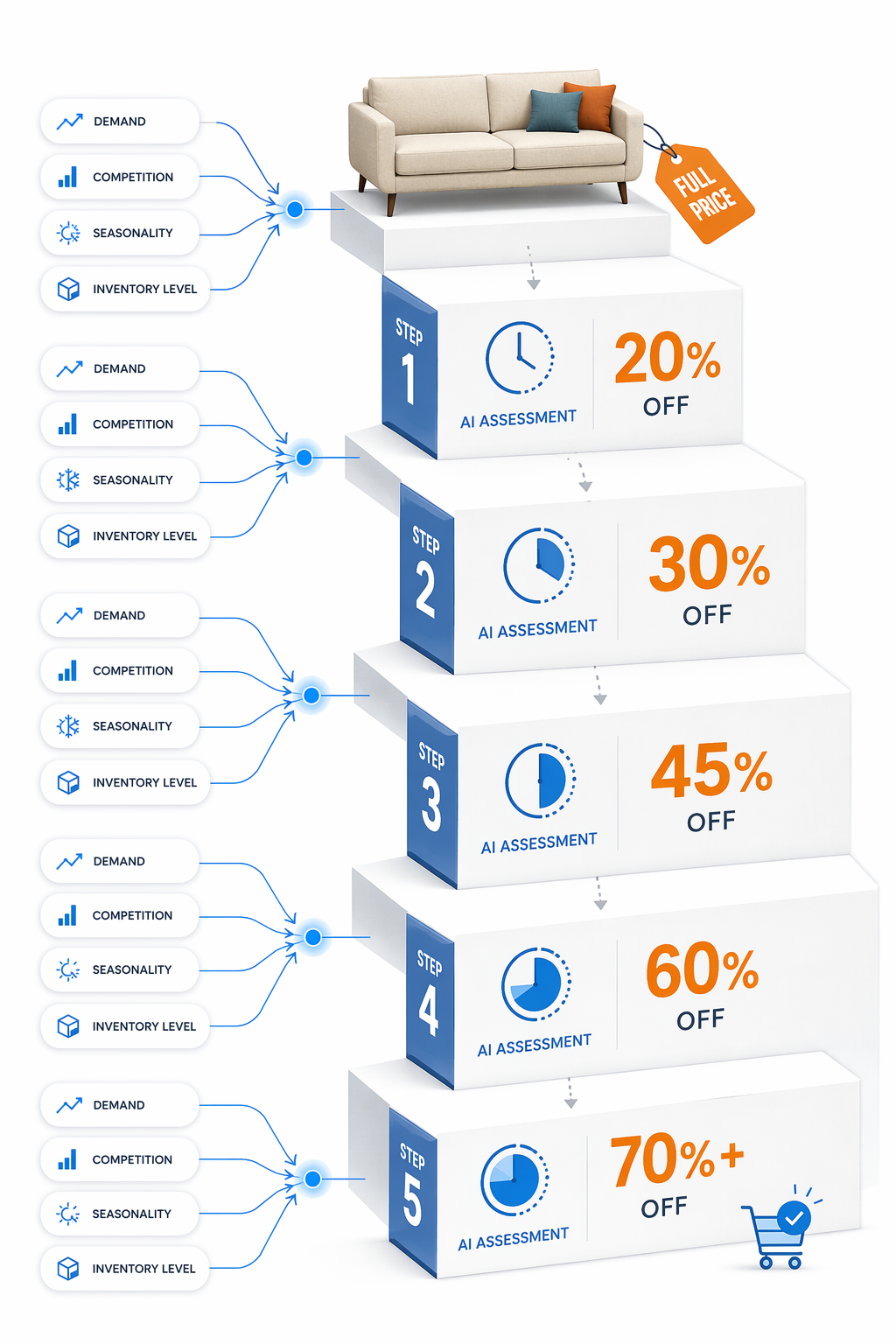
For a slow-moving sofa, that distinction matters. An early 20% markdown may protect more gross margin than waiting until the item has consumed weeks of warehouse capacity and then pushing it into a 70% clearance bucket. For a rug that is still converting at an acceptable rate, the same system may decide to hold price longer. The operational hinge is the forecast: which items are truly at risk, and which only look weak because the sample is noisy?
That is where Wayfair’s forecasting work connects to discount timing. In 2025, Wayfair won the IIF Forecasting Impact Competition after reducing forecast error by 13% and bias by 11% compared with its legacy model.[4] Those are not discount-margin results, so they should not be oversold as proof that every markdown became more profitable. They do, however, support the mechanism a retailer needs: better prediction reduces the chance of marking down healthy inventory too early or protecting weak inventory too long.
The transferable lesson for a mid-market home retailer is not “copy Wayfair’s pricing engine.” Wayfair has scale, traffic, assortment breadth, and proprietary data that smaller retailers will not match. The transferable lesson is narrower and more useful: discount timing improves when pricing decisions are connected to live demand signals, competitive movement, seasonality, and actual inventory exposure. Without that connection, AI becomes a faster way to automate the same clearance panic.
IKEA: the markdown avoided is sometimes the best markdown
IKEA’s case belongs in the same discussion, but not because it is running the same visible markdown machine. Its stronger contribution is upstream. If Wayfair illustrates how AI can manage discount progression, IKEA illustrates how better demand sensing can reduce the volume of products that need aggressive discounting in the first place.
IKEA Global reported that its demand sensing work used up to 200 data sources per product and improved forecast acceptance from about 92% to about 98%.[5] Forecast acceptance is not the same as sell-through or margin, but it is still meaningful inside a retailer. It means planners are more willing to trust and use the forecast, which affects purchasing, allocation, replenishment, and eventually the amount of inventory that reaches clearance under pressure.
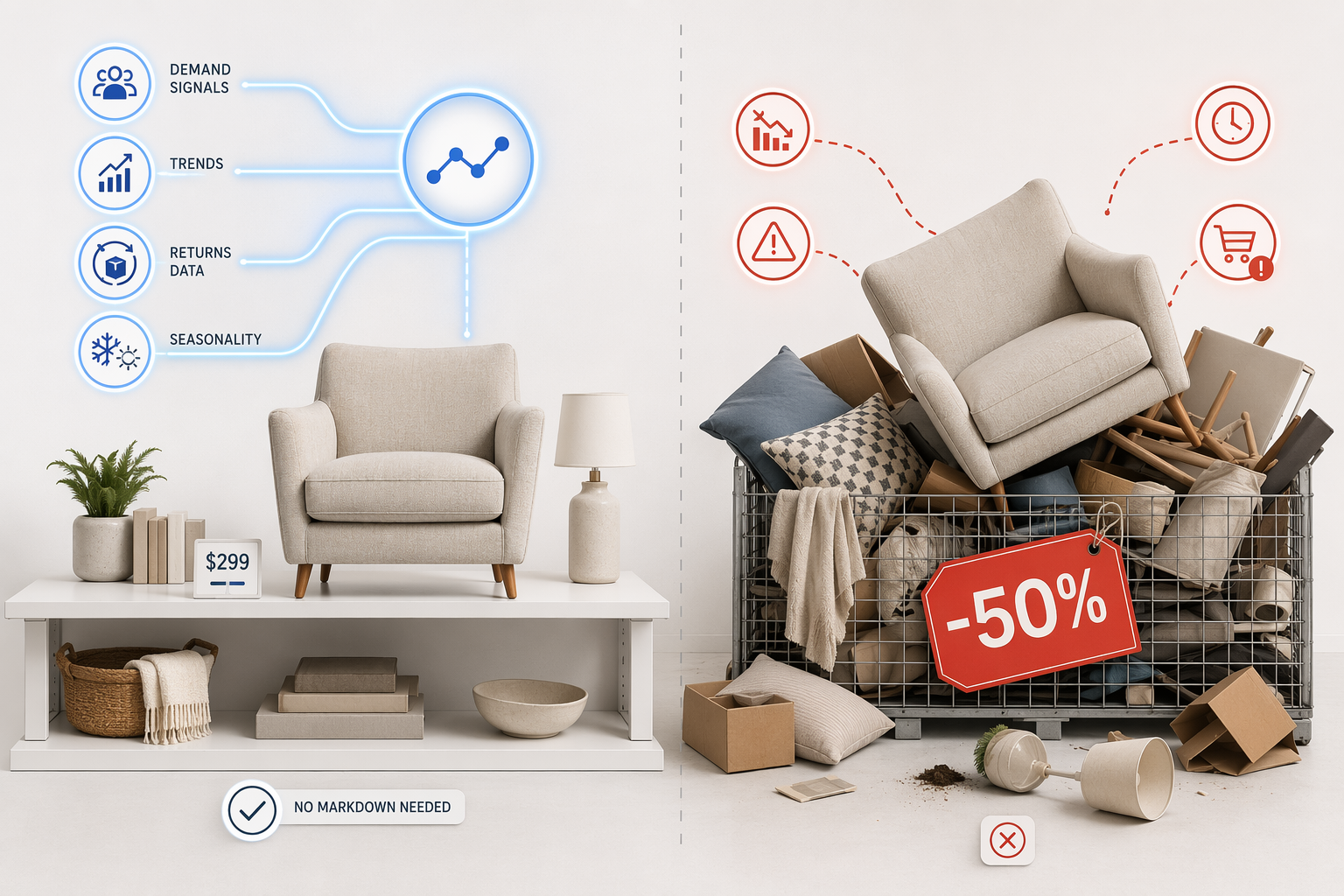
This is less dramatic than a real-time markdown display, but it may be more valuable for retailers that repeatedly overbuy seasonal décor, patio furniture, storage products, or trend-sensitive home accents. Once too much bulky inventory is already in the network, the merchant is negotiating with time. Before the buy is placed or replenishment is approved, the retailer still has more ways to avoid margin damage.
Intelligence Node’s discussion of IKEA pricing strategy frames excess inventory as a markdown cost, which is the right lens for this category.[6] The cost of a bad forecast is not only the final discount percentage. It is also the storage, handling, opportunity cost, and promotional distraction that build before the item ever gets its red tag.
There is a caveat. The IKEA demand sensing figures come from a May 2021 source, and the public material does not guarantee the same performance level in 2026.[5] Still, the mechanism remains highly transferable: mid-market retailers do not need to begin with personalized markdowns if their basic inventory position is wrong. They may get more value first from improving forecast inputs, planner adoption, and the decision rules that determine how much inventory enters the pipeline.
Home Depot: targeting the offer, not just changing the price
Home Depot’s AI story is different again. It is less about public evidence of clearance markdown optimization and more about the customer and order intelligence that can make discounts more selective. For a retailer serving both consumers and professionals, that distinction matters. A contractor buying repeatedly for jobs should not necessarily see the same offer logic as a one-time shopper replacing a faucet.
Fortune described Home Depot’s online business as a $25 billion operation using AI across order intelligence and pricing signals.[7] Home Depot has also discussed Magic Apron, its AI assistant, and expanded Pro Xtra digital capabilities that include personalized pricing for professional customers.[8] Those pieces point toward a more segmented discount environment: price and promotion can be informed by customer type, project context, purchase history, and value to the retailer.
That is not the same as saying Home Depot has publicly proven AI-driven clearance margin lift. The available material is largely corporate description and business reporting, and independently measured discount optimization outcomes were not found. The responsible conclusion is narrower: Home Depot shows how AI-supported order intelligence and loyalty data can support targeted pricing and offer eligibility, especially for high-value professional segments.
For home goods retailers, this is the part that often gets ignored during clearance. The default clearance banner treats every visitor as equally necessary to move inventory. Segment-level promotion rules ask a harder question: who needs the incentive, who would have bought anyway, and who is valuable enough that a targeted offer protects a longer relationship?
What mid-market retailers can actually take from these cases
A mid-market ecommerce director should be skeptical of any AI pricing pitch that jumps straight from “machine learning” to “revenue growth.” The better investment case is more operational and less glamorous: fewer late, blunt, poorly targeted clearance decisions.
| Retailer case | What the AI work mainly affects | Transferable lesson | Main caveat |
|---|---|---|---|
| Wayfair | Daily price adjustment and progressive markdown sequencing | Connect markdown depth to demand, competition, seasonality, and inventory exposure | Pricing mechanics are proprietary, and third-party adjustment data has limited methodological detail |
| IKEA | Demand sensing and forecast acceptance | Prevent some clearance pressure by improving the inventory position before markdowns are needed | Public performance figures are from 2021 and may not reflect current results |
| Home Depot | Order intelligence, pricing signals, and customer segmentation | Use customer value and purchase context to decide who should see which offer | Public sources do not provide independently audited discount optimization outcomes |
The practical starting point is usually not a fully dynamic pricing engine. It is a cleaner decision system around products that are already known to create clearance pain: bulky furniture, seasonal outdoor goods, holiday décor, rugs, storage, and other items where time and space quickly turn into margin loss.
A retailer evaluating AI for discount timing should ask whether the system can support three decisions with evidence: which SKUs are likely to miss plan, when the first markdown should happen, and how the offer should differ by customer segment or channel. If the tool only produces a recommended discount without showing the demand, inventory, seasonality, and customer logic behind it, the retailer is still relying on faith — just with a newer interface.
The cases also argue against treating forecasting and promotion as separate departments. IKEA’s lesson weakens if forecasts are ignored by buying and allocation. Wayfair’s markdown progression weakens if inventory visibility is stale. Home Depot’s segmentation lesson weakens if loyalty, order, and pricing data cannot talk to each other. AI does not remove the retail handoff problem; it makes the cost of broken handoffs easier to see.
The defensible AI discounting case
Home goods retailers are not using AI to make clearance disappear. Returns will still distort inventory. Seasonal windows will still close. Buyers will still make bets that do not work. The evidence is also uneven: Wayfair gives the strongest public signal on discount timing, IKEA gives the strongest forecasting discipline example, and Home Depot shows segmentation potential without public proof of clearance-margin impact.
That unevenness is not a reason to dismiss the category. It is a reason to make the business case more precise. AI is most credible here when it is tied to forecasting, inventory visibility, and segment-level promotion rules. The promise worth funding is not that AI will magically raise revenue. It is that it can reduce the margin damage caused by waiting too long, cutting too deeply, or offering the same clearance deal to customers who did not need it.
References
- AI Shopping for Home Goods: 2026 Retailer Playbook — Paz.ai, 2026.
- These are the companies using AI-driven dynamic pricing the most — Yahoo Finance, December 2024.
- Wayfair's clearance pricing pattern — Pagecrawl, 2026.
- Wayfair wins 2025 IIF Forecasting Impact Competition — LinkedIn, 2025.
- Using AI for smarter demand forecasting — IKEA Global, May 2021.
- 9 IKEA Pricing Strategies Driving Global Retail Success — Intelligence Node.
- How Home Depot is rebuilding retailing with AI — Fortune, June 2026.
- The Home Depot Expands Pro Digital Experience with Latest Project Management and AI Tools — Home Depot Corporate, March 2026.

Comments
Join the discussion with an anonymous comment.