

How SOXL Volatility Drives Your AI Tool Costs Higher
Chip prices have dropped 1,000× since 2022, yet enterprise AI budgets have ballooned 483%. This article explains the paradox: semiconductor supply volatility drives software inflation, but the real culprit is agentic workflows consuming 5–30× more tokens per task. It offers a framework to predict and control AI costs by budgeting via workflow token consumption and applying tiered model routing.
The invoice problem is straightforward: AI is supposed to be getting cheaper, but the marketing stack is not. Token costs reportedly fell roughly 1,000× from about $20 per million tokens in 2022 to about $0.40 per million tokens in 2026, while enterprise AI inference budgets rose from $1.2 million per year in 2024 to $7 million per year in 2026, a 483% increase; at the same time, software prices posted a 14.5% year-over-year increase in May 2026, described as the biggest increase on record in BLS CPI data reported by Benzinga. [1][2][3]
That is the contradiction hiding inside a lot of AI budget conversations. Finance hears that inference is cheaper. Vendors point to lower per-token pricing. Practitioners open a renewal, a usage dashboard, or a procurement questionnaire and see more seats, more automations, more background runs, more context retrieval, and more premium-model calls than last quarter.
SOXL volatility matters because it is one visible signal of the infrastructure pressure feeding into software pricing. SOXL is not a clean measure of semiconductor capacity; it is a 3× leveraged ETF, affected by daily rebalancing and volatility decay. But when it reportedly rallies 450% year to date and still suffers drawdowns of more than 30%, it tells operators something useful: AI chip sentiment is violent, capital is chasing the supply chain, and vendors are pricing in more uncertainty than a neat token-cost chart admits. [4]
Cheaper units do not mean cheaper workflows
A per-token price is only one line in the cost model. It tells you the cost of a unit. It does not tell you how many units a task now consumes, how many times the task retries, how much context is attached, how many tools an agent calls, or whether a workflow runs once for a human or continuously in the background.
| What got cheaper | What got larger | Why the invoice can still rise |
|---|---|---|
| Tokens: roughly $20 per million in 2022 to about $0.40 per million in 2026 [1] | Enterprise AI inference budgets: $1.2M/year in 2024 to $7M/year in 2026 [2] | Teams are buying more AI work, not just cheaper AI units |
| Individual model calls for simple drafting | Multi-step workflows with retrieval, ranking, evaluation, and retries | Each completed outcome can contain many hidden calls |
| Commodity access to hosted AI tools | Software renewals and usage-based plans exposed to chip-supply pressure | Software inflation reached 14.5% YoY in May 2026 in BLS CPI data reported by Benzinga [3] |
This is where a lot of marketing teams mis-budget. They forecast next quarter’s AI spend by looking at a model provider’s unit price table and assuming the workflow will behave like a prompt box. Then the team moves from occasional drafting to campaign research, account summaries, landing-page variants, paid-search expansion, automated QA, CRM enrichment, and always-on assistants. The price per unit may fall. The number of units per completed marketing outcome can rise faster.
SOXL is the warning light, not the budget model
The semiconductor market still matters. If AI data centers absorb global chip supply, software vendors do not operate in a vacuum. Benzinga’s report tied the record 14.5% software price increase to AI data centers absorbing chip supply, using May 2026 BLS CPI data. [3]
For a marketing operations lead, that connection is practical rather than theatrical. It helps explain why a vendor can say model efficiency is improving while also increasing platform fees, tightening usage caps, charging for premium AI credits, or moving heavier features into enterprise tiers. Infrastructure volatility is upstream. The renewal lands downstream.
But SOXL should not become the center of the budget meeting. A leveraged ETF can show sentiment and volatility around AI semiconductors; it cannot tell a demand gen team whether its content workflow should use a frontier model for every metadata rewrite. The more useful question is smaller and less glamorous: how many tokens does one approved asset, enriched account, campaign brief, or qualified chat conversation actually consume?
The real multiplier is workflow design
Gartner estimated in March 2026 that agentic workflows consume 5× to 30× more tokens per task than conventional AI interactions. [5] That range explains far more about marketing AI cost behavior than a headline token-price decline.

A chatbot prompt, a retrieval-augmented generation workflow, an agentic research task, and an always-on assistant should not live in the same budget cell. They may all use tokens. They do not consume them in the same pattern.
| Workflow type | What happens behind the interface | Budget treatment |
|---|---|---|
| Simple chatbot prompt | One user asks, one model responds, with limited context | Budget by expected user volume and average prompt size |
| RAG workflow | The system retrieves documents, injects context, generates an answer, and may cite or summarize sources | Budget by context size, retrieval frequency, and repeated use of the same source material |
| Agentic research task | The agent plans, searches, calls tools, evaluates outputs, retries, and produces a final artifact | Budget by completed task, not by visible prompt |
| Always-on assistant | The system monitors, reacts, stores context, responds across sessions, and may run without a direct human prompt | Budget by operating pattern, concurrency, and guardrails |
Take a hypothetical campaign brief workflow. In its simplest form, a marketer pastes notes into a model and asks for a first draft. In a more mature version, the workflow pulls audience documentation, product pages, CRM segments, competitor notes, past campaign performance, brand guidance, and channel constraints before drafting. Then it asks another model to score the draft, rewrites weak sections, formats the output for paid search, email, and landing-page teams, and logs the result in a project system. The marketer still sees “generate brief.” The invoice sees a chain of model calls.
That distinction matters because teams often expand AI usage through convenience. A content ops manager adds brand-memory retrieval so the team stops copying guidelines into every prompt. A paid media specialist uses an agent to generate keyword clusters and ad variants. A demand gen lead asks for account-level personalization across a target list. Each change may be defensible. Together, they turn one visible task into a wider architecture.
RAG raises costs through context, not magic
Retrieval-augmented generation is often sold as a quality improvement, and it can be. The budget issue is that retrieved material becomes context. If every answer includes long policy documents, product sheets, customer transcripts, or campaign archives, the workflow consumes tokens before the model has written a useful sentence.
The fix is not to avoid retrieval. The fix is to stop treating all context as equally valuable. A pricing-page summary used in hundreds of sales enablement answers should be cached and chunked carefully. A one-off brainstorm does not need the full brand archive. A compliance-sensitive answer may justify heavier retrieval and a better model. A social caption rewrite probably does not.
Agents spend tokens while deciding what to do
Agentic workflows add another cost layer because the model is not only producing the final output. It may be planning the task, choosing tools, checking intermediate results, deciding whether to retry, and reconciling conflicting information. Those steps can improve output quality, especially for research and operations tasks. They also mean the visible output is a poor proxy for usage.
This is why “use AI more” is an incomplete instruction. A team can use AI more by replacing manual formatting with a small model. It can also use AI more by launching an autonomous account-research agent that runs across every open opportunity. Those two changes have different cost curves and should pass through different approval paths.
Budget by completed marketing outcome
A workable AI budget starts with the thing the team is actually trying to finish. Not “monthly tokens.” Not “number of AI users.” The unit should be an outcome that a marketer, manager, or finance partner recognizes.
- Cost per approved blog brief, not cost per prompt.
- Cost per enriched target account, not cost per agent run.
- Cost per published landing-page variant, not cost per draft.
- Cost per qualified chatbot conversation, not cost per message.
- Cost per campaign QA pass, not cost per model call.
This changes the internal conversation. If an agentic research workflow costs more than a simple prompt but replaces several hours of analyst work and improves sales readiness, it may be worth protecting. If a premium model is rewriting low-stakes email subject lines at scale, the routing policy is probably wrong.
The budget review should ask four questions before approving a new AI workflow:
- What is the completed outcome?
- How many model calls happen before that outcome is accepted?
- How much context is attached to each call?
- Which calls actually require the most expensive model?
Controls that reduce cost without killing useful AI work
Cost control does not have to mean banning agents or forcing everyone back into manual production. It means routing expensive intelligence to the steps where it changes the result.
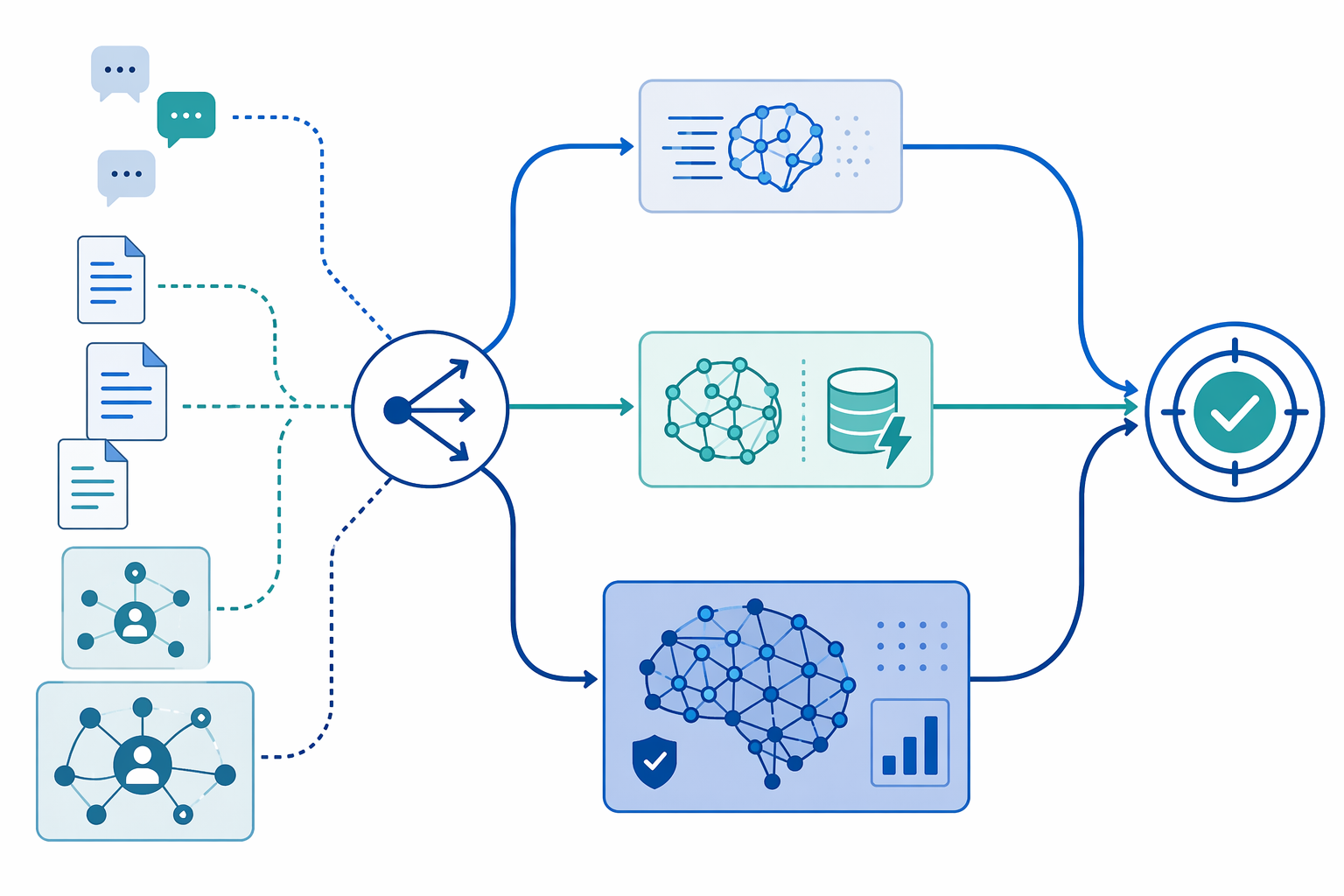
Tiered model routing
Not every step deserves the same model. Classification, formatting, deduplication, tagging, extraction, and simple rewriting can often be routed to smaller or cheaper models. Strategy synthesis, complex reasoning, sensitive customer-facing answers, and final judgment steps may justify a stronger model.
| Task | Default routing instinct | Escalate when |
|---|---|---|
| Tagging content by funnel stage | Small or mid-tier model | The taxonomy is ambiguous or compliance-sensitive |
| Summarizing a known product page | Cached response or small model | The answer must combine multiple changing sources |
| Generating campaign strategy from mixed performance data | Premium model | The output affects budget allocation or executive review |
| Rewriting ad copy variants | Small or mid-tier model | Legal, brand-risk, or regulated claims are involved |
| Researching target accounts with tool calls | Agentic workflow with caps | The account value justifies deeper research |
Semantic caching
Marketing teams repeat themselves more than they think. Brand descriptions, product summaries, boilerplate disclaimers, audience definitions, feature explanations, and campaign taxonomies get regenerated constantly. Semantic caching lets the system reuse an answer when the new request is meaningfully similar to a prior one, rather than paying for another full generation.
The operational rule is simple: cache stable knowledge and frequently repeated transformations; do not cache answers that depend on fresh performance data, customer-specific context, or current legal review.
Context-window discipline
Large context windows make sloppy workflow design easy. A team can attach the whole brief, the whole transcript, the whole knowledge base, and the whole campaign archive because the model technically accepts it. That does not make it a good default.
A better pattern is to retrieve narrowly, summarize durable material once, and pass only the pieces needed for the current decision. For example, a landing-page rewrite may need the positioning statement, target audience, offer, and conversion goal. It usually does not need every prior campaign retrospective.
Caps, logs, and exception paths
Every agentic workflow should have a visible stopping rule: maximum tool calls, maximum retries, maximum context size, and a condition that sends the task back to a human. Without those limits, a workflow can spend tokens trying to resolve ambiguity that a person could clear in one comment.
The logs should be readable by the business owner, not only by engineering. A content ops manager should be able to see that a campaign brief used retrieval three times, called a premium model twice, retried once, and failed because source material was missing. That is the difference between governing AI and merely receiving a usage bill.
When self-hosting belongs in the conversation
Owning infrastructure is tempting when API bills grow, but most marketing teams should optimize routing, caching, and context before entertaining self-hosting. Spheron Network’s 2026 analysis put a rough self-hosting breakeven threshold around 50 million to 100 million tokens per month for 70B-class models and gave an example of $347,000 per year in compute cost for a 70B model at 1,000 daily active users. [6]
That threshold is useful as a boundary, not as a dare. A marketing team using AI for drafting, campaign support, lightweight analysis, or moderate personalization may be nowhere near the usage pattern that justifies infrastructure ownership. Even teams with high usage still need to account for reliability, model operations, security review, monitoring, latency, and staff time.
The practical sequence is API discipline first, infrastructure debate second. If a team cannot explain its cost per completed outcome under an API model, it is unlikely to run a cleaner self-hosted model. Moving waste onto owned hardware does not make it strategy.
A quarterly AI cost model marketing can actually use
For Q3 2026 planning, a usable AI forecast does not need a perfect semiconductor forecast. It needs a workflow inventory and a routing policy.
- List the AI workflows currently in production: drafting, research, enrichment, chat, QA, reporting, personalization, routing, and internal assistants.
- Define the completed outcome for each workflow.
- Measure or estimate model calls per outcome, context size per call, retry rate, and premium-model share.
- Assign a default model tier to each step, with escalation rules.
- Identify repeated requests that can use semantic caching.
- Set caps for agentic workflows before expanding rollout.
- Report cost per outcome next to volume and quality metrics.
This model gives marketing a better answer when finance asks why AI spend is up. “Tokens got more expensive” may not be true. “We moved from single-prompt drafting to agentic workflows with retrieval and evaluation” is more accurate. It also gives the team levers to pull: reduce context, lower premium-model share, cache repeated work, cap retries, or reserve agents for outcomes valuable enough to justify them.
Falling unit costs do not save a team whose workflows expand faster than prices decline. The budgeting habit has to change: estimate cost by task architecture and routing policy, not by headline token prices.
References
- AI Inference Economics: The 1,000× Cost Collapse Reshaping GPUs, GPUnex Research, 2026
- AI Inference Cost Crisis 2026, Oplexa, 2026
- Software Prices See Biggest Increase On Record As AI Data Centers Absorb Global Chip Supply, Benzinga, June 2026
- SOXL Soars 450% YTD As AI Chip Rally Ignites Leveraged ETF Frenzy, Sahm Capital, June 2026
- Gartner March 2026 analysis on agentic workflow token consumption, Gartner, March 2026
- AI Inference Cost Economics in 2026: GPU FinOps Playbook, Spheron Network, 2026

Comments
Join the discussion with an anonymous comment.