

How Google's New AI Chip Stock Moves Affect Your Tools
The escalating rivalry between Google's TPU chips and Nvidia's GPUs is sending real stock market signals and beginning to reshape the infrastructure that powers AI marketing tools. This article breaks down what the market moves mean and how marketers should adjust their tool evaluation criteria.
Meta’s leaked multibillion-dollar TPU deal did something most chip announcements do not: it moved the market in opposite directions quickly enough for non-investors to notice. Nvidia fell roughly 4% to 6% intraday, Alphabet gained about 4% to 6%, and Broadcom, Google’s TPU manufacturing partner, jumped 11% after the news circulated in November 2025.[1][2][3]
That is the useful part of Google’s new AI chip stock-price impact story for marketers. The stock moves are not a recommendation to buy Alphabet, sell Nvidia, or rewrite a budget because a trading desk changed its view for a day. They are a signal that investors treated Google’s TPU push as a real competitive event, not another cloud-platform announcement buried in an infrastructure keynote.
For the person managing a marketing technology stack, the question is narrower and more useful: does Google’s chip momentum change the infrastructure behind AI tools enough to affect renewals, pricing conversations, model access, or platform risk? The answer is yes, but not on the schedule implied by a single stock-price reaction.
Why The Market Reaction Matters
Nvidia has been the default beneficiary of the AI infrastructure boom because so much training and inference demand has run through its GPUs. When Alphabet and Broadcom rose on news of Meta using Google TPUs, while Nvidia sold off, the market was pricing in the possibility that some AI capacity spending could move away from Nvidia-heavy infrastructure and toward Google’s custom silicon ecosystem.[1][2][3]
The important word is “some.” A stock move can validate competitive pressure without proving a market transition is complete. It says investors saw a credible alternative for a very large buyer. It does not say the average marketing AI startup has already shifted clouds, that subscription prices will fall next quarter, or that every vendor using Nvidia-backed capacity is suddenly at a disadvantage.
Still, the reaction deserves attention because infrastructure choices become product choices later. If a major AI platform gets cheaper or more predictable access to compute, it can ship features differently. If a vendor is exposed to scarce or expensive capacity, it may throttle usage, raise prices, narrow model options, or reserve the best capabilities for higher-tier customers.
The TPU Push Is Becoming A Platform Bet
Meta’s reported TPU agreement is the clearest market-moving example, but it is not the only sign that Google is trying to turn custom chips into a broader enterprise infrastructure business. Anthropic has made a tens-of-billions commitment connected to Google’s AI infrastructure, OpenAI has been offered TPU capacity, and Google’s Lake Mariner data center investment was reported at $3.2 billion.[4][5][6]
Those are not small software-vendor trials. They point to multi-year capacity planning by companies that need enormous AI compute and cannot afford to treat infrastructure as an afterthought. Once commitments get that large, they influence where partners build, which clouds receive optimization work, and which ecosystem can promise enough capacity for demanding AI applications.
A projection often cited in this discussion comes from a Medium post by Vikas Sah and Kearney: Google’s TPU share could rise from about 5% to about 25% by 2030, while Nvidia’s share could decline from about 90% to about 70%.[7] That is useful as a scenario, not as settled consensus. It tells buyers what kind of shift some analysts think is plausible; it should not be treated as official guidance from Google, Nvidia, or the broader market.
Morgan Stanley’s estimate gives the revenue side of that scenario a more concrete frame: every 500,000 external TPU chips could represent about $13 billion in revenue opportunity for Alphabet.[8] For marketers, the point is not Alphabet’s revenue line by itself. The point is what that revenue could fund: more Google Cloud AI capacity, more partner incentives, and more reason for AI software vendors to optimize around Google’s stack.
How Chip Competition Reaches Marketing Tools
Most marketing teams do not buy chips. They buy campaign automation, content generation, analytics, personalization, research, sales enablement, and creative production tools. But those tools sit on cloud infrastructure, and infrastructure limits show up in places buyers do see: price, usage caps, latency, model availability, roadmap timing, and support for enterprise controls.
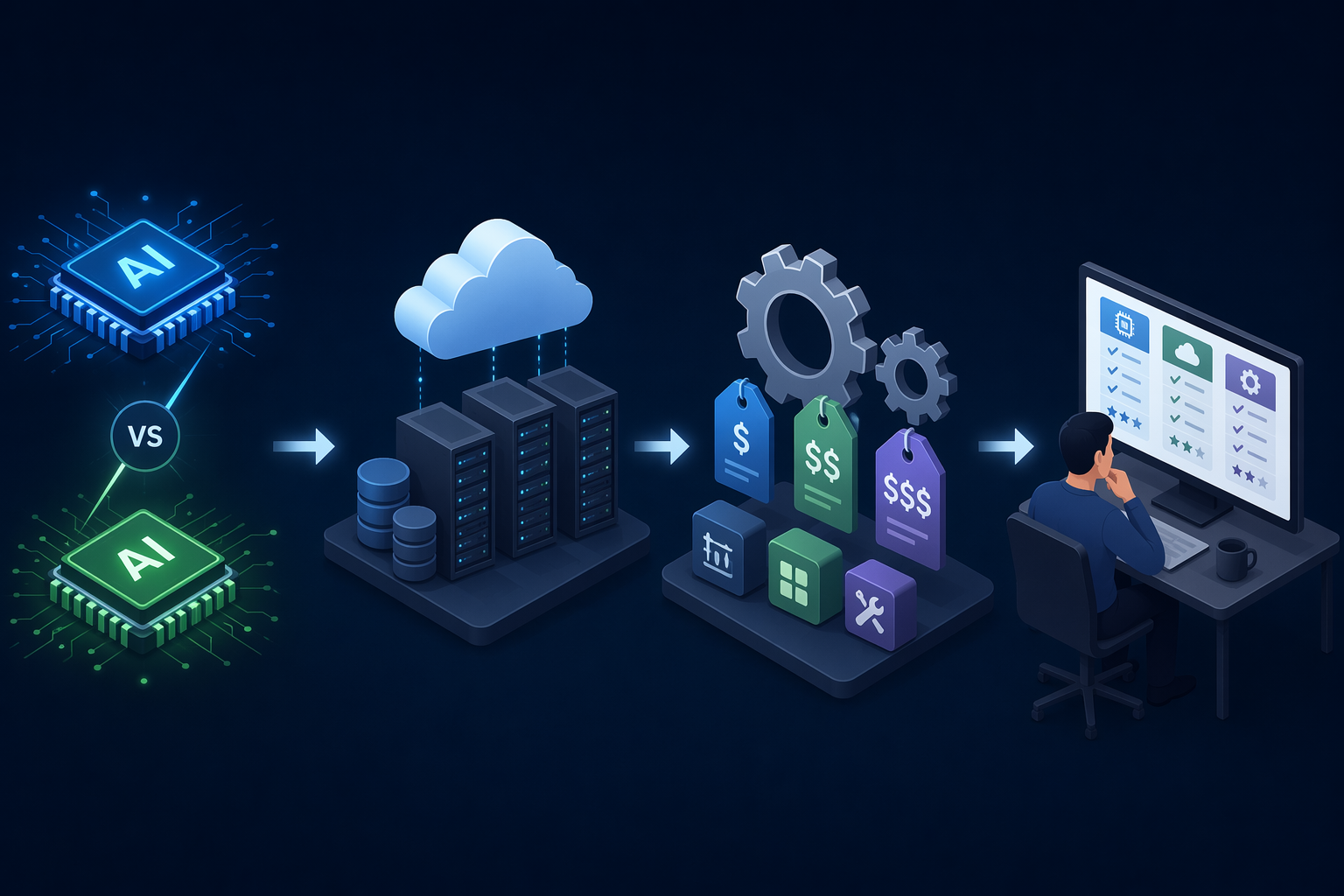
The path usually looks like this:
| Infrastructure Layer | What Changes | How It Can Surface In Marketing Tools |
|---|---|---|
| Chip supply | GPU or TPU availability affects how much AI compute a provider can offer | Usage limits, waitlists, slower rollout of compute-heavy features |
| Cloud platform | Vendors build on Google Cloud, AWS, Azure, or specialist AI clouds | Different model menus, procurement terms, data-residency options, and enterprise integrations |
| Compute cost | Inference and training costs shape vendor margins | Seat pricing, credit pricing, premium tiers, or feature bundling |
| Optimization work | Engineering teams tune models and workloads for specific infrastructure | Better performance in one ecosystem and slower parity elsewhere |
| Capacity commitments | Large buyers lock in supply years ahead | Roadmaps become more dependable for some platforms and more constrained for others |
This is why the TPU story belongs in tool evaluation even if no marketer ever asks for a chip SKU in a procurement form. A vendor’s infrastructure exposure affects what it can promise. If a platform relies heavily on Google Cloud and Google’s TPU capacity improves, that vendor may eventually gain more room to offer AI-heavy workflows at predictable margins. If a platform depends on Nvidia-heavy specialist providers, its near-term risk profile may be different: possibly excellent model performance and ecosystem maturity, but more exposure to GPU demand pressure.
The technical announcements matter only to the extent they change that evaluation. Google announced TPU 8t and TPU 8i in April 2026, but as of July 2026 they were not generally available, and the performance claims available were pre-production benchmark claims from Google Cloud.[9] That makes them worth watching, not worth using as proof that a current vendor’s cost base has already changed.
The Vendor Questions Should Get More Specific
The practical move is not to ask a sales rep whether the product “uses AI infrastructure.” That will produce a polished answer and very little useful risk information. The better questions are about dependency, portability, and capacity planning.
- Which cloud or specialist AI infrastructure providers support your core AI features today?
- Are the most expensive AI features tied to one provider, or can workloads move across clouds?
- Do enterprise customers get different model access, throughput, or latency guarantees based on plan level?
- How are AI usage limits priced: by seat, credit, action, generated asset, token volume, or custom contract?
- If compute costs rise, does the contract allow price changes during the term or only at renewal?
- Which planned features depend on third-party model or infrastructure availability?
These questions are especially relevant for AI tools that promise high-volume personalization, creative generation, predictive scoring, synthetic research, or agentic workflows. Those features can consume far more compute than a lightweight copy suggestion or classification task. If the vendor cannot explain how capacity is secured, the roadmap deserves more scrutiny.
This also changes how teams should read pricing pages. A low entry price can be a customer-acquisition tactic, a sign of efficient infrastructure, or a plan that becomes expensive once usage scales. Chip competition may improve pricing pressure over time, but buyers still need to understand the unit economics inside the contract they are signing now.
The Reality Check: Nvidia Demand Is Still Deep
The strongest reason not to overreact is demand outside the hyperscaler headlines. Nebius reported that 99% of customer demand was still for Nvidia GPUs.[10] TrendForce also reported that CoreWeave and Lambda remained cautious on TPUs.[11]
That matters because many AI startups and tool vendors do not behave like Meta or Anthropic. They often rely on specialist AI cloud providers, managed model platforms, or whichever capacity lets them ship quickly. If those providers and their customers are still overwhelmingly Nvidia-oriented, then Google’s TPU gains at the hyperscaler and large-enterprise level have not fully filtered into the infrastructure layer that powers many marketing tools.
There is also an adoption-versus-effectiveness distinction. A major company committing to TPUs proves that the option is viable for certain workloads and strategic buyers. It does not prove that every marketing AI workload will run better, cheaper, or sooner on TPUs. Tool vendors still have to optimize software, manage reliability, negotiate capacity, and decide whether supporting another infrastructure path is worth the engineering work.
What To Do With The Stock Signal
Treat the November 2025 stock reaction as an early warning that infrastructure diversification is becoming more credible. It belongs in the same file as vendor consolidation risk, model-provider dependency, data-governance posture, and renewal flexibility. It does not belong in the “change tools immediately” folder.
For a marketing technology manager, the near-term adjustment is simple: add infrastructure exposure to the evaluation scorecard. A tool does not need to disclose every supplier contract, but it should be able to explain which clouds and model providers its core features depend on, how AI usage is metered, and what happens if capacity costs change.
For an agency strategist, the implication is slightly different. Client recommendations should avoid assuming that all AI tools have the same cost structure underneath. Two platforms may offer similar content, analytics, or personalization features while carrying different exposure to Google Cloud, Azure, AWS, Nvidia-heavy providers, or third-party model APIs. That difference can matter when a client starts scaling from pilot usage to daily workflow dependency.
For an AI tool evaluator, the right stance is medium-term attention. Google’s TPU push is real enough to affect platform strategy and investor expectations. Nvidia’s installed demand is still strong enough that the market will not rewire itself overnight. The procurement consequence is not panic; it is better questioning before the next renewal locks in another year of assumptions.
References
- CNBC reporting on Nvidia and Alphabet stock reaction to Meta TPU deal news, CNBC
- BBC reporting on Nvidia and Alphabet stock reaction to Meta TPU deal news, BBC
- Business Insider reporting on Broadcom stock reaction to Meta TPU deal news, Business Insider
- The Information reporting on Meta’s TPU deal, The Information
- Reporting on Anthropic’s tens-of-billions Google AI infrastructure commitment
- Reporting on OpenAI being offered TPU capacity and Google’s Lake Mariner data center investment
- Medium post by Vikas Sah and Kearney on TPU and Nvidia market share projections, Medium
- Morgan Stanley estimate on external TPU chip revenue opportunity
- Google Cloud Blog announcement of TPU 8t and TPU 8i, Google Cloud Blog, April 2026
- The Information reporting on Nebius customer demand for Nvidia GPUs, The Information
- TrendForce reporting on CoreWeave and Lambda caution toward TPUs, TrendForce

Comments
Join the discussion with an anonymous comment.