
How Geospatial AI Is Changing Local Campaign Targeting
Brand marketers can use geospatial AI and location intelligence to target local campaigns more precisely than demographic or radius-based methods. Real campaigns show 27–42% improvements in ad efficiency and 2–4× gains in new-customer acquisition efficiency across email, social, paid search, and CTV.
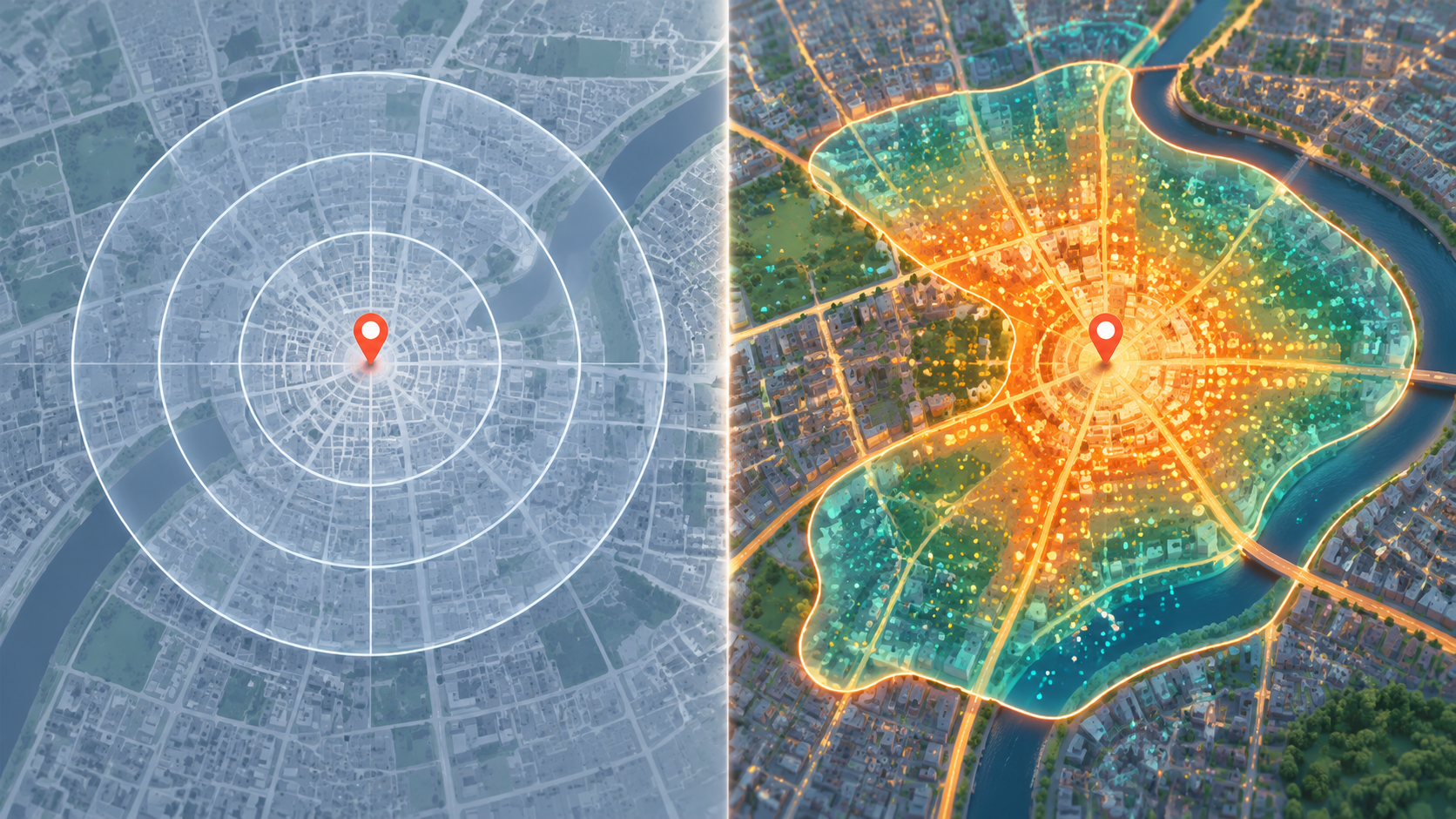
A local campaign can look precise on a map and still waste money in the store report. The usual setup is familiar: draw a five-mile radius around every location, add household income or age ranges, exclude a few obvious dead zones, and let the platform optimize. It is mapped, but the audience logic is still blunt. Distance from a storefront does not tell you which grocery shoppers cross that corridor on Saturdays, which neighborhoods already leak demand to a competitor, or which households behave like high-propensity buyers even though they sit outside the neat circle.
That is where geospatial AI earns attention in brand marketing campaigns. The useful version is not a vague promise about smarter maps or satellite imagery. In paid media, the practical value comes from location intelligence: observed movement patterns, points of interest, trade areas, neighborhood-level behavior, and audience segments that can be activated in social, paid search, programmatic, CTV, retail media, or owned channels.
The strongest published campaign examples are hard to ignore, with the necessary caveat that they come from vendors rather than independent audits. Quick Quack Car Wash reported a 27% higher click-through rate and 42% lower cost per click from Facebook audiences built with Spatial.ai compared with standard targeting.[1] A nationwide retailer using Placer.ai reported 2.2x ROAS in a validated new market and then doubled its ad budget.[2] AAA used Spatial.ai PersonaLive segmentation in email and produced a 25.66% open rate versus a 17.99% baseline, with more than $100,000 in sales from one personalized email.[3] Nestlé Purina used Amazon’s geographic audience activation to drive 4x more new-to-brand views at 86% lower cost than standard prospecting.[4]
The Difference Is the Signal, Not the Shape on the Map
Radius geofencing answers one question: who is physically near a location or has entered a defined perimeter. That can be useful for very tactical campaigns, especially when proximity is the main intent signal. But for multi-location retail, it often hides the real problem. A shopper may live three miles away and never cross the store’s trade area. Another may live nine miles away but commute past it, visit adjacent retailers, and behave more like a likely customer than the person inside the default radius.
Geospatial AI changes the targeting question from “who is nearby?” to “which places, movements, and neighborhood patterns indicate demand?” That distinction matters when a paid media lead has to explain why one store’s campaign is efficient and another store’s identical radius is not. The map is only the interface. The audience logic is underneath it.
In practice, the useful workflow usually combines four layers. Foot traffic analytics show where people actually go. Trade area analysis estimates the real catchment zone around a store, mall, competitor, or market. Psychographic neighborhood segmentation groups areas by modeled behaviors and preferences. Geographic audience activation pushes those signals into a buying environment, whether that is Meta, Amazon Ads, a DSP, paid search, CTV, or an email platform.

Where Geospatial AI Enters the Media Workflow
The mistake is treating location intelligence as another audience checkbox. It is more useful when it changes a decision earlier in the plan: which markets deserve budget, which locations need separate treatment, which audiences should be suppressed, and which neighborhoods should receive different creative or offers.
| Planning Question | Geospatial Layer | Campaign Decision It Changes |
|---|---|---|
| Where is demand actually coming from? | Foot traffic analytics | Store-level catchment, competitor overlap, audience exclusions |
| Is this market worth incremental spend? | Trade area analysis | Budget allocation, market expansion, launch sequencing |
| Which neighborhoods behave differently? | Psychographic segmentation | Creative versioning, offer strategy, channel prioritization |
| Where can the audience be bought? | Geographic audience activation | Meta, Amazon Ads, DSP, CTV, paid search, or email execution |
This is also where tool selection starts to matter. Placer.ai is strongest in the planning layer: foot traffic analytics, trade area analysis, and market validation. Spatial.ai’s PersonaLive is built around address-level psychographic segmentation and includes more than 60 behavioral segments.[3] Kogenta sits closer to agency planning intelligence, with Publicis and WPP both using its geographic intelligence in campaign planning.[5][6] Amazon GIA matters when the activation environment is Amazon Ads and the brand wants to reach geographically defined audiences inside Amazon’s media system.[4]
Those are not interchangeable jobs. A team trying to justify spend in a new metro needs different evidence than a team trying to improve Meta prospecting or a team trying to find pet-owning households in Amazon’s ecosystem. Calling all of it “AI location targeting” makes the category sound simpler than it is, and that is usually where bad tests begin.
Quick Quack Shows What Happens When the Audience Changes, Not Just the Bid
Quick Quack Car Wash is the cleanest paid social example because the comparison is easy to understand. The brand used Spatial.ai audiences in a Facebook campaign and reported a 27% higher click-through rate and 42% lower cost per click compared with standard targeting.[1] Those metrics do not prove store visits or lifetime value by themselves, but they do show a meaningful efficiency change inside the media auction.
The important part is not that Facebook became more automated. Facebook was already automated. The signal going into the campaign changed. Instead of relying only on standard platform targeting, the campaign used geospatial audience intelligence to identify people more likely to respond to the brand based on neighborhood and behavioral patterns.[1]
For a multi-location advertiser, that is the difference between asking the platform to optimize inside a generic local pool and giving it a better pool at the start. If a campaign manager is defending performance to a regional leader, “we narrowed the radius” is weak evidence. “We changed the audience input and beat the standard targeting cell on CTR and CPC” is a testable claim.
Trade Area Validation Comes Before Media Activation
The Placer.ai retailer case is less about a clever audience and more about budget confidence. A nationwide retailer used trade area analysis to validate a new market before expanding ad spend, reported 2.2x ROAS, and then doubled its ad budget.[2] That sequence is worth noticing: the location intelligence helped the brand decide where spend was justified before the campaign became a bigger line item.
This is often the missing step in local media planning. Teams debate platform mix while assuming the store footprint is equally addressable. Trade area analysis can make that assumption visible. It can show whether a location pulls from a compact neighborhood, a commuter corridor, a shopping cluster, or a wider regional draw. Each pattern suggests a different media plan.
A compact trade area may support tighter paid social and search coverage. A commuter-driven location may need dayparting, route-based creative, or broader CTV reach. A store that draws from an adjacent retail center may justify conquesting or co-tenancy logic. The point is not to make the map look sophisticated; it is to prevent the same budget rule from being copied across stores that behave differently.
Psychographic Neighborhoods Make Personalization Less Generic
The AAA case is not a paid media case, but it belongs in the discussion because it shows the same segmentation logic working in another channel. AAA used Spatial.ai PersonaLive to segment cold contacts for a personalized email campaign. The campaign produced a 25.66% open rate against a 17.99% baseline and generated more than $100,000 in sales from a single personalized email.[3]
Email does not have the same auction mechanics as Meta, search, CTV, or Amazon Ads. That makes the result useful in a different way. It suggests the value was not only cheaper inventory or better bidding; the segmentation helped decide what message should go to which people. For paid media teams, that matters because audience quality and creative relevance are usually separated in reporting even though customers experience them together.
This is where psychographic segmentation can be more useful than another demographic overlay. Age and income may describe a household. Behavioral neighborhood signals can suggest what kind of offer, pain point, or creative angle is likely to make sense in that place. That does not remove the need for creative testing, but it gives the test a sharper starting point.
Amazon GIA Connects Geography to Retail Media Intent
Nestlé Purina’s Amazon GIA case is the strongest retail media example in the set. The brand used geographic audience activation to target pet-owning households by trade area and reported 4x more new-to-brand views at 86% lower cost than standard prospecting.[4] That is a larger efficiency jump than the paid social example, though it should still be read as a campaign-specific vendor-published result.
The mechanism is also different. Amazon’s environment already contains commerce behavior and retail media signals. Geographic audience activation adds a local layer to that system, so the campaign is not simply prospecting broadly for pet owners. It is trying to find relevant households in the right trade areas inside a platform where shopping behavior is closer to the transaction.
For brands with physical distribution, retail media, and local store priorities, that combination is important. A national audience can look efficient while doing little for the markets where the product needs incremental demand. A geographically activated retail media plan gives the brand a way to connect household relevance, market priority, and media activation in one buying environment.
Agency Adoption Is Validation, Not Proof of Performance
Publicis and WPP using Kogenta’s geographic intelligence is a useful signal because large holding companies do not standardize planning layers casually.[5][6] It suggests location intelligence has moved into the operating system of campaign planning for major agencies, rather than remaining a niche experiment for isolated innovation teams.
Still, agency adoption is not the same as campaign proof. It tells marketers that serious planning teams consider geographic intelligence operationally useful. It does not tell a regional retail VP that the next campaign will beat the control. For that, the test still needs a clean comparison: geospatial audience versus standard targeting, validated trade area versus default radius, personalized neighborhood segment versus generic creative, or geographically activated retail media versus standard prospecting.
How to Test Geospatial AI Without Overclaiming It
A useful test starts with the business problem, not the platform demo. If the problem is wasted spend around stores, begin with trade area and foot traffic analysis. If the problem is weak prospecting efficiency, test geospatial audiences against the platform’s standard targeting. If the problem is generic creative, use psychographic segmentation to create message variants. If the problem is retail media scale in priority markets, evaluate geographic activation inside the retail media environment.
- Define the control before launch: standard radius, demographic targeting, platform prospecting, or the current local campaign structure.
- Document the signal being added: foot traffic, trade area boundaries, psychographic segments, or geographic audience activation.
- Keep the comparison close enough to explain: same market, similar budget window, comparable creative, and a clear primary KPI.
- Separate media metrics from business metrics: CTR and CPC are not the same as store visits, sales, ROAS, or new-to-brand acquisition.
- Review coverage before rollout: dense urban and suburban markets usually provide stronger location signals than rural or low-mobile-footprint areas.
That last point is not a footnote. Geospatial AI depends on aggregated mobile location data, points-of-interest databases, and modeled signals. Some markets will have stronger data density than others. Some customer groups will be less visible through mobile-derived signals. The right conclusion in those cases may be to limit the test, adjust the markets, or use location intelligence for planning rather than activation.
Privacy and Platform Constraints Shape What Can Be Activated
Geospatial targeting is not cookie-dependent, which is one reason it has become attractive as audience signals change. But that does not make it frictionless. Location data, even when aggregated and modeled, sits inside a changing privacy environment. State-level privacy laws, consent rules, data-provider policies, clean room requirements, and platform data-use restrictions all affect what can be collected, matched, exported, or activated.
The operational question for a marketing team is simple: can the vendor explain how the segment is built, what level of aggregation is used, how data is refreshed, which platforms allow activation, and what restrictions apply? If the answer is buried under “AI-powered” language, the team does not have enough to defend the test.
This is also why the best use cases are usually specific. “Use geospatial AI for local marketing” is too broad. “Use trade area analysis to decide which new markets deserve incremental Meta and CTV spend” is testable. “Use PersonaLive segments to personalize winback messaging in markets with high insurance propensity” is testable. “Use Amazon GIA to reach pet-owning households in priority trade areas and compare new-to-brand efficiency against standard prospecting” is testable.
What the Evidence Supports in 2026
The case evidence supports a practical conclusion, not a universal promise. Vendor-published campaigns show 27% higher CTR and 42% lower CPC in paid social, 2.2x ROAS tied to trade area validation, a 25.66% email open rate against a 17.99% baseline with more than $100,000 in sales, and 4x more new-to-brand views at 86% lower cost in Amazon Ads.[1][2][3][4] Those results are strong enough to justify serious testing. They are not strong enough to guarantee the same lift in every category, market, budget level, or channel mix.
For sophisticated local advertisers, geospatial AI has moved from experimental to operational. The strongest use is as a signal layer that improves audience definition, market selection, and activation quality. It should beat radius and demographic methods when the market has enough data coverage, the signal matches the business problem, and the measurement plan can show what changed. Without those conditions, it becomes another expensive map.
References
- Quick Quack Car Wash, Spatial.ai
- Nationwide Retailer Doubles Ad Spend After 2.2x ROAS, Placer.ai
- How to Personalize Email Campaigns with PersonaLive Segmentation, Spatial.ai
- Nestlé Purina helps pet owners find pet nutrition products with Amazon’s geographic insights, Amazon Ads
- Publicis, Kogenta
- WPP, Kogenta

Comments
Join the discussion with an anonymous comment.