
What the FIFA 64-Team Expansion Means for Marketers
FIFA's proposed 64-team World Cup creates 128 matches, opening massive broadcast and sponsorship inventory while fragmenting audiences across continents. This article explains the commercial implications and outlines how brand marketers and media buyers should shift toward geo-targeted, CTV-first strategies for 2030.
For marketers, the proposed FIFA 64-team expansion starts with a blunt inventory problem: if the 2030 World Cup moves to 64 teams, the tournament likely becomes a 128-match property, up from 104 matches in the 2026 format, with 96 group-stage games before the knockout rounds even begin.[1] That is 24 more sellable matches, more local windows, more broadcast units, more sponsor activations, and more room for brands that have never been able to get near the World Cup at official prices.
It is also the point where the old World Cup buying logic starts to crack. Scarcity made the tournament unusually clean for marketers: a limited set of matches, shared cultural focus, and a relatively simple argument for mass-reach media. A 128-match World Cup gives planners more to buy, but it does not give consumers more hours in the day or guarantee that a casual viewer will treat an early group-stage match as an appointment.
As of July 2026, the 64-team format is still a proposal under review, not a confirmed 2030 media plan. The analysis here assumes the most commercially discussed version: 16 groups of four teams, six co-host countries, and matches spread across three continents.[1] That assumption matters because the commercial upside and the media-planning risk come from the same place: scale.
More Matches Do Not Mean More Undivided Attention
For FIFA, more matches are easy to package as growth. For marketers, they are a supply shock. A 128-match event can carry more ad breaks, more shoulder programming, more digital highlights, more regional sponsor inventory, and more CTV ad opportunities. It also makes the average match less scarce.
That distinction should shape every budget conversation. A brand does not buy “the World Cup” in the abstract; it buys audiences, screens, markets, and moments. In a 64-team version, those moments multiply, but their value spreads unevenly. A U.S. brand may care about U.S., Mexico, and Canada fixtures. A global beer sponsor may care about the tournament’s total cultural footprint. A challenger brand in a newly qualified market may care about one national-team run more than the final itself.
The early rounds are where the pressure shows up first. Ninety-six group-stage games create a bigger content calendar, but they also reduce the odds that any single early match concentrates a broad audience across countries, time zones, and devices.[1] That does not make the inventory weak. It makes it more specific. The planner’s job moves from securing presence around the event to deciding which parts of the event deserve premium money.
| Commercial Change | What It Creates | What Marketers Need To Watch |
|---|---|---|
| 128 total matches | More broadcast, CTV, social, and sponsorship inventory | Lower scarcity for many individual fixtures |
| 96 group-stage matches | More national-team and regional activation windows | Fragmented attention before the knockout rounds |
| Six host countries across three continents | More local market relevance and tourism-adjacent campaigns | Harder time-zone planning and more uneven live viewing |
| Expanded sponsor tiers | Potential access for brands priced out of global partnership | More clutter and more difficult attribution |
The Broadcast Market Gets Bigger, Messier, and Less One-Size-Fits-All
The proposed format would land in a rights market already trained to pay heavily for live sports. Industry sources cited in coverage of the 2030 rights discussion have pointed to a possible $1.5 billion to $2 billion U.S. broadcast-rights target, compared with Fox’s reported $485 million fee for the 2026 tournament.[2][3] Those numbers are projections, not a formal FIFA RFP. Still, they give media buyers a useful signal: if the rights fee climbs, the cost of access will not stay polite.
The likely response is not simply “more expensive TV.” It is more packaging. A larger World Cup gives rights holders more room to split windows, build CTV-first products, sell language-specific audiences, price national-team packages, and reserve premium placements for knockout-stage certainty. The 64-team pitch does not just create more games; it creates more ways to slice the games.
That is useful for buyers who dislike all-or-nothing sports commitments. A brand can test mid-tier group-stage inventory in selected markets, build heavier reach against one country’s matches, or use CTV to separate household-level audiences from the blunt force of national TV. It also gives sellers more chances to rename scarcity. “Official,” “premium,” “host market,” “supporter,” “second screen,” and “highlights” will not all mean the same thing, and they should not carry the same CPM logic.
CTV is where this gets more operational than theoretical. One 2026 World Cup marketing playbook citing Nexxen data said 43% of 2030 viewers were expected to watch primarily via connected TV, and that CTV ads in live sports showed 66% higher effectiveness.[4] Those figures should not be treated as a guarantee for every brand or every market, but they do point toward the planning environment a 2030 buyer should expect: live sports reach with digital-style segmentation pressure.
The practical implication is that broadcast and CTV should be planned together, not as legacy versus modern media. Linear still carries cultural weight in major matches. CTV can make the long tail of group-stage games more usable by market, language, device, and audience behavior. The mistake is buying the expanded tournament as if the average group-stage match behaves like a semifinal.
Revenue Ambition Is Not the Same as a Clean Media Forecast
The money around FIFA is large enough that it is tempting to turn every number into a straight growth line. That would be lazy planning. The Athletic reported that the 64-team push was being discussed alongside a possible $15 billion revenue figure tied to FIFA’s World Cup ambitions.[1] The Guardian separately reported record $15 billion World Cup-specific revenue expectations for 2026.[5] Forbes, looking at the 2026 commercial environment, cited $10.5 billion in total brand ad spend around the tournament and also described different revenue frames for tournament-specific and cycle-level money.[6]
Those figures can all be directionally useful, but they should not be blended into one master forecast. “World Cup revenue,” “FIFA cycle revenue,” “brand ad spend,” “broadcast rights,” and “sponsorship fees” are different things. A marketer deciding whether to pay an official premium needs the commercial architecture, not a trophy-case number.
The more relevant question is how FIFA and its partners monetize the extra surface area. Sponsorship Marketing Association material on the 2026 tournament described FIFA Partner packages in the $150 million to $200 million range, World Cup Sponsor packages in the $65 million to $95 million range, and Regional Supporter packages in the $10 million to $25 million range.[7] A larger field and broader geography could make the lower tiers more attractive, especially for brands that care about specific participating nations or host markets rather than global dominance.
That is the good version of expansion for advertisers: more access points, more negotiable packages, and more local relevance. The bad version is paying a global-event premium for inventory that behaves like regional sports plus a logo lockup. The difference will sit in contract language, category exclusivity, content rights, data access, and whether the sponsor can activate quickly around the teams that matter.
Official Sponsorship Still Matters, but It Is No Longer the Only Credible Route
Official rights can still be powerful. They reduce legal ambiguity, open access to marks and tickets, simplify retail partnerships, and give global brands a cleaner story for sales teams and distributors. In a crowded tournament, official status may also help a brand avoid looking like one more opportunistic social post chasing a national-team result.
But the premium deserves a harder defense in a larger tournament. CNBC reported Meltwater data showing non-sponsor brands generated 61 million social engagements in a specific pre-tournament window, compared with 33 million for official sponsors.[3] The same CNBC report noted Nike’s non-sponsor ad drawing 70 million YouTube views versus 7 million for Adidas’s official campaign, and a Levi’s stadium stunt driving a 44% lift in brand mentions.[3]
Those examples are useful because they challenge the automatic equation of rights with relevance. They are also easy to misuse. The 61 million versus 33 million comparison reflects a specific pre-tournament social media window, not a tournament-long, cross-platform ROI study.[3] YouTube views are not the same as sales lift. Brand mentions can move without durable consideration. A clever non-sponsor campaign can beat an official sponsor in one feed and still fail to do the boring work a CMO needs after the tournament: defend spend, prove incrementality, and explain what changed in the business.
The better lesson is not that ambush-style creative is superior. It is that cultural fluency, speed, and distribution can sometimes outperform paid status when the audience is already moving through social platforms, creator commentary, highlights, and national-team identity. In a 64-team World Cup, that window may widen because more countries create more local storylines. It may also get noisier because every brand sees the same opening.
The Sponsorship Decision Should Start With Market Rights, Not Ego
A global official sponsorship makes sense when the brand can use the rights across markets, retail channels, sales teams, hospitality, product packaging, and content. If the buy mostly becomes a badge in a TV spot, the expanded tournament makes the economics harder to defend.
- A global FIFA Partner package is easier to justify when the brand needs worldwide category protection, executive hospitality, retailer leverage, and always-on tournament association.
- A World Cup Sponsor package is more useful when the brand wants official status but can concentrate activation in fewer categories, regions, or product lines.
- A Regional Supporter package becomes more interesting in a 64-team format if a brand’s growth markets overlap with newly relevant national teams or host-country audiences.
- A non-sponsor strategy can work when the brand has fast creative approvals, strong social distribution, legal discipline, and a clear measurement plan that does not pretend earned attention is free.
This is where a bigger World Cup may genuinely help mid-market and regional brands. More participating nations mean more supporter identities. More host markets mean more local commercial hooks. More group-stage games mean more chances for a brand to build around a national moment that would never have justified a global sponsorship. If FIFA expands the tier structure around that reality, the smarter buys may sit below the most prestigious logo packages.
Fragmentation Is the Planning Problem
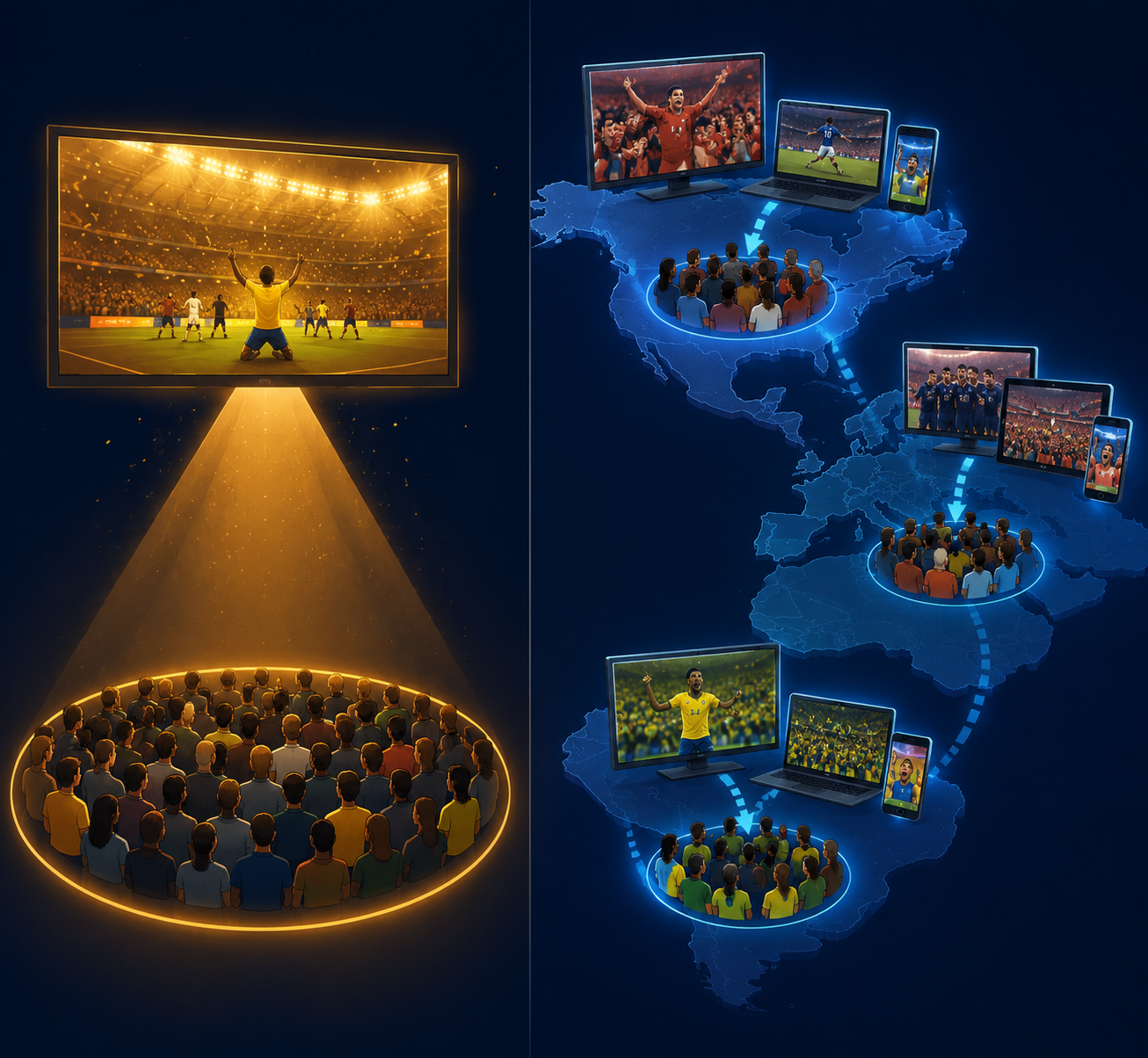
The 2030 proposal’s six-country, three-continent scale is commercially attractive because it makes the World Cup feel omnipresent. It is operationally difficult for the same reason. A match that is perfect for one market may be inconvenient live viewing in another. A sponsor asset that travels well in English may miss the emotional register of a country watching its first or rare appearance. A CTV package that looks efficient in aggregate may hide weak delivery against the audiences the brand actually needs.

The planning unit should therefore get smaller. Instead of one tournament brief, brands need market clusters: priority countries, diaspora audiences, language groups, retail territories, and platform behaviors. A U.S. Hispanic audience plan will not look like a general U.S. sports-reach plan. A brand trying to grow in West Africa should not evaluate the tournament through the same lens as a brand defending share in Western Europe. The group-stage calendar becomes a segmentation map, not just a schedule.
That shift changes measurement. Gross reach will still matter, especially for the biggest fixtures. But the expanded World Cup rewards more specific questions: Did the brand reach the right national-team audience before and after the match? Did CTV frequency build or irritate? Did social creative move faster than the conversation? Did local retail, app activity, search, or lead quality respond in the markets where the brand actually spent?
Scenario Planning Before FIFA Finalizes the Format
Because approval, format, and rights pricing remain uncertain, the 2030 plan should not be a single locked budget. It should be a set of scenarios that can absorb FIFA’s final decision without sending the brand back to zero.
- Build an official-sponsor scenario that defines which rights the brand would actually use, which markets would activate, and which business teams would benefit.
- Build a regional-rights scenario for priority markets where national-team participation, retail presence, and local media efficiency overlap.
- Build a broadcast-plus-CTV scenario that separates must-own matches from testable group-stage inventory.
- Build a non-sponsor scenario with legal guardrails, real-time creative workflows, influencer and creator distribution, and a measurement plan tied to business outcomes.
- Build a no-go scenario that defines the price, clutter, or audience fragmentation level at which the brand should shift money to adjacent football culture instead.
The no-go scenario is not pessimism. It is leverage. If U.S. rights pricing moves toward the high end of current projections, sellers will have every reason to bundle weaker inventory with must-have moments.[2][3] Buyers who already know which matches, markets, and screens matter can negotiate instead of reacting to a deck built around total tournament scale.
Where AI Helps, and Where It Does Not
A larger World Cup strengthens the case for AI-assisted content operations, but not because AI makes strategy automatic. The useful work is narrower: versioning creative by market, language, scoreline, player moment, and platform format; monitoring which national-team conversations are accelerating; and helping teams move approved assets quickly when a match changes the mood of a country.
That requires preparation before kickoff. Legal teams need approved claims and restricted terms. Brand teams need templates that can flex without becoming generic. Media teams need rules for when a moment deserves paid amplification. Local teams need authority to reject creative that looks clever at headquarters and tone-deaf in market.
The best use of AI in this environment is not replacing judgment; it is reducing the delay between judgment and execution. A 96-game group stage will produce too many micro-moments for a centralized approval chain to treat each one like a Super Bowl spot. The brands that benefit will be the ones that decide in advance which moments are worth reacting to and which are just noise.
The Political Uncertainty Is Real, but It Is Not the Main Planning Variable
The proposal is not universally welcomed inside football. BBC coverage noted opposition from UEFA president Aleksander Ceferin, who called the idea “a bad idea,” while AFC president Sheikh Salman warned of “chaos” and CONCACAF president Victor Montagliani said it “doesn’t feel right.”[8] The Athletic also reported that FIFA president Gianni Infantino’s July 2026 openness to the expansion came in a political context, with broad member-association support relevant to his leadership position.[1]
Marketers do not need to handicap FIFA politics like federation insiders. They do need to treat every 2030 number as conditional until the format, host allocation, match calendar, and rights structure are confirmed. A budget built on “64 teams are coming” is premature. A planning model built on “what if the World Cup becomes too large to behave like one shared media event?” is useful now.
The 2030 Buying Question
The expanded World Cup is attractive because it gives advertisers more ways in. It is dangerous because it makes the headline property look more unified than the audience experience will be. The brand team that wins will not be the one that simply buys the biggest tournament. It will be the one that knows which countries matter, which screens carry real attention, which matches deserve premium pricing, and which cultural moments can be earned without pretending every viral example is repeatable.
That reframes the marketer’s 2030 question. It is not “How do we buy the World Cup?” It is “Which audiences, markets, screens, and moments are worth buying when the World Cup becomes too large to behave like one shared media event?”
References
- World Cup 64-team FIFA expansion, The Athletic, July 14, 2026, link
- FIFA 64-team World Cup 2030: What it could mean for TV rights, Awful Announcing, link
- World Cup marketing: Levi’s, Nike, Taco Bell, CNBC, June 26, 2026, link
- World Cup 2026 marketing playbook, The Gutenberg, link
- Fifa expects record $15bn World Cup revenue, The Guardian, July 18, 2026, link
- Why brands are investing billions in the 2026 FIFA World Cup, Forbes, June 5, 2026, link
- The FIFA World Cup 2026 sponsorship impact, Sponsorship Marketing Association, December 2, 2025, link
- Fifa 64-team World Cup expansion opposition, BBC Sport, link

Comments
Join the discussion with an anonymous comment.