
How to Handle Marketing Communication After an FDA False-Positive Food Recall
When the FDA notifies you of a positive pathogen test, you issue a recall, and then the agency retracts that test as a false positive—while the outbreak investigation continues—your marketing and PR team needs a careful, real-time communication strategy. This article uses the July 2026 Taylor Farms Cyclospora case to provide a practical framework for navigating that narrow corridor between relief and ongoing caution to preserve consumer trust.
The hardest hour in an FDA false positive food recall is not the hour when the agency corrects the record. It is the hour after that, when the company has a defensible reason to feel relieved and the public still sees the words “outbreak,” “lettuce,” “recall,” and “hospitalizations” in the same news cycle.
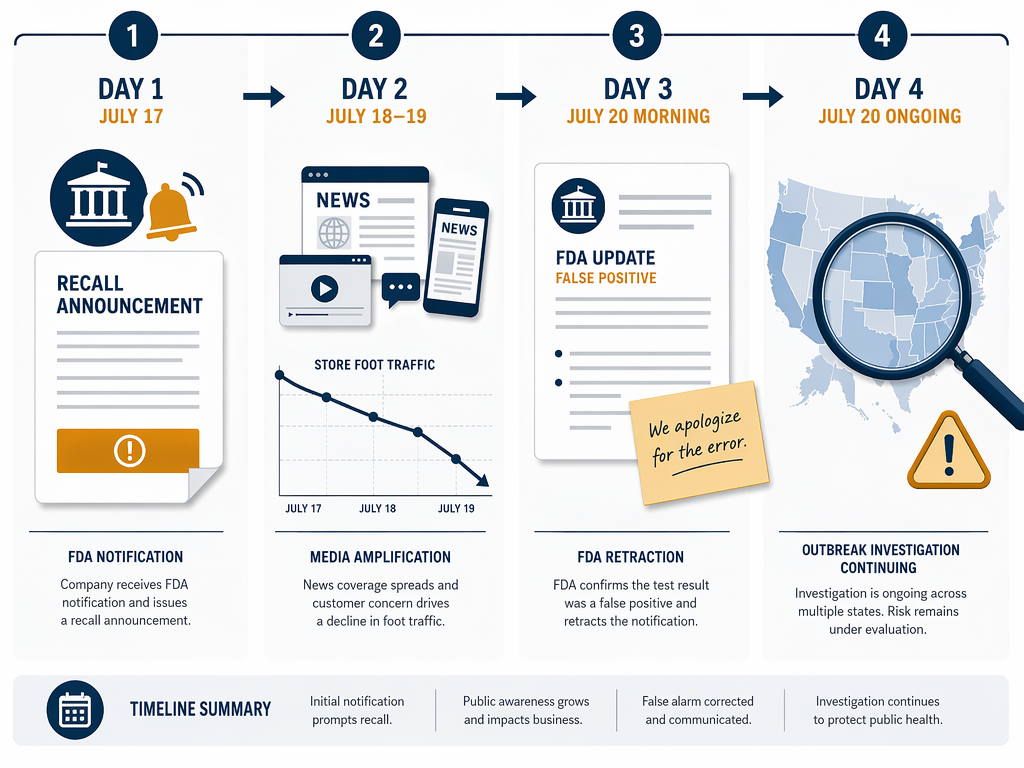
That is where Taylor Farms found itself in July 2026. On July 17, the FDA notified Taylor Farms of a presumptive positive Cyclospora test on iceberg lettuce, and the company issued a voluntary recall of foodservice 3-pound shredded iceberg lettuce and diced iceberg lettuce, notifying customers that included Taco Bell and Walmart.[1] By July 20, the FDA said the sample had been a false positive and apologized, while the broader Cyclospora investigation remained active.[2]
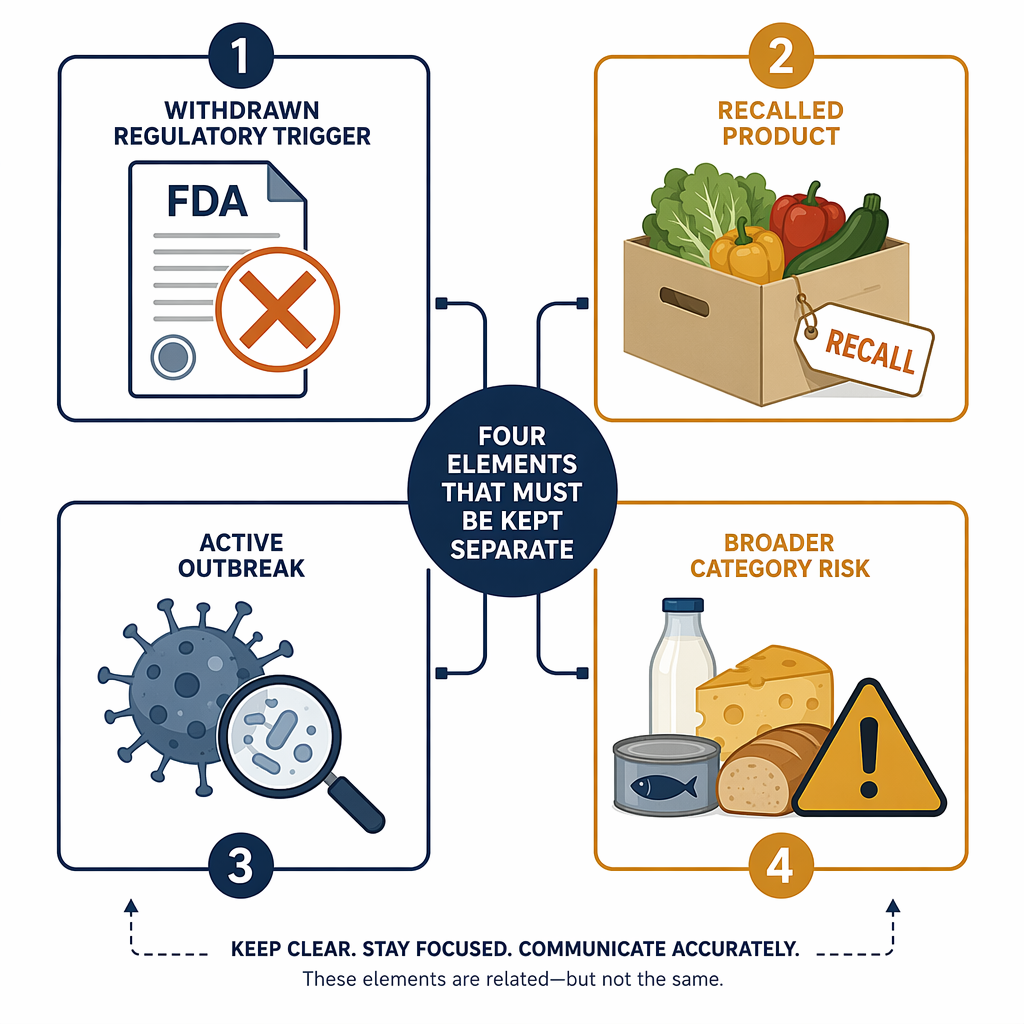
For a marketing or PR lead, that sequence is not a neat correction. It is four separate realities arriving too close together: a recalled product, a withdrawn test result, a still-open public-health investigation, and a category warning consumers may not parse carefully. The FDA’s July 2026 investigation materials described a 5-state Cyclospora outbreak involving more than 1,644 illnesses and 94 hospitalizations, and the agency continued advising consumers to avoid iceberg lettuce while the source remained under investigation.[3]
The brand damage did not wait for laboratory closure. QSR Web reported Placer.ai data showing Taco Bell visits dropped 18.9% before the false-positive announcement, a reminder that customer behavior moves on the public timeline, not the confirmatory-testing timeline.[4]
The July 17–20 Sequence Is the Message Problem
A standard recall communications plan usually assumes a straight line: identify the affected product, remove it, tell consumers what to do, cooperate with regulators, and update as more facts emerge. A false-positive recall breaks that line. The brand has already sent notices, customers have already pulled product, account teams have already taken calls, and media outlets have already connected the company to an outbreak. Then the trigger changes.
Taylor Farms’ public statement did several things worth noting. It disclosed that the company acted after FDA notification, expressed concern for people affected by the outbreak, clarified that no Taylor Farms branded salad kits were involved, and kept the emphasis on public-health cooperation rather than blame.[1] That last choice matters. The FDA apology may be important to the company, its lawyers, and its customers, but it is not the only fact consumers need in the moment.
The FDA’s retraction removed the presumptive positive test as a basis for connecting the specific Taylor Farms sample to Cyclospora. It did not, by itself, end the outbreak investigation. It did not tell every consumer that every iceberg lettuce product in every setting was safe. It did not erase the practical effects of the recall on foodservice operators who had already posted notices, changed ingredients, fielded guest questions, and explained disruptions to store teams.
| Date | What Changed | Communication Consequence |
|---|---|---|
| July 17 | FDA notified Taylor Farms of a presumptive positive Cyclospora test; Taylor Farms issued a voluntary foodservice lettuce recall. | The company had to act quickly, notify customers, and explain the recall before all facts were settled. |
| July 18–19 | Recall coverage spread nationally; QSR Web reported Placer.ai data showing Taco Bell visits fell 18.9% before the false-positive announcement. | Brand and customer impact began before the regulatory record changed. |
| July 20 | FDA said the Taylor Farms sample was a false positive and apologized. | The company had grounds to correct the record, but not to declare the broader issue over. |
| July 20 and ongoing | FDA and CDC continued investigating the 5-state Cyclospora outbreak and FDA still advised avoiding iceberg lettuce. | Consumer guidance still had to defer to active public-health instructions. |
Why “False Positive” Is Not a Clean Reset
In technical terms, a false positive is a testing problem. In communications terms, it is a sequencing problem. The public first hears the association, then later hears the correction. The correction is narrower than the original impression, and the burden falls on the company to explain that narrowing without sounding evasive.
Food pathogen testing can produce both false positives and false negatives, including in PCR-based testing contexts, and Eurofins USA has described why these errors matter in food microbiology.[5] That context can help internal teams understand what happened. It should not become the center of consumer messaging. Most consumers do not need a molecular-testing lecture while they are deciding whether to throw out lettuce or take a child with gastrointestinal symptoms to a clinic.
The practical message has to separate the cleared point from the still-open field. “The FDA has informed us that the test result that triggered our recall was a false positive” is one statement. “There is no public-health concern involving iceberg lettuce” would be another, and in this case it would not match the ongoing FDA guidance as of July 20.[2][3]
This is where many recall statements become too legally clean and too operationally vague. They tell stakeholders what the brand is not responsible for, but they do not give retailers, foodservice partners, social teams, customer-care agents, and salespeople safe language for what remains true.
Separate Four Facts Before You Write a Word
Before the first holding statement after retraction goes out, the comms room needs a whiteboard version of the truth. Not a slogan. Not a litigation paragraph. A shared map of what has changed and what has not.
- The withdrawn regulatory trigger: the FDA has said the specific positive test result was false and has apologized for that error.[2]
- The recalled company product: Taylor Farms had already voluntarily recalled specific foodservice shredded and diced iceberg lettuce products after FDA notification.[1]
- The active outbreak: FDA and CDC continued investigating a 5-state Cyclospora outbreak with more than 1,644 illnesses and 94 hospitalizations as of the FDA’s July 2026 investigation page.[3]
- The broader category risk: FDA still advised consumers to avoid iceberg lettuce while the investigation remained unresolved.[3]
Those four facts should not be collapsed into one line. If they are, someone in the chain will overstate something. A social reply will say “we were cleared” when the category warning remains active. A sales email will say “the FDA made a mistake” while a customer is still removing lettuce. A spokesperson will talk about technical testing error while a reporter is asking about hospitalizations.
The working message should sound more like this: the company acted quickly on the FDA notification; the FDA has now said the test result that triggered the recall was false; the company is correcting the product record; and because the broader outbreak investigation remains active, consumers and partners should continue following FDA and CDC guidance. That sequence gives the brand room to defend the facts without trying to outrun the public-health record.
The First Hours After Retraction
Once the FDA retraction is public, speed matters again. The first recall notice likely went through regulatory, legal, quality, sales, food safety, customer service, and executive review. The correction needs the same discipline, but it cannot wait for every function to rewrite its preferred version.
The first action is to update the owned statement, not to flood the market with triumphant posts. Put the retraction in the top third of the statement. Date and time-stamp the update. Link or refer to the FDA correction. Preserve the original recall context so journalists and customers can see why the company acted. Keep the concern-for-victims language intact if the outbreak is still active.
That update should avoid three easy but dangerous phrases: “case closed,” “no risk,” and “FDA error.” The first two can be inaccurate while the investigation remains active. The third may be technically satisfying and reputationally expensive. It centers the brand’s grievance at the very moment consumers need instructions.
The second action is partner synchronization. Foodservice and retail customers should receive a short account-team note before they are surprised by the company’s public correction. The note should give them repeatable language, not a PDF graveyard. It should state what product was affected, what the FDA changed, what consumers should still do, and where to send media or customer-service questions.
| Audience | What They Need First | Language to Avoid |
|---|---|---|
| Consumers | Whether the specific recalled product record has changed and what current public-health guidance says. | “Everything is safe now.” |
| Foodservice and retail customers | A concise correction they can share internally, plus current handling and customer-response guidance. | “The FDA was wrong, so resume normal messaging.” |
| Store or restaurant teams | Plain answers for guests and a clear escalation path. | Technical testing explanations they cannot verify. |
| Media | A time-stamped correction, a named source, and a clear distinction between the false positive and the ongoing outbreak. | Overbroad claims of vindication. |
| Sales teams | Customer-safe language that protects relationships without minimizing public-health concern. | Blame-first talking points. |
The third action is channel restraint. The company website, newsroom, customer notices, account-team scripts, and media statement need alignment. Social posts may be necessary, but they should not compress the correction into a celebratory graphic. In a still-active outbreak, a short post can travel farther than its caveats.
A Safer Message Architecture
The cleanest architecture is not apology-update-reassurance. This situation needs a correction with guardrails.
- Acknowledge the update: “The FDA has informed us that the test result that triggered our voluntary recall was a false positive.”
- Reaffirm the original decision: “We initiated the recall promptly based on the information available at the time.”
- Define the product scope: “The recall involved specified foodservice iceberg lettuce products; Taylor Farms has stated that no Taylor Farms branded salad kits were involved.”[1]
- Preserve public-health context: “The broader Cyclospora investigation remains active, and consumers should continue following FDA and CDC guidance.”[3]
- Commit to updates: “We will update customers and consumers as the regulatory record changes.”
That order matters. If the first sentence attacks the test, the brand sounds defensive. If the first sentence expresses only concern, the correction may be missed. If the statement ends with “we were cleared,” partners may repeat that line in places where the active outbreak warning still applies.
Do Not Let Legal Precision Become Consumer Confusion
Legal and regulatory teams are right to protect the record. In a false-positive recall, the record is commercially important: which product was recalled, why the company acted, what the agency later changed, and whether branded retail items were implicated. But the consumer does not experience the event as a docket. The consumer experiences it as a food decision.
This is why the statement needs both precision and usability. “No Taylor Farms branded kits were involved” is useful because it narrows the retail brand question.[1] “The FDA test was a false positive” is useful because it corrects the product association.[2] “The broader investigation is ongoing” is useful because it keeps people aligned with the active public-health guidance.[3] Each sentence does a different job.
The dangerous version is a statement that is technically defensible but practically incomplete: “The FDA has confirmed the test was a false positive; we are pleased to put this matter behind us.” That might feel efficient inside a conference room. Outside it, the matter is not behind the hospitalized patients, the operators still substituting ingredients, or the shoppers still being told to avoid iceberg lettuce.
What to Give Frontline Teams
The public statement is only one asset. In the first 24 hours after a retraction, the higher-risk communication may happen in places the comms team does not directly control: a franchisee’s local Facebook page, a store manager’s conversation with a guest, a sales rep’s email to a distributor, a customer-service chat, or a retailer’s internal alert.
Give those teams a small set of approved answers they can actually use.
- What changed: “The FDA has said the test result that triggered the voluntary recall was a false positive.”
- What did not change: “The broader Cyclospora investigation remains active, so we are continuing to follow public-health guidance.”
- What product was involved: “The recalled items were specified foodservice iceberg lettuce products, not Taylor Farms branded salad kits, according to the company’s statement.”[1]
- What consumers should do: “Follow the latest FDA and CDC guidance and check official updates before consuming iceberg lettuce.”
- Where to escalate: “Send health, media, or account-specific questions to the designated company contact rather than improvising.”
This is not about scripting every sentence. It is about stopping well-intentioned people from filling silence with overstatement. “False positive” can become a rumor of total clearance if it is left alone.
Regulatory Transparency Is Moving Faster Than Brand Approval Cycles
Food companies should not assume future recall events will stay quiet while internal teams perfect the message. In July 2025, FDA Commissioner Marty Makary sent a letter encouraging infant formula, baby food, and children’s food manufacturers to streamline and enhance public recall communications, using “radical transparency” language in that narrower children’s-food context.[6] It was not a blanket directive to every food company, but it signals a regulatory expectation that public notification should move faster and more clearly.
That direction is consistent with broader discussion in food safety communications: recall notices are under pressure to become more timely, more consumer-friendly, and easier to act on.[7] For marketing and PR teams, the implication is uncomfortable but simple. The first public version may not be the final scientific version, and the final scientific version may not reverse the first public impression.
The answer is not to slow-walk communications until every uncertainty disappears. In a foodborne illness investigation, that can put people at risk and damage credibility with regulators. The answer is to build statements that can survive correction: clear product scope, clear source attribution, clear consumer action, and explicit uncertainty where uncertainty exists.
What the Following Weeks Should Look Like
After the first correction, the work shifts from crisis announcement to disciplined maintenance. This is where brands often lose patience. Executives want the phrase “false positive” to do more work than it can do. Sales wants a clean deck for customers. Social teams want the story to stop. The investigation may not cooperate.
A weekly message review is more useful than a new campaign. The team should compare every public line against the latest FDA and CDC record, customer questions, media framing, and frontline feedback. If the agency changes the advisory, update the consumer guidance. If additional products are ruled in or out, update the scope. If case counts change, avoid turning new numbers into a brand argument; use them only to explain the public-health context.
Consumer behavior data should be treated with the same restraint. Belle Communication cited a GS1 US 2025 survey reporting that 93% of consumers were concerned about recalls, 60% avoided an entire product category after a recall, 59% hesitated to repurchase recalled products, and 57% discarded products after recall news.[8] Those figures are second-hand as presented in the available material, and they describe consumer attitudes and reported behavior around recalls broadly, not the actual recovery of Taylor Farms or Taco Bell in this specific case.
That distinction matters. The Placer.ai foot-traffic drop reported by QSR Web shows immediate movement around Taco Bell visits during the recall news cycle.[4] It does not prove long-term brand damage, and it does not prove recovery. The event was less than 72 hours old as of July 21, 2026. Long-term sentiment, sales, and trust data would need time.
Recovery Claims Need Evidence, Not Relief
A useful comparison is not another lettuce case but the time scale of recovery itself. After McDonald’s E. coli outbreak in 2024, Restaurant Dive reported that the company planned a $100 million investment to help affected franchisees and drive recovery, with executives discussing recovery over a multi-month period.[9] That does not make the McDonald’s case a direct parallel to Taylor Farms. It does show why a brand should be careful about declaring trust restored within days.
For Taylor Farms, the available July 2026 facts support a narrower conclusion: the company acted on a regulatory notification, the FDA later said the triggering test was false, and the broader outbreak investigation continued. Anything beyond that, including durable reputation recovery or customer behavior normalization, is not yet established by the available record.
A Practical Playbook for the Next False-Positive Recall
No template should flatten every recall into the same apology and reassurance sequence. Still, a false-positive recall has a few recurring tasks that can be prepared before the next 11 p.m. approval chain begins.
- Build a two-stage statement process: one version for the initial recall and one for a later correction, including fields for agency attribution, product scope, consumer action, and unresolved investigation status.
- Pre-approve uncertainty language: give legal, food safety, and communications teams wording that can say “under investigation,” “presumptive,” “not confirmed,” and “updated by FDA” without sounding evasive.
- Create partner-ready microcopy: prepare short scripts for QSR accounts, retailers, customer-care teams, store operators, and sales so each group can repeat the same facts safely.
- Separate brand correction from consumer guidance: correct the record about your product without diluting active public-health advice for the broader category.
- Log every public update: time-stamp owned statements and preserve prior versions or update notes so journalists and customers can follow the sequence.
- Delay recovery storytelling: wait for credible trend data before claiming that traffic, sentiment, or trust has rebounded.
The strongest posture is operationally humble: we acted quickly on the information we had; the FDA has corrected the test result; we are correcting the record; and we are still helping customers and consumers follow the active public-health guidance. That is not as emotionally satisfying as vindication. It is safer for the people who have to repeat the message after the press release goes out.
As of July 21, 2026, the Taylor Farms Cyclospora case is still developing. The FDA/CDC record may change, case counts may be updated, and additional findings may narrow or widen the public-health picture. Any responsible marketing communication plan has to move with that record, not with the brand’s desire for the story to be over.
References
- Taylor Fresh Foods Statement Regarding Cyclospora Outbreak, Taylor Farms.
- Taylor Farms lettuce sample tested for cyclospora was a false positive, FDA says, Fox Carolina, July 20, 2026.
- Investigation of 5-State Outbreak of Cyclospora Illnesses: Iceberg Lettuce, July 2026, FDA.
- Taylor Farms recalls lettuce amid cyclospora outbreak, reports FDA false positive test, QSR Web.
- The Evils of False Positives and False Negatives, Eurofins USA.
- FDA Encourages Food Industry Leaders to Streamline and Enhance Product Recall Communications with the Public and FDA, FDA, July 9, 2025.
- What’s changing in food safety communications, PR Daily.
- Food Industry Crisis Communication Planning, Belle Communication.
- McDonald’s $100M investment will help franchisees recover from E. coli outbreak, Restaurant Dive.

Comments
Join the discussion with an anonymous comment.