

The Fairlife Cyberattack Is a Marketing Problem
The Fairlife ransomware attack in July 2026 halted production—here's why it's a marketing problem, not just an IT one. Learn how supply chain cyber risk directly threatens marketing commitments and brand equity.
The Fairlife cyberattack is easy to file under IT, legal, or operations. That would miss the part CPG marketers actually have to live with: a production pause does not stay inside the plant. It moves into retailer inboxes, promotion calendars, sales decks, paid media schedules, influencer briefs, and every public growth story the brand has been telling.
Fairlife paused U.S. production after a July 16, 2026 cyberattack breached the milk brand’s systems, according to reports from ABC News, CBS News, and Cybersecurity Dive.[1][2][3] That timing matters. In March 2026, Fairlife had announced a $650 million expansion in Michigan, a capacity story that fits neatly into the kind of growth narrative investors, retailers, and consumers understand.[1][2][3] Four months later, the same business was dealing with a cyber incident that affected production.
As of July 21, 2026, the public facts are still limited. No ransomware group had claimed responsibility in the available reporting. The status of data exposure was not settled in the public record. The recovery timeline was not clear. Those unknowns are not footnotes; they are part of the marketing problem. When teams do not know when product will move again, they cannot confidently tell retail partners, sales teams, agencies, creators, or shoppers what comes next.
The break happens after the breach
Most cyber coverage naturally starts with the attacker, the malware, the system access, and the forensic timeline. Marketing has a different starting point: what commitments are already live?
A factory pause turns into a marketing issue the moment existing plans assume product availability. A shopper promotion may already be locked. A retail media campaign may be booked around a seasonal push. A national account team may have negotiated endcap space or circular placement. Influencer content may be scheduled against a product that is expected to be on shelf. Sales teams may be waiting for approved language before their next retailer call.
None of that requires a dramatic consumer backlash to become expensive. The first consequence is usually more ordinary: a promise made in one planning cycle becomes hard to keep in the next one.
For a physical-goods brand, availability is part of the brand experience. If the product is not there when a retailer expected it, the account team has to explain the miss. If a campaign drives demand into constrained inventory, the marketing team has helped create frustration. If a competitor can fill the shelf gap faster, the brand has given that competitor a clean opening without ever changing its own positioning.
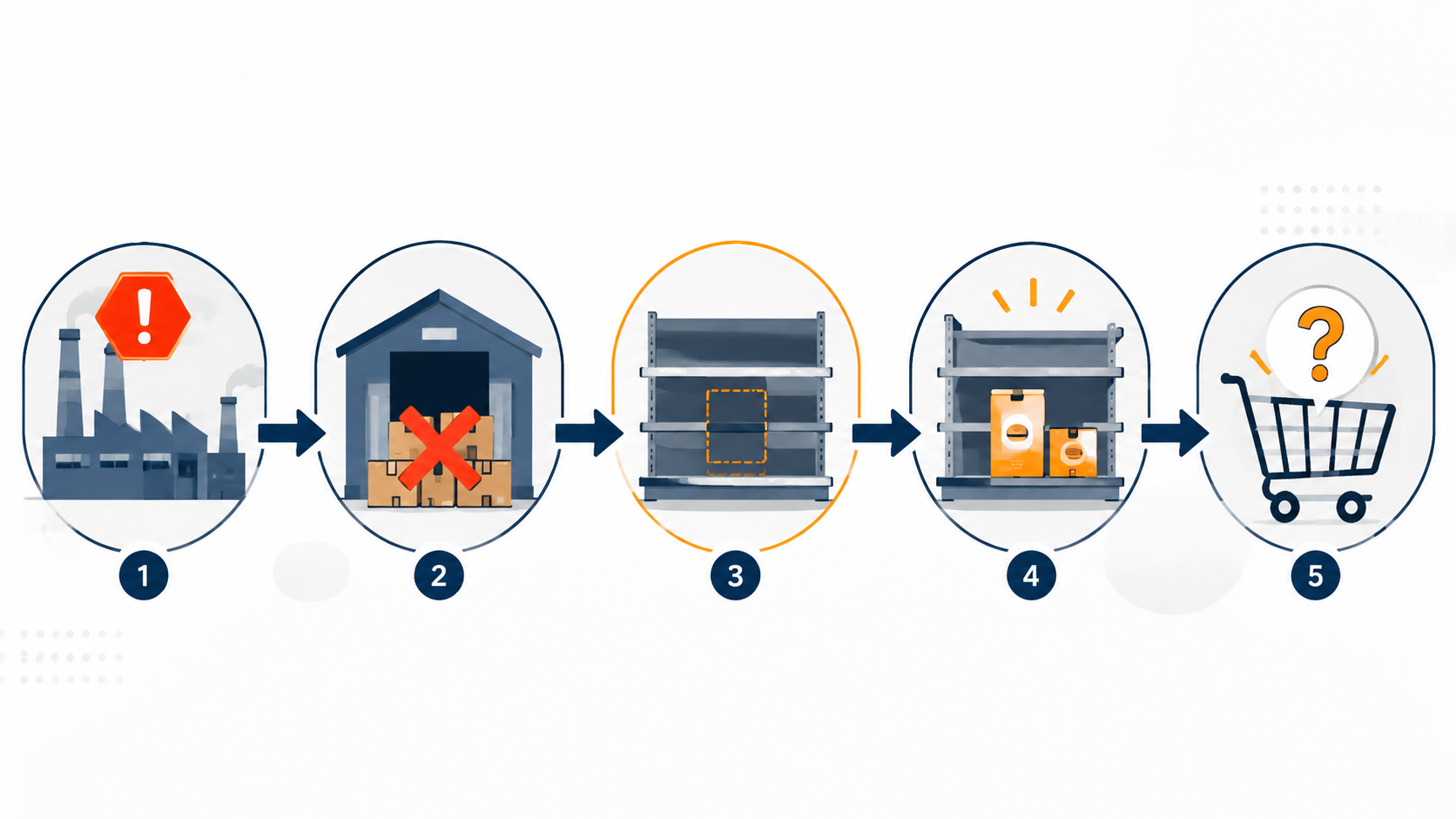
How a production stop becomes a brand problem
The downstream chain is not theoretical. It is the everyday operating logic of CPG, only under stress:
- Production stops or slows, creating uncertainty about finished-goods supply.
- Retail orders become harder to fulfill on time or in full.
- Shelf placement, promotional commitments, and buyer confidence become vulnerable.
- Competitors get a chance to capture availability-driven demand.
- Consumers may begin to associate the brand with unreliability if gaps persist or communication is poor.
The shelf-space risk is especially unforgiving. Retailers do not run on a brand’s crisis narrative; they run on turns, service levels, promotional execution, and category performance. A buyer may sympathize with a cyber incident and still need to fill a cooler, protect a feature, or avoid disappointing shoppers. Marketing cannot solve the production stoppage, but it will often be asked to help protect the commercial relationship while operations is still working out what can ship.
That is where vague “brand trust” language becomes too soft. The sharper issue is credibility with specific audiences. Retailers want to know what is delayed, what is available, and when the next update will come. Sales teams need a version of the facts that does not outrun legal or technical certainty. Agencies need to know whether to pause, redirect, or re-sequence creative. Customer service needs boundaries for what it can say. If each group improvises, the brand can create a second problem on top of the first.
Inventory-linked marketing is where the exposure gets most visible. A campaign built around “find it now,” a retail media push tied to a specific SKU, or launch content that sends people to stores can become a liability if availability changes faster than the media plan. The creative may still be good. The offer may still be attractive. The problem is that the operating assumption underneath it has expired.
CPG teams already feel the disruption, even when they do not call it cyber risk
The Fairlife incident is current and concrete, but the readiness gap is broader. The DOSS 2026 CPG Operations Benchmark Report found that 90% of CPG operations teams experienced at least one supply chain consequence in the past year, and that 25% of CPG launches were canceled due to operational disruptions.[4] The same report surveyed 230 U.S. CPG leaders, with a younger respondent skew: 53% millennial and 29% Gen Z.[4]
Those figures do not prove that cyberattacks caused every disruption or cancellation. They do something more useful for marketers: they show that launch fragility is already normal enough to deserve planning time. If one in four launches in that benchmark was canceled because operations failed to support the plan, then marketing calendars cannot be treated as clean promises detached from manufacturing, fulfillment, and supply chain visibility.
A launch plan usually contains the artifacts marketing knows how to manage: messaging, sell sheets, retail toolkits, product pages, paid media, creator briefs, sampling, PR, and internal enablement. The risk register, if one exists, often covers creative approvals, claims review, budget, channel timing, and perhaps a packaging or distribution delay. Cyber resilience inside the production network rarely gets translated into a launch dependency that marketing can see.
That is the blind spot. Marketing does not need malware expertise to ask whether a campaign depends on a single facility, a narrow production window, a vulnerable supplier, or a recovery timeline no one has stress-tested with commercial commitments attached.
| Marketing commitment | Operational dependency | What changes during a cyber-related production pause |
|---|---|---|
| Retail promotion | On-time shipment and adequate inventory | The account team may need to renegotiate timing, substitute SKUs, or accept weaker placement |
| Launch campaign | Finished goods available by channel | Creative, media, and PR may need to be paused or resequenced |
| Influencer or sampling program | Product in market and fulfillment capacity | Content can drive demand to unavailable product or create confusing shopper experiences |
| Sales enablement | Confirmed facts from operations, legal, and IT | Field teams may lack consistent language for buyers and distributors |
| Brand trust protection | Clear update cadence and credible recovery information | Silence or overconfident claims can create avoidable reputational exposure |
This is not a niche cybersecurity scenario
The broader cyber data supports the same direction. Foley & Lardner, citing the IBM/Ponemon 2025 Cost of a Data Breach Report, reported that supply chain cyberattacks increased 431% since 2021 and took a combined 267 days to detect and contain.[5] The same source said manufacturing was the most-targeted sector for the fourth consecutive year, accounting for 26% of all attacks.[5]
Those numbers should not be used to predict the outcome of the Fairlife case. They do make it harder for physical-goods marketers to treat cyber disruption as an edge case that belongs somewhere else. Manufacturing is not an incidental target, and supply chain compromise is not only a back-office problem when the business model depends on making, moving, and replenishing product.
Food and agriculture also sit inside the exposure zone. The Food & Ag-ISAC recorded 205 cyberattacks on the sector through mid-2026, according to reporting cited in the Fairlife coverage.[3] That figure should be handled carefully: it describes recorded sector activity, not the probability that any one brand will be attacked. Still, for a dairy brand, a beverage brand, a frozen-food brand, or any company with temperature-sensitive inventory and retailer service expectations, the sector context is relevant.
Consumer trust is real, but it is not the first operating problem
There is a consumer-trust layer here, but it should not be exaggerated from the available facts. A Vercara 2024 survey of 1,000 adults found that 70% said they would stop shopping with a brand after a security incident, according to CX Dive; the methodology details were behind registration.[6] That is an attitude measure, not proof of actual post-incident purchase behavior.
For CPG marketers, the immediate trust issue may be less theatrical than a mass consumer exit. It may be a retailer questioning whether the brand can support a promotion. It may be a distributor asking for a firmer allocation view. It may be a loyal shopper seeing empty space where the product usually sits and buying something else because dinner, lunchboxes, or weekly routines cannot wait for a corporate update.
Brand equity is often damaged in small operational moments before it is damaged in public sentiment. A missed delivery, a pulled campaign, a confusing retailer message, a coupon that cannot be redeemed against available stock—each one teaches a different audience how much confidence to place in the next commitment.
What marketing needs to know before the next incident
The answer is not to turn marketing leaders into cybersecurity managers. It is to stop building plans that depend on operational resilience marketing has never examined.
Before a launch, seasonal push, or major retail commitment, marketing needs a clearer view of where cyber-related production failure would hit the commercial plan. The useful questions are plain:
- Which campaigns assume inventory from one facility, supplier, system, or production window?
- Which retailer commitments carry the highest penalty if shipments are delayed?
- Which media, retail media, creator, PR, and sampling plans can be paused quickly without wasting spend or confusing shoppers?
- Who gives marketing the first reliable update on production status, allocation, and recovery expectations?
- What language can sales, customer service, agencies, and executives use while attribution, data exposure, and recovery timing are still uncertain?
That last point matters because the early hours of a developing incident reward discipline. Overstating certainty can create legal and trust problems. Saying too little can leave account teams and partners to fill in the blanks. The operating need is a shared escalation path: what marketing can say now, what it cannot say yet, who approves updates, and when the next checkpoint arrives.
The Fairlife case is not a finished postmortem. It is a live reminder that growth messaging, capacity investment, retailer execution, and cyber resilience now occupy the same planning room. Marketing teams do not need to own cybersecurity. They do need to audit where a supply chain cyber failure would break launches, retailer commitments, content plans, and brand trust.
References
- Fairlife pauses US production after cyberattack breached milk company, ABC News
- Coca-Cola's Fairlife milk pauses production after cyberattack, CBS News
- Ransomware attack prompts Coca-Cola to suspend production at dairy, Cybersecurity Dive
- 2026 CPG Operations Benchmark Report, DOSS
- Combatting Supply Chain Cyber Threats and Protecting Digital Supply Chains, Foley & Lardner, October 2025
- How cyber incidents impact consumer trust, CX Dive

Comments
Join the discussion with an anonymous comment.