
How Dollar Tree Uses DoorDash to Evolve Its Marketing Strategy
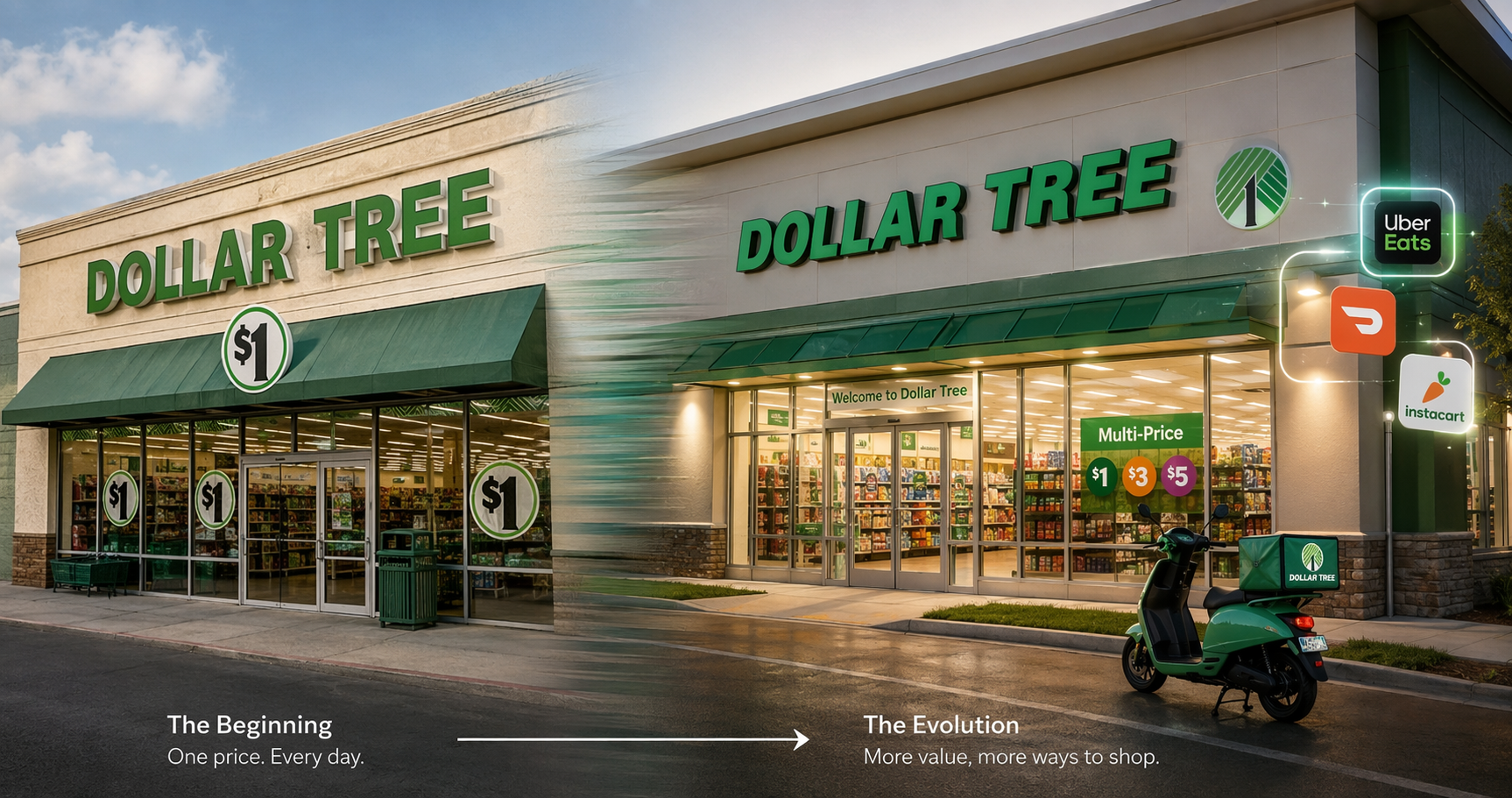
Dollar Tree's DoorDash partnership is more than a delivery deal—it's the distribution-layer execution of a deliberate multi-price and demographic pivot. This article breaks down the strategy, the evidence it's working, and what it means for value retail marketing.
The tempting headline is that Dollar Tree is now on DoorDash. The more useful marketing story is what had to change before that headline made sense.
On May 28, 2026, DoorDash announced on-demand delivery from more than 9,000 Dollar Tree stores across 48 states, with a first-order promotion using code SHOPDT for 40% off, up to $20 off, on eligible orders for a limited time.[1] That is a big footprint, and the promotion is not a throwaway detail. For a value retailer, the first order is where the channel has to overcome friction: delivery fees, basket size, substitution tolerance, and the customer’s mental model of what a Dollar Tree trip is supposed to be.
But footprint is not strategy. A store count tells us where orders can come from. It does not tell us whether the assortment can support the order, whether the customer is likely to use the channel, or whether the retailer is widening access without weakening the value promise that made the brand useful in the first place.
The DoorDash deal sits on top of a broader delivery stack
Dollar Tree is not treating delivery as a single-platform experiment. DoorDash gives it broad local reach and a subscription-heavy customer base through DashPass. Instacart gives it a same-day grocery-style use case across a larger stated store base. Uber Eats adds another on-demand shopping surface for a different app-native audience. The strategic point is not that every platform is interchangeable. It is that Dollar Tree is using delivery partners to segment occasions that used to be handled almost entirely by a store visit.
Instacart’s Dollar Tree expansion covered about 13,000 Dollar Tree and Family Dollar stores for same-day delivery, positioning the partnership around speed, convenience, and household replenishment.[2] DoorDash’s 2026 announcement is narrower in store count but highly specific to the Dollar Tree banner and its 9,000-plus store footprint.[1] The difference matters: grocery-style replenishment and browse-led impulse shopping are not the same customer mission, even if both happen through a phone.
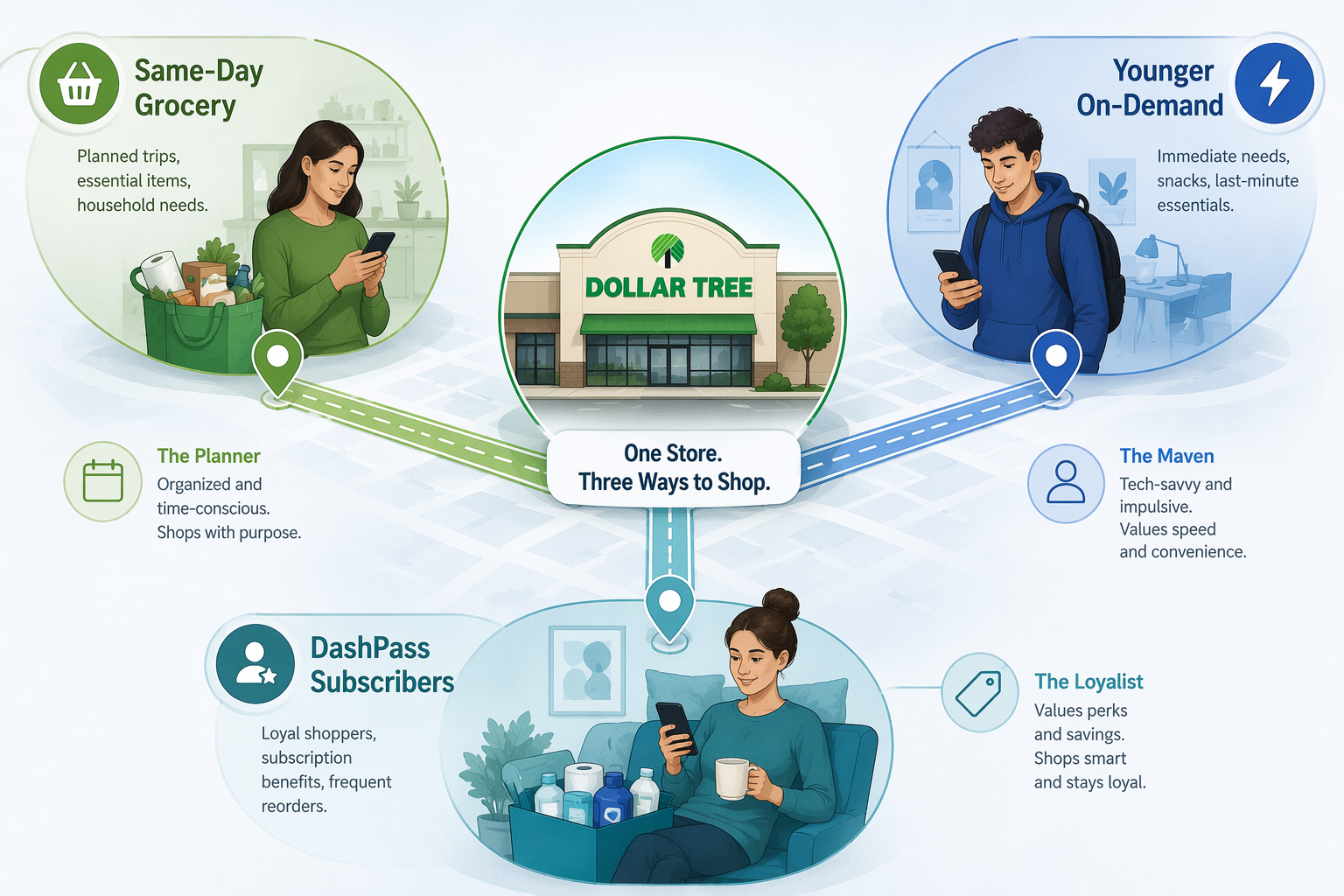
This is where the phrase “dollar tree doordash delivery marketing strategy” can become misleading if it stays at the announcement level. The DoorDash launch is the most visible execution layer. The actual strategy is the interlock between assortment, customer mix, and channel design.
Delivery only works if the basket has changed
Dollar Tree built its appeal around low-risk discovery: seasonal finds, party supplies, snacks, cleaning items, small household fixes, and the satisfying feeling that the cart can contain a little of everything without consequence. In store, that “thrill of the hunt” has always been part of the draw. Online, the hunt has different economics. A customer browsing a delivery app is not wandering an aisle. They are assembling enough need, desire, and convenience value to justify an order.
That is why Dollar Tree’s multi-price transition is not a side note. By early 2026, about 5,300 locations were operating in the company’s multi-price format, with merchandise reaching price points such as $5, $7, and $10, while management said the format was delivering meaningfully higher sales productivity.[3][4] Those higher price points give the digital basket more room to breathe. They create ways for a DoorDash order to include a few higher-ticket household, party, décor, pantry, or seasonal items rather than relying only on a long string of very low-priced units.
The important restraint is that Dollar Tree has not simply traded its old value architecture for a looser discount-store model. Reporting on the company’s multi-price strategy notes that 85% of its opening price point assortment remains $2 or less.[5] That is the guardrail. If every item starts drifting upward, the brand asks its original shopper to relearn the store under pressure. If the opening price point stays protected while the assortment gains selective higher-priced items, the retailer can serve two jobs at once: preserve the low-entry trip and make larger baskets more plausible.
That distinction is easy to lose in delivery coverage. A low-price retailer cannot just bolt on a delivery app and assume convenience will compensate for thin baskets. The product architecture has to give the customer enough reasons to build an order, and the store operator enough room to support the economics. Dollar Tree’s multi-price rollout gives the DoorDash channel a stronger foundation than a pure single-price assortment would have offered.
The higher-income shopper is incremental, not a replacement
The demographic signal behind this strategy deserves careful handling. A Yahoo Finance analysis, citing management commentary from a December 2025 earnings call, reported that roughly 60% of Dollar Tree’s new customers came from households earning $100,000 or more annually.[6] That does not prove those households are the DoorDash users placing Dollar Tree orders. It also does not mean Dollar Tree has become a premium retailer. It means the brand has been attracting incremental shoppers whose habits may make app-based ordering more natural.
That matters because delivery adoption is not evenly distributed by occasion or customer type. A higher-income household may still shop Dollar Tree for value, but the value equation can include time saved, party preparation, forgotten school supplies, last-minute seasonal items, or small household fill-ins. The customer is not necessarily choosing Dollar Tree because they cannot afford another retailer. They may be choosing it because the assortment solves a practical problem at a low enough price to feel smart.
DashPass sharpens that fit. A subscriber already paying for delivery benefits has a different threshold for trying a new retail use case inside the app. For Dollar Tree, that lowers the behavioral distance between “I should stop by later” and “I can add this now.” DoorDash also has a retail marketplace environment built for browsing across nearby merchants, which makes discovery more plausible than it would be in a purely search-led replenishment flow.
The SHOPDT promotion fits this stage of the funnel. Forty percent off a first eligible order, capped at $20, is not proof of sustainable demand.[1] It is a trial mechanic. In a category where customers may be unsure whether a small-format value store belongs in a delivery app at all, the first order has to teach the behavior before the channel can be judged.
The financial trajectory was already moving before DoorDash results existed
The DoorDash launch was only about seven weeks old as of this writing, so there is no released basis for claims about DoorDash-specific conversion, retention, average order value, or repeat behavior. The better evidence is not channel performance yet. It is whether Dollar Tree’s broader repositioning had momentum before the DoorDash layer arrived.
On that measure, the company had real support. Dollar Tree reported fiscal 2025 net sales growth of 10.4% to $19.4 billion and said fourth-quarter gross margin expanded by 150 basis points.[3] It also guided fiscal 2026 net sales to a range of $20.5 billion to $20.7 billion.[3] Retail TouchPoints reported that the company planned 325 net new stores in 2026 and had delivered 20 consecutive years of positive same-store sales.[4]
The margin detail is especially relevant for marketers because repositioning often looks healthy from the top line while quietly making the operating model messier. In Q1 fiscal 2026, Dollar Tree reported gross margin expansion of 120 basis points and adjusted operating margin improvement of 110 basis points to 9.5%.[3] Those figures do not validate DoorDash. They do suggest that the company’s multi-price and banner-focus strategy was not merely a traffic story dressed up as transformation.
The Family Dollar divestiture also belongs here, but only briefly. Dollar Tree completed the sale of Family Dollar in July 2025, creating a cleaner management focus around the core Dollar Tree banner and its growth model.[3] That kind of simplification matters when a retailer is trying to modernize assortment, store format, and digital access at the same time.
Why DoorDash is a rational partner now
DoorDash is not just a restaurant delivery app trying to stretch into retail at the edges. The company said it became the No. 1 U.S. third-party marketplace for grocery and retail order volume in 2025.[7] PYMNTS also reported that DoorDash marketplace sales rose 37%, driven by grocery growth.[8] For Dollar Tree, that means the partnership plugs into a consumer behavior that DoorDash has already been expanding: ordering more categories from local merchants through the same interface.
That platform momentum is useful, but it should not be exaggerated into a guarantee. Grocery and retail order growth at DoorDash does not automatically mean a value-store basket performs well. Dollar Tree still has to earn the order in a channel where customers compare convenience, availability, substitutions, item photography, fees, and delivery timing in one compressed decision.
The better reading is that DoorDash gives Dollar Tree a distribution environment where its evolving customer base is already spending time, while Dollar Tree gives DoorDash a dense, high-frequency, low-price retail brand that can fill small urgent occasions. The overlap is strategically neat.
What other value retailers can actually copy
The replicable part of Dollar Tree’s move is not “add DoorDash.” A weaker retailer could copy the distribution announcement and still create a bad customer experience or an uneconomic basket. The useful template has three reinforcing pieces:
- Assortment flexibility: enough price-point range to build delivery-friendly baskets without erasing the opening value promise.
- Customer mix expansion: incremental shoppers with use cases and habits that make off-premise ordering plausible.
- Platform-specific reach: delivery partners chosen for distinct shopper missions rather than treated as interchangeable pipes.
A value retailer that lacks one of those pieces should be cautious. If the assortment is still too narrow, the customer may struggle to build a basket. If the brand has not earned permission with incremental shoppers, delivery can become a subsidized convenience layer for existing demand. If platform choice is based only on coverage, the retailer may miss the difference between replenishment, impulse discovery, and urgent fill-in trips.
Dollar Tree’s DoorDash partnership is coherent because it arrives after meaningful changes in price architecture, customer acquisition, and banner focus. It is supported by the company’s broader financial trajectory, but it has not yet been proven as a DoorDash-specific growth engine. Until either Dollar Tree or DoorDash releases conversion, retention, basket, or profitability data from the partnership, the strongest claim is disciplined: this is a well-aligned execution of a larger marketing transformation, not a completed victory lap.
References
- Dollar Tree Partnership, DoorDash, May 28, 2026, https://about.doordash.com/en-us/news/dollar-tree-partnership
- Instacart press release, Instacart, https://company.instacart.com/pressreleases/...
- Dollar Tree, Inc. Reports Results for the Fourth Quarter and Fiscal Year 2025, Dollar Tree, https://corporate.dollartree.com/news-media/press-releases/detail/303/...
- Dollar Tree Plans 325 Net New Stores in 2026, Doubles Down on Multi-Price Assortment, Retail TouchPoints, https://www.retailtouchpoints.com/news/dollar-tree-plans-325-net-new-stores-in-2026-doubles-down-on-multi-price-assortment/617889/
- Dollar Tree’s Multi-Price Model Is Rewriting The Dollar Store Playbook, Food Trade News, March 17, 2026, https://foodtradenews.com/2026/03/17/dollar-trees-multi-price-model-is-rewriting-the-dollar-store-playbook/
- DLTR Trends Show Value Retail, Yahoo Finance, https://finance.yahoo.com/markets/stocks/articles/dltr-trends-show-value-retail-141900542.html
- DoorDash Leads in Third-Party Marketplace Grocery & Retail Order Volume, DoorDash, https://about.doordash.com/en-us/news/doordash-leads-in-third-party-marketplace-grocery-retail-order-volume
- DoorDash Grocery Growth Fuels 37% Marketplace Sales Jump, PYMNTS, 2026, https://www.pymnts.com/news/delivery/2026/doordash-grocery-growth-fuels-37-marketplace-sales-jump/

Comments
Join the discussion with an anonymous comment.